While Debussy and the French Impressionists led a revolt against Wagnerism in music, there were others among their countrymen who were enthralled by the power of Wagner’s vision.
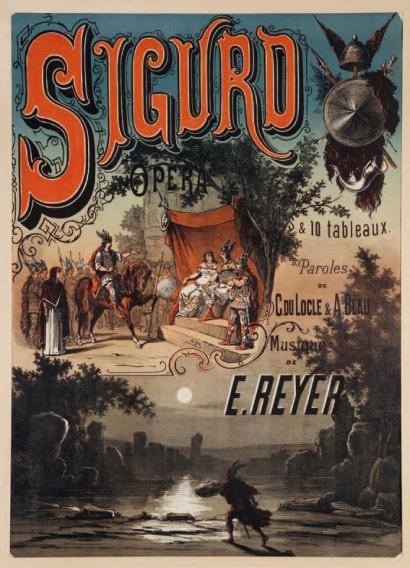
One of these was Ernest Reyer (who was born Rey, but added the “er” to appear more Germanic). Reyer set his own version of the Siegfried story, as related in the Scandinavian Volsunga Saga, which, by way of the “Nibelungenlied,” also provided the basis for Wagner’s “Ring.” But Reyer’s approach to the tale was in the tradition of French grand opera.
The resultant “Sigurd,” composed between 1862 and 1867, was very popular with the French during its initial production at the Paris Opera in 1885. Earlier plans to present it there had fallen through, so that the work received its world premiere in Brussels in 1884. It was also heard in Covent Garden, Lyon, Monte Carlo and, before the end of the century, the French Opera House in New Orleans and La Scala Milan.
What’s interesting is that in the end Reyer’s music seems to bear more resemblance to Berlioz than it does to Wagner. Unable to live on the proceeds from his operas, he actually succeeded Berlioz as music ciritic at the Journal des débats.
Reyer’s early musical studies were overseen by his aunt, Louise Farrenc, the only woman on the faculty of the Paris Conservatory (beginning in 1842!). He rubbed shoulders with Gustave Flaubert and Théophile Gautier (writing operas on texts of both), but he felt equally at home playing dominoes with the peasantry of Provencal. He claimed that the best source of inspiration was his pipe.
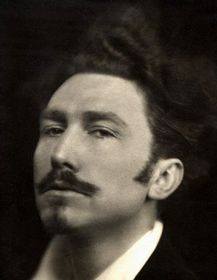
As a blow against Debussy and the pernicious influence of “Pelleas,” Pound contrived to write music of such rhythmic complexity as to leave “Le sacre du printemps” in the shade. Characteristically, the freewheeling poet described his method as “improving a system by refraining from obedience to all its present ‘laws.’” In other words, he was a proud contrarian.
In 1919, when Pound was 34 years-old, he conceived “Le Testament de Villon,” an operatic setting of François Villon’s poem of 1461. An ardent champion of Trenton’s own George Antheil from the composer’s early days in Paris, Pound enlisted Antheil’s help in developing a system of micro-rhythms the better to express the vitality of Villon’s Old French. The two worked at it in 1923. In 1924, Pound wrote a book titled “Antheil and the Treatise of Harmony,” a piece of hagiography so extravagant that it succeeded even in embarrassing the composer.
Preview performances in 1924 and 1926 brought criticism from the performers of the utter impracticality of the score. There are no rests or breath marks. There are crushing dissonances. The work’s demands call for scratches, hiccoughs, and the use of human bones in the percussion part.
Virgil Thomson praised the piece. “The music was not quite musician’s music,” he wrote, “though it may well be the finest poet’s music since Thomas Campion.” Pound’s colleague, the poet William Carlos Williams, described him thus: “…He knows nothing of music, being tone-deaf. That’s what makes him a musician.”
Excerpts from Pound’s “Le Testament de Villon” will receive a rare performance at the London Contemporary Music Festival on December 15. It is being advertised as the work’s UK premiere in its original version for two tins and a washboard. The first complete performance, in Antheil’s arrangement for small orchestra, was given over BBC radio in 1933.
Subsequently, Pound began work on two other operas. Neither was ever completed.
With the lingering evidence of Thanksgiving both in our refrigerators and around our waistlines, it’s hardly surprising that our thoughts and memories would be full of home. Perhaps you still are “home,” with family and a full day of travel ahead of you, or you can’t wait to get home (your own).
Whatever the case may be, this Sunday night on “The Lost Chord,” we’ll have music by American composers inspired by the idea of home.
We’ll have a work by the “Dean of American composers,” Aaron Copland – his “Letter from Home,” from 1943-44; then a recent piece by John Fitz Rogers, “Magna Mysteria,” from 2010.
Rogers, who studied with Steven Stucky, Roberto Sierra, Martin Bresnick, and Jacob Druckman, is an associate professor at the University of South Carolina School of Music and the founder of the Southern Exposure New Music Series, which received the 2005-2006 Chamber Music America/ASCAP Award for Adventurous Programming.
“Magna Mysteria” was commissioned in 2009 to celebrate the restoration of Trinity Episcopal Cathedral (Columbia, South Carolina). From its very title, which translates as “Great Mysteries,” it is clear that this is a work about questions. Its intent is nicely encapsulated in the promotional material accompanying this brand new release from Innova Recordings:
“Weaving together Latin biblical texts and poetic verse from the sixth-century philosopher Boethius, the composition explores ideas of home and the seeking of home, the elevation of home to a metaphorical or spiritual realm, and the nature of time.”
What is clear is that the work is gorgeous. If you have a fondness for the choral music of Morten Lauridsen or Stephen Paulus, you will enjoy this, though Rogers is very much his own man. His music is tonal, melodic, and quite lovely. Thank you, Marvin Rosen, for introducing me to this beautiful piece, which I first heard on your radio show, Classical Discoveries.
We’re home for the holidays this week, on “The Lost Chord.” I hope you’ll join me for “Homebodies,” tonight at 10 ET, with a repeat Wednesday evening at 6; or that you’ll listen to it later as a webcast at wwfm.org.
Once again, you’ve got to love the Golden Age of Hollywood. In terms of music, movies from that era just seemed so… inclusive.
On the one hand, you could have crooner Rudy Vallée acting in Preston Sturges comedies (and not singing a note); on the other, you could have Leopold Stokowski shaking hands with Mickey Mouse. There seemed to be a wider acceptance of musicians of all stripes as equally valid entertainers, and an assumption that the general public would understand (or at least not be put off by) a line of dialogue about Delius or Sibelius. When the Three Stooges weren’t flipping fruit into opera singers’ mouths, that is.
This is especially fascinating when viewed from the perspective of the present, when seemingly the bar is set lower and lower all the time, with everyone racing to the lowest common denominator so as not to seem too pointy-headed. Wouldn’t it make sense that people of any era would want to aspire to be more? That they would want to be led, represented and entertained by the most talented, most intelligent people? It’s a very strange world we live in.
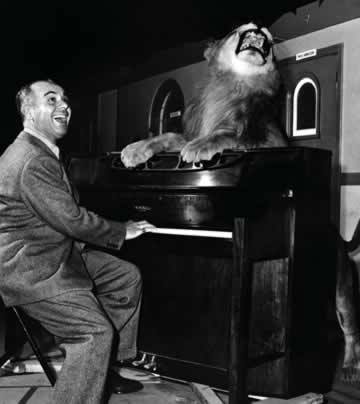
José Iturbi was one of the seemingly unlikely cinematic superstars of the 1940s. Like Oscar Levant, Iturbi was a serious pianist. In the ‘20s, he had made a name for himself as a barnstorming virtuoso who toured Europe, Asia, Africa and South America. He made his North American debut with the Philadelphia Orchestra under Stokowski.
Eventually, he made the transition to conducting, which had long been his dream. He led the great symphony orchestras of Philadelphia and New York, the London Symphony, the orchestra of La Scala Milan, and the Concertgebouw Orchestra of Amsterdam. He would serve as music director of the Rochester Philharmonic.
Iturbi generally played himself in Hollywood musicals, including “Thousands Cheer” (1943), “Anchors Away” (1945) and especially “Three Daring Daughters” (1948), in which he was actually the lead.
For all his talent and charisma, however, Iturbi was always churning up controversy, making provocative remarks and losing his temper. Ironically, for a musician who owed so much of his fame to his absorption into popular culture, he made a big hullabaloo about appearing on concert programs that included both classical and popular music. It wasn’t popular music he objected to, particularly; it was the mixing of the two. This is particularly puzzling from a pianist who studied at the Valencia and Paris Conservatories, yet played jazz and boogie-woogie in innumerable film shorts.
His private life was equally turbulent, perhaps even more so, with tragic results. His wife died of accidental poisoning. He sued his daughter, claiming she was an unfit mother to his grandchildren. The daughter later committed suicide.
Iturbi could be a brilliant pianist, though he sometimes drew criticism that he was diluting his talents through his involvement with Hollywood, and a number of his concerto recordings, which he conducted himself from the keyboard, don’t really seem to take flight. Even so, there are gems among his recorded repertoire, and the part he played in keeping classical music in the mainstream is to be lauded.
It’s a vine that is now severely withered. I wonder if Luciano Pavarotti’s “Yes, Giorgio” (1982) was the last in the line of dubious movies featuring great classical musicians.
Happy birthday, José Iturbi (1895-1980).
Iturbi in “Holiday in Mexico” (1946):
Insane take on Liszt’s “Hungarian Rhapsody No. 2” from “Anchors Aweigh” (1945):
Iturbi plays Mozart with his sister, while conducting the Rochester Philharmonic, in 1946:
Iturbi plays Albeniz, Granados and Navarro, from 1933:
Oscar Levant in “The Barkleys of Broadway” (1949):
Lauritz Melchior with Esther Williams and Van Johnson in “Thrill of a Romance” (1945):
A disconcerting thought occurred to me the other night, as I was driving up to my folks’ late Wednesday, after having completed production work on this week’s “Picture Perfect.” We are now as far away from the original “Star Wars” (released in 1977), as “Star Wars” was from “Gone With the Wind” (released in 1939)! I am always thinking thoughts like that, and it’s like getting my brain pinched in a collapsed telescope. It would have been possible, then, in 1977, that Clark Gable and Vivien Leigh, had they lived, could have come back for a belated sequel to one of the most beloved classics in American cinema.
I’m not saying I would have wanted that, but it is something to ponder, with the impending release of “Star Wars: The Force Awakens” on December 18. Can this film possibly live up to the hype? Of course, the bar has been set pretty low after the prequels. But come on, the Millennium Falcon is back, John Williams is doing the music, and George Lucas is in no way involved. Who doesn’t want to see a 70 year-old Han Solo brandish a sidearm at least one more time?
Clearly, this could rapidly degenerate into obsessive geekdom, so allow me merely to point out the fact that this week on “Picture Perfect,” we will begin a multi-part musical retrospective of the “Star Wars” movies. Part one will focus on the film that started it all.
“Star Wars,” as it was known when it was first released in theaters on May 25, 1977 (later to be retitled “Star Wars Episode IV: A New Hope”) provided a fun and fantastic escape to a long time ago, in a galaxy far, far away. Things became a lot more serious and jargon-heavy as the saga progressed. We’ll try to shrug off some of that ponderousness and remember what it was like to first encounter the wonder of John Dykstra’s Oscar-winning special effects (before they were replaced, retroactively, with CGI), and John Williams’ fresh and heroic music, credited with singlehandedly reviving the fortunes of the orchestral film score. “Star Wars” went on to become the best-selling orchestral soundtrack of all-time.
Now, there are two options when it comes to listening to a classic soundtrack originally released during this era. The first is to enjoy it in the form it was originally issued, in which composer and music editor took cues from different parts of the movie and arranged them into musically satisfying sequences on the album. The second is to listen, as many prefer today, when soundtracks are released note-complete, to everything presented chronologically, even if some of the cues are mere fragments, as it is heard in the film. Fortunately, because of the continued interest in “Star Wars,” the music has been reissued several times, so that it can be enjoyed either way.
Since I personally first obtained this soundtrack on vinyl, I have a preference for the form in which I first encountered it (though I’m certainly happy to own the complete score, as well). The double-LP contents no longer seem to be commercially available. Therefore, I am happy to present this rare opportunity to enjoy the music as countless did when the album was released, back in 1977.
Williams’ Academy Award-winning score, while adored by millions, has been criticized by some for its at times derivative nature, with suggestions of Holst, Prokofiev, Stravinsky, Korngold, Dukas and Walton, among others. I tend to think of it as being brilliantly post-modern, hand-in-glove with Lucas’ cinematic approach, which draws on any number of western, swashbuckler, war, and samurai motifs. Influences abound – intentionally, I think – but at no time can the composer be mistaken for anyone other than John Williams.
I hope you’ll join me as we listen to the London Symphony Orchestra, having the time of its life, on the original soundtrack to “Star Wars,” tonight at 6 ET, with a repeat tomorrow morning at 6; or that you’ll listen to it later as a webcast at wwfm.org.