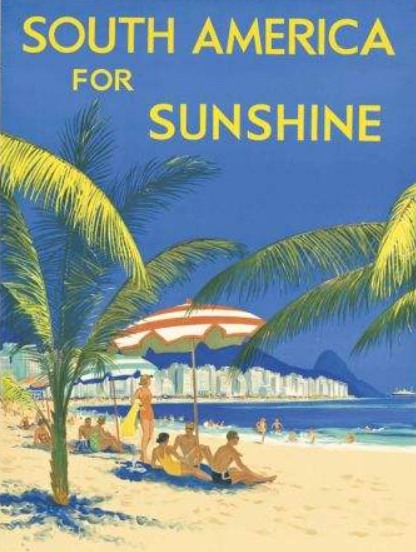
With more snow and frigid temperatures on the way – at least where I’m typing, here in the Mid-Atlantic United States – I’m thinking it might be cheering for some to reflect that it’s actually summer in the Southern Hemisphere. Who am I to deny the pleasure? This week on “Sweetness and Light,” I invite you to think warm thoughts as we take a musical journey to Latin America.
Argentina, Brazil, Chile, Paraguay, and Peru will be represented in works by Agustín Barrios, Theodoro Valcárcel Caballero, Camargo Guarnieri, Astor Piazzolla, and Heitor Villa-Lobos.
We’ll cap the hour back in New York with more cowbell and Morton Gould’s vibrant “Latin-American Symphonette.”
Join the conga line. It’s a South American getaway on “Sweetness Light,” this Saturday morning at 11:00 EST/8:00 PST, exclusively on KWAX, the radio station of the University of Oregon!
If you think the world is in rough shape now, fasten your seatbelt; it’s going to be a bumpy 1,461 days.
This week on “Picture Perfect,” gaze into the crystal ball for an hour of dystopian visions – glimpses of a bleak future rendered hopeful, in large part, through music.
“Fahrenheit 451” (1966), based on the Ray Bradbury novel, presents a society in which books are outlawed by the state and burned as a means to control the masses. The title refers to the temperature at which paper will ignite. Oskar Werner and Julie Christie star in this Francois Truffaut-directed film. Composer Bernard Herrmann finds the heart at fire’s center.
A robot is left behind to clean up a long-abandoned Planet Earth, in “WALL-E” (2008), one of Pixar’s finely-crafted entertainments. This one has a serious subtext, about rampant consumerism and its impact on an earth made uninhabitable by the sheer volume of garbage.
But there’s also a love story, as WALL-E pursues another robot into outer space, with fate-changing consequences. The inventive score is by Thomas Newman.
As dystopias go, Steven Spielberg’s “A.I.: Artificial Intelligence” (2001) is a little more unpleasant than most. “A.I.” grew out of an incomplete project of Stanley Kubrick. Based on Brian Aldiss’s short story, “Super-Toys Last All Summer Long,” the film stars Haley Joel Osment as a child-like android programmed to love, only to be rejected by his adopted family. Abrasive blood sport, unpleasant visions of a debauched city, and human extinction ensue. A great time is had by all!
Also, the film doesn’t know when to end. Oh, how I hate this movie.
That said, John Williams gives it his usual best. The voice of soprano Barbara Bonney graces the admittedly gorgeous soundtrack.
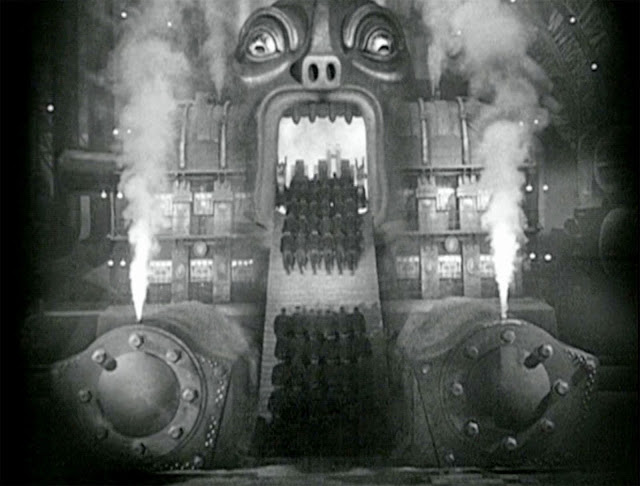
One of the landmarks of silent cinema, Fritz Lang’s “Metropolis” (1927) is an eerily prescient vision of a world divided between the “haves” and “have-nots.” Once seen, the subterranean hell of the workers “hive” is not soon to be forgotten. So much of the film continues to resonate, even as its iconography is shamelessly recycled.
Gottfried Huppertz’s original score already adheres to the Straussian model of Golden Age film scores, with leitmotifs representing the characters and ideas. It’s a concept that became associated with Max Steiner and Erich Wolfgang Korngold, and which has had an enormous influence on film composers down through the decades, all the way to John Williams and beyond.
Learn more about the challenges of writing such a complex score – which was performed live, with orchestra, at showings of the movie, even as the film was still being edited right up until its premiere – when listening to tonight’s show.
In the meantime, hang on to your humanity! Join me for these cautionary tales about totalitarian government, corporate control, and technology gone awry, on “Picture Perfect,” music for the movies, now in syndication on KWAX, the radio station of the University of Oregon!
Clip and save the start times for all three of my recorded shows:
PICTURE PERFECT, the movie music show – Friday at 8:00 PM EST/5:00 PM PST
SWEETNESS AND LIGHT, the light music program – ALL NEW! – Saturday at 11:00 AM EST/8:00 AM PST
THE LOST CHORD, unusual and neglected rep – Saturday at 7:00 PM EST/4:00 PM PST
I remember first encountering David Lynch’s “Eraserhead” (1977) at the midnight movies as a teenager in the early ‘80s and thinking WTF? And this was before WTF was even a thing. As an acronym, I mean. Being a teenager, I was delighted by the film’s surreal, anxious vibe, of course. Wouldn’t you know it, its sensibility was shaped by the young director’s experiences living in Philadelphia while he attended the Pennsylvania Academy of the Fine Arts. Had I only taken it as the warning it should have been, as I myself wound up living in that hell hole for 32 years!
[Note to self: Save that paragraph for the opening of my autobiography.]
This corn-fed Boy Scout from Missoula, Montana, blossomed into one the most unique and influential voices in American cinema. Lynch came to Philadelphia as an aspiring visual artist; he left with a lifetime supply of nightmare imagery, uneasy energy, and offbeat humor. In fact, on at least one occasion, he described the city as a virtual portal to hell.
“It wasn’t a normal city…,” Lynch recalled. “The fear, insanity, corruption, filth, despair, violence in the air was so beautiful to me.”
[Well, he had me until the beautiful part.]
For the movies, Lynch went on to direct “Blue Velvet” (1986), “Wild at Heart” (1990), “Lost Highway” (1997), and “Mulholland Drive” (2001), with a special shout-out to “The Straight Story” (1999), perhaps his most peculiar project, in that it was made for Disney and there is nothing in it to frighten the horses. In fact, it’s a rather touching film. For television, he created the cult classic “Twin Peaks” (1990-91).
He never lost his “aw shucks” demeanor. Mel Brooks, who produced Lynch’s “The Elephant Man” (1980), described him as Jimmy Stewart from Mars. At one point, George Lucas offered him the opportunity to direct “Return of the Jedi.” If you saw Lynch’s “Dune” (1984), I think you have a pretty good idea how that would have gone.
He was nominated for three Academy Awards for Best Director and received an honorary Oscar in 2019. He had such a distinctive style, it could only be described as… Lynchian.
Lynch had an amusing cameo as crusty director John Ford in Steven Spielberg’s “The Fabelmans” (2022). More recently, he struggled with emphysema after years as a smoker.
At the time of his death, he was 78 years-old.
“I’ve said many, many, many unkind things about Philadelphia, and I meant every one.”
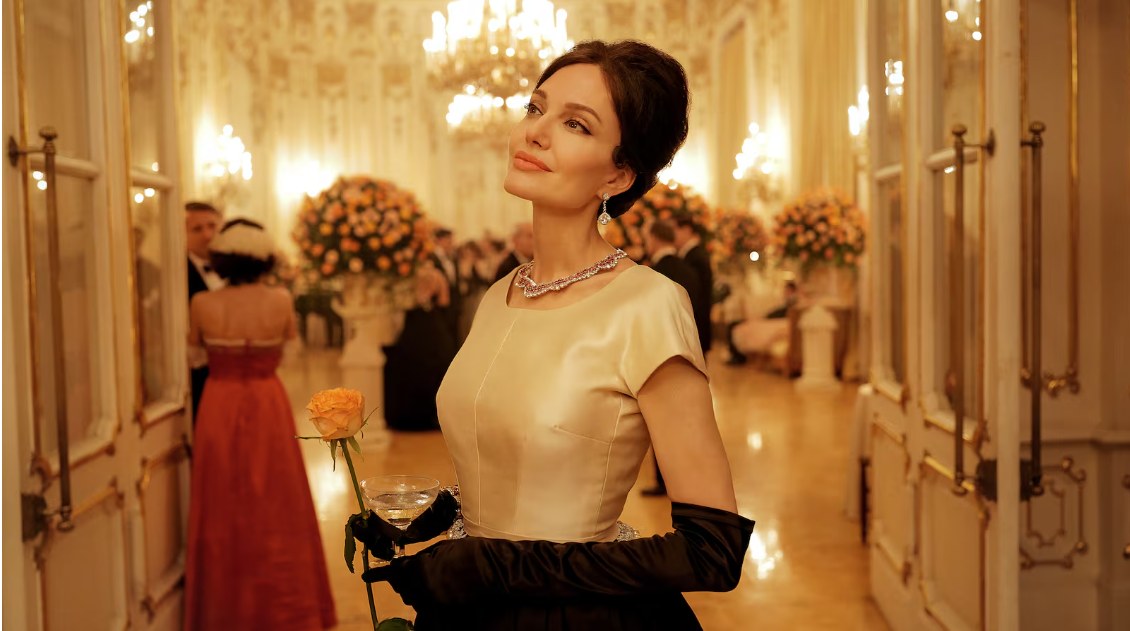
“Maria” is a kind of film that might have been made in the 1960s. Ordinarily, I would mean that as a compliment. Unfortunately, anything that would have once been considered experimental about it was explored more successfully, iconically even, by Fellini and others, over a half century ago. (I just looked up the director, Pablo Larraín, and in 2012, for a poll conducted by Sight & Sound magazine, he named “8 1//2” as one of his favorite films.) In any case, it would have been impossible to make this particular picture back then, since its subject is the last week of the life of super-diva Maria Callas, who died on September 16, 1977. As it stands, it’s a film that too often trades in empty technical exercises and clichés. It doesn’t come across so much as homage as been-there, done-that.
The pills, the ego, the faded glamor – we’ve seen it all before, only here it’s an opera singer, instead of a rock and roll legend. Elvis Presley died on August 16, exactly one month before Callas did. Most Callas portrayals tend to include something of her caustic manner and imperious nature (see Terence McNally’s “Master Class”). But was she really so much of a Norma Desmond figure? (“Sunset Boulevard” is another one of Larraín’s favorite films.)
“Maria” has been described as the third in Pablo Larraín’s “Important Women Trilogy” (somebody has to come up with a better name), following “Jackie” (2016), about the grieving Jacqueline Kennedy – whose life, of course, intersected with Callas’, by way of her marriage to Aristotle Onassis – and “Spencer,” about Princess Diana (2021). None of these are straight bio-pics. Rather, they attempt to get at their subjects’ psychological states through artistic means.
I can’t speak for the success of the others (which I have not seen), but “Maria” rings fairly hollow (not unusual, alas, for films about musicians). That said, Natalie Portman and Kirsten Stewart were both nominated for Oscars for their respective portrayals, which bodes well for Angelina Jolie. Hollywood loves its own, and here Jolie stretches far enough beyond audience expectation that she can’t help but be noticed.
To be fair, the film does have some good performances (Jolie’s included, given the material she has to work with, her distracting lip injections aside). But it’s generally the quieter parts, the less-flashy ones, assumed by an international cast, that inspire the more satisfying turns. “Maria” is a coproduction of independent film companies in Italy, Germany, England, and the United States, with additional footage shot in Hungary and Greece. Remember when Hollywood used to actually produce these kinds of films?
Pierfrancesco Favino and Alba Rohrwacher (both Italian) leave lasting impressions, especially the former, as Callas’ long-suffering butler and housemaid, respectively. Haluk Bilginer (Turkish) plays Aristotle Onassis; either that, or a lecherous George Burns. Anyway, he has a good death scene. Stephen Ashfield (Scottish) appears as conductor Jeffrey Tate, minus the spina bifida (perhaps the filmmakers feared blowback if they had attempted such a portrayal?), who I never realized until now bore such a likeness to Elton John. (He didn’t.) There’s also a fabricated conversation with JFK, played by Caspar Phillipson (Danish), all jaw, with a quasi-Kennedy coif, reprising his role from “Jackie.” (Callas did sing at Kennedy’s Madison Square Garden birthday reception in 1962, perhaps upstaged by Marilyn Monroe’s rendition of “Happy Birthday, Mr. President,” also depicted in the film.)
Kodi Smit-McPhee (Australian) has the most thankless role as Mandrax (named for a drug Callas abuses), a journalist who follows Callas sporadically throughout the film with the conceit of filming a documentary about her. Except he’s an hallucination. The narrative is divided into three parts signified, with an unnecessary and self-reflexive flourish, by the clack of a clapperboard and digitally-added signs of wear and tear, manufactured artifacts of the celluloid era. It works in Alexander Payne’s “The Holdovers.” Not so much here. The whole meta conceit is eye-rollingly pretentious, more like something that would have been perpetrated by a film student as opposed to a director with ten previous films under his belt. The fantasy sequences are similarly trite and come across as the kinds of things that used to turn up in rock videos (for example, an orchestra playing fragile acoustic instruments in the pouring rain).
I found some of the musical choices, when Callas isn’t on stage, more unconventional, a little peculiar even. I understand this is the world of opera, but often it seems as if the dramatic off-stage moments are somewhat randomly scored with familiar passages. The “Humming Chorus” from “Madama Butterfly” the “Anvil Chorus” from “Il trovatore,” the prelude to “Parsifal.” Yes, Callas sang in these operas, and I may be nitpicking, but she didn’t sing in the choruses, and in the case of “Parsifal,” though she performed a surprising amount of Wagner early in her career, she never sang Kundry after 1950. In any case, it’s not the repertoire that endures in most people’s memories as quintessential Callas. And what’s with the Brian Eno?
Most unfortunate, the film never successfully manages to convey the Callas mystique. Lest there be any doubt, “Maria” concludes with a montage of genuine footage of Callas herself. She never speaks a word, yet it’s evident from her few minutes of screen time that the filmmakers were unable to capture her essence.
Tom Volf’s documentary from a few years ago, “Maria by Callas” (2017), gives a much better sense of who she was, through actual performances, TV interviews, home movies, family photographs, private letters, and unpublished memoirs, most of which had never been shown to the public.
Often during the last half hour or so of “Maria’s” 2 hour and 5 minute running time, I felt like surely it was about to end. Not out of boredom, necessarily. It just felt dramatically as if the film had run its course.
And in the name of all that’s holy, what’s the deal with the heinous and pervasive practice of these streaming services cutting off their movies mid-credits? It’s bad enough that the movies aren’t given the respect of nationwide theatrical releases anymore (Netflix does its films a disservice in not presenting them in an environment in which a viewer can be totally immersed, as opposed to giving in to an ice cream craving or nodding off on the couch), but whatever immersion one is able to achieve at home is shattered by being jerked out of a sustained illusion of reality that’s been so painstakingly crafted over two or three hours. It’s a frustrating experience, and I am tired of railing against Netflix, Hulu, Tubi, etc., every time it happens.
It’s especially frustrating in the case of “Maria,” as I was curious to see the microscopic music credits at the end. (No, they’re not listed on IMDB.) So I had to go back, start the movie, and fast-forward through the entire thing again. Thanks, Netflix.
Anyway, you can add this to the mountain of classical music movies that just don’t get it. Too often “Maria,” the film, comes across as an exercise in style over substance, something that its subject, Callas the artist, never was.
Ruth Slenczynska, believed to be the last living pupil of Sergei Rachmaninoff, was born 100 years ago today. Slenczynska, who was born in Sacramento, CA, now makes her home in Hershey, PA.
Slenczynska made her debut in Berlin at the age of 6. She performed with orchestra for the first time in Paris at the age of 7. At 15, she walked away from it all, attending Berkeley (she was a psychology major) and hoping to live a normal life. She married at 19, but divorced nine years later.
She began to teach piano for a living, which drew her back into the concert world. She was artist in residence at Southern Illinois University Edwardsville, a full-time position, from 1964 to 1987. In 1957, she published her memoirs, “Forbidden Childhood,” recounting her experiences as a prodigy. She also wrote “Music at Your Fingertips: Aspects of Pianoforte Technique.”
Her complete recordings for American Decca, set down between and 1956 and 1963, have been reissued on compact disc by Deutsche Grammophon. Several albums were released on Ivory Classics. She recorded the music for her most recent release, “Ruth Slenczynska: My Life in Music,” at the age of 97.
The Washington Post published an article on her in February of last year. In it, she recollects Rachmaninoff’s first impression of her, when she met him in Paris at the age of 9. “This very tall man opened the door and looked down at me. He pointed at me with his long finger and said, ‘THAT plays the piano?’”
If that’s not Rachmaninoff, I don’t know what is.
Even without the Rachmaninoff connection, her pedigree is breathtaking. Among her other teachers were Artur Schnabel, Egon Petri, Alfred Cortot, and Josef Hoffman.
Happy birthday, Ruth Slenczynska!
Slenczynska talks and plays Rachmaninoff in 1963
Slenczynska in a Pathé newsreel, at the age of 5
Slenczynska at 99
Nice write-up by Australian Broadcasting Corporation