Category: Daily Dispatch

  • National Geographic TV Music After Thanksgiving

    National Geographic TV Music After Thanksgiving

    On the day after Thanksgiving, with the house alive with memories and perhaps a few lingering relatives, enjoy an hour of music from television “events” that once appealed to the entire family.

    Years in advance of modern cable, at the very dawn of color television, the National Geographic Society aired its first “special” on September 10, 1965. The program, titled “Americans on Everest,” featured stunning footage taken from the summit of the world’s tallest peak. These specials really were special, with breathtaking images and real-life adventures unlike anything previously experienced in American living rooms.

    Three months later, viewers were introduced to the familiar “National Geographic Theme,” which was composed by Elmer Bernstein for the third of the broadcast specials, “Voyage of the Brigantine Yankee.” When one realizes that Bernstein also wrote the score for “The Magnificent Seven,” it becomes one of those “Ah ha!” moments. Both themes remain among the most recognized by American audiences.

    National Geographic went on to work with a number of the top film composers of the day. This week on “Picture Perfect,” we’ll travel the world with four of them.

    Bernstein, who was also responsible for the music for “The Ten Commandments,” “The Great Escape,” and “To Kill a Mockingbird,” returned in 1967 to write the music for a follow-up to “Voyage of the Brigantine Yankee,” called “Yankee Sails Across Europe.”

    Ernest Gold, composer of “Exodus,” was engaged in 1972 to write the score for “The Last Vikings,” a documentary about the inhabitants of the rugged northern coast of Norway, who at the time still practiced some of the traditions followed centuries before by their Norse forebears. Gold’s score is a good example of what a talented composer can accomplish through an economy of means – in this case, a wind ensemble, harp, cello and percussion.

    Leonard Rosenman, a pupil of Arnold Schoenberg, Roger Sessions, and Luigi Dallapiccola – a most unlikely pedigree on which to build a career in Hollywood – wrote classic scores for “East of Eden,” “Rebel Without a Cause,” and “Fantastic Voyage.” He also composed the music for one of the best known of the National Geographic specials, “Dr. Leakey and the Dawn of Man,” in 1966.
    Finally, Jerome Moross wrote a charming and buoyant Americana score for “Grizzly!,” which aired in 1967. Moross, of course, was the composer of one of the all-time great western scores, for “The Big Country.”

    Naturally, we’ll also get more than our share of that iconic National Geographic theme. All of this music was issued on limited edition compact discs from the Intrada label.

    I hope you’ll join me for music from outstanding television documentaries produced by National Geographic, on “Picture Perfect,” music for the movies, now in syndication on KWAX, the radio station of the University of Oregon!


    Clip and save the start times for all three of my recorded shows:

    PICTURE PERFECT, the movie music show – Friday at 8:00 PM EST/5:00 PM PST

    SWEETNESS AND LIGHT, the light music program – ALL NEW! – Saturday at 11:00 AM EST/8:00 AM PST

    THE LOST CHORD, unusual and neglected rep – Saturday at 7:00 PM EST/4:00 PM PST

    Stream them, wherever you are, at the link!

    https://kwax.uoregon.edu/

  • Quincy Porter Lost Thanksgiving Gem New England Episodes

    Quincy Porter Lost Thanksgiving Gem New England Episodes

    Here’s another piece I used to play every year for Thanksgiving, but like so many other recordings I drew from my own collection, it disappeared from the air waves when I was given the boot during COVID and was never asked back. One of these days, I’ll have to send it out into syndication on “The Lost Chord.”

    Quincy Porter is yet another one of those largely forgotten American composers of the generation of Aaron Copland and George Gershwin. Born in New Haven, CT, in 1897, he attended Yale, where he studied with Horatio Parker (Charles Ives’ longsuffering teacher) and David Stanley Smith. He also studied with Vincent d’Indy at the Schola Cantorum in Paris and Ernest Bloch in New York.

    In 1923, he joined the faculty of the Cleveland Institute of Music. He was there for five years, until he made the decision to devote himself exclusively to composition. A Guggenheim Fellowship allowed him to return to Paris. The money held out for three productive years, but in the end he was back at the Cleveland Institute. Briefly. The next year he was teaching at Vassar. In 1938, he was appointed dean and later director of the New England Conservatory of Music. In the 1946, he returned to Yale, where he taught until 1965.

    With Copland and Howard Hanson, he cofounded the American Music Center in 1939. He served as chairman of the organization’s board from 1958 until his death in 1966.

    In 1944, he received the Pulitzer Prize for Music for his “Concerto Concertante” for two pianos and orchestra. Where is he now?

    “New England Episodes” was given its premiere in Washington, D.C., in 1958. According to the liner notes to my recording, “The subject of this evocative suite is the puritan past of New England with its hymns, its rigidities, its moments of lightness and its melancholy.”

    There’s a moment when the chimes take on the character of church bells, which I find an especially nice touch, but I find the entire work transporting. I hope you do too.

  • Hovhaness Symphony No. 60 Appalachian Mountains

    Hovhaness Symphony No. 60 Appalachian Mountains

    Yesterday, in writing about a concert I attended with the Chamber Orchestra of Philadelphia, I made a remark about Aaron Jay Kernis’ “Musica Celestis” that might be construed as flippant, describing a certain genre of mystic music as holy schmoly, perhaps inadvertently suggesting a touch of kitsch and even insincerity. If so, the work is in good company, since the same charges were leveled in some circles against Wagner’s “Parsifal.” As I said, “Musica Celestis” is probably my favorite piece by Kernis, and Lord knows, I meant no disrespect to Vaughan Williams’ masterly “Fantasia on a Theme by Thomas Tallis,” mentioned by way of comparison.

    Alan Hovhaness’ name was also bandied in close proximity, and I want to make very clear that I have nothing against Hovhaness and indeed have enjoyed most of the music by him that I have heard (and I have heard a lot). “Holy schmoly” was merely an adolescent attempt to punch up the prose of that particular sentence. And I’m not going to change it, because I admit I never grew up, and as Polonius exhorts, “To thine own self be true,” etc. Love me for who I am!

    To prove there was no offense intended, here’s one of Hovhaness’ 67 symphonies (give or take). It’s unusual, in that Hovhaness is often influenced by music of the East (he is of Armenian descent), and you might detect some of that even here, but in this case, he also assimilates American folk song and shape-note melodies, of all things. I think it’s a great listen for Thanksgiving. Here’s the Symphony No. 60, “To the Appalachian Mountains.” The work was commissioned in 1985 to celebrate the cultural heritage of Tennessee. The third movement is freely based on the folk song “Parting Friends.”

  • Virgil Thomson Thanksgiving Birthday Music

    Virgil Thomson Thanksgiving Birthday Music

    Virgil Thomson was not only a composer, he was a writer on music, who wielded power of a kind unimaginable in this day of eroded standards, as a critic at the New York Herald-Tribune.

    Perhaps his brand of “faux-naïf” Americana is not for everyone. Still, it earned him a wide and enduring audience. His music for Robert Flaherty’s “Louisiana Story” (1948) remains the only film score ever to be awarded a Pulitzer Prize.

    For Thomson’s birthday, here’s some music to get you in the mood for Thanksgiving.

    His “Symphony on a Hymn Tune” was composed during his Paris years. Thomson, like Aaron Copland and so many others, studied in France with Nadia Boulanger. The symphony was inspired by the composer’s memories of his Kansas City boyhood. The “Sunday best” of the church hymns occasionally gets tangled up in a few modernistic burrs – the exchanges between the violin, cello, trombone, and piccolo at the end of the first movement, for instance – but in 1928, it was a landmark in terms of helping to establish a distinctly American idiom.

    More austere, perhaps, is Thomson’s symphonic poem “Pilgrims and Pioneers” – but just stick around for the fiddle tunes.

    Finally, a seasonal work: the Concertino for Harp, Strings and Percussion, “Autumn” – according to Thomson, actually more of a “portrait of an artist ageing.”

    Happy birthday, Virgil Thomson (1896-1989) – and Happy Thanksgiving!


    Check out Thomson on TV!


    PHOTOS: Thomson, enjoying all his pleasures at once

  • Chamber Orchestra Blooms Under Hayes’ Baton

    Chamber Orchestra Blooms Under Hayes’ Baton

    This was my kind of concert!

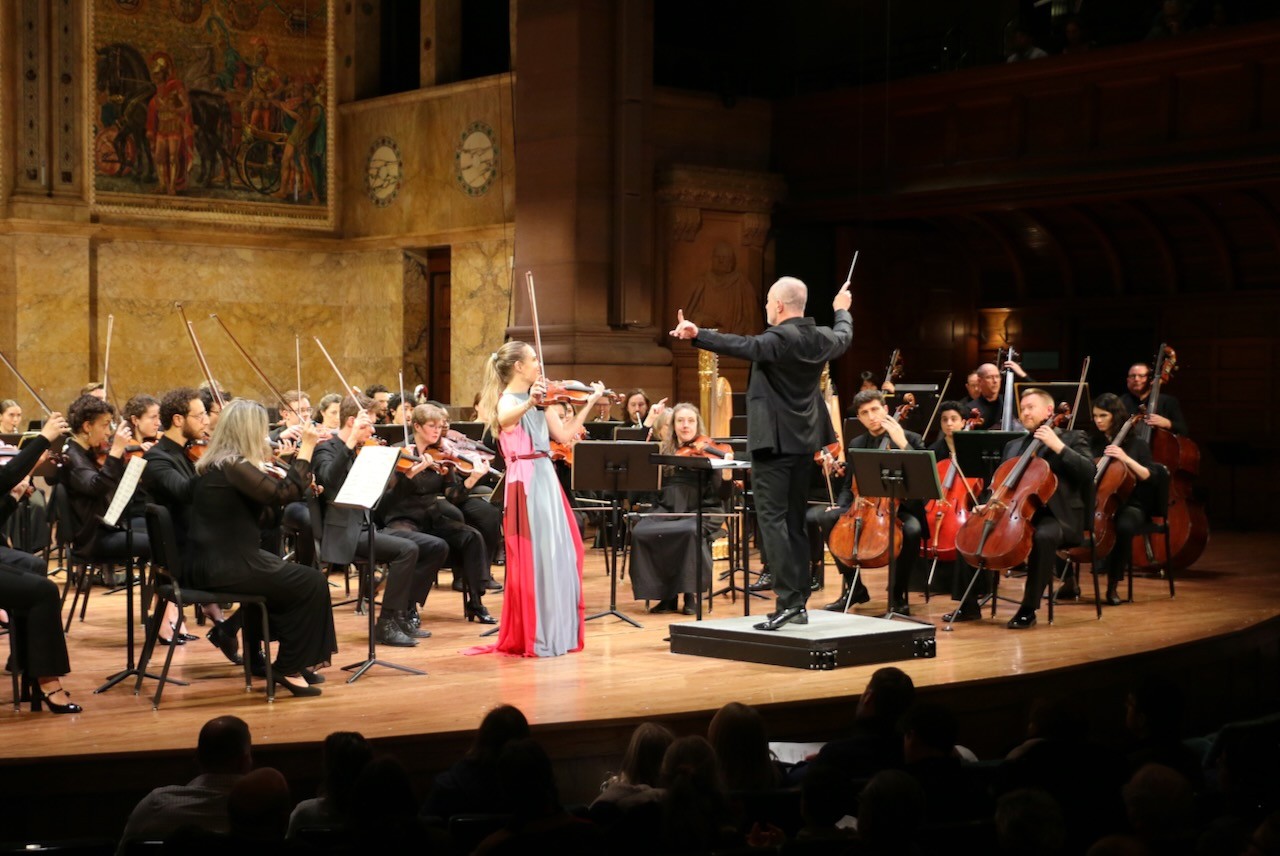
    Yesterday afternoon, at the Kimmel Center for the Performing Arts’ Perelman Theater, The Chamber Orchestra of Philadelphia was conducted by David Hayes in a program of 20th century classics.

    Aaron Jay Kernis’ “Musica Celestis” (1990-91) takes its inspiration from medieval mystic and composer Hildegard von Bingen – a work in the holy schmoly, “Fantasia on a Theme by Thomas Tallis”/Alan Hovhaness mode, with perhaps a little Barber’s “Adagio” tossed into the mix. Both Kernis’ and Barber’s works are arrangements of movements from their respective string quartets. This has always been my favorite Kernis piece, with perhaps his “Superstar Etude No. 1” (in the style of Jerry Lee Lewis) a guilty pleasure. Kernis himself was in attendance for yesterday’s performance. The program was a repeat of one previously presented on Friday night.

    Béla Bartók’s Divertimento for String Orchestra (1939) was next, the first movement, a game of Baroque solo-tutti table tennis; the second an atmospheric tiptoe through the dank corridors of Dracula’s castle (Hayes, in some spoken remarks, compared it to the scene in every horror movie where you think, “Don’t open that door!”); and the third, a frenzied village dance, more determined in character than in any way euphoric. This is not your standard 18th century entertainment or diversion! But you’ll have this, with Nazism swallowing Europe and the world teetering at the brink of war. (Germany invaded Poland only weeks after the work’s completion.)

    The concert concluded with Leonard Bernstein’s “Serenade, after Plato’s ‘Symposium’” (1954) – scored for violin, harp, string orchestra, and percussion – essentially Bernstein’s violin concerto. Plato’s work is all about love, with dinner guests waxing philosophical on the multifarious aspects of Eros; but drink is involved, so things eventually devolve into a more worldly appreciation of the grape. Whether intentional or not, something of Bernstein’s character is reflected in the work’s debauched trajectory.

    Dionysian Sandy Cameron was the soloist, wearing a silver tunic, cross-laced “Demetrius and the Gladiators” boots, and diaphanous, ankle-length chlamys. It was her “Megalopolis” moment. Cameron moshed and swayed, contorted and smiled to the music, while meeting all the work’s technical and emotional challenges. Aristophanes never sounded so much like Korngold.

    I always thought this was Bernstein’s concert masterpiece, though of course there are moments when it is unmistakably the work of the guy who wrote “West Side Story” (already being formulated at the time). Hey, the work has six percussionists.

    I’ve been following Hayes on and off over the decades, since his days as a student at the Curtis Institute of Music. Apparently, I haven’t followed closely enough. I always considered him a choral conductor (for years, he was music director of the Philadelphia Singers; later, he directed the New York Choral Society), but his resume is much more diverse. I knew, but I guess must have willfully downplayed the significance of his service on the conducting staff of the Philadelphia Orchestra for a decade, from 2001-11. He kind of dropped of my radar when he moved to New York, and he’s racked up a whole lot of impressive credits since.

    Then a couple of years ago I saw him conduct the world premiere of Adolphus Hailstork’s Symphony No. 4 at Alice Tully Hall, on a program that also included works by Jennifer Higdon and Zhou Tian, with all three composers in attendance. Parenthetically, I was sorry to have to miss one of my favorite Hailstork works, the “Sonata da Chiesa,” on the Chamber Orchestra of Philadelphia’s October concert, with Michael Torke’s “December” and Beethoven’s “Emperor” Concerto, but unfortunately I had scheduling conflicts and was unable to attend.*

    At any rate, evidently I wasn’t really paying attention, as David Hayes is all growed-up!

    This is Hayes’ first season as music director of the chamber orchestra (succeeding Dirk Brossé). I hope the inclusion of so much worthwhile, wholly accessible 20th century and contemporary music works for the organization, because it really works for me. I could have very happily spent my Sunday afternoon at home (it was a whirlwind round-trip as I had another obligation on Sunday night), but this concert was like classical music shoo-fly pie. Bravo, and more please!


    *ERRATA: It was actually a more recent Hailstork work they performed, “Sagrada: Sonata da Chiesa No. 2.” All the more shameful for me to have missed it!


    Video excerpt from Bernstein’s “Serenade” from Friday night’s performance:

Tag Cloud

Aaron Copland (93) Beethoven (95) Composer (114) Film Music (142) Film Score (143) Film Scores (255) Halloween (94) John Williams (195) KWAX (229) Leonard Bernstein (104) Marlboro Music Festival (125) Movie Music (157) Mozart (90) Opera (212) Philadelphia Orchestra (89) Picture Perfect (174) Princeton Symphony Orchestra (108) Radio (88) Ross Amico (244) Roy's Tie-Dye Sci-Fi Corner (290) The Classical Network (101) The Lost Chord (269) Vaughan Williams (104) WPRB (397) WWFM (881)

DON’T MISS A BEAT

Receive a weekly digest every Sunday at noon by signing up here


RECENT POSTS