Assembling a million-dollar stereo system has its price. Yet another classical music cautionary tale. I’m lucky mine ends with walls of dollar CDs from @[100064570938690:2048:Princeton Record Exchange]. Tantalizing photos, but clearly this is a chronicle of an obsession gone too far. When you’re done with the article, here’s a link to the documentary “One Man’s Dream.” https://www.youtube.com/watch?v=4b2IOOhJmxw
Category: Daily Dispatch
-
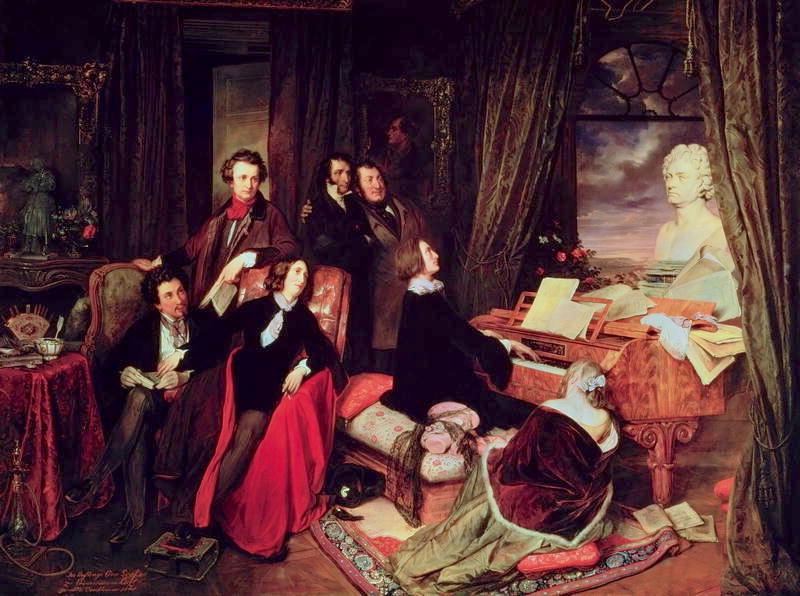
Liszt’s Piano Beethoven’s Ghost Romantic Salon
On Beethoven’s birthday, here’s “Liszt at the Piano,” a famous painting, oil on wood, by Josef Danhauser, who lived from 1805 to 1845. Depicted is quite the salon, with, left to right, writers Alexandre Dumas, Victor Hugo, and George Sand; violinist Niccolò Paganini; with his arm around him, composer Gioachino Rossini; at the keyboard, the titular Franz Liszt; and at Liszt’s feet, his mistress during his Paris years, the Comtesse Marie d’Agoult – also a writer (who published under the name Daniel Stern) and the mother of Liszt’s three children. Their daughter Cosima would marry the conductor Hans von Bülow and then leave him for Richard Wagner.
Why am I posting a painting of Liszt and his peeps to celebrate Beethoven? Take a gander at that surreal, luminous bust floating outside the window. Yes, that’s right – it’s the likeness of Ludwig van, remarkably similar to the famous bust sculpted in 1821 by Anton Dietrich.
The painting was completed in 1840, 13 years after Beethoven’s death. Everyone else depicted would have still been alive – actually Paganini died the same year – with the exception of Lord Byron (if you look closely, you’ll see his gilt-framed portrait behind Rossini), who died of fever in 1824, while fighting for the cause of Greek Independence against the Ottoman Empire.
What is the point of this gathering of super-artists? Were they all even ever in the same room together? Where is Sand’s lover, Frédéric Chopin? Why Rossini and not Hector Berlioz, who was a friend and beneficiary of both Paganini and Liszt? (Actually, there is some question as to whether that might not be Berlioz and NOT Hugo between Dumas and Sand.)
I can only assume Rossini’s inclusion is because he actually made the pilgrimage to meet Beethoven, who was inadvertently condescending in praising Rossini’s “The Barber of Seville,” but dismissive of any attempt at serious opera by Italian composers. (Anyone who’s read Berlioz’s Memoirs knows that Beethoven wasn’t alone in this, though Berlioz adored Spontini and Beethoven owed a thing or two to Cherubini.) But beyond that, Rossini’s standing in this company is tenuous at best.
One of the privileges of painting is that an artist can conjure truths that transcend mere photographic realism. (You don’t really think about cameras being around at this time, but Chopin was photographed not too long after.) Obviously, Danhauser intended this as a kind of Pantheon of the Romantics. (Why else include Byron?) All of them are transfixed, enraptured even, by the music conjured by Liszt at the piano. All of them look to Beethoven as a spiritual father.
Beethoven, more than any other composer, was seen as a bridge from 18th century Classicism – the tidy, rational Enlightenment – to a new age of sensation – intensity of feeling, raw passion, and heaven-storming aspiration. His personal struggle was evident. Perfection did not come easily to Beethoven. He grappled with it. And he captured that struggle in his music. In struggling to express what he was compelled to express, he pushed hard through countless trials to forge new paths. Plagued by deafness, he remained defiant. Unbowed, he transcended personal and human limitations to express the sublime in all of us. His indomitable drive and achievement caused him to be perceived by many as the proto-Romantic. The development from his Haydnesque Symphony No. 1 to the Mahler-in-utero Symphony No. 9 is one of the great artistic journeys of all time. And those late string quartets? Fuhgeddaboudit.
One of the scores on Liszt’s piano is the slow movement from Beethoven’s Piano Sonata No. 12. It bears the superscription “Marcia funebre – Sulla morte d’un Eroe” (“Funeral March – On the death of a Hero”).
Beethoven’s heroism has burned with Promethean daring for artists and listeners who, down the ages, have sought affirmation of, and consolation in, the inherent possibility of all that is great in humanity.
That’s my lofty observation. The painting was actually commissioned by Conrad Graf, a piano builder, so it also functions on the more mundane level as an advertisement!
Happy birthday, LvB.
Piano Sonata No. 12, Movement III: “Funeral March – On the death of a Hero”
Some time ago, I also wrote about the meeting of Beethoven and Liszt
https://www.facebook.com/photo/?fbid=1077344973184565&set=a.883855802533484
-

Winter Wonderland’s Surprising Jewish Roots
In putting together yesterday’s broadcast of “Sweetness and Light,” I looked into the origins of the Christmas song “Winter Wonderland,” and I learned a few things.
First of all, the song joins the pantheon of great American Christmas songs composed by Jews (see Sammy Cahn, Jay Livingston, Johnny Marks, Mel Tormé, and of course Irving Berlin).
Second, it was written in my home state of Pennsylvania within an hour of where I grew up. The lyricist, Richard Bernhard Smith (Dick Smith), was born in Honesdale, PA, 32 miles northeast of Scranton.
Third, Smith wrote the words while being treated for tuberculosis in Scranton’s West Mountain Sanitarium. His sister claimed he was inspired by the sight of Honesdale’s Central Park covered in snow. (Perhaps that should be third and fourth? I had better stop counting.)
Felix Bernard, who wrote the music, was born in Brooklyn, into a Jewish family named Bernardt. Smith was an Episcopalian. So in this case, the Christmas tune was the product of something of a mixed marriage.
The first recording was made in 1934 by Richard Himber and his Hotel Ritz-Carlton Orchestra, as kind of an afterthought, on time left over from another session. Among the musicians in the orchestra was Artie Shaw. But it was Guy Lombardo who made it into one of the year’s biggest hits. The song, of course, went on to be covered countless times.
Sadly, Smith, whose illness was diagnosed in 1931, died on September 29, 1935 – his 34th birthday – a poignant footnote to this timeless fantasy of winter fun and romance.
Lombardo’s nationwide broadcasts were New Year’s Eve staples for nearly 50 years, originating first from New York City’s Roosevelt Hotel and later the Waldorf Astoria. I remember watching him on television in his twilight years with my grandparents when I was child growing up in the 1970s. Following Lombardo’s death in 1977, Dick Clark’s “New Year’s Rockin’ Eve,” first broadcast in 1972 – and which unquestionably appealed to a younger crowd – sounded the death knell for a more elegant era.
The first recording, with Himber at the Ritz-Carlton, with Joey Nash vocal
Lombardo and His Royal Canadians in 1934:
Lombardo 1946 remake, with the Andrews Sisters
-

Das Christ-Elflein A Forgotten Holiday Gem
Stop me if you’ve heard this one before. An elf, a Christmas tree, and Baby Jesus walk into a bar…
Well, not quite, maybe, but it is kind of like the premise of Hans Pfitzner’s “Das Christ-Elflein” (“The Christmas Elf”).
This week on “The Lost Chord,” I’ll be reaching deep into the archive for an encore presentation of highlights from this neglected holiday gem, a largely forgotten link in the German fairy tale opera craze that also yielded Engelbert Humperdinck’s “Hansel and Gretel.”
I’ve got plenty more to say about it, but this time of year I know you’re busy, so rather than ladle out all the kinderpunsch here, I’ll save some of it for the show.
Treat yourself to the Elf! Enjoy highlights from Hans Pfitzner’s fairy tale opera “Das Christ-Elflein.” That’s “Fairy Christmas,” on “The Lost Chord,” now in syndication on KWAX, the radio station of the University of Oregon!
Clip and save the start times for all three of my recorded shows:
PICTURE PERFECT, the movie music show – Friday at 8:00 PM EST/5:00 PM PST
SWEETNESS AND LIGHT, the light music program – ALL NEW! – Saturday at 11:00 AM EST/8:00 AM PST
THE LOST CHORD, unusual and neglected rep – Saturday at 7:00 PM EST/4:00 PM PST
Stream them, wherever you are, at the link!
IMAGE: A contemporaneous German Christmas card, similarly mixing sacred and secular traditions
-
Winter Solstice Music with Ross Amico on KWAX
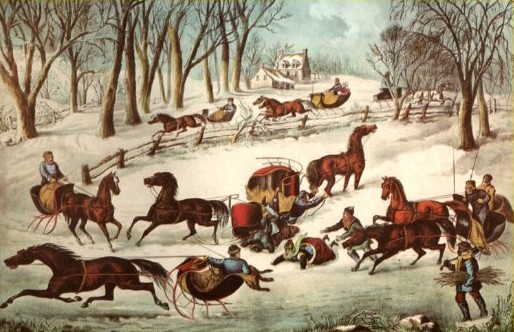
Yes, I know the winter solstice isn’t until next Saturday. However, since by then I’ll already be going full-bore ho-ho-ho, this week on “Sweetness and Light,” I figured I’d get a jump on Old Man Winter and do my best to conjure some seasonal atmosphere, in providing a pleasant background for putting together a holiday checklist and perhaps even filling out a few Christmas cards over a cup of tea. It will be all music evocative of wintry scenes and activities.
We’ll hear works by Philip Lane, Frederick Delius, Erich Wolfgang Korngold, and Leopold Mozart; also the original version of “Jingle Bells,” published in 1857 by James Pierpont as “The One-Horse Open Sleigh,” in a hilarious performance by the Robert DeCormier Singers. Be forewarned: sleighs will be “upsot!”
Put on the kettle and link arms with Classic Ross Amico. We’ll be walking in a winter wonderland on “Sweetness and Light,” this Saturday morning at 11:00 EST/8:00 PST, exclusively on KWAX, the radio station of the University of Oregon!
Stream it wherever you are at the link:
Tag Cloud
Aaron Copland (94) Beethoven (95) Composer (114) Film Music (150) Film Score (143) Film Scores (255) Halloween (100) John Williams (198) KWAX (233) Leonard Bernstein (105) Marlboro Music Festival (125) Movie Music (165) Mozart (91) Opera (215) Philadelphia Orchestra (90) Picture Perfect (174) Princeton Symphony Orchestra (110) Radio (90) Ross Amico (244) Roy's Tie-Dye Sci-Fi Corner (290) The Classical Network (101) The Lost Chord (269) Vaughan Williams (107) WPRB (397) WWFM (881)