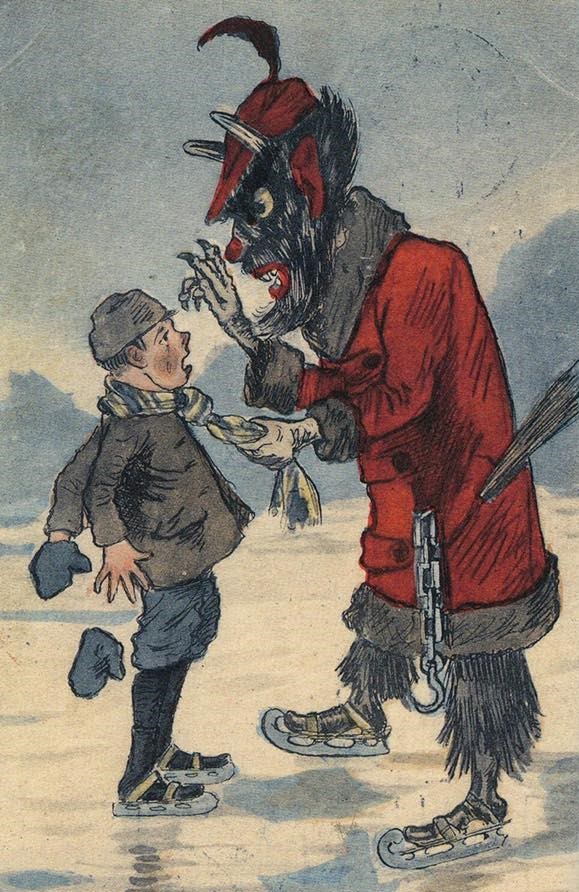
Only days after the arrival of Krampus, the Christmas devil, comes the birthday of Emil Waldteufel. Waldteufel is German for “forest devil.” He was born on this date in 1837.
Though Waldteufel had long been a mainstay of Paris society balls of the Second Empire, he was nearly 40 by the time he achieved international fame. It was the Prince of Wales – the future King Edward VII – who introduced him to London, and his music came to dominate Queen Victoria’s state balls at Buckingham Palace. One of his best-known works, “Les Patineurs” (“The Skaters’ Waltz”) was introduced there in 1882. Another of his most successful waltzes, from the other end of the decade, was “Roses de Noël” (“Christmas Roses”).
The holidays are in bloom! Take some time to smell the roses with Emil Waldteufel.
“The Skaters’ Waltz”
“Roses de Noël”
Because of the unusual nature of the conductor, in period costume and facial hair, to this I add the Rimsky-Korsakov Central Navy Band of Russia playing “Estudiantina”
I intended to post Day 6 when I got back from a concert in Philadelphia on Friday (for which I had to be there extra early), but then I got stuck there until extra late. Yesterday, Day 7, I already had a baseline of three posts – two to promote my radio shows, “Sweetness and Light” and “The Lost Chord,” and another to acknowledge Pearl Harbor Day – and then I simply got too busy and was unable to contribute a fourth.
In order to keep up, what I really needed was a good snowstorm. But as it is, this year, you’re only getting 6 Days of Sibelius.
How important is Jean Sibelius to Finland? December 8, the composer’s birthday, is a national holiday. The Finnish flag is flown everywhere and the date is celebrated as a Day of Finnish Music. I can’t think of a single artist here in the United States we revere on anywhere near the same level. But of course, for the Finns Sibelius is a source of national pride for multiple reasons, not least because of his importance to the cause of Finnish independence.
Yle Klassinen, now my classical music station of choice, is playing all Finnish music today. Keep in mind, they’re seven hours ahead of New Jersey, so at the time I’m posting this, it’s already late afternoon there. You can stream the audio online or, if you have a digital radio (like me), enjoy it in that fashion. If the playlist doesn’t come up in English for you, there should be a translate function, when you visit the website.
With Ralph Fiennes now in theaters as Odysseus in “The Return,” I’m girding myself for a cathartic dose of holiday bloodletting. To get myself in the mood, this week on “The Lost Chord,” I’ll have an hour of music inspired by Odysseus’ homeward journey.
We’ll hear Ernst Boehe’s symphonic poem “Departure and Shipwreck,” from his cycle “From Odysseus’ Voyages” (1903-05), and Benjamin Britten’s radio play “The Rescue of Penelope” (1943), narrated by Dame Janet Baker.
Odysseus, of course, is one of the heroes of the Trojan War, waylaid time and again on his homeward journey by Poseidon and the frailties of his own men. It takes him ten years to find his way back to Ithaca. When he gets there, he finds his wife beset by boorish suitors all vying for her hand and his throne.
What happens next pushes all the same buttons that are still pushed whenever the descendants of Arnold Schwarzenegger and Sylvester Stallone begin applying the camouflage, strapping on their bandoliers, and sheathing their big knives. In the process, there’s also some meaningful father-son bonding. Homer always did know how to lend class to the classics.
If you’re looking for angry gods, shipwrecks, cannibalism, gratuitous nudity, riotous drunkenness, blinded Cyclopes, and the vicarious slaughter of one’s rivals, I hope you’ll me for “Home Sweet Homer” on “The Lost Chord,” now in syndication on KWAX, the radio station of the University of Oregon!
Clip and save the start times for all three of my recorded shows:
PICTURE PERFECT, the movie music show – Friday at 8:00 PM EST/5:00 PM PST
SWEETNESS AND LIGHT, the light music program – ALL NEW! – Saturday at 11:00 AM EST/8:00 AM PST
THE LOST CHORD, unusual and neglected rep – Saturday at 7:00 PM EST/4:00 PM PST
On this date in 1941, a Japanese strike force of 353 aircraft laid waste to the United States naval base on Oahu, Hawaii. Thousands of American servicemen and civilians were killed, precipitating the country’s entry into World War II.
Although Europe, Russia, and the Far East were already at war, for the U.S. the attack on Pearl Harbor was an unanticipated catastrophe in peacetime. Days always start early in the service, but 7:48 on 12/7/41, a Sunday, will always be the wake-up call nobody wanted to get.
In past years, I’ve written about American-born composers with connections to those caught in the attacks or who memorialized those who perished in them. This year, I direct your attention to two European refugees who proudly embraced their adopted country in its time of need. Both were Jewish. Both got out of Nazi Germany early, in 1933.
Kurt Weill was denounced by the Nazis not only on racial grounds, but also for his leftist political leanings. After an interlude in Paris, he and his wife, Lotte Lenya, arrived in New York in 1935. There, he reinvented himself, embracing American popular song and stage music and finding success as a composer for Broadway. He became an American citizen in 1943.
Three of Weill’s Walt Whitman songs – “Beat! Beat! Drums!,” “Oh Captain! My Captain!,” and “A Dirge for Two Veterans” – were written in response to the Pearl Harbor attack. He composed a fourth, “Come Up from the Fields, Father,” in 1947. Weill went on to orchestrate the first three of them. Carlos Surinach orchestrated the last, following the composer’s untimely death, three years later, at the age of 50.
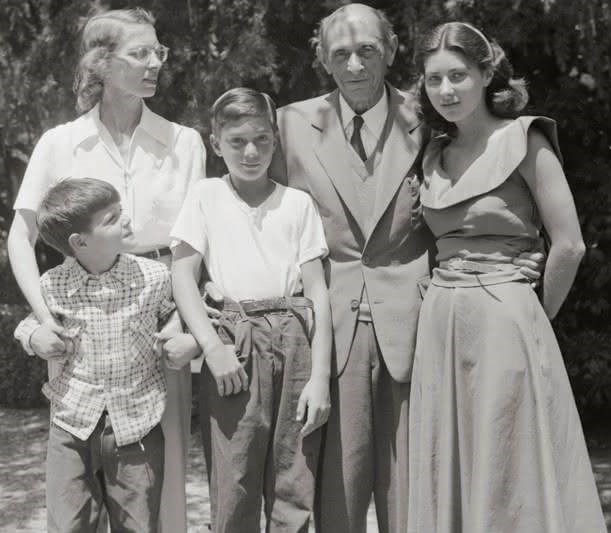
Arnold Schoenberg, who was actually Austrian, also left Germany in 1933. When the Nazis banned Jews from the universities, he lost his teaching position at the Prussian Academy of Arts. Furthermore, his music was branded “degenerate.” Schoenberg had actually converted to Lutheranism in 1898; but Nazi anti-Semitism caused him to swing back hard to Judaism, in defiance of Hitler. He became an American citizen in 1941.
In contrast to Weill, Schoenberg found the vulgarity and vacuity of much of American culture frustrating. Yet he was clearly grateful to have been “driven into paradise,” as he described it, where “my head can be erect.”
The attack on Pearl Harbor stirred him to reflect on his indebtedness to his adopted country. Leonard Stein, his assistant at the time, recollected a conversation they had had on December 7, following the bombing, which led him to believe that perhaps Schoenberg’s “Ode to Napoleon” was written in direct response to the event. More broadly, the composer’s setting of the poem by Lord Byron is a thrust in the face of tyranny that culminates in a commitment to the ideal of democracy as personified by George Washington.
Not popular entertainment, perhaps – sprechstimme would be a hard-sell for the masses – but clearly Schoenberg had his heart in the right place.
Weill, “Four Walt Whitman Songs” (orchestrated)
Schoenberg, “Ode to Napoleon”
PHOTOS: Schoenberg and family in the 1940s; Weill and Lenya at the piano
This week on “Sweetness and Light,” I invite you to a holiday tea party. That’s right, the music will all in some way be related to tea.
We’ll get the kettle roiling with Dmitri Shostakovich’s charming arrangement of “Tea for Two,” recollect the elegant Palm Court of the Plaza Hotel in days of yore with Samuel Barber’s “Souvenirs,” and experience sugar-induced hallucinations of dancing tea leaves in Richard Strauss’ high-calorie ballet “Schlagobers,” or “Whipped Cream.”
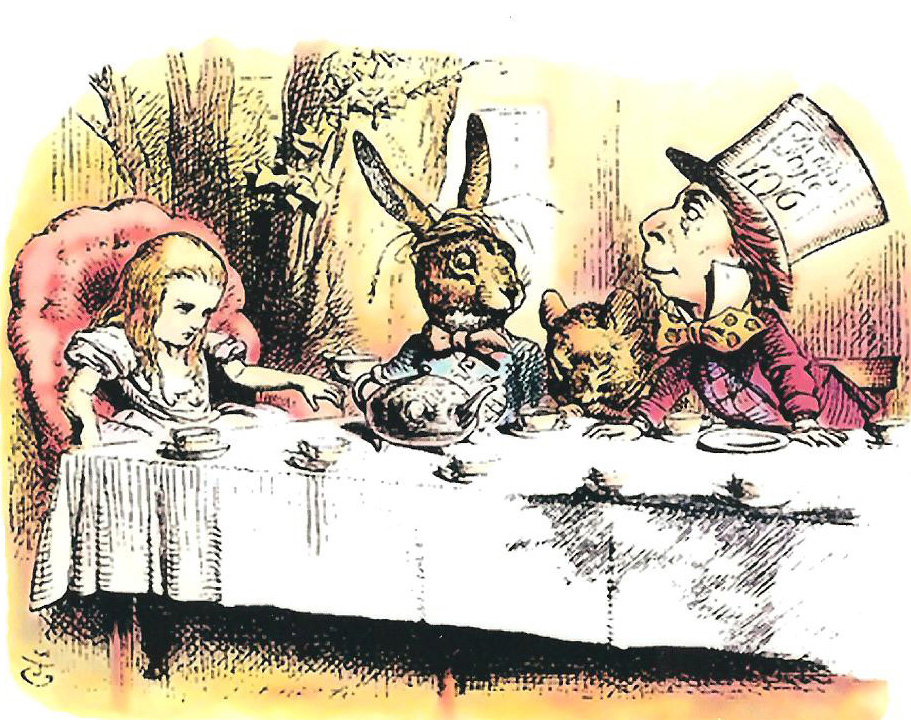
Lewis Carroll’s Hatter may have been mad, but even he would think twice before imperiling an “unbirthday” with a fidgety monkey. The maddening patter of the 1953 novelty song “The Little Red Monkey” relates a simmering simian’s reactions to violin, euphonium, and tea.
Your eyes will be pinwheeling and your brain will be humming from an overindulgence of caffeine and cake when you join me for “Sweetness and Light,” this Saturday morning at 11:00 EST/8:00 PST, exclusively on KWAX, the radio station of the University of Oregon!