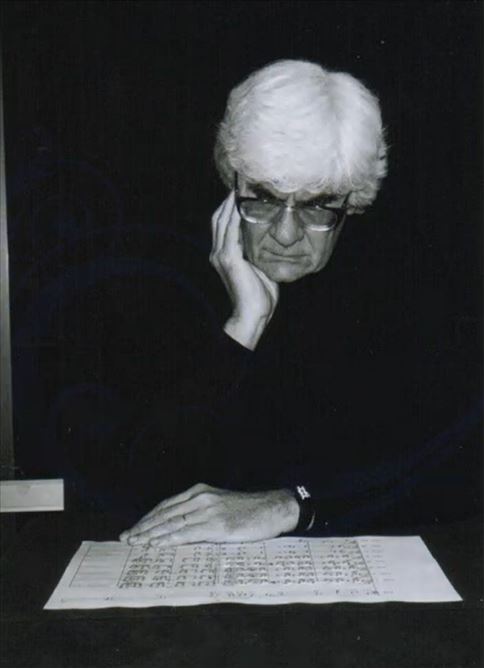
The Brazilian composer Marlos Nobre died yesterday at the age of 85. This Cello Concerto was given its world premiere in 2019. The soloist is Antonio Meneses, who died of a brain tumor in August, two months after sharing his diagnosis and announcing his retirement. It’s been a hard year for Brazilian music.
Meneses performs another work written for him, Nobre’s “Cantoria”
Without Meneses, Nobre’s Percussion Concerto
Nobre plays an improvisation on Antonio Carlos Jobim’s “Dindi”
As a classical music lover, I watch a lot of videos on YouTube. Frequently they’ll be in foreign languages, so I have to rely on closed captioning. Anyone with any experience with the program knows the system often comes up with some real howlers. The other week, I was watching something about Sibelius, and when someone referred to his incidental music for “Pelleas and Melisande,” closed captioning transliterated it as “Paleo Smelly Zone.” Sure, it sounds disgusting, perhaps even a little unsavory. But that’s what makes it funny. Here’s a link to a performance of the complete piece.
I used the “Entr’acte” from Sibelius’ incidental music as a signature tune for one of my radio shows, back in the day.
I’m pretty sure I ripped it off from WFLN, Philadelphia’s classical music station for nearly 50 years, which used it as fill, to “take it up to the top of the hour,” at the conclusion of one of its day parts. As I recall, some of the other works they used as signatures included the third movement of a Concerto for 7 trumpets by Johann Ernst Altenburg, the last movement of Haydn’s Symphony No. 6 “Le matin,” the Gavotte from Fauré’s “Masques et bergamasques,” one of the “Cypresses” for string quartet by Dvořák, and of course, Fauré’s “Pavane,” for the overnight program, “Sleepers Awake.”
That station taught me everything I know about the standard repertoire. And they did it by playing complete pieces of music, with local hosts pronouncing all the names correctly. It was a commercial outlet (with no ads between midnight and 6), not at all stuffy, but the standards were impeccable. How I miss that level of professionalism in American classical radio!
PHOTO: Sibelius enjoying a rare laugh, with cigar, perhaps to cover up the scent of the “Paleo Smelly Zone”
Sibelius is not exactly the first composer anyone would associate with ballet.
So I was astonished to learn, quite recently, that a couple of his (non-dance) scores were picked up by London’s Sadler’s Wells Theatre Ballet and choreographed in the late 1940s. Specifically, the suite “Belshazzar’s Feast” was used in “Khadra,” choreographed by Celia Franca, and the tone poem “En saga” was used in “Sea Change,” choreographed by John Cranko. Both were early in their careers. In Franca’s case, it was the first ballet she ever choreographed. She went on to found the National Ballet of Canada. Likewise, “Sea Change” was the first major project for Cranko, who would soon achieve world fame. Later, he would direct the Stuttgart Ballet. You can learn more – a lot more – about both ballets, with photos, here:
Sibelius did actually compose music for a ballet-pantomime, “Scaramouche,” in 1912-13. When he agreed to the project, on scenario by the Danish playwright Poul Knudsen, it was with the understanding that he would only be supplying a few dance numbers. When he learned that he was expected to compose a full hour of music, he despaired. Furthermore, he detected immediately that the libretto had basically been cribbed from Arthur Schnitzler’s “The Veil of Pierrette,” a recent success with music by Ernst von Dohnanyi. Attempts to annul or even alter the contract proved to be futile. Sibelius, a meticulous composer, feared that his international reputation was on the line. At one point, in frustration, he smashed a telephone.
In the end, he was able to complete the work to his satisfaction and the music was met with acclaim; the ballet-pantomime, not so much. It was revived in Copenhagen about ten years later and was savaged by the critics, who had not forgotten about Schnitzler. Sibelius’ music, however, was again praised. That said, the fact that the individual cues are tied so closely to the action have caused the score to be dragged into the depths of obscurity. It has, however, been recorded several times.
Of course, one of Sibelius’ best-known pieces, “Valse triste,” also happens to be a dance – a “sad waltz.” Originally one of six numbers that comprise the incidental music for a 1903 play, “Kuolema,” or “Death,” by the composer’s brother-in-law, Arvid Järnefelt, the work underscores the opening scene. A son attends his dying mother, who is swept up in a dream of the dance. At the end of the scene, she is claimed by Death in the form of her late husband. Its morbid origin aside, the work proved to be what is now known as an ear-worm and became an international hit. The composer encountered it everywhere, arranged for every conceivable instrument, played in cafes and by salon orchestras.
Unfortunately, Sibelius had essentially sold the work to his publisher outright, and he received few royalties. He would spend many fruitless hours, in between symphonies, crafting the occasional piece of light music, hoping to recapture lightning in a bottle. Alas, it proved to be a will o’ the wisp. Works like the “Suite mignonne” and “Suite champêtre,” while unquestionably charming, were not a patch on the maddening ubiquity of “Valse triste.”
“Valse triste” itself was to be choreographed a number of times, including, in tandem with “Scenes with Cranes” (also distilled from “Kuolema”), by Peter Martins for New York City Ballet.
Trip the light fantastic with Twinkletoes Sibelius!
“Valse triste”
“Suite mignonne” and “Suite champêtre”
“Belshazzar’s Feast”
“En saga”
EIGHT DAYS OF SIBELIUS – DAY 1
In the book “Sibelius: A Close-Up” (1937), Bengt de Törne, also a composer, recollects a conversation he had with the master:
“Then his voice changed in tone as he told me that he wanted to give me some good advice. ‘Never pay any attention to what critics say,’ he proceeded, and expatiated on this theme. When I ventured to put in the remark that their articles might sometimes be of great importance, he cut me short. ‘Remember,’ he said, ‘a statue has never been set up in honour of a critic!’”
This has often been simplified to the pithier “Pay no attention to the critics. No one has ever erected a statue to a critic.”
Sibelius, on the other hand, has had his share of statues and monuments erected to him.
BOTTOM, LEFT TO RIGHT:
Bust (1958), creator unknown, Cleveland Finnish Cultural Garden
If, like me, you’re of the opinion that Dvořák never wrote a bad note, or if you are a particular fan of the “New World” Symphony, you might be interested to tune in this week to hear the “Hiawatha Melodrama.”
Dvořák composed what is now commonly numbered his Symphony No. 9 (for decades it was known as the Symphony No. 5) in 1893, while he was director of the National Conservatory of Music in New York City. The work was influenced by Native American music and African American spirituals. The composer intimated that certain sections were inspired by his reading of “The Song of Hiawatha.” In fact, he intended the famous Largo as a sketch for a later opera or cantata on the theme, and the third movement scherzo was suggested by a dance at Hiawatha’s wedding feast.
Beginning in the early 1990s, cultural historian Joseph Horowitz and Dvořák scholar Michael Beckerman began experimenting with presentations involving portions of Longfellow’s text with music from Dvořák’s symphony. These developed into a 35-minute work, which achieved its final form in 2013. (In musical terms, a melodrama is the marriage of music with spoken word.) The arrangers also lifted passages from Native American-influenced music from Dvořák’s Sonatina, Op. 100 (the composer sketched the theme for the Larghetto on his starched cuff during a visit to Minnehaha Falls in Minnesota), and his “American Suite.”
We’ll hear the world premiere recording, on the Naxos label, featuring as the narrator bass-baritone Kevin Deas.
To round out the hour, I’ve programmed selections from “Hiawatha’s Wedding Feast,” one of three cantatas that comprise “Scenes from the Song of Hiawatha,” by the English composer of African descent Samuel Coleridge-Taylor. Coleridge-Taylor composed the work five years after Dvořák completed his “New World” Symphony.
“Hiawatha’s Wedding Feast,” became a cultural phenomenon. By the time it was taken up by Sir Malcolm Sargent, it was given annually, from 1928 to 1939, in a costumed, semi-ballet version, featuring close to a thousand performers. Unfortunately, this was among the works the composer had sold outright, his heirs thereby missing out on the royalties. By the time of Sargent’s advocacy, the short-lived Coleridge-Taylor had already been dead for 16 years.
The recording, released on the Argo label back in 1991, is one of the earliest of rising star Bryn Terfel.
I hope you’ll join me for “Indian Summer” – works inspired by Longfellow’s “The Song of Hiawatha” – on “The Lost Chord,” now in syndication on KWAX, the radio station of the University of Oregon!
PHOTO: “Hiawatha and Minnehaha” by Jacob Fjelde, Minnehaha Park, Minneapolis