Category: Daily Dispatch

  • Chopin’s Heart: A Postmortem Journey

    Chopin’s Heart: A Postmortem Journey

    “Swear to make them cut me open so I won’t be buried alive!”

    No, that was not Edgar Allan Poe, but rather the pianist and composer Frederic Chopin.

    Chopin died on this date in 1849.

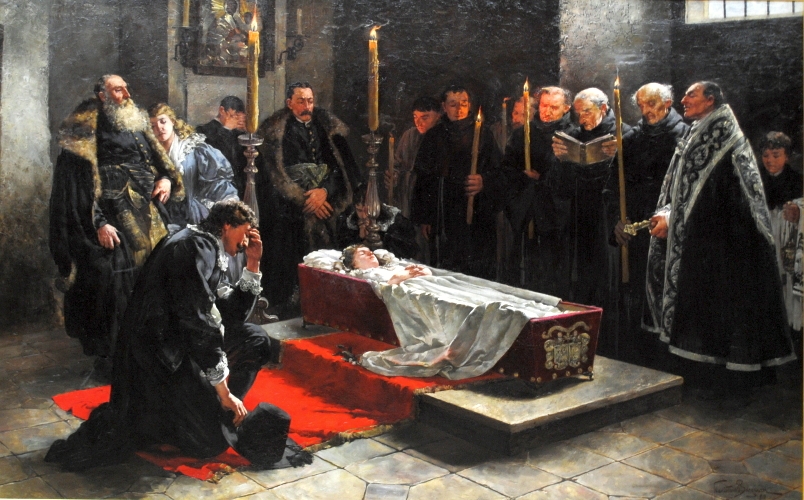
    His music may go straight to the heart, but did you know that when the composer died, his heart went right to Poland?

    Chopin had lived in exile in Paris since he arrived there in 1831 and became one of its most celebrated pianists; this in a city teeming with great pianists (including Chopin’s friend and rival, Franz Liszt).

    For most of his life, Chopin struggled against poor health. When he sensed his impending death in 1849, he made the request of his sister, Ludwika Jędrzejewicz, that his heart be removed from his corpse and transported back to the land of his birth.

    Ludwika complied, smuggling her brother’s heart under her cloak in a jar full of booze (probably cognac), and delivering it to Holy Cross Church in Warsaw. The heart is now immured there in a pillar. A decorative monument to the composer soon became a rallying point for Polish nationalists.

    During World War II, understanding the significance of Chopin as a source of national pride, the Nazis stole the heart (paging Indiana Jones!), but it was returned after the war and reinterred.

    At Chopin’s funeral in Paris, Mozart’s Requiem was played, as were Chopin’s own Preludes No. 4 in E minor and No. 6 in B minor. His body was buried in Père Lachaise Cemetery. At his graveside was heard the famous and now-hackneyed “Funeral March” from his Piano Sonata No. 2, in an orchestration by Napoléon-Henri Reber. The plinth on his grave is capped by a statue of Euterpe, muse of music, weeping over her broken lyre.

    Mozart’s Requiem has been performed annually at Holy Cross Church, per the composer’s request, as part of a solemn mass conducted every year on the anniversary of his death. The International Chopin Piano Competition also takes place during this time.

    While the ultimate cause of Chopin’s early demise (at 38) has been the subject of speculation – his death certificate reads tuberculosis, but modern medicine has posited, among other things, cystic fibrosis, cirrhosis, and alpha-1 antitrypsin deficiency – an examination of Chopin’s preserved heart in 2014 (through the unopened jar) suggests the likely cause of his passing was a rare case of pericarditis indeed caused by complications of chronic tuberculosis.

    To avoid risking a public outcry, the composer’s heart was exhumed by church officials, scientists, and medical experts under cloak of night. Their motive was no more sinister than ensuring that the container preserving the heart had not cracked. Happily, even though the patient appears to have died of tuberculosis, his heart remains in excellent health.


    Actually, despite the recurring fate of premature burial in a number of his fictions, Poe did not seem to have any extraordinary concerns about being buried alive himself. However, taphophobia is definitely a thing.

    https://www.smithsonianmag.com/sponsored/people-feared-being-buried-alive-so-much-they-invented-these-special-safety-coffins-180970627/

    Arturo Benedetti Michelangeli plays Chopin’s Funeral March

    Samson François plays the Piano Concerto No. 2

    Ballade No. 4

    Sviatoslav Richter fires off an Étude

    Alexander Brailowsky reduced to offal by Ophüls

  • Sibelius Line Extends Conductor Stasevska Welcomes Baby

    Sibelius Line Extends Conductor Stasevska Welcomes Baby

    The Sibelius family tree has a new shoot!

    Dalia Stasevska has given birth to a baby daughter.

    Stasevska, chief conductor of the Lahti Symphony Orchestra and principal guest conductor of the BBC Symphony Orchestra, is married to Lauri Porra, Sibelius’ great-grandson. Porra trained on the cello but found fame as the bassist for Finnish metal band Stratovarius.

    Get a load of this awesome electric guitar concerto.

    Stasevska conducted a satisfying performance of Sibelius’ 5th Symphony in Philadelphia last season. Here’s 90 seconds of her conducting Sibelius’ 3rd, the work over which the composer’s grandson and I bonded. Ask me about it sometime.

    The couple announced the pregnancy on August 22. The birth occurred on October 12. Congratulations to the happy parents!

  • Ormandy’s Stereo Legacy: New Philadelphia Orchestra Box

    Ormandy’s Stereo Legacy: New Philadelphia Orchestra Box

    Here it comes! Two years after my euphoric reception of Sony Classical’s mega-box of mono recordings by Eugene Ormandy and the Philadelphia Orchestra comes news of the first installment of presumably multiple boxes of the partnership’s legendary stereo recordings.

    Of course, now we’re getting into duplication territory, as a fair number of these have been reissued countless times and form the core of the Ormandy/Philadelphia legacy. HOWEVER, they will all be remastered, presumably (if following the blueprint of the earlier set) individually filed in sleeves reproducing the original album notes and cover art, and interleaved with a number of dimly-recollected curiosities from the LP era, some of them never revived in any form.

    Release date: November 17. I placed my pre-order earlier this week. You can shop around for the lowest price. I’m locked in at $170, and for 88 CDs and the luxury packaging, I consider it a steal.

    https://www.sonyclassical.com/releases/releases-details/eugene-ormandy-the-stereo-collection-1958-1963

    I’m projecting there will be four of these boxes in all: the mono set, this stereo release of recordings from 1958-1963, a second stereo set covering 1964-1968, and a stereo set embracing the later RCA years. Last year, there was an Ormandy/Minneapolis set of mono recordings predating his Philadelphia years. I already have a fair amount of that material, but it’s only 11 CDs, so maybe I should take a closer look to be sure it’s not something else I should invest in. But it’s really Philadelphia I want. Including maybe a Robin Hood Dell set!

    In case you missed it, here’s my enthusiastic reception of the “Eugene Ormandy: The Columbia Legacy” boxed set from May 2020.

    The actual press release on Sony Classical’s website is cut-and-pasted with no paragraph breaks and no indication of the actual disc-by-disc content. Here’s a better indication from a secondary source. Still, no mention of the soloists.

    https://www.importcds.com/eugene-ormandy-and-philadelphia-orch-columbia-coll/194399774328

    Okay, Sony, so maybe you’re not the best when it comes to promoting your reissues. Just keep producing sets of the quality of the original Ormandy box, and you can keep taking my money!

  • New Show Opener Space 1999 An American Werewolf

    Have you checked out our exciting new show-opener yet? Thanks to Jeffrey Morris and Frederick Haugen for the cool graphic design and Michael Nelson for the funky theme music, which lends the segment such a great retro vibe.

    Jeffrey was Roy’s guest last night for a discussion about “Space: 1999” nightmare-fuel episode “Dragon’s Domain” (1975). The conversation is archived here: https://www.facebook.com/roystiedyescificorner/videos/740540671404055

    Jeffrey is in the process of filming a documentary about the cultural impact of “Space: 1999”s iconic spacecraft, the Eagle. Learn more about it and his other film and television projects for @[100058107853311:2048:FutureDude Entertainment] at futuredude.com.

    Roy and I will reconvene tomorrow to sink our teeth into “An American Werewolf in London” (1981). Flash us a moon in the comments section, when we livestream on Facebook, YouTube, etc., this Sunday night at 7:00 EDT!

    https://www.facebook.com/roystiedyescificorner

  • Schwanda the Bagpiper Weinberger’s One Hit Opera

    Schwanda the Bagpiper Weinberger’s One Hit Opera

    Capitalizing on the widely-held belief that the proper domain of the bagpipe is Hell, Jaromir Weinberger crafted his most popular hit. In fact, “Schwanda the Bagpiper” (in Czech, “Švanda dudák”) was his only hit. In 1927, the opera became an international sensation. But beyond a couple of orchestral highlights (the Polka and Fugue), even that one hit isn’t all that well known.

    Learn more about this rollicking farce, involving a love triangle, a card game with the devil, and the beguiling power of the bagpipes. Jaromir Weinberger may have been a one-hit wonder, but there’s still plenty of bounce in this Czech. I hope you’ll join me for “Czech in the Balance” on “The Lost Chord,” now in syndication on KWAX, the radio station of the University of Oregon!


    Remember, KWAX is on the West Coast, so there’s a three-hour difference for the Trenton-Princeton area. Here are the respective air-times of my recorded shows (with East Coast conversions in parentheses):

    PICTURE PERFECT, the movie music show – Friday on KWAX at 5:00 PACIFIC TIME (8:00 PM EDT)

    THE LOST CHORD, unusual and neglected rep – Saturday on KWAX at 4:00 PACIFIC TIME (7:00 PM EDT)

    Stream them here!

    https://kwax.uoregon.edu/

Tag Cloud

Aaron Copland (93) Beethoven (95) Composer (114) Film Music (124) Film Score (143) Film Scores (255) Halloween (94) John Williams (188) KWAX (229) Leonard Bernstein (101) Marlboro Music Festival (125) Movie Music (139) Opera (202) Philadelphia Orchestra (89) Picture Perfect (174) Princeton Symphony Orchestra (106) Radio (87) Ralph Vaughan Williams (85) Ross Amico (244) Roy's Tie-Dye Sci-Fi Corner (290) The Classical Network (101) The Lost Chord (268) Vaughan Williams (103) WPRB (396) WWFM (881)

DON’T MISS A BEAT

Receive a weekly digest every Sunday at noon by signing up here


RECENT POSTS