Here’s a little piece of frivolity I was reminded of this morning when responding to a comment by Joel Wagoner about the Polish composer Mieczysław Karłowicz, some of whose music I featured yesterday on “The Lost Chord.”
Joel, a longtime listener to my radio programs on several stations over the better part of three decades, reminded me that I had introduced him to Karłowicz’s music. He also recalled that the composer’s death, in an avalanche, was memorialized in a symphonic poem (“Kościelec”) by Wojiech Kilar.
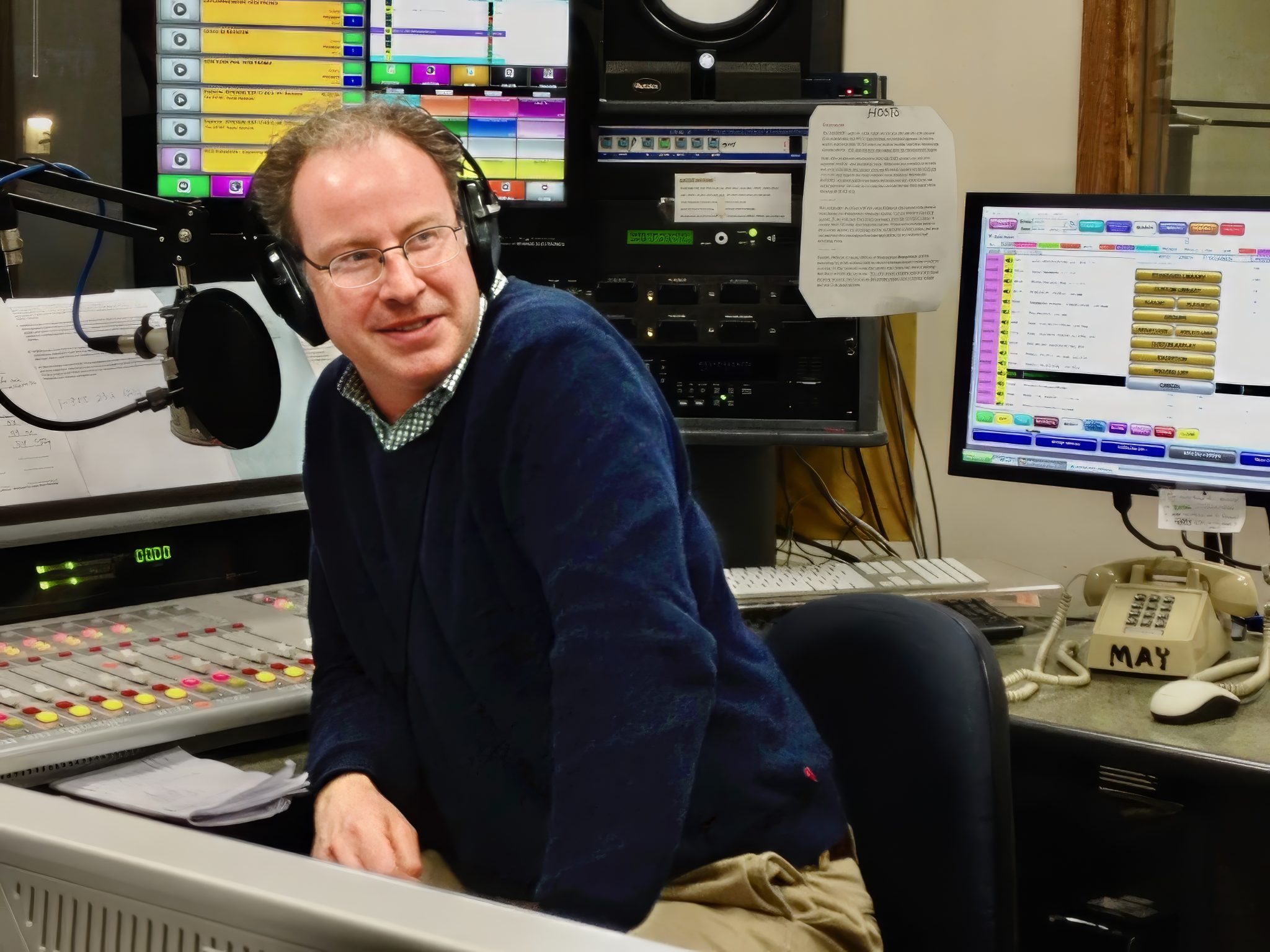
This brought to mind an incident that took place, on the air, before an open microphone, in defiance of this most somber of biographical details.
I was introducing some of Karłowicz’s music and talking about the composer’s gloomy disposition and pessimistic nature; then, for whatever reason, I got to the part about the avalanche and I started laughing. The poetic justice of the manner of his demise just struck me as hilarious. I tried to fight it, but you know how it is – it’s like laughing in church or at a funeral or during a serious moment in a play – the more inappropriate it seemed, the harder it was to suppress it.
When you’re at the control board, you’re always supposed to pot down for a cough or a sneeze or to clear your throat – at least, you do if you’re a professional – but what do you do when you can’t stop laughing? I suppose there are worse things. If anyone was offended, I never heard about it.
It’s not the only time this happened to me on the air. Another time, I remember, someone called me up to ask, “Ross, what’s so funny?” I don’t remember now, but I’m sure it was something else inappropriate that popped into my head, and I couldn’t tell her.
This doesn’t bode well for my impending years in the old age home, when, in my senility, all my inhibitions fall away, and everything out my mouth is raw id.
Category: Daily Dispatch
-
Inappropriate Laughter Before an Open Microphone
-

“Poland Spring” on “The Lost Chord”
Poland is in bloom! This Saturday on “The Lost Chord,” find refreshment in musical discoveries by four Polish composers.
We’ll hear a Fantasy for Cello and Piano by Alexandre Tansman. Tansman spent most of his career in Paris, with an interlude during the war years in the United States. Here, he met Arnold Schoenberg, wrote film scores, and developed an affection for American jazz. Still, his most enduring influences were those of his Polish and Jewish roots.
Hyper-romantic Mieczyslaw Karlowicz lived his life at such a heightened emotional pitch that he was perhaps fated to die young. His music certainly tends in that direction, occupied as most of it is with ecstasy and death. “A Sad Tale,” his last completed work, is a contemplation of suicide. Karlowicz himself was killed in an avalanche while hiking in the Tatras. He was 32 years-old.
On a lighter note, we’ll enjoy choral music by Andrzej Koszewski – his “Kaszuby Suite,” steeped in folk traditions of northwestern Poland – and a neoclassical woodwind quintet by Wojciech Kilar, who is probably best known in the West for his film scores, including those for “Bram Stoker’s ‘Dracula,’” “The Portrait of a Lady,” and “The Pianist.”
It’s a flowering of Polish music on “Poland Spring,” on “The Lost Chord,” now in syndication on KWAX Classical Oregon!
——-
Clip and save the start times for all three of my recorded shows:
PICTURE PERFECT, the movie music show – Friday at 8:00 PM EDT/5:00 PM PDT
SWEETNESS AND LIGHT, the light music program – Saturday at 11:00 AM EDT/8:00 AM PDT
THE LOST CHORD, unusual and neglected rep – Saturday at 7:00 PM EDT/4:00 PM PDT
Stream them, wherever you are, at the link!
https://kwax.uoregon.edu See less -

Hope Is the Thing with Feathers on “Sweetness and Light”
This week on “Sweetness and Light,” I’ve assembled a playlist of avian music for the month of May.
Yes, yes, I’ve programmed Ottorino Respighi’s “The Birds,” his evergreen suite for small orchestra based on musical bird portraits of the 17th and 18th centuries, and Handel’s Organ Concerto in F major, “The Cuckoo and the Nightingale.”
But I’ve also included a lesser-heard selection by Hubert Parry, from his incidental music for Aristophanes’ “The Birds,” a bridal march revived for the weddings of both Princess Elizabeth (soon to be Elizabeth II) and Prince William; a piece of light music kitsch juxtaposing bird song and chanting monks by Albert Ketèlbey; and a galop by Danish composer Hans Christian Lumbye, the Johann Strauss of the North, celebrating the exotic birds of the Tivoli Volière.
Finally, it’s very much my pleasure to have dusted off some vintage recordings of Elisabeth Schumann (whose hobby it was to engage in bird-whistling) and John McCormack, who will sing works by Carl Zeller and Eric Coates, respectively.
Better start lining the cage with newspaper. It’s “For the Birds” this week on “Sweetness and Light,” this Saturday morning at 11:00 EDT/8:00 PDT, exclusively on KWAX, the radio station of the University of Oregon!
Stream it wherever you are at the link:
https://kwax.uoregon.edu/ -
Erich Wolfgang Korngold on “Picture Perfect”
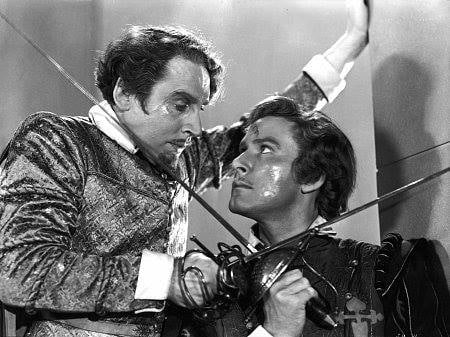
May 29 marks the birthday of one of my favorite composers: Erich Wolfgang Korngold (1897-1957). Thanks to a steady diet of Errol Flynn films, Korngold will forever be a part of the soundtrack to my life.
Korngold went from being one of Europe’s most astounding musical prodigies – his works admired by Mahler, Strauss and Puccini, and championed by Schnabel, Weingartner and Klemperer – to becoming one of Hollywood’s transformative film composers. He is a link from Old World opulence to New World fantasy, his music gracing a number of Warner Brothers’ classic historical adventures.
The best ones starred Flynn, and this week on “Picture Perfect,” we’ll hear music from “The Sea Hawk” (1940) and “The Adventures of Robin Hood” (1938), as well as the mostly forgotten “Another Dawn” (1937). Flynn stars alongside Kay Francis and Ian Hunter (who would go on to play Richard the Lionheart in “Robin Hood”) in this love triangle involving pilots in a British desert colony.
The film may be an obscurity to all save classic movie buffs, but Korngold thought enough of his music that he salvaged the main title as the opening theme of his Violin Concerto, premiered by Heifetz in 1947.
It was an invitation from theatrical impresario Max Reinhardt that brought Korngold to Hollywood in the first place, for a cinematic adaptation of “A Midsummer Night’s Dream” (1935). The film stars James Cagney, Dick Powell and Olivia de Havilland, in her big screen debut, with Mickey Rooney an irrepressible Puck.
For the project, Korngold adapted the famous incidental music of Felix Mendelssohn, interweaving material from Mendelssohn’s symphonies and orchestrating some of the “Songs without Words.” Even so, the music bears the composer’s unmistakable stamp, as you’ll hear in the opening number, lifted from the “Scottish Symphony,” but infused with plenty of Korngoldian swagger.
I hope you’ll join me, as the playlist is all-Korngold this week on “Picture Perfect,” music for the movies, now in syndication on KWAX Classical Oregon!
Happy birthday, EWK!
——-
Clip and save the start times for all three of my recorded shows:
PICTURE PERFECT, the movie music show – Friday at 8:00 PM EDT/5:00 PM PDT
SWEETNESS AND LIGHT, the light music program – Saturday at 11:00 AM EDT/8:00 AM PDT
THE LOST CHORD, unusual and neglected rep – Saturday at 7:00 PM EDT/4:00 PM PDT
Stream them, wherever you are, at the link!
https://kwax.uoregon.edu -
Caught in My Own Web: Tangled Up in Indignation Over Tim Greiving’s John Williams Bio
There’s a longer, 6400-word version of this review, which I don’t know if I’ll ever be able to completely wrangle into shape. I’ve been trying now for four days, and seriously, I would like to get on to something else. At times it is positively brutal, not so much because of my tone, which I tried my best to moderate, but because of my honest, detailed, factual reporting, with ample evidence of the sheer number of mistakes, the poor writing, and the shameful quality of the editing.
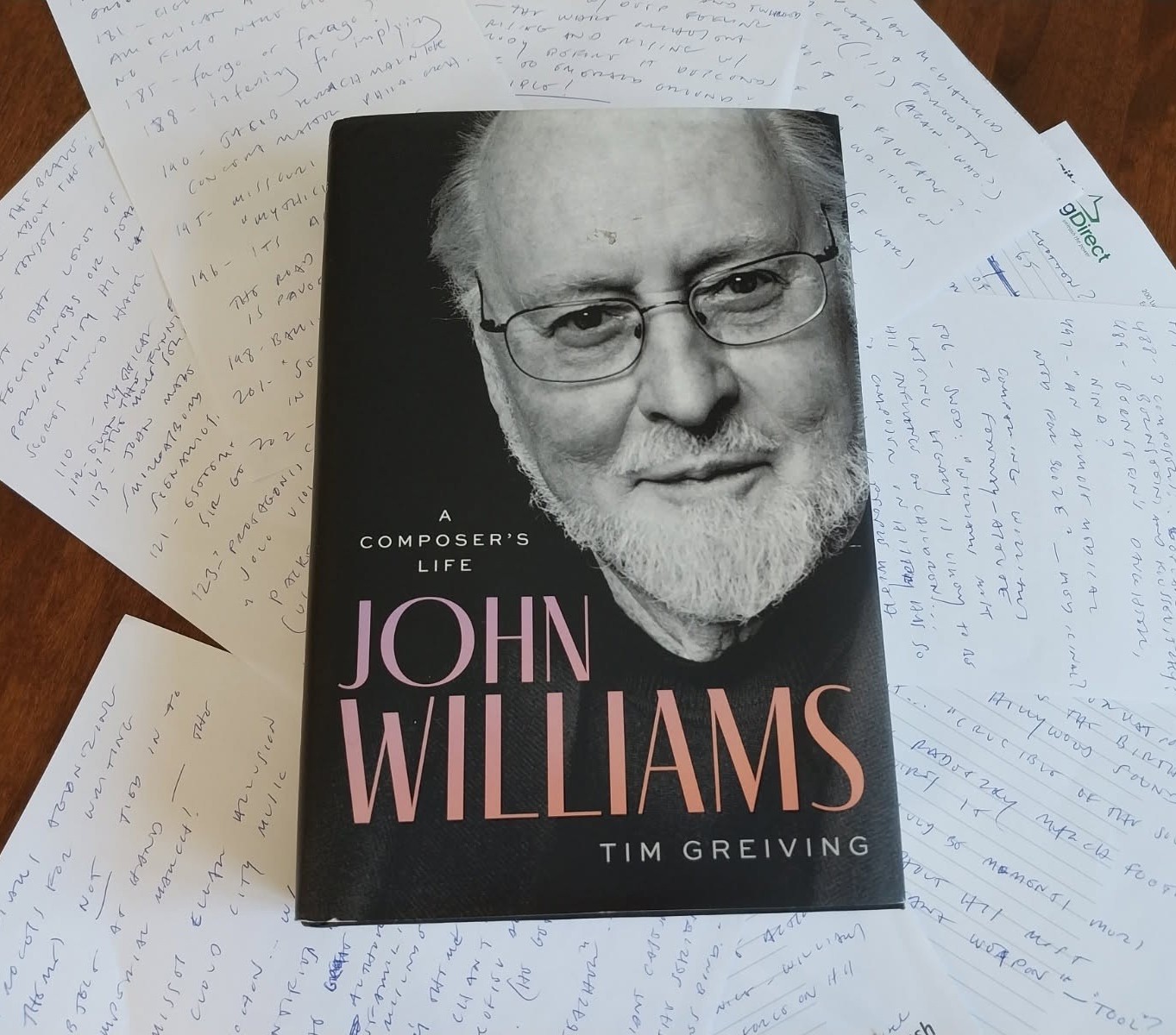
The source of my agony has been Tim Greiving’s epic biography of John Williams (“John Williams: A Composer’s Life”), released by Oxford University Press in September. I was overjoyed to receive it for Christmas. Little did I realize I’d unwrapped 630 pages of quicksand.
I compiled the bulk of my report over two days this month, separated by a couple of weeks. My mood evidently shifted, as the two halves do not flow together. Here, I do my best to restore the paragraphs I set down on Day 1, which are much kinder, if more broadly argued.
*****
The author is at his worst when he goes purple or wades into simile and metaphor. He’s simply too imprecise, random, and just plain sloppy. The book reads like a first draft, and I am shocked that Oxford University Press would allow anything like this to go to print. And yet it has turned up on holiday gift lists and year’s top recommendations from many reputable sources. Am I taking crazy pills? Or are people simply not equipped to recognize good prose anymore?
The internet has had the effect of tearing down the old guard of gatekeepers and leveled the playing field, but I’ve been around long enough – and I’m not THAT old – to remember when, if you were going to be published, you had to be able to write well enough that a reader isn’t made to stop every few sentences to think about what’s wrong with what he or she just read. When I read a published book, I expect polished prose, not a high school essay that keeps shifting tones and tenses, repeats itself, mixes metaphors, and commits any number of actual malaprops.
I do a lot of reading in bed. Since I knew I wanted to post my observations on this book, I kept a tablet and pen on my nightstand. Little did I expect that I would be having to put down the book and pick up the pen so often, frequently multiple times per page. Some nights, if I felt I just wanted to enjoy reading for a change, I had to stifle the impulse. But on those nights, I could feel the perspiration beading on my brow. By no means did I chronicle every error in the book, but even in my sporadic effort I managed to accumulate eight double-sided pages.
There are the bones of a good book here, and the author obviously loves his subject. There are times when he’s so confessional, as in the acknowledgments section at the end, that he actually moves me. But he needed a genuine editor, not to get the length down – I think the world deserves a 600-page John Williams biography – but rather to tame the prose, to whack the weeds and bring some order and to get everything looking professional and consistent, to lend it the feel of authoritativeness it deserves. Because for as shoddily-written as it is, it will remain an important resource for anyone who truly cares about the composer, beyond the casual fan’s ten favorite soundtracks.
I hasten to add, the book as an object is beyond reproach, very handsomely produced, with an attractive dustjacket, a glossy photo section, and quality paper that, under reasonable conditions, is not likely to yellow within a few years, unlike so many books these days. Perhaps the font could have been a little larger and the margins a little more generous, but these things didn’t really bother me once I got used to them. The alternatives probably would have added another hundred pages. Perhaps more? How many more pages would Oxford University Press allow, anyway?
I strongly suspect that Greiving, in common with many film music “scholars,” possesses a very limited knowledge of classical music (from which, as he himself astutely observes, the language of Hollywood film music evolved). I’d even go further to speculate that he doesn’t know all that much about music in general, at least in terms of how it is ordinarily written about and discussed, and not only in the academic literature. I am by no means a pointy-headed, jargon-bandying university type. I am speaking of the proper application of terms like “orchestrations,” for instance, which the author seems to use often as a synonym for “works” or “compositions.”
I don’t doubt he has an extensive knowledge of film music and composers, as I always have, but I’m afraid it may all come down to the enthusiastic absorption and retention of trivia, statistics, and history. I am not denigrating those things in themselves. I am merely pointing out that there is an awkwardness to some of the music writing that would not exist had the author more experience reading about orchestral music in periodicals or books that deal with the subject. This shortcoming does not wreck Greiving’s book, but it does unfortunately draw attention to itself. Repeatedly.
There are times when the author pulls himself together and the writing becomes less turgid or juvenile and he makes some very astute points. And at those moments, I say to myself, “Yes!” But my god, man, I wish that someone with some experience reading actual books had sat down and proofread this thing. Such a handsomely produced volume and such an ambitious undertaking, with a major artistic and pop cultural figure as its subject, should have been one of the year’s best books.
Astonishingly, it was included on many such lists – which makes me a little sad for the world, that our editing and publishing would be in the hands of such amateurs. There were many times in the course of my reading that I really, really hoped my own writing doesn’t come across like this to older readers of more experience, who lived through an era of higher standards.
*****
Anyway, this is not complete or polished, but it’s something, a fragment that touches on some of the issues I had with the book, so that I can get this off my desk and get back to posting again. What a logjam!
Maybe I’ll share the longer version, or fragments of it, next week. That’s the one with all the actual, painful examples, but it’s also full of specifics about Williams himself and what I found commendable about the book, alongside what I found so very frustrating. The last thing I want is for it to come across as a public flogging. One of the reasons I hesitate is that I’m afraid if I post it as it is, there’s going to be a lot of painful stripes.
Grieving deserves all respect for undertaking such a project, and clearly it was a labor of love. Frankly, the book should never have gone to print in the condition it’s in. And that’s all on Oxford University Press. A good editor could have worked miracles on it and ensured the book and its author looked their very best.
If there’s ever a second edition, Tim, I am here for you. Don’t hesitate to message me.
Tag Cloud
Aaron Copland (94) Beethoven (95) Composer (114) Film Music (149) Film Score (143) Film Scores (255) Halloween (98) John Williams (197) KWAX (232) Leonard Bernstein (105) Marlboro Music Festival (125) Movie Music (164) Mozart (91) Opera (215) Philadelphia Orchestra (90) Picture Perfect (174) Princeton Symphony Orchestra (110) Radio (90) Ross Amico (244) Roy's Tie-Dye Sci-Fi Corner (290) The Classical Network (101) The Lost Chord (269) Vaughan Williams (107) WPRB (397) WWFM (881)