Category: Daily Dispatch

  • Frankly Surprised:  An Actual, Straight-Down-the-Middle Composer Wins the Pulitzer

    Frankly Surprised: An Actual, Straight-Down-the-Middle Composer Wins the Pulitzer

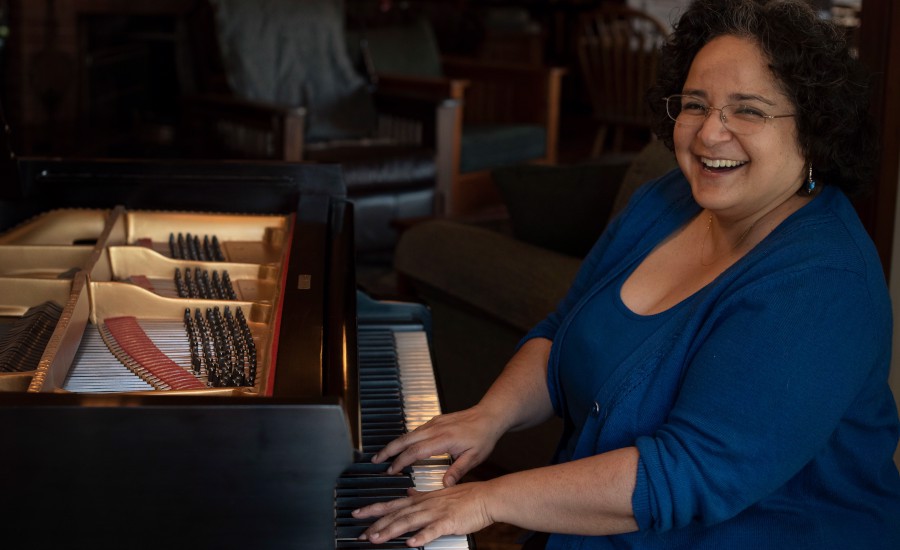
    Gabriela Lena Frank is the recipient of this year’s Pulitzer Prize for Music. The prize was announced yesterday, but certain slow-to-react social media outlets are still catching up with the news.

    Frank was recognized for “Picaflor: A Future Myth.” The work is tied to the composer’s personal experiences with the California wildfires and her knowledge Andean legend.

    The composition was introduced in Marian Anderson Hall at the Kimmel Center for the Performing Arts on March 13, 2025, by the Philadelphia Orchestra conducted by Marin Alsop. It was a co-commission of the orchestra, the Oregon Symphony, and Bravo! Vail Music Center.

    Cast in “ten powerful movements,” as characterized by the Pulitzer committee, “Picaflor” follows an original program, inspired by Andean-Peruvian mythology transplanted to a futuristic setting. “It draws upon the legends of a sky kingdom ruled by a sun god creator, a rebellious hummingbird… who tears through the sky, and the chaski – messengers of the Inca Empire. The piece is also immersed in the concept of pachacuti, the belief that era-worlds undergo cataclysmic transformations every few hundred years. These elements reflect the composer’s own climate activism in both art and life, and her pride as a generational daughter of Indigenous Perú.”

    The work is dedicated to the late Finnish composer Kaija Saariaho and is the culmination of a residency with the Philadelphia Orchestra.

    Frank, whose works have been frequently programmed, was born in Berkeley, CA, to a mother of mixed Peruvian/Chinese ancestry and a father of Lithuanian/Jewish descent. Following in the footsteps of musical heroes Béla Bartók and Alberto Ginastera, she serves as a kind of musical anthropologist. According to her bio, she’s “traveled extensively through South America, and her pieces often reflect and refract her studies of Latin American folklore, incorporating poetry, mythology, and native musical styles into a Western classical framework that is uniquely her own.”

    I haven’t heard this particular piece yet, but her music is colorful and full of incident.

    It’s nice to have a Pulitzer winner that can be performed by an actual symphony orchestra again.

    ———

    Frank previews “Picaflor” in 90 seconds:


    “Escaramuza” (2010)


    “Leyendas: An Andean Walkabout” (2001)


    “Elegía Andina” (2000)


    “Three Latin American Dances” (2004)


    Through a strange quirk of fate, because of my illness this weekend, I was unable to attend “Eugene Onegin” at the Met. So I traded my ticket for a seat at the Met debut of Frank’s recent opera, “El último sueño de Frida y Diego,” a magical-realist, upside-down Orpheus and Euridice story about painters Frida Kahlo and Diego Rivera.

    https://www.metopera.org/season/2025-26-season/el-ultimo-sueno-de-frida-y-diego

    There’s my Cinco de Mayo connection!

    You don’t have to go to New York to see it. It will be simulcast in select cinemas as part of the “Met Live in HD” series on May 30. Find a theater near you at the link (below the photo, there’s a red tab on the right).

    https://www.metopera.org/season/in-cinemas/2025-26-season/el-ultimo-sueno-de-frida-y-diego/

    A 16-second teaser


    Congratulations, Gabriela Lena Frank!
  • Grieving in Advance of Greiving “John Williams” Book Review

    Grieving in Advance of Greiving “John Williams” Book Review

    May the Fourth Be with You!

    The original “Star Wars” opened on May 25, 1977. But if you think fandom would allow historical accuracy to get in the way of a good pun, you must be a stuck-up, half-witted, scruffy-looking nerf-herder.

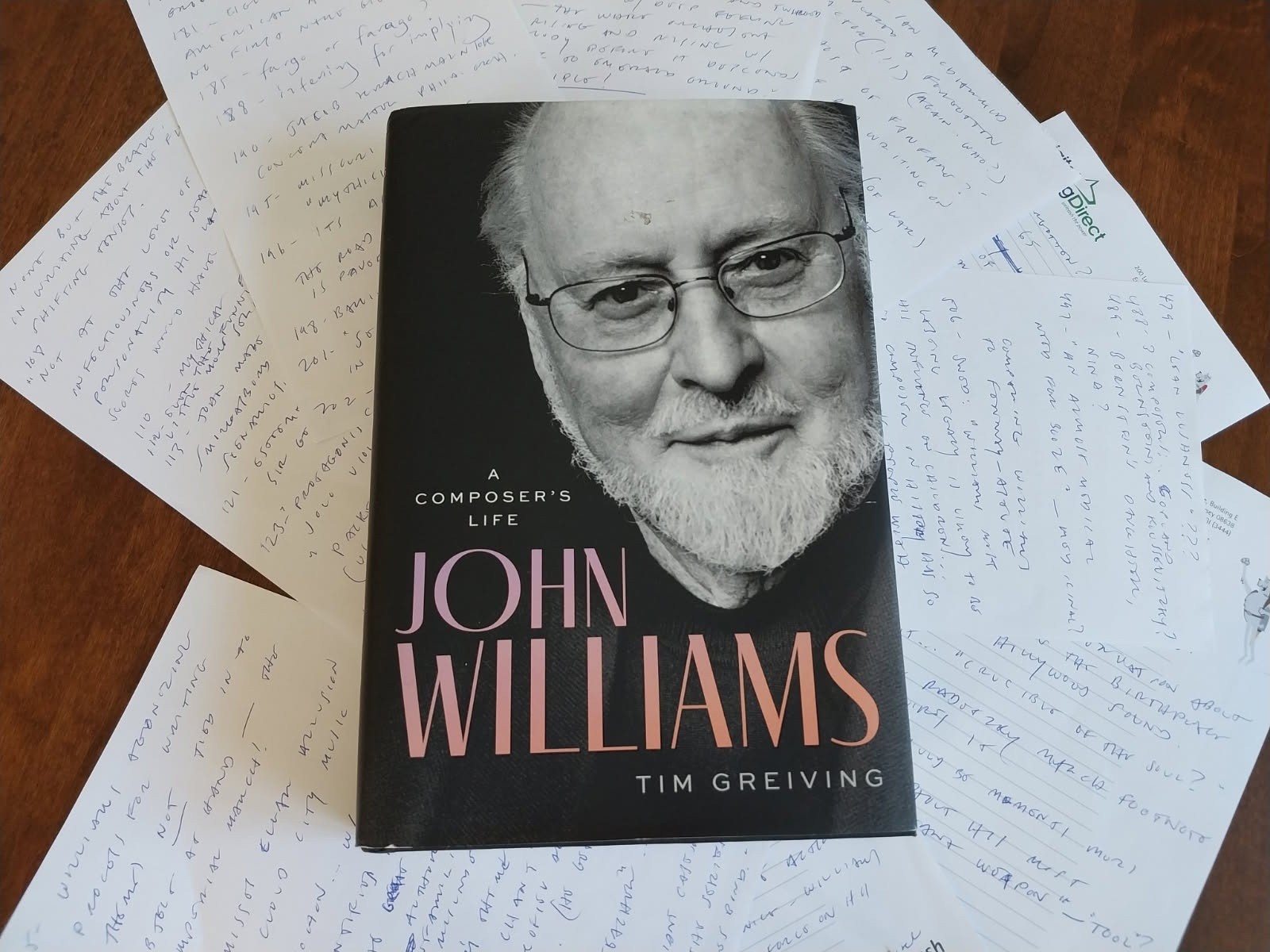
    For this “Star Wars Day,” I had planned to share my observations concerning the recent John Williams biography by Tim Greiving (published by Oxford University Press in September, but I received my copy for Christmas) – which, providentially, I just happened to finish reading (it is, after all, 600 pages).

    Alas, I’m still emerging from the fog of an illness that had me shivering through the weekend, so I’ll be holding off until ORTHODOX STAR WARS DAY, May 25th, the day fans should be celebrating anyway.

    There’s a lot to hash over (as you can see from my double-sided notes in the photo), and not all of it is positive. For one thing, I’d be surprised if Oxford University Press even proofread the thing. But some of it is: for as much as I know about John Williams, I still learned a lot.

    I’ll try my best to be kind, because it is quite an achievement, and if the guy loves John Williams, he’s a friend, but I’d be soft-peddling if I didn’t say the book is also teeth-gnashingly frustrating to read. It astonishes me that it doesn’t seem to have been the experience of a lot of other reviewers.

    You have been forewarned… now anticipate!

    In the meantime, try not to drink too much Bantha milk, fanboys.

  • Impetuous Youth on “The Lost Chord”

    Impetuous Youth on “The Lost Chord”

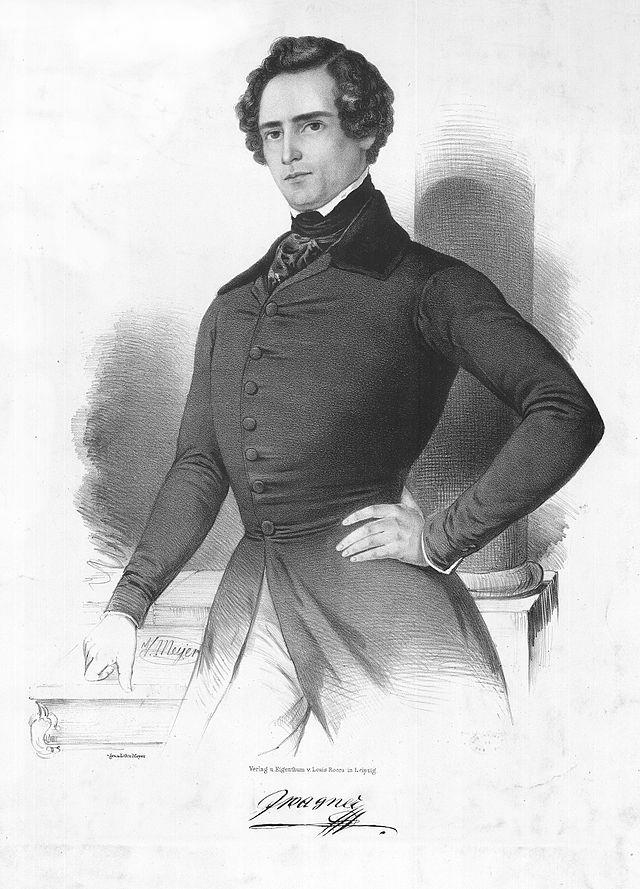
    Wagner wrote symphonies? That’s right. He took a crack at writing two of them, in a Beethovenian style, before finding his niche as a revolutionary opera composer.

    This week on “The Lost Chord,” we’ll hear Wagner’s Symphony in E, alongside early attempts by Gustav Holst and Claude Debussy. Judging from their mature works, these three would be among the least likely to attempt sonata form.

    Impetuous youth! I hope you’ll join me for “Bold Heads on Young Shoulders” – audacious composers at the start of their careers strive for symphonic mastery – on “The Lost Chord,” now in syndication on KWAX Classical Oregon!

    ——–

    Clip and save the start times for all three of my recorded shows:

    PICTURE PERFECT, the movie music show – Friday at 8:00 PM EDT/5:00 PM PDT

    SWEETNESS AND LIGHT, the light music program – Saturday at 11:00 AM EDT/8:00 AM PDT

    THE LOST CHORD, unusual and neglected rep – Saturday at 7:00 PM EDT/4:00 PM PDT

    Stream them, wherever you are, at the link!

    https://kwax.uoregon.edu

  • Jockeys and Juleps on “Sweetness and Light”

    Jockeys and Juleps on “Sweetness and Light”


    With the Kentucky Derby drawing near, it’s all about horses and horseraces on “Sweetness and Light.”

    We’ll hear William Bolcom’s ballet “Seattle Slew;” a concert piece arranged from one of John Williams’ breakout film scores, for Mark Rydell’s “The Reivers,” adapted from William Faulkner’s coming-of-age novel about a boy swept up in automobile theft and illicit horseracing; and of course Stephen Foster’s “Old Kentucky Home.”

    In addition, there will be Derby and thoroughbred-related works by Robert Farnon, Louis Moreau Gottschalk, William Schuman, and Leroy Anderson.

    Meet me at the starting gate. It will be an hour of jockeys and juleps on “Sweetness and Light,” this Saturday morning at 11:00 EDT/8:00 PDT, exclusively on KWAX Classical Oregon!

    Stream it, wherever you are, at the link:

    https://kwax.uoregon.edu/

    ——–

    I had this Sports Illustrated in 1977. I wonder if I have it still? I don’t know why, but I was crazy about Seattle Slew. But then, everyone was. The kind of media attention focused on the race back then would be baffling to anyone who grew up in the internet age. I was 10 years old in May 1977. I named my hermit crab Seattle Slew.

  • Fantasy Quests on “Picture Perfect”

    Fantasy Quests on “Picture Perfect”

    This week on “Picture Perfect,” we’re on a quest for fantasy.

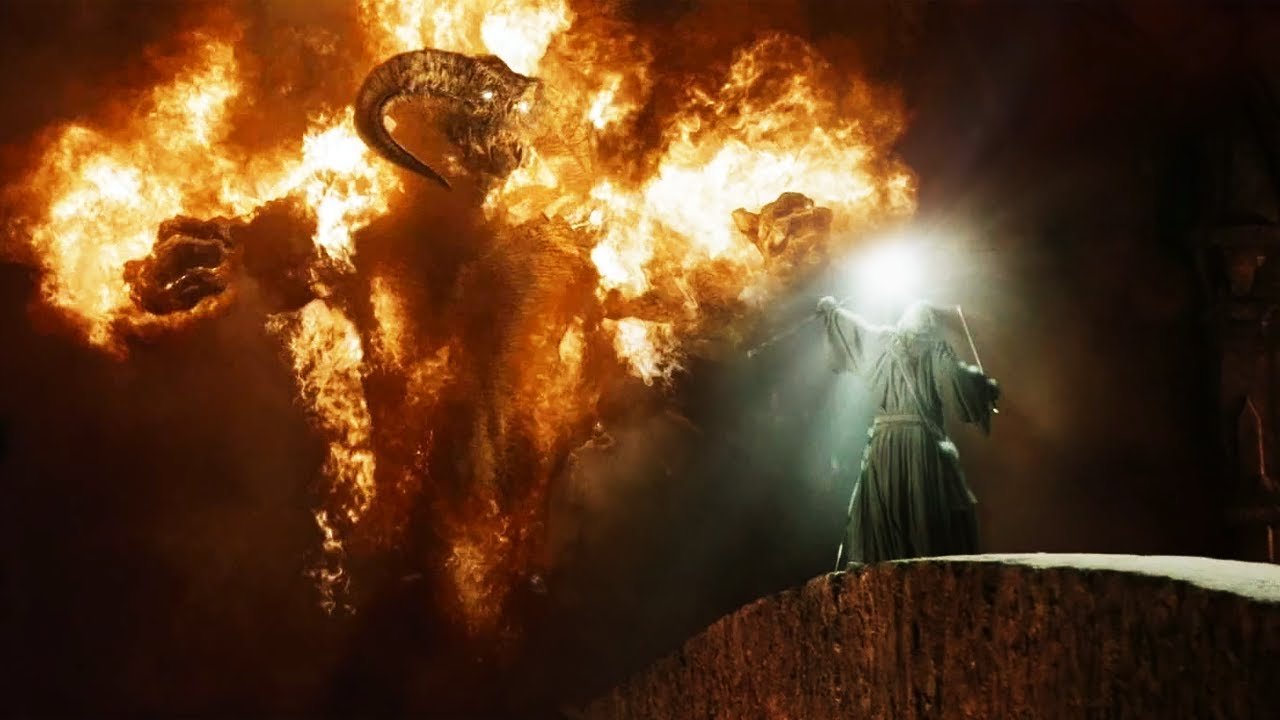
    For decades, “The Lord of the Rings” had been a kind of Holy Grail for genre fans, and anticipation ran high in regard to when exactly there would be a decent live action adaptation of J.R.R. Tolkien’s magnum opus. Alas, either filmmakers couldn’t acquire the rights, or they were hampered by technological limitations. Though the realization of Tolkien’s richly-imagined world of hobbits, orcs, and balrogs eluded many, fantasy films of a derivative nature were thick on the ground. Some were good, some not so good. But many of them had outstanding scores.

    “The Dark Crystal” (1982), though produced by Jim Henson and company, was a long way from Big Bird and Ernie & Burt, with some pretty dark scenes. The score by Trevor Jones is first rate, given the full romantic treatment and recorded by the London Symphony Orchestra, augmented by Fairlight and Synclavier synthesizers, as well as the occasional period instrument.

    “Willow” (1988) allegedly grew out of George Lucas’ desire to film “The Hobbit.” Rather than fork over a sizeable portion of his earnings to the Tolkien estate, he opted instead to take the “Star Wars” approach of synthesizing archetypal images, from the Old Testament through Ray Harryhausen films, to create his own original story. Except the influences weren’t so cleverly assimilated this time. Composer James Horner followed suit, with a score rich in allusions to Schumann, Wagner, Grieg, Tchaikovsky, Rachmaninoff, and especially Prokofiev.

    The first feature-length adaptation of “The Lord of the Rings” (1978) was literally rendered in animation. The film manages to cover only the first book-and-a-half of the trilogy, and the last half hour or so is probably incomprehensible to anyone who hasn’t read it. It had been director Ralph Bakshi’s plan to divide the trilogy into two parts – already a concession to the studio – but the first film’s modest performance meant there was no funding for a second.

    Two-time Academy Award winner Leonard Rosenman was engaged to write the score. Rosenman composed the music for the James Dean classics “East of Eden” and “Rebel Without a Cause.” Bakshi had originally wanted to use Led Zepplin songs. He later expressed his dislike for Rosenman’s score, which he found to be too conventional – somewhat ironic in that Rosenman, a pupil of Arnold Schoenberg, Roger Sessions, and Luigi Dallapiccola, was known for writing some of the most challenging scores in film history, including the uncompromising music for “Fantastic Voyage.”

    It would be over two decades before another feature film based upon Tolkien’s source material was mounted. Peter Jackson’s “The Fellowship of the Ring” (2001) is brimful of state-of-the-art special effects, so much so that a great many important details from Tolkien’s novel are lost in the shuffle. Still, Jackson’s trilogy went on to garner 30 Academy Award nominations, of which it won 17. Howard Shore’s music was recognized with Oscars for the first and third installments. The third, “The Return of the King,” inexplicably went on to become one of the most decorated films of all time.

    Prophecies must be fulfilled, order restored, and the land made whole! We’re on a quest for fantasy music, on “Picture Perfect,” music for the movies, now in syndication on KWAX Classical Oregon!

    ——–

    Clip and save the start times for all three of my recorded shows:

    PICTURE PERFECT, the movie music show – Friday at 8:00 PM EDT/5:00 PM PDT

    SWEETNESS AND LIGHT, the light music program – Saturday at 11:00 AM EDT/8:00 AM PDT

    THE LOST CHORD, unusual and neglected rep – Saturday at 7:00 PM EDT/4:00 PM PDT

    Stream them, wherever you are, at the link!

    https://kwax.uoregon.edu

Tag Cloud

Aaron Copland (94) Beethoven (95) Composer (114) Film Music (149) Film Score (143) Film Scores (255) Halloween (98) John Williams (197) KWAX (232) Leonard Bernstein (105) Marlboro Music Festival (125) Movie Music (164) Mozart (91) Opera (215) Philadelphia Orchestra (90) Picture Perfect (174) Princeton Symphony Orchestra (110) Radio (90) Ross Amico (244) Roy's Tie-Dye Sci-Fi Corner (290) The Classical Network (101) The Lost Chord (269) Vaughan Williams (107) WPRB (397) WWFM (881)

DON’T MISS A BEAT

Receive a weekly digest every Sunday at noon by signing up here


RECENT POSTS