If I had any extra sense, I could rely on ESP. As it stands, it’s probably safer to post: this week, on Roy’s Tie Dye Sci-Fi Corner, we’ll vent our fury, by discussing… well, “The Fury” (1978). Brian De Palma’s Hitchcock-infused telekinesis thriller was a stranger thing, well before “Stranger Things.”
Lantern-jawed Kirk Douglas gets up to all sorts of derring-do on his quest to rescue his kidnapped son, before he can be transformed into a killing machine by a nefarious ex-colleague. But Amy Irving, in a parallel story, has the final say, as blue-eyed Gillian, who can make you shudder. Composer John Williams out-Bernard Herrmanns Bernard Herrmann, with a score that, Pauline Kael opined, “may be as apt and delicately varied… as any horror movie has ever had.”
You’ll have more fun than a room full of John Cassavetes, when you join us for our discussion of “The Fury,” on the next Roy’s Tie-Dye Sci-Fi Corner. Live-scream in the comments section, as we live-stream on Facebook, this Friday evening at 7:00 EST!
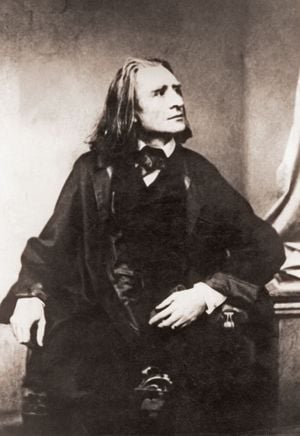
When Franz Liszt died in 1883, his housekeeper allowed his students to go through his belongings and carry off manuscripts to keep as mementos. Just over a hundred years later, in 1989, parts of a previously unknown piano concerto were retrieved from Weimar, Nuremberg, and Leningrad. These were reunited by University of Chicago doctoral candidate Jay Rosenblatt.
Scholars had simply assumed that the fragments were from an early draft of the much-beloved Piano Concerto No. 1. In reality, it is a “Third Piano Concerto” now believed to predate the accepted two. The work has not entered the standard repertoire, but it remains an interesting curiosity.
One of the few pianists to take up the piece has been Rosenblatt’s teacher, Jerome Lowenthal, born in Philadelphia on this date in 1932. Here is Lowenthal’s recording of the work:
Interestingly, it took the better part of a century for the truth about another lesser-known Liszt concerto to emerge.
Sophie Menter had studied with Liszt in Weimar, beginning in 1869. So gifted a musician was she that Liszt described her as “the greatest pianist of her day.” He praised her “singing hand” and called her his “only legitimate daughter as a pianist.” She was by her teacher’s side when he died in Bayreuth in 1886.
At the time, she held a professorship at the St. Petersburg Conservatory There, she became friendly with Peter Ilych Tchaikovsky. She asked Tchaikovsky to orchestrate a piano concerto she claimed that she herself had written, to showcase her talents as a performer. Tchaikovsky agreed, and also dedicated his own “Concert Fantasy for Piano and Orchestra” to her.
What he didn’t realize is that the concerto – according to Menter’s friend, fellow Liszt pupil Vera Timanoff, to whom Menter allegedly confided – was actually composed by Liszt. Had Tchaikovsky known, he might very well have torn up the manuscript. He loathed Liszt, and was especially disgusted by Liszt’s transcription of the Polonaise from “Eugene Onegin.” As it was, Tchaikovsky conducted the work’s first performance in Odessa in 1893.
Here is the “Concerto in the Hungarian Style” – formerly known as the “Sophie Menter Concerto” – performed by Janina Fialkowska, the same pianist who gave the first public performance of Liszt’s “Third Piano Concerto” in 1990:
As an addendum, György Cziffra plays the Liszt transcription that Tchaikovsky so despised.
In classical music, sometimes it’s not so much who you know, as who you don’t know that matters!
Clockwise from left: Franz Liszt, Sophie Menter, Janina Fialkowska, and birthday boy Jerome Lowenthal
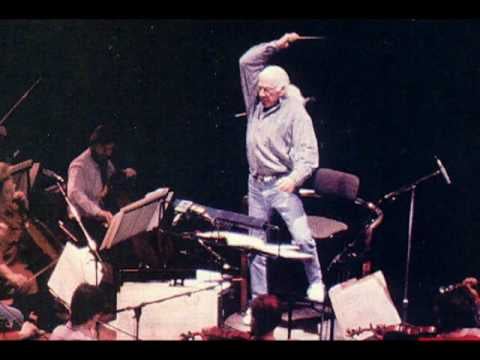
He may have been the older composer (by three years), but if we’re to go by dates on a wall calendar, Jerry Goldsmith was born two days after John Williams. And despite being one of the greatest film composers of his age, he never could wholly escape Williams’ shadow.
Blame it on the blockbusters.
By the late ‘70s, once the studios got their heads around the unprecedented box office of “Jaws” and “Star Wars,” Goldsmith started to get tossed either projects Williams passed on, or cheap knockoffs of Williams’ successes.
Williams got “Star Wars;” Goldsmith got “Star Trek: The Motion Picture.” Williams got “Superman;” Goldsmith (first choice, but he had to turn it down) got “Supergirl.” Williams got “Raiders of the Lost Ark;” Goldsmith got “King Solomon’s Mines” (the Richard Chamberlain version). Williams got “E.T. The Extra-Terrestrial;” Goldsmith got “Baby: The Secret of the Lost Legend.”
Don’t get me wrong: Goldsmith was an amazing composer, and his talents were matched to plenty of enduring classics: “The Sand Pebbles” (1966), “The Blue Max” (1966), “The Flim-Flam Man” (1967), “Planet of the Apes” (1968), “Patton” (1970), “Papillon” (1973), “Chinatown” (1974), “The Wind and the Lion” (1975), “MacArthur” (1977), “The Boys from Brazil” (1978), “The Great Train Robbery” (1979), “Alien” (1979, butchered in the sound editing), and numerous incarnations of “Star Trek” (beginning in 1979).
He could also write like the wind. He had just ten days to compose and record a replacement score for “Chinatown” (after Phillip Lambro’s original was rejected). The result is one of the most effective scores of the 1970s.
Sadly, the movies got weaker. In 1997, he stepped in for Randy Newman on “Air Force One.” Does anyone even care?
By his final decade, he was stuck writing music for garbage like “The Mummy” (1999), “The Haunting” (1999), and “Looney Tunes: Back in Action” (2003). A notable exception was “L.A. Confidential” (1997), but rarely were his later projects up to his talent.
Goldsmith himself expressed frustration at his music being drowned out by ever more-elaborate sound effects, which is why his scores became more streamlined – and less memorable – in the ‘90s. He would have lost his mind in these days of laptop editing, when films can be trimmed and shuffled within an inch of their lives, right up until the day of distribution.
But he was one of the last of the greats, and he lived through a great era, so we certainly have enough to cherish.
For television, he wrote music for “Dr. Kildare,” “The Twilight Zone,” “Gunsmoke,” “The Man from U.N.C.L.E.,” “The Waltons,” and “Barnaby Jones.” He was the recipient of five Emmy Awards.
Incredibly, despite EIGHTEEN nominations, he was honored with but a single Oscar, for his influential score to “The Omen” (1976). Goldsmith died in 2004, at the age of 75. If he were to come back today, he would mop the joint with all the Hans Zimmers of the world.
Happy birthday, Jerry Goldsmith. I sure does miss you.
Had your fill of snow? Make an appointment today to sweat it out in the fin de siècle hothouse of Alban Berg.
Berg has always been regarded as the Romantic among serialists – one critic described him as “the Puccini of twelve-tone music” – so it’s hardly surprising to find a shimmering, unresolved longing in much of his music, linking him to the more traditional-minded among his Viennese contemporaries.
Berg’s operas, “Wozzeck” and “Lulu,” are in the standard repertoire. His “Lyric Suite” and Chamber Concerto are played with frequency. But it is his Violin Concerto of 1935 that has really entered people’s hearts.
In this work – a response to the death of Manon Gropius, the 18-year-old daughter of Alma Mahler and Walter Gropius – Berg processes loss and grief with the kind of humanity that seems have eluded Arnold Schoenberg, his teacher, in his own dogmatic dodecaphony. Furthermore, Berg’s masterpiece offers identifiable signposts for the uninitiated, with allusions to a chorale melody employed by Johann Sebastian Bach and a Carinthian folk song.
The concerto is a fine example of a talented artist bending the rules of a particular system to achieve his own expressive ends. Berg dedicated the piece “To the memory of an angel.” Work on the concerto proved to be a cathartic experience for the composer. He confessed in a letter to violinist Louis Krasner, who commissioned the piece, that it had actually brought him joy.
Berg himself died of a blood poisoning, the result of an insect sting, later that year. He was 50 years-old. His output may be comparatively small, but he continues to stand tall as one of the most important musical voices of the early 20th century. He is certainly the most readily approachable of composers of the Second Viennese School.
Happy birthday, Alban Berg.
Lulu Suite
Violin Concerto
Seven Early Songs
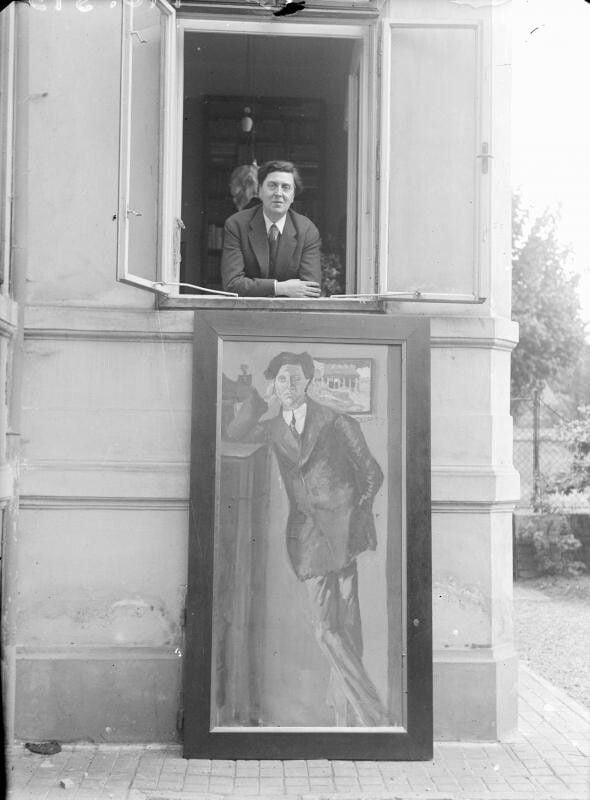
PHOTO: Alban Berg, captured on canvas, if not in spirit, by Arnold Schoenberg
Where are all the inspirational movies? Now, more than at any time in recent memory, there should be a wave of optimistic films to lift us up, out of all the dread, gloom, and rancor.
Over the course of his unparalleled career, John Williams almost always managed to convey the exhilaration of being alive, even in the darkest thrillers. Everyone remembers his theme for the great white, but it’s the swashbuckling third act that made “Jaws” a monstrous hit.
Not that everything has to be a march, necessarily, but how about a few interludes of light and beauty? Must these be totally absent from the movies these days? Is the best in life really reflected in the hip, the dark, the badass, and the ironic? Must the pace always be relentless?
The 1970s was far from the most hopeful decade. In the wake of Vietnam, Watergate, and all the political and social unrest of the 1960s, who could have predicted that a young generation of filmmakers would embrace imagination, wit, and adventure? After a hot afternoon of sweating it out on a gas line, the American public was hungry for affirmation and escape. They could still find it in a darkened theater, and these movies became enormous moneymakers.
But then, as usual, the Man got a hold of it and squeezed hard. A corporate mindset took root and bled everything of its fun and turned the world into a bleak thrill-ride.
There was plenty of grit in American movies of the 1970s, to be sure. But at some point, you’ve got to look away from all the crime and conspiracy, the dystopias and divorces, the horrors, real and supernatural, and celebrate the simple pleasures of biking to a friend’s house, sitting in a park with the sun on your face, or standing on a lawn in your bare feet.
Who knows, maybe it’s just not practical to expect any kind of soul, patience, or reflection anymore, with all the smartphones and computers. And the tighter deadlines for composers, and the ability to manipulate films virtually until the day they are released.
Does anyone watch the birds or the snow or the clouds, or even dream? Or breathe? Or is that considered boring? All I’m asking for is a little poetry, or even a smile.
Even when the movies weren’t the best, John Williams put his stamp on the music, so that you felt you were actually watching something ennobling. He’s one of few who still knows how to convey that life is worth living.
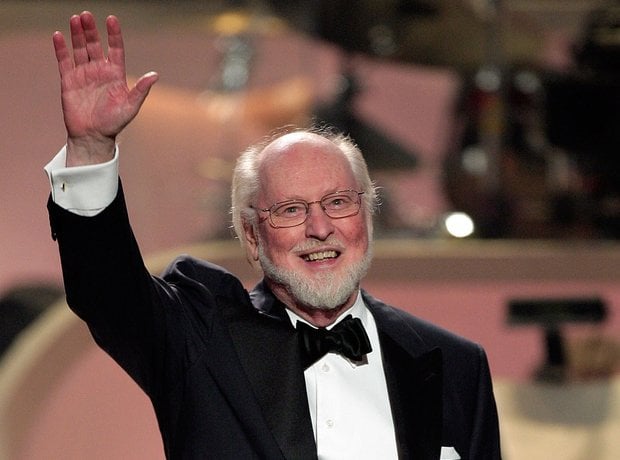
Happy birthday, Maestro. Now at work on a violin concerto for Anne-Sophie Mutter, John Williams turns 89.