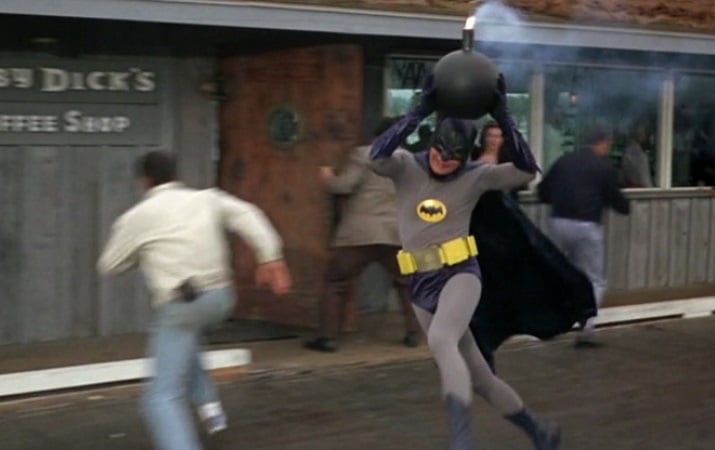
Or as Adam West observes, “Some days, you just can’t get rid of a bomb.”
Last night’s painful discussion of “Batman” (1966) ran 2 ½ HOURS. It was a perfect storm of Roy having an emotionally draining week, my not having eaten dinner, our struggling to adapt to a three-person format, and computer woes causing us to start 40 MINUTES LATE. That’s right, we didn’t finish until NEARLY 10 PM. Somebody stop the madness, please!
I haven’t watched it yet, but how good could it be? Thanks to Vinny Foti for sticking it out on a night when clearly we weren’t at our best, and thank you to our long-suffering viewers.
BIF! BAM! POW! Zzzzz…
Joker, Penguin, and Riddler weren’t the only ones taking it on the chin.
You’ll be guaranteed a more concise beating – if for no other reason than we’d like to get back to our hoagies and buffalo wings – as we tackle the dystopian sports classic “Rollerball” (1975), on the next Roy’s Tie-Dye Sci-Fi Corner, livestreamed on Facebook, this Super Sunday at 7PM EST.
I’ve been silent about celebrity deaths recently – otherwise, I’d never be off Facebook!
But I have to acknowledge, I am very sorry to learn of the passing of Christopher Plummer. A seasoned veteran of stage of screen, Plummer had one hell of a career, and he was much-decorated and acclaimed for it.
Even so, Oscar remained standoffish. He received his Academy Award for Best Supporting Actor, for “Beginners,” only in 2010. At 82, it made him the oldest person ever to be so recognized in an acting category. Six years later, he was nominated again, at 88, for “All the Money in the World.” He was now the oldest actor ever to receive a nomination.
Whether he was Iago, Cyrano de Bergerac , Sherlock Holmes, or Georg von Trapp, Plummer was a virtuoso, always in command of his instrument. That’s not to say he undertook everything in the service of art. In 1978, he appeared as the Emperor of the Galaxy in “Starcrash,” an Italian knockoff of “Star Wars,” because it allowed him a free trip to Rome. The film achieves its delirious apotheosis when Plummer assumes an authoritative stance and intones, “Imperial Battleship! Halt… the flow of time!”
In 1956, he essayed the role of Henry V at Ontario’s Stratford Festival. However, for one performance, he was laid low by an attack of kidney stones. This opened the door for his understudy, a struggling young actor by the name of William Shatner. Shatner and Plummer would later face off, with Plummer as a Shakespeare-spouting Klingon, in “Star Trek VI: The Undiscovered Country.”
Here’s a fine recording of William Walton’s music for the Laurence Olivier film of “Henry V” (1944). Plummer supplies the big speeches, and then some.
The Stratford Plummer-Shatner “Henry” story is recounted here:
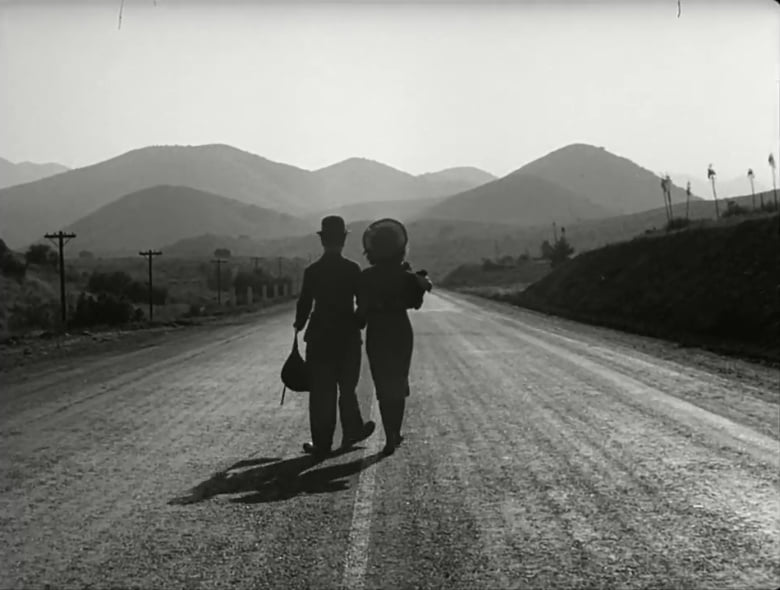
Charlie Chaplin’s “Modern Times” opened 85 years ago today. The romantic theme, “Smile,” is Chaplin’s own and went on to be become a popular standard, memorably recorded by Nat King Cole and others. 1936 was already well into the era of “talking pictures,” and this was to be Chaplin’s swan song as the Little Tramp. The concluding image of Chaplin and Paulette Goddard walking down a road, hand-in-hand, is one of the most iconic in cinematic history. Its message of hope in uncertain times springs from the struggles of the Depression. It’s a lesson that’s still relevant today.
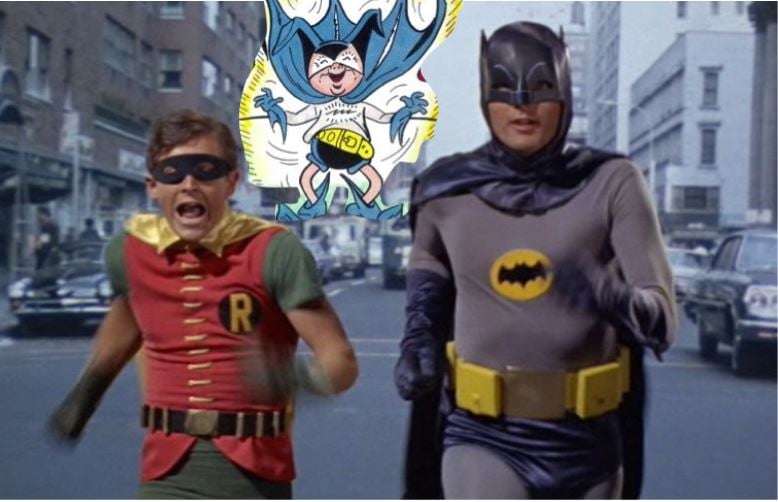
That’s right, Roy and I are polishing up the sidecar for Tie-Dye Sci-Fi regular Vinny Foti, who will join us for a six-fisted caped crusade. Our subject will be the 1966 movie “Batman,” released into theaters following the first season of the camp-classic pop-art television hit starring Adam West and Burt Ward. You know, the one with the Neal Hefti theme music that goes bada bada bada bada bada bada bat… BATMAAAAAAAN!!!
For me, even though it is the least faithful to the spirit of the comics, this is the ONLY Batman movie.
Make sure you’ve got plenty of shark repellent. Roy, Vinny, and I will be chatting about the Bat, when you join us for the next Roy’s Tie-Dye Sci-Fi Corner, livestreamed on Facebook, same Bat-time, same Bat-channel, this Friday evening at 7:00 EST!
In my post of November 21, 2019, having just watched the first episode of the third season of the Netflix series “The Crown” – the one with a subplot involving Sir Anthony Blunt, Surveyor of the Queen’s Pictures – I wondered, as the timeline crept into the ‘70s and ‘80s, if writer-creator Peter Morgan might include a reference to Malcolm Williamson.
Williamson, also from the world of the arts, brought further scandal to the Royal Family as a notoriously unreliable Master of the Queen’s Music.
Since the 17th century, musicians have been appointed Master with the expectation that they would supply music for important milestones in the lives of the Royal Family and for ceremonial occasions. Past Masters of the Queen’s (or King’s) Music have included John Eccles (who served four monarchs), William Boyce, John Stanley, Sir Edward Elgar, Sir Arnold Bax, and Sir Arthur Bliss.
When Williamson, Australian by birth, was named Bliss’ successor in 1975, already there was grumbling among his peers. Sir William Walton suggested the appointment was politically motivated, a means of “cementing the cracks in the Commonwealth.” Williamson had his share of personal demons, to be sure. He was prone to anxiety and depression, and he was certainly no stranger to the bottle. In his later years, he suffered a series of strokes.
Unfortunately, he was also horrible with deadlines. He failed to complete a symphony in time for the Queen’s Golden Jubilee in 1977, and his ambitious “Mass for Christ the King,” also intended for the occasion, was delivered late. Significantly, he became the first Master in over a century not to receive a knighthood.
Following his death in 2003, the parameters of the post were revised. No longer is the appointment to be one for life, but rather for a fixed, ten-year term. The current master is Judith Weir. Weir was appointed in 2015. She is the first woman to hold the position (and yes, she is still referred to as “Master”).
Alas, having concluded Season 4, I am sorry to say, I detected no reference to Williamson in “The Crown.” Even an exasperated aside, delivered to the Queen, about another unfulfilled commission would have been welcome. But understandably the season was more concerned with the drama surrounding Diana Spencer and an uncanny performance by Gillian Anderson as Margaret Thatcher.
There was, however, a nice “Easter egg” for classical music aficionados in Episode 8, the episode in which press secretary Michael Shea is given a prominent role. Shea was also a writer of books, and the episode opens with him seated at his typewriter, tapping out the conclusion to his latest literary effort. Nearby, on a turntable, spins Peter Maxwell Davies’ “Farewell to Stromness.”
Maxwell Davies would serve as Master of the Queen’s Music from 2004 to 2014. He was the first to serve under the new guidelines. An amusing choice since, if anything, Max was an even more colorful figure than Williamson – if perhaps better about meeting deadlines.
Throw “The Crown” in a blender with “Mozart in the Jungle,” cast Malcolm McDowell as Max, and THAT would be the show I’m looking for.
Here’s hoping for a cameo in a future episode.
“Farewell to Stromness”
An arrangement of the piece was played at the wedding of Charles and Camilla in 2005.
Max’s String Quartet No. 8, with its allusions to Dowland, dedicated to the Queen on the occasion of her 80th birthday:
“Kings and Shepherds,” a carol for the Queen:
Of course, Max gained notoriety in the 1960s for works like “Eight Songs for a Mad King,” inspired by George III.
Decades later, in 2010, when the police showed up at his door after a protected swan struck a power line over his property in the Orkney Islands, Max invited them in – and offered them swan terrine.
Only mad Max would set Purcell to a foxtrot. Love the suggestions of the Victrola running down, having to be cranked up, and then the stylus swishing around at the end.
PHOTOS: Wild Williamson (left) and Mad Max in 1973