This week on “Picture Perfect,” things will get pretty steamy, though not in the way you might think. We’ll have an hour of scores from films that exemplify the science fiction subgenre known as “steampunk.”
Generally speaking, steampunk employs forward-looking technologies and gadgetry – in many cases literally powered by steam – in incongruous, quasi-Victorian settings.
We’ll hear selections from Martin Scorsese’s “Hugo” (2011), with its abundant gears, steam, and free-writing automaton, with music by Howard Shore; “The Golden Compass” (2007), with its carriages, old-fashioned air ships, and vintage arctic gear, with music by Alexandre Desplat; “Wild Wild West” (1999), with its cowboys, proto-James Bond gadgetry, and Gustave Eiffel-style iron spider, with music by Elmer Bernstein; and “Time After Time” (1979), with Jack the Ripper, H.G. Wells, and a time machine of his invention, with music by Miklós Rózsa.
We’re powered by steampunk this week, on “Picture Perfect,” music for the movies, this Saturday evening at 6:00 EST, on WWFM – The Classical Network and wwfm.org.
PHOTO: Battling a giant iron spider from a flying bicycle? This must be steampunk!
I often think these things, but music makes me feel them.
e.e. cummings, and the comings and goings of back yard friends.
Happy Thanksgiving.
i thank You God for most this amazing
day:for the leaping greenly spirits of trees
and a blue true dream of sky;and for everything
which is natural which is infinite which is yes
(i who have died am alive again today,
and this is the sun’s birthday;this is the birth
day of life and of love and wings:and of the gay
great happening illimitably earth)
how should tasting touching hearing seeing
breathing any–lifted from the no
of all nothing–human merely being
doubt unimaginable You?
(now the ears of my ears awake and
now the eyes of my eyes are opened)
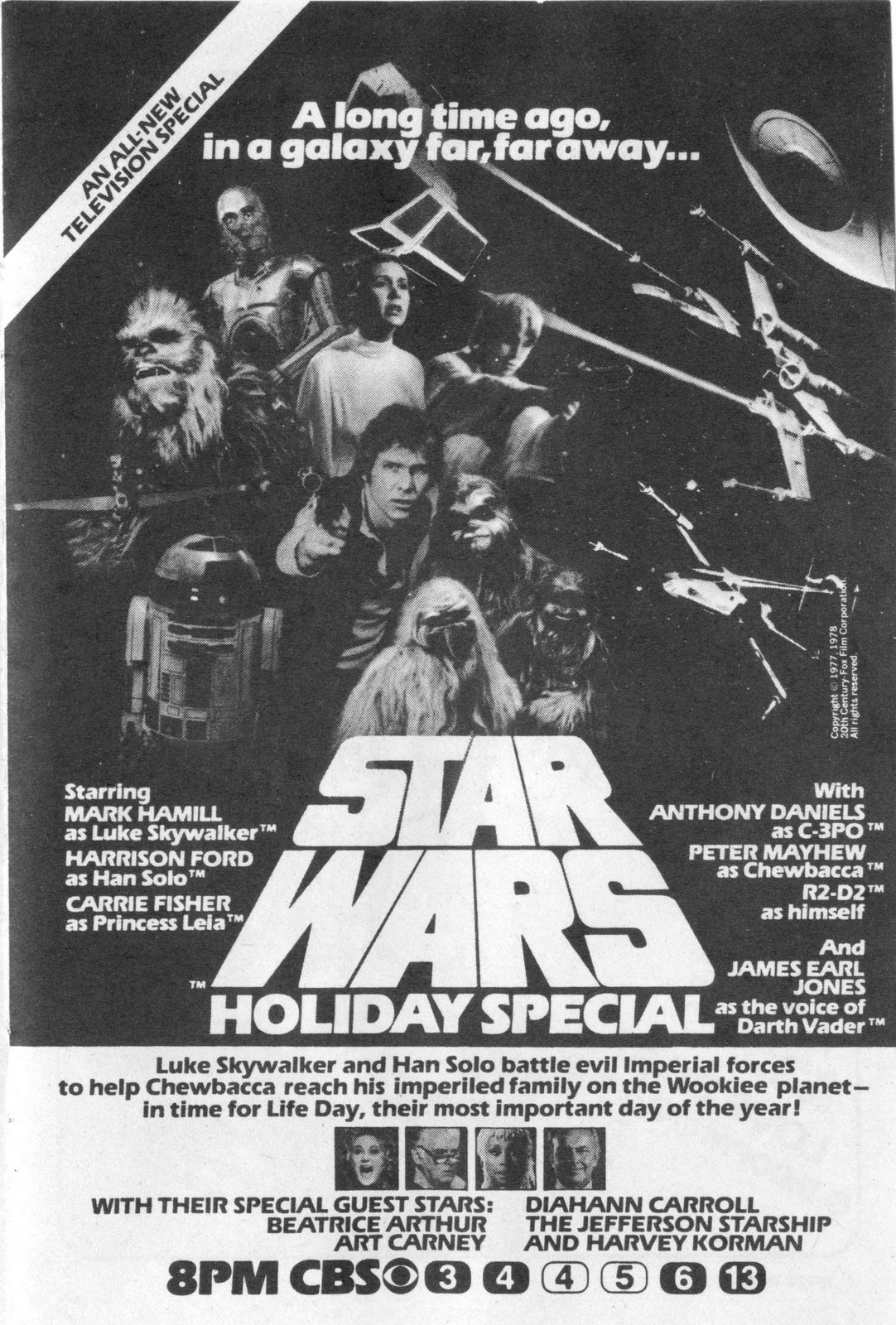
Since it’s not my wish to spoil anyone’s Thanksgiving, I’m warning you a little early this week that Roy and my topic on Friday will be the universally-reviled “Star Wars Holiday Special.” How hated is it? “Star Wars” creator George Lucas once remarked that if he could locate every copy, he would smash them with a hammer. I’m sure you will feel the same.
First aired on CBS television on November 17, 1978 (preempting “Wonder Woman” and “The Incredible Hulk”), the “special” takes a core plot of Chewbacca trying to reach his home planet of Kashyyyk in time to celebrate Life Day with his Wookiee family, and folds it into an improbable variety show format that includes music and comedy perpetrated by Bea Arthur, Art Carney, Diahann Carroll, and Harvey Korman (the kids just love those guys), and an appearance by The Jefferson Starship. I know, right? In the end, Princess Leia sings a Life Day song to the tune of… “Star Wars.” Yes, it’s THAT bad. The SOLE saving grace is an admittedly cool, stylized cartoon that introduces the character of Boba Fett. (This was still two years before “The Empire Strikes Back.”)
The special was met with slack-jawed disbelief by audiences and critics alike. It has never received an authorized release on home video. Quite simply, everyone associated with it wants you to believe that it never happened, that it was a bad dream, an undigested bit of beef, a fragment of underdone potato. But we know better.
George Lucas may wish his holiday folly would just go away, but thanks to the then practically-brand-new technology of VHS, its horribleness has been preserved to be relived again and again on YouTube.
Enjoy your Thanksgiving, because this year Black Friday will be very black indeed. Share your excruciating memories of the “Star Wars Holiday Special” on the next Roy’s Tie-Dye Sci-Fi Corner. We begin processing the trauma, livestreamed on Facebook, this Friday evening at 7:00 EST.
I am sure there are those who are resistant to the art of Virgil Thomson – Thomson the composer, I mean. His brand of Americana-inflected simplicity could easily be reduced to “faux naïve.”
Personally, I find the blend of French and American elements fascinating. Thomson, like Aaron Copland and so many others, studied in Paris with the legendary pedagogue Nadia Boulanger. The next time you listen to “Appalachian Spring,” or anything by Copland, note the French influence – the uncluttered textures, the neoclassical winds. It’s inescapable. If anything, these qualities are even more evident in Thomson’s music, and he adhered to a French sensibility for the rest of his life.
Thomson was equally renowned (and feared) as critic for the New York Herald-Tribune. As a critic, he certainly was not afraid to speak his mind. He was also more vocal than most in his conviction that the alleged rarefied aesthetics of music, at least in his case, were secondary to the needs of the bank account. Fortunately for Thomson, the two were not necessarily incompatible.
His most famous work, perhaps – other than the film scores he wrote for the documentaries “The Plow That Broke the Plains,” “The River,” and “Louisiana Story” (the only film score to date to be awarded a Pulitzer Prize) – is the “Symphony on a Hymn Tune.”
The symphony, composed during his years in Paris, was inspired by Thomson’s memories of his Kansas City boyhood. The “Sunday best” of the church hymns occasionally gets tangled up in a few modernistic burrs – the exchanges between the violin, cello, trombone and piccolo at the end of the first movement, for instance – but in 1928, it was a landmark in establishing a distinctly American idiom.
This is perfect Thanksgiving music.
Happy birthday, Virgil Thomson (1896-1989)!
Here’s an amazing discovery: a two-part 1981 interview with Thomson, conducted by David Dubal, then music director of WNCN, now host of WWFM – The Classical Network’s “The Piano Matters.” The interview is punctuated by recordings of Thomson’s music.
Part 1 includes “Sea Piece with Birds,” “Four Blake Songs” (with Mack Harrell), and “The Plow That Broke the Plains.”
Part 2 includes “Ragtime Bass” (performed by Dubal), “The Feast of Love,” “Bugles and Birds” (a portrait of Pablo Picasso), and “Alternations” (a portrait of Maurice Grosser).
Boy, does this make me nostalgic for old-time radio, right down to all the ticks and pops.
Thomson, by the way, made good on his promise to compose a portrait of Dubal. Here it is in its orchestral guise.
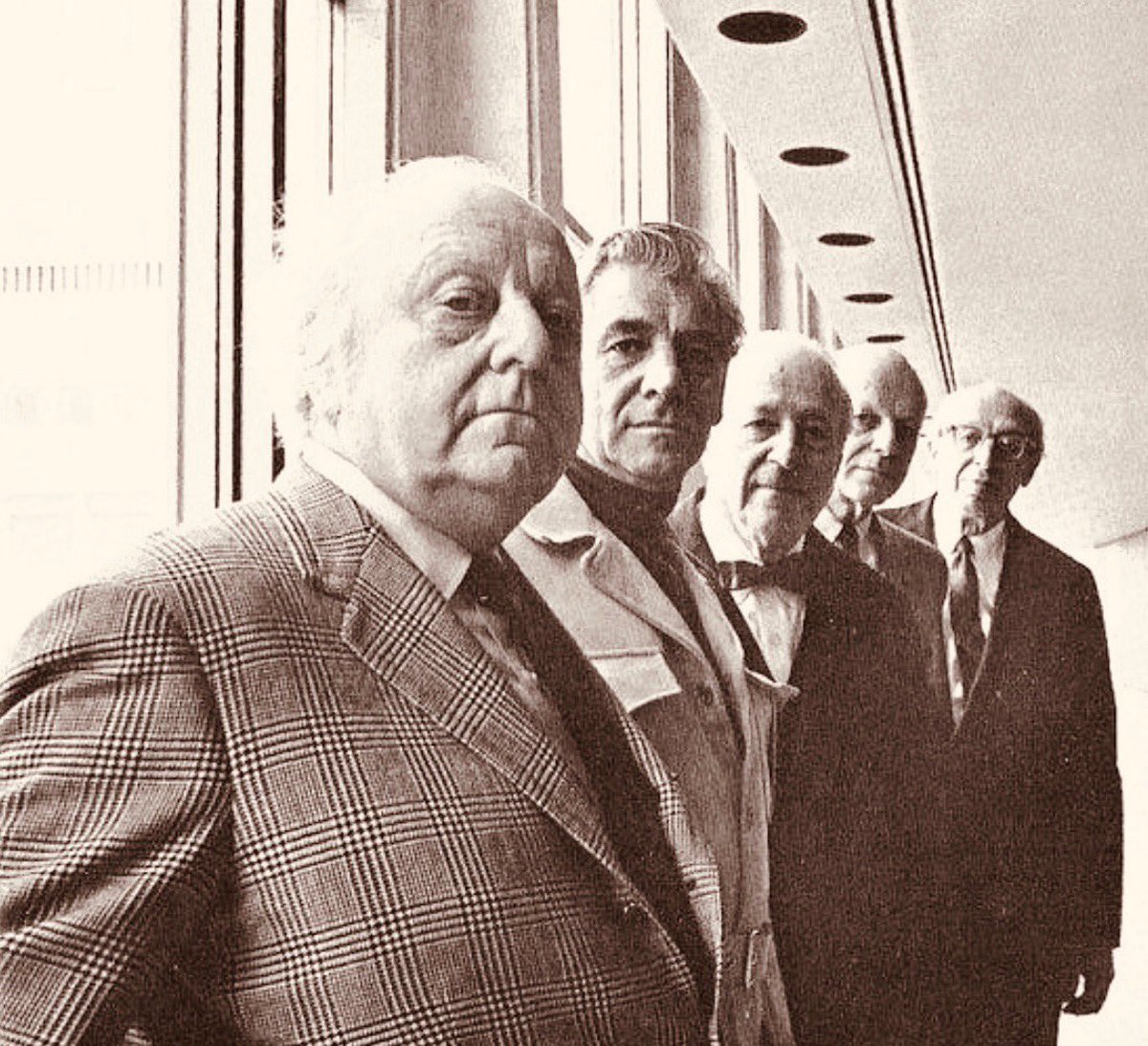
PHOTO: If mid-century American music had a team of Avengers-style superheroes, this would be it: (from front to back) Virgil Thomson, Leonard Bernstein, Walter Piston, William Schuman, and Aaron Copland at Lincoln Center in 1970