Category: Daily Dispatch

  • Virgil Thomson: Americana and French Flair

    Virgil Thomson: Americana and French Flair

    I am sure there are those who are resistant to the art of Virgil Thomson – Thomson the composer, I mean. His brand of Americana-inflected simplicity could easily be reduced to “faux naïve.”

    Personally, I find the blend of French and American elements fascinating. Thomson, like Aaron Copland and so many others, studied in Paris with the legendary pedagogue Nadia Boulanger. The next time you listen to “Appalachian Spring,” or anything by Copland, note the French influence – the uncluttered textures, the neoclassical winds. It’s inescapable. If anything, these qualities are even more evident in Thomson’s music, and he adhered to a French sensibility for the rest of his life.

    Thomson was equally renowned (and feared) as critic for the New York Herald-Tribune. As a critic, he certainly was not afraid to speak his mind. He was also more vocal than most in his conviction that the alleged rarefied aesthetics of music, at least in his case, were secondary to the needs of the bank account. Fortunately for Thomson, the two were not necessarily incompatible.

    His most famous work, perhaps – other than the film scores he wrote for the documentaries “The Plow That Broke the Plains,” “The River,” and “Louisiana Story” (the only film score to date to be awarded a Pulitzer Prize) – is the “Symphony on a Hymn Tune.”

    The symphony, composed during his years in Paris, was inspired by Thomson’s memories of his Kansas City boyhood. The “Sunday best” of the church hymns occasionally gets tangled up in a few modernistic burrs – the exchanges between the violin, cello, trombone and piccolo at the end of the first movement, for instance – but in 1928, it was a landmark in establishing a distinctly American idiom.

    This is perfect Thanksgiving music.

    Happy birthday, Virgil Thomson (1896-1989)!


    Here’s an amazing discovery: a two-part 1981 interview with Thomson, conducted by David Dubal, then music director of WNCN, now host of WWFM – The Classical Network’s “The Piano Matters.” The interview is punctuated by recordings of Thomson’s music.

    Part 1 includes “Sea Piece with Birds,” “Four Blake Songs” (with Mack Harrell), and “The Plow That Broke the Plains.”

    Part 2 includes “Ragtime Bass” (performed by Dubal), “The Feast of Love,” “Bugles and Birds” (a portrait of Pablo Picasso), and “Alternations” (a portrait of Maurice Grosser).

    Boy, does this make me nostalgic for old-time radio, right down to all the ticks and pops.

    Thomson, by the way, made good on his promise to compose a portrait of Dubal. Here it is in its orchestral guise.


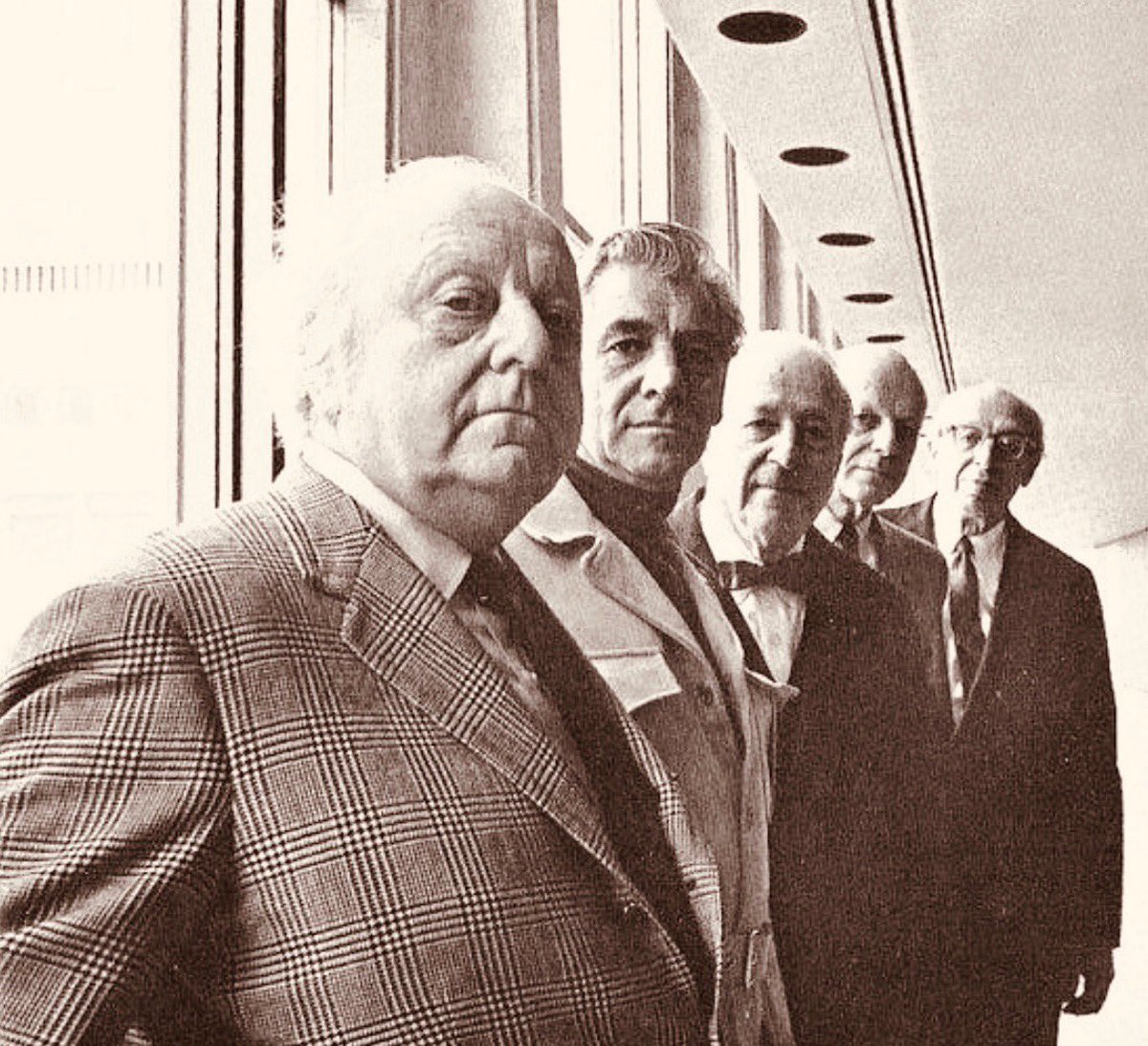
    PHOTO: If mid-century American music had a team of Avengers-style superheroes, this would be it: (from front to back) Virgil Thomson, Leonard Bernstein, Walter Piston, William Schuman, and Aaron Copland at Lincoln Center in 1970
  • Scott Joplin’s 1970s Revival: The Sting & Beyond

    Scott Joplin’s 1970s Revival: The Sting & Beyond

    The ‘70s were a very good decade for Scott Joplin.

    Joshua Rifkin’s first LP of Joplin piano rags became a classical bestseller for Nonesuch Records in 1970. The same year, Joplin was inducted into the Songwriter’s Hall of Fame. Gunther Schuller revived period orchestrations of some of his works in 1973. The recording, “The Red Back Book,” won a Grammy.

    In 1972, Joplin’s opera, “Treemonisha,” was finally given its first complete staging. And in 1976, Joplin received a citation from the Pulitzer Prize committee “for his contributions to American music.” Of course, by then, Joplin had already been dead for 59 years.

    More than anything, it was probably the use of his rags on the soundtrack for “The Sting,” in 1973 (which earned Marvin Hamlisch an Oscar for best “original” score), that brought Joplin roaring back into the popular consciousness. It’s a pretty good bet that without “The Sting” – and the resulting Top-40 status of “The Entertainer” (which reached number 3 on the Billboard charts) – the movie “Scott Joplin” (1977) would not have been made. At any rate, Joplin’s sudden ubiquity couldn’t have hurt.

    Billy Dee Williams, still three years ahead of his first turn as Lando Calrissian in “The Empire Strikes Back,” was already a star, thanks to successes in “Brian’s Song,” “Lady Sings the Blues,” and “Mahogany.” Williams here plays the title role in what had been planned as a TV movie, until Universal Pictures decided the film had theatrical potential. His performance received praise from the critics, even as the film itself earned tepid reviews. Its TV production values and the trajectory of its plot, necessarily all downhill after the first half hour, did not work in its favor.

    Clifton Davis co-stars as ragtime artist Louis Chauvin, and a bewhiskered Art Carney plays Joplin’s publisher, John Stark. Fascinatingly, Eubie Blake appears as the judge of a piano “cutting contest” that took place in 1899. Blake, who essentially lived forever (he died in 1983 at the age of 96), would have been 12 at the time of the events depicted. 1899 was also the year Blake – himself a ragtime luminary who branched out into musical theater (his collaboration with Noble Sissle, “Shuffle Along,” is the source of “I’m Just Wild About Harry”) – composed his own “Charleston Rag.” Blake actually met Joplin once in Washington, D.C. Incidentally, that’s Dick Hyman playing on the film’s soundtrack.

    “Scott Joplin” has not appeared on home video since the days of VHS, though it is available for viewing through some streaming outlets. Clips are posted on YouTube.

    Happy birthday, Scott Joplin (c. 1868-1917), another artist who brought so much joy and beauty into the world, only to leave us too soon.


    “The Sting” and Joplin’s “The Entertainer”

    Gunther Schuller’s New England Conservatory Ragtime Ensemble and “The Maple Leaf Rag”

    Joshua Rifkin plays “Bethena: A Concert Waltz”

    Joplin’s “Treemonisha”

    Eubie Blake plays his “Charleston Rag”


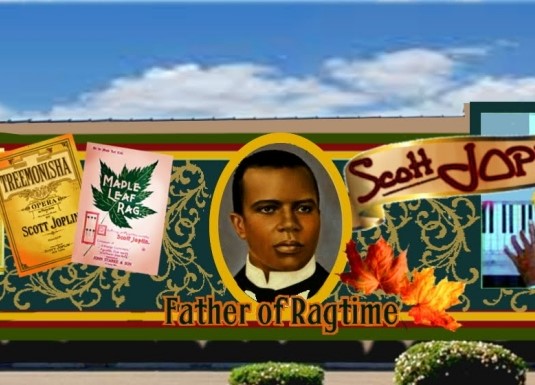
    PHOTO: Detail of a mural in Joplin’s hometown of Texarkana, TX

  • Moreau Beast Makeup Outer Limits Preview

    I had on my best Beast Folk make-up for last night’s exploration of the 1977 film “The Island of Dr. Moreau” – with side commentary on the 1932 and 1996 versions, H.G. Wells’ original novel, and the 1977 Marvel comics adaptation. That’s probably more Moreau than anyone needs to know.

    Roy and I will resume this Friday, with a special Fakesgiving discussion of the justifiably-maligned “Star Wars Holiday Special” (1978).

    Then on Sunday, Roy will be joined by special guests Dominic Stefano, son of Joseph – creator of the classic television series “The Outer Limits” – and David Rash, whose book, “From the Inner Mind to the Outer Limits… The Outer Limits Scripts of Joseph Stefano Volume One,” will be released in March, with preorders beginning in January.

    Tune in and test your limits. Roy’s Tie-Dye Sci-Fi Corner is livestreamed on Facebook every Friday and Sunday evening at 7:00 EST.

    https://www.facebook.com/roystiedyescificorner/

  • Powell’s Lost Falla Ballet Film Honeymoon

    Powell’s Lost Falla Ballet Film Honeymoon

    Wow! How did I never hear of this before?

    On Manuel de Falla’s birthday, I’ve been bouncing around YouTube, looking for exceptional or unusual material, and as always, the effort – if anything so enjoyable could be described as such – has paid off.

    I have always been a great admirer of the filmmaking team of Michael Powell and Emeric Pressburger, who made such strange, astonishing films as “The Red Shoes” (1948) and “The Tales of Hoffmann” (1951), and yet somehow I have never encountered this one, apparently made by Powell alone, after the team had amicably split.

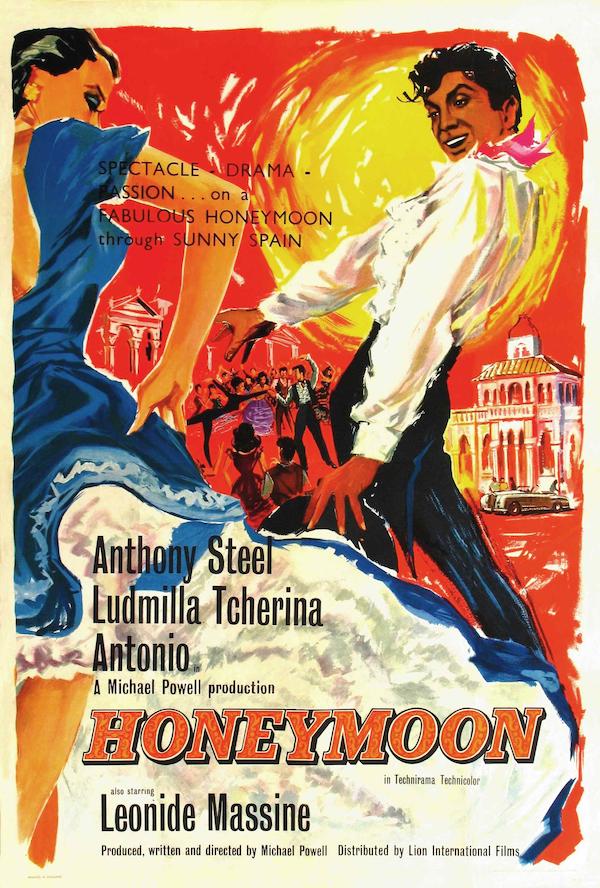
    “Honeymoon” (1959) reunited Powell with legendary Ballets Russes principal dancer and choreographer Léonide Massine, for a film based in part on Falla’s ballet “El Amor Brujo” (here translated as “Bewitched Love”). Massine created the role of the Miller in Falla’s “The Three-Cornered Hat” with the Ballets Russes and a specially-assembled all-Spanish company, back in 1919. Naturally, after his turn as the sinister shoemaker in “The Red Shoes,” Massine here assumes the role of the creepy Ghost.

    Supposedly the film is something of a Spanish travelogue with musical interludes. Mikis Theodorakis, of “Zorba the Greek” fame, wrote the aptly named “The Honeymoon Song.” It was later covered by The Beatles.

    For the leads, Powell was hoping to reunite with his “Red Shoes” star Moira Shearer and Paul Scofield, of all people. Instead, he got Ludmilla Tchérina, once the youngest prima ballerina in history when she danced “Romeo and Juliet” in Paris in 1942, while still in her teens, for the Ballets Russes de Monte Carlo. Tchérina had worked with Powell in both of his previous dance films. For the male lead, the director was less fortunate, stuck with Anthony Steel, whom Powell despised. (He described him as “the archetypal British s**t.”)

    Allegedly, “Honeymoon” is regarded as one of Powell’s least-impressive achievements. Unquestionably it is at least as much “Red Shoes” as it is authentic Falla. Still, I am grateful to have discovered it.

    The “El Amor Brujo” sequence is posted here in two parts.

    Happy birthday, Manuel de Falla!


    Check out the freaky graveyard scene at 6:49 (here linked directly), which leads into the ballet’s most famous music, “The Ritual Fire Dance.” Like a Goya painting brought to life!

  • Saint Cecilia Crossword Music Feast

    Saint Cecilia Crossword Music Feast

    Hail! Bright Cecilia, hail!

    November 22 is the feast day of Saint Cecilia. This week’s Classic Ross Amico crossword celebrates music’s patron saint with fifty clues, in homage and thanksgiving.

    To fill out the puzzle, follow the link and select “solve online” at the bottom of the page. You’ll then be able to type directly into the squares. Once you feel you’ve exhausted the puzzle, you’ll find the solutions by clicking on “Answer Key PDF.”

    There’s plenty to be thankful for, musically speaking, when you follow the link.

    https://www.armoredpenguin.com/crossword/Data/2020.11/2210/22104525.388.html

Tag Cloud

Aaron Copland (93) Beethoven (95) Composer (114) Film Music (137) Film Score (143) Film Scores (255) Halloween (94) John Williams (195) KWAX (229) Leonard Bernstein (103) Marlboro Music Festival (125) Movie Music (152) Mozart (88) Opera (208) Philadelphia Orchestra (89) Picture Perfect (174) Princeton Symphony Orchestra (108) Radio (88) Ross Amico (244) Roy's Tie-Dye Sci-Fi Corner (290) The Classical Network (101) The Lost Chord (268) Vaughan Williams (103) WPRB (396) WWFM (881)

DON’T MISS A BEAT

Receive a weekly digest every Sunday at noon by signing up here


RECENT POSTS