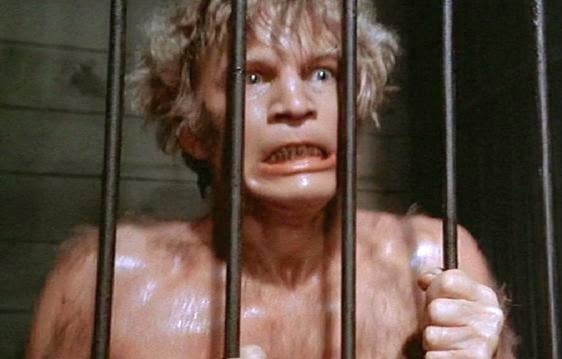
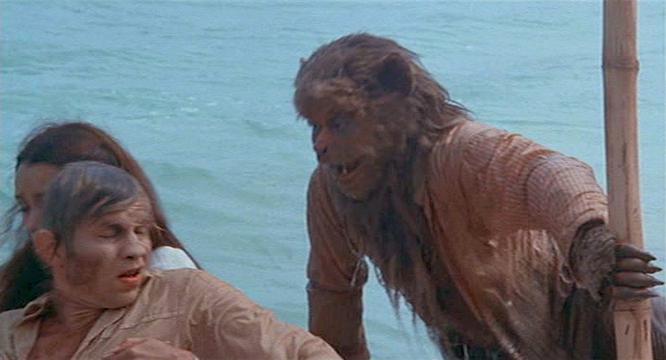
No, wait a minute. That’s something else entirely, though Devo is one of many bands inspired by “The Island of Dr. Moreau.” Roy Bjellquist and I will repeat “the Law,” when we discuss the 1977 film version of the H.G. Wells classic, on the next Roy’s Tie-Dye Sci-Fi Corner. Scream your insights in the House of Pain (i.e. the comments section), as we live-stream on Facebook, this Friday evening at 7:00 EST!
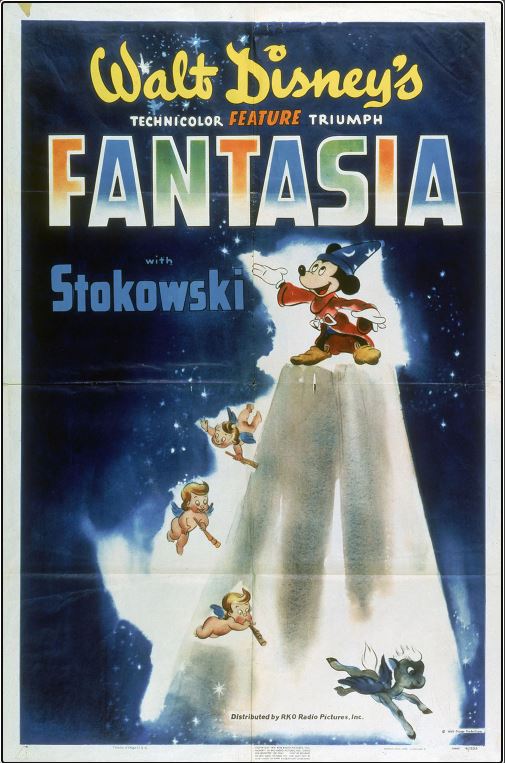
Walt Disney’s “Fantasia” was released into theaters for the first time 80 years ago today.
Giddy with the success of “Snow White and the Seven Dwarfs” (1937), which became a surprise hit – the highest grossing feature up to that time (soon to be supplanted by “Gone with the Wind”) – and hoping to reinvigorate the popularity of house brand Mickey Mouse, Disney spared no expense in the creation of this bold, beautiful, mind-bending, slightly pretentious, occasionally kitschy experimental enterprise, engaging Leopold Stokowski and the Philadelphia Orchestra to record the film’s soundtrack and, on its initial run, displaying it in special road show productions, featuring souped-up, “Fantasound” surround audio. This was the first feature film to be released in stereo. It ran in one venue in New York for a solid year. At a point, Disney even toyed with the idea of pumping different scents into the theater, but he must have realized it was all becoming a little too Scriabinesque.
Eventually reality caught up. “Fantasia” was a money-loser from the start. The war in Europe cut off any possibility of overseas revenue, and it became apparent that the film would have to be reissued, with cuts, in standard format, in regular theaters, if the studio hoped to make any of its money back. As it was, it didn’t turn a profit until 1969. I suspect it was the same crowd that was buzzing to “2001: A Space Odyssey” that finally pushed “Fantasia” into the black. It is now the 24th highest-grossing film in the United States. There aren’t any studios, and very few classical record companies, that would make that kind of investment in the future anymore.
I venture to guess most people who were lucky enough to see “Fantasia” in the cinema, back in the days before home video brought an end to its regular theatrical reissues, were charmed to see Stokowski shake hands with Mickey Mouse. Even so, this is the moment that became seared into many an impressionable memory. And I know I loved it.
Apologies for posting it in two parts, but “Fantasia” was reissued and “restored” a number of times over the years. This one I know sports Stoky’s original audio.
The connection between music and science has been much remarked upon.
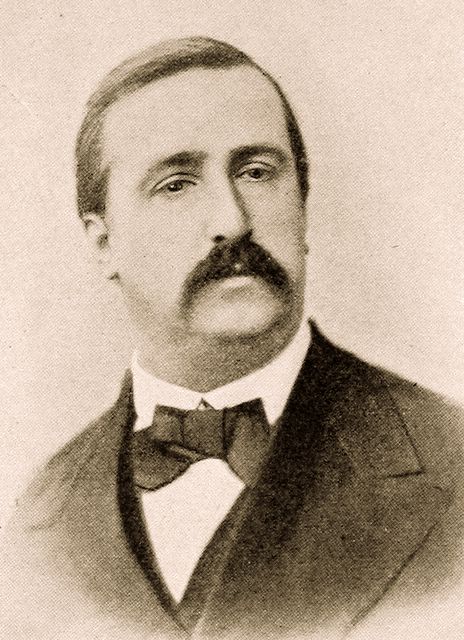
Consider the case of doctor and chemist Alexander Borodin. Borodin was born on this date in 1833. As a boy he took piano lessons, but he received his formal education at the Medical-Surgical Academy in St. Petersburg. He then served as a surgeon in a military hospital before pursuing three years of advanced scientific study in Western Europe.
In 1862, he returned to his alma mater to teach. He lobbied for the admittance of women, and in 1872, he founded his own women’s school of medicine. The remainder of his scientific career was devoted to research. He is co-credited with the discovery of the aldol reaction, a means of forming carbon-carbon bonds in organic chemistry.
Of course, Borodin’s other passion was music. Around the time of his return to the Academy, he came into contact Mily Balakirev, a driving force in the Russian nationalist movement. Balakirev took the chemist under his wing and appointed himself overseer of the younger man’s efforts in the writing of a Symphony No. 1. Borodin began work on his Symphony No. 2 in 1869. Since regarded as an especially successful blend of Slavic drama and lyricism with European classical form, it was not a particular success at its premiere in 1877.
Borodin’s attention was easily diverted while at work on the piece by his absorption in an opera on the subject of Prince Igor. This was to become his most significant musical contribution and one of the most important Russian historical operas. Because of his other commitments and repeated distractions, the opera was left unfinished at the time of his death. It fell to his friends and colleagues, Nikolai Rimsky-Korsakov and Alexander Glazunov, to complete it.
Its big show-stopper, of course, is the “Polovtsian Dances,” which has been used to sell everything from records to cleanser.
Borodin was yet another beneficiary of the exceeding generosity of Franz Liszt, whose contributions in this regard are not widely enough acknowledged. It was Liszt’s advocacy as a conductor that brought Borodin to the attention of European audiences. In gratitude, the composer dedicated “In the Steppes of Central Asia” to Liszt in 1880.
Borodin was also embraced by the French Impressionists, who admired his unusual harmonies. Of course, he achieved even greater renown when melodies from his works became the basis for the musical “Kismet” in 1953. In 1954, he was honored with a posthumous Tony Award!
Since for Borodin music was basically an avocation, something to which he devoted himself mostly during holidays or when he was otherwise unable to report to work, it became a running gag among his friends that they’d wish him poor health.
“In winter I can only compose when I am too unwell to give my lectures,” he wrote. “So my friends, reversing the usual custom, never say to me, ‘I hope you are well’ but ‘I do hope you are ill.’”
He had plenty of experience with illness. The composer survived cholera and suffered several heart attacks. He finally dropped dead during a ball at the Academy in 1887.
H.G. Wells’ “The Island of Dr. Moreau” strives for something more than South Seas gothic.
Translated for the screen most effectively in 1932 as “Island of Lost Souls” (which, by the way, Wells hated), the novel has never received a wholly faithful adaptation. The 1977 version, starring Burt Lancaster, Michael York, and Richard Basehart, hopes to skate by on some admittedly decent performances (especially once York begins to sprout hair) and John Chambers’ post-“Planet of the Apes” creature make-up.
Sure, the whole “Frankenstein” angle is intact, a warning against mad science for the sake of mad science, overweening brilliance courting madness and tragedy, the impetuous thirst for knowledge without long-term strategy or moral responsibility. But the story is also a political allegory, a nightmare commentary on colonialism, and a phantasmagoria of Darwinism, degeneration, and eugenics.
What does it mean to be human? Why do we need “law?” Are we indeed made in God’s image? What does it suggest when a creator lacks empathy?
I can’t guarantee that we’ll tackle all the big questions, but we will be tarrying in this inversion of paradise on the next Roy’s Tie-Dye Sci-Fi Corner. Join us for a vivacious vivisection of Dr. Moreau. We’ll be whipping you for your commentary, when we live-stream on Facebook, this Friday evening at 7:00 EST.
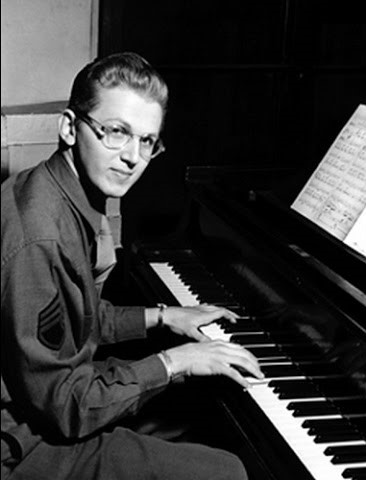
On this Veterans Day, here’s a pleasant discovery: Mel Powell’s “Homage to Debussy.”
Powell served with (and played with) Glenn Miller during World War II. He also collaborated with Benny Goodman, Raymond Scott, and Django Reinhardt, among others. Hearing Goodman perform for the first time is what shifted his focus, for a period, from classical music to jazz. After the war, he wound up writing music for movies and cartoons, including Tom and Jerry.
Muscular dystrophy effectively ended his career as a traveling musician. Instead, he returned to his classical roots, studying composition at Yale with Paul Hindemith. His early works were conceived in a neoclassical style. Gradually, however, he began to push into atonality and serialism. He taught at Mannes College of Music and Queens College, in New York, then succeeded Hindemith as chair of the Yale composition faculty. There, he also directed one of the country’s first electronic music studios. But he never completely turned his back on jazz.
Powell was living in California, where he had served as provost and professor of music at CalArts, when he was awarded the Pulitzer Prize for Music in 1990. The honored work, “Duplicates: A Concerto for Two Pianos and Orchestra,” was inspired by a conversation he had over four decades earlier, while serving in the U.S. Army Air Force .
“… I was in Paris and met an old musician who knew Debussy and would regale us with anecdotes. I’ve forgotten most of the stories, but one thing he told me has come back to me frequently over the years. It was about a time he and Debussy were having a glass of wine at the Chat Noir, and Debussy said: ‘Do you know what the perfect music would be? A perpetual cadenza. It would be like a chain of gold coins, each like the other, but different enough to claim independence.’ I’ve never forgotten that. And that became my goal for ‘Duplicates.’”
Sadly, there doesn’t appear to be an audio file of the work posted online.
Powell died in 1998, at the age of 75. He was married to Martha Scott, an actress probably best-remembered for playing Charlton Heston’s mother in both “The Ten Commandments” and “Ben-Hur.” She also played Emily in the original Broadway production of “Our Town” and in the film version, opposite William Holden.
We may not have access to “Duplicates,” but there’s certainly plenty of Powell to enjoy, when following the links below:
“The Earl” (1941)
Art Clokey’s “Gumbasia” (1955), which employs a cut from Powell’s “Thigamigig”
Goodman and Powell in 1976
From “The Return of Mel Powell” (1987)
Sonatina for Piano (1952)
“Filigree Settings for String Quartet” (1959)
“Three Synthesizer Settings” (1979/1980)
“Recitative and Toccata Percossa” (1951) introduced and performed by harpsichordist Mahan Esfahani