Category: Daily Dispatch

  • Philly Orchestra Celebrates 120 Years

    Philly Orchestra Celebrates 120 Years

    Happy birthday, The Philadelphia Orchestra! Looking pretty good for 120.

    The Fabulous Philadelphians gave their first public concert under Fritz Scheel on this date in 1900. The event took place at the orchestra’s former home of the Academy of Music, located on the southwest corner of Broad and Locust Streets. On the program were works by Carl Goldmark (“In Spring” Overture), Beethoven (Symphony No. 5), Tchaikovsky (Piano Concerto No. 1), Weber-Berlioz (“Invitation to the Dance”), and Wagner (“Entry of the Gods into Valhalla”).

    The soloist on that occasion was Ossip Gabrilowitsch. Gabrilowitsch’s teachers at the Saint Petersburg Conservatory included Anton Rubinstein and Nikolai Medtner. He then studied for two years in Vienna under the legendary pedagogue Theodor Leschitizky. Not only was Gabrilowitsch a prominent pianist, he was also offered the music directorship of the Boston Symphony Orchestra, which he politely declined. Later, he became founding director of the Detroit Symphony in 1918. He was also Mark Twain’s son-in-law. In my possession is a biography I picked up at a library sale a few years ago, “My Husband, Gabrilowitsch,” that I noticed had been inscribed by Twain’s daughter, Clara Clemens!

    Fritz Scheel was succeeded as music director of the Philadelphia Orchestra by Carl Pohlig in 1908. Leopold Stokowski (pictured) followed in 1912; Stoky would lead the group for the next 24 years. Then came Eugene Ormandy, who held the podium until 1980 – 44 years. Ormandy passed the baton to Riccardo Muti, who directed from 1980 to 1992. Muti was followed Wolfgang Sawallisch, who remained with the orchestra for the next decade. Sawallisch was succeeded by Christoph Eschenbach in 2003. Eschenbach was followed by Charles Dutoit, appointed “Chief Conductor” in 2008. And, bringing us up to the present, Yannick Nézet-Séguin arrived, with vitality to burn, in 2012. What a history!

    Looking forward to next week’s Digital Stage concert (available November 25-29), which will include the Philadelphia premiere of Florence Price’s Symphony No. 1. Price’s symphony was the first by an African American woman to be performed by a major orchestra (the Chicago Symphony, in 1933). Also on the program will be Samuel Barber’s “Adagio for Strings.” For more information on this and other Philadelphia Orchestra events, visit philorch.org.

    Thank you, Philadelphia, for taking a chance on substantial works by composers such as Price and Louise Farrenc. I was there, in the hall, for Farrenc’s Symphony No. 2. So sorry not to be able to attend the Price performance in person. Perhaps next year.

    Happy 120th!


    PHOTO: The Philadelphia Orchestra at the Academy of Music in 1916, ready to go for the American premiere of Gustav Mahler’s “Symphony of a Thousand”
  • Hesse’s Magic Theater on The Lost Chord

    Hesse’s Magic Theater on The Lost Chord

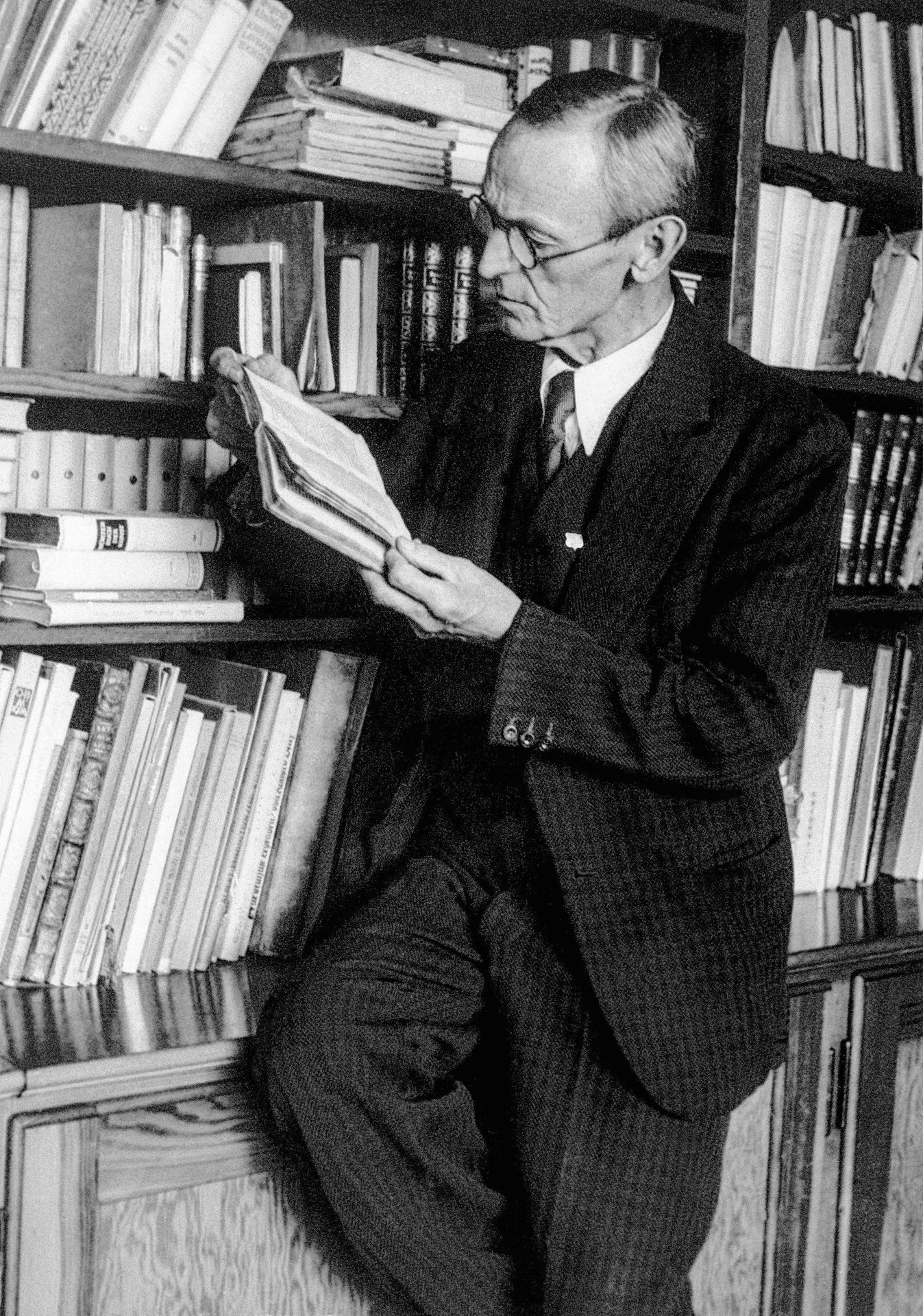
    In Hermann Hesse’s “Steppenwolf,” the loner Harry Haller stumbles across a secret door, inscribed “MAGIC THEATER – NOT FOR EVERYBODY – FOR MADMEN ONLY.” In “The Glass Bead Game,” the game itself, in which scholars strive to achieve perfection through a synthesis of the arts and sciences, is also described as a magic theater.

    This Sunday night on “The Lost Chord,” explore this common thread in Hesse’s novels, with a concerto for horn and orchestra, “The Glass Bead Game,” by James Beckel, and “Music for the Magic Theater,” by George Rochberg.

    Go mad for Hesse. Join me for “Novel Inventions,” this Sunday night at 10:00 EST, on WWFM – The Classical Network and wwfm.org.

  • Space Travel Crossword Celebrate SpaceX Launch

    Space Travel Crossword Celebrate SpaceX Launch

    With the projected launch of SpaceX’s Crew Dragon spacecraft, this Sunday night at 7:27 EST (by coincidence, on the birthday of astronomer and composer William Herschel), this week’s Classic Ross Amico crossword is all about space travel and space exploration.

    To fill out the puzzle, follow the link and select “solve online” at the bottom of the page. You’ll then be able to type directly into the squares. Once you feel you’ve exhausted the puzzle, you’ll find the solutions by clicking on “Answer Key PDF.”

    Commence the classical music countdown here:

    https://www.armoredpenguin.com/crossword/Data/2020.11/1514/15145144.060.html

  • Film Noir Shadows & Moral Ambiguity

    Film Noir Shadows & Moral Ambiguity

    This week on “Picture Perfect,” as the shadows lengthen, we revisit the world of film noir, a genre notoriously slippery to define, but easy to know when you see it – with its long shadows and moral ambiguities; cock-eyed camera angles and snappy repartee; isolation and innuendo. It’s a genre where a pair of gams is an invitation to the gallows; where a man’s best friend – and sometimes his worst enemy – is his Colt .38; where only cigarettes and bourbon can ease the pain.

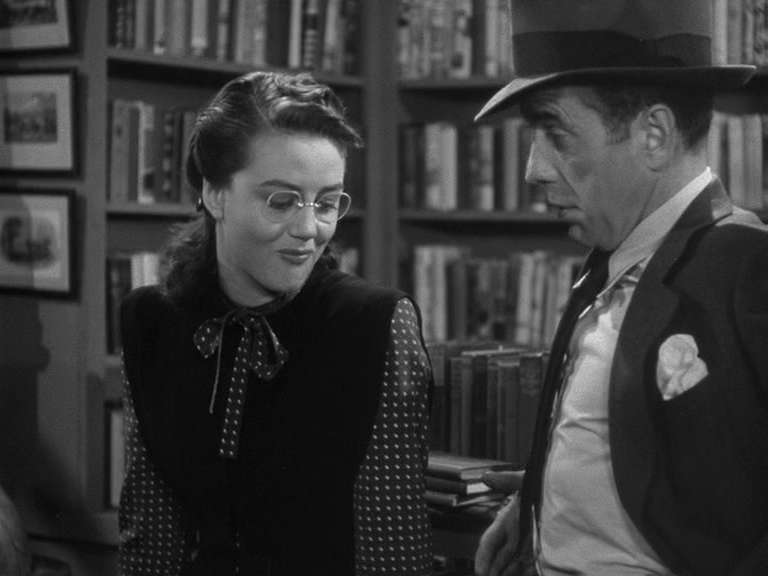
    The labyrinthine mystery at the heart of “The Big Sleep” (1946) is so disorienting, even the book’s author, Raymond Chandler, couldn’t tell whodunit. Who cares? Humphrey Bogart and Lauren Bacall get some more steamy dialogue to satisfy fans of “To Have and Have Not,” and there’s plenty of Bogey pounding the pavement and tossing off tart one-liners in pursuit of the truth. But my favorite scene involves Dorothy Malone, who runs the hottest bookstore in town.

    Whenever there are gallows to be built or gangsters to be beaten, Warner Brothers could be counted on to assign Max Steiner.

    “Chinatown” (1974) is one of the best of the neo-noirs of the 1970s. This time, Jack Nicholson plays private dick J.J. Gittes, who takes on a seemingly routine case that begins to spiral out of control. When producer Robert Evans rejected Philip Lambro’s original score, Jerry Goldsmith stepped in as a last-minute replacement. The composer was hired with the understanding that he had only ten days to write and record new music. For his effort, Goldsmith received an Academy Award nomination.

    The Coen Brothers clearly love noir, from their first feature, “Blood Simple,” to their Academy Award winners, “Fargo” and “No Country for Old Men,” to their absurdly entertaining reimagining of “The Big Sleep,” “The Big Lebowski.” “Miller’s Crossing” (1990) was one of the more underappreciated of these. The film follows the well-worn device of an anti-hero playing two sides off of one another, until he is the last one standing – shades of Dashiell Hammett’s “Red Harvest,” with a healthy dose of “The Glass Key” thrown in, for good measure. The Irish-inflected score is by Coen regular Carter Burwell.

    Before he became stereotyped as a composer for epic films like “Ben-Hur,” “King of Kings” and “El Cid,” Miklós Rózsa was the king of noir, providing scores for genre classics such as “Double Indemnity” and “The Strange Love of Martha Ivers.” We’ll hear a suite assembled from three such projects: “Brute Force” (1947), a hard-hitting prison drama, starring Burt Lancaster as a desperate inmate and a contemptible Hume Cronyn as a sadistic guard; “The Killers” (1946), also starring Lancaster as a marked boxer; and “The Naked City” (1948), with Barry Fitzgerald leading a police investigation into the murder of a young model. The suite is titled “Background to Violence.”

    Put on your rumpled linen suit, draw the Venetian blinds, and play the sap for nobody this week. It’s film noir in the gritty city, on “Picture Perfect,” music for the movies, this Saturday evening at 6:00 EST, on WWFM – The Classical Network and at wwfm.org.


    The theatrical trailer for “Brute Force”:

    PHOTO: Bogart and Malone talk literature

  • Aaron Copland Birthday Celebration

    Aaron Copland Birthday Celebration

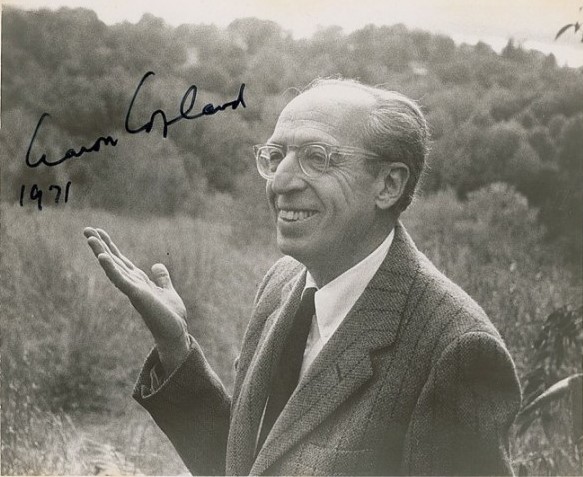
    How fortunate that one of our greatest composers lived through an era when so much could be documented on film. With Thanksgiving right around the corner, I’ve assembled a Copland cornucopia, for his birthday.

    Copland conducts “El Salón México,” for his 60th

    Bernstein introduces Copland’s Clarinet Concerto

    Copland conducts it in L.A., with Benny Goodman the soloist
    https://www.youtube.com/watch?v=iYwPJrRnGSE

    Copland plays his Piano Concerto, with Bernstein conducting

    Copland conducts “Appalachian Spring” in D.C. on his 80th

    Copland at home, playing the coda to “Appalachian Spring”

    “Aaron Copland: A Self Portrait”

    Seiji Ozawa conducts Copland’s arrangement of “Happy Birthday” for Bernstein’s 70th

    Happy birthday, Aaron Copland!

Tag Cloud

Aaron Copland (93) Beethoven (95) Composer (114) Film Music (137) Film Score (143) Film Scores (255) Halloween (94) John Williams (195) KWAX (229) Leonard Bernstein (103) Marlboro Music Festival (125) Movie Music (152) Mozart (88) Opera (208) Philadelphia Orchestra (89) Picture Perfect (174) Princeton Symphony Orchestra (108) Radio (88) Ross Amico (244) Roy's Tie-Dye Sci-Fi Corner (290) The Classical Network (101) The Lost Chord (268) Vaughan Williams (103) WPRB (396) WWFM (881)

DON’T MISS A BEAT

Receive a weekly digest every Sunday at noon by signing up here


RECENT POSTS