Category: Daily Dispatch

  • Monster Movies and My Inner Childhood

    Monster Movies and My Inner Childhood

    As any student of psychology is well aware, we’ve all got monsters inside us. In my case, monsters, to great extent, have made me what I am.

    Before classical music, before comic books, there were monster movies. I watched the old Universal horror films as a small child, sitting on the couch next to my mother – “Dracula,” “Frankenstein,” “The Mummy,” “The Wolfman,” “The Invisible Man.” Monsters became an obsession with me throughout my boyhood. I caught every creature feature on Saturday afternoons. I read Forrest Ackerman’s Famous Monsters of Filmland. I even put together my share of Aurora monster models, with their glow-in-the-dark accessories. (I remember being dissatisfied with the Wolfman’s glowing head, which really didn’t match the body, so I borrowed some of my mom’s paints to create the semblance of fur, leaving only the face exposed. Of course, it was oil paint, so it smelled and took forever to dry.)

    Apparently I wasn’t alone. It astonishes me to look back now and realize the hold that these movies of the ‘30s and ‘40s still had on us children, in particular boys, in the early 1970s. Why were these 40 year-old films still so compelling? Well, they were atmospheric, for one. Later, I would compare them to dreams, and the older they were, and the murkier they were, the more potent I found them to be. When I discovered “Nosferatu,” presented one Halloween in a darkened auditorium at school, it took monsters to a whole other level. Of course, I never missed a showing of “King Kong” (my grandmother would allow me to eat in front of the television), and I remember my uncle taking pity on me once, arguing my case, so that my parents came back and got me out of bed, so that I could stay up and watch Henry Hull in “The Werewolf of London.” I was a purely black-and-white guy back then – which meant no Hammer! Too lurid and far too much blood.

    Of course, we all only had a few channels in those days, and these films were still in heavy rotation. So the young were exposed to a lot of what entertained their grandparents, and their parents found enjoyment in it too. To some extent it provided a pop cultural foundation, so that, whether we knew it or not, three generations were all drawing on shared experience. Personal preferences may have varied, depending on a viewer’s age, with Pap drowsing to westerns, Mom tuning in to Sonny and Cher, and the kids watching Saturday morning cartoons, but we were all familiar with Bette Davis and Bugs Bunny and the Bowery Boys. I liked TV a lot better back then.

    The Universal classics were spooky, no doubt, but also somehow reassuring. They were like shadow plays, they were cathartic, and they became part of my everyday life. Two movies, however, really got under my skin and freaked me out, and both of them were based on stories by writers who were still very much active – although of course I didn’t know it at the time. One was “The Last Man on Earth” (1964), with Vincent Price fighting a world full of post-apocalyptic vampires. This, I would later learn, was based on the book “I am Legend,” by Richard Matheson. Matheson had written some of the most memorable “Twilight Zone” episodes (including the one with the gremlin that taunts airborne William Shatner), as well as the stories for what became “The Incredible Shrinking Man,” “The Legend of Hell House,” and “Trilogy of Terror,” among many, many others.

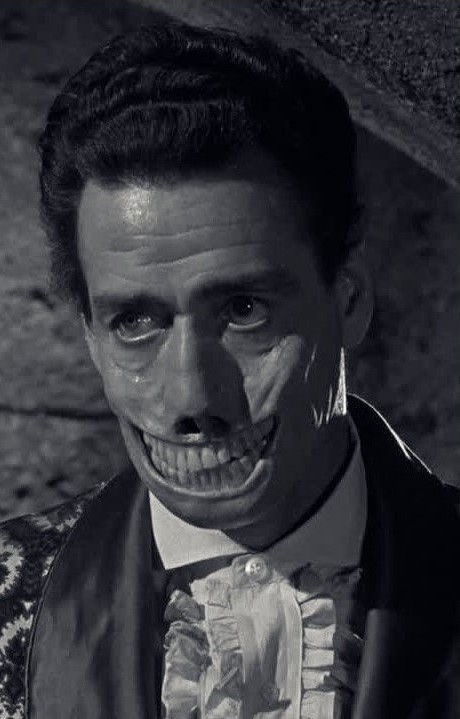
    The other film I found particularly disturbing was “Mr. Sardonicus” (1961). A cruel lord of a skull-like castle inflicts terror upon its inhabitants because of his frustrations over a horrible disfigurement. A specialist is summoned from London in a last-ditch effort to find a cure. As incentive, Sardonicus devises further hideous tortures, to be inflicted upon his young wife, whom the specialist transparently loves. Sardonicus’ make-up is impressionable – or at least it would have been to a boy in the ‘70s – as is his over-the-top cruelty. He is a marvelous villain in the melodramatic tradition, and the movie builds to a satisfying twist.

    William Castle was producer and director. Castle was notorious for spicing up his B-movie entertainments with in-theater gimmicks, like electric buzzers installed under the seats, skeletons sent flying over his audiences, and calculated “fright breaks,” or sustained pauses to scream away the “tinglers.”

    For “Mr. Sardonicus,” Castle himself appears toward end of the film to address the audience, asking us to vote for the villain’s punishment or acquittal. In the theater, apparently, glow-in-the-dark ballots were distributed to patrons. Really, though, can there be any other resolution than Sardonicus’ condemnation and death? It’s believed that no other ending was ever filmed. That William Castle was a genius!

    Is this someone you want in charge of an election? In this instance, definitely! Obviously Castle’s films had a high camp quotient. It’s not for nothing that some of the best starred Vincent Price. But at 9 or 10, all I saw was that horrible grin, and Sardonicus’ harsh but wholly deserved fate.

    The screenplay was by Ray Russell, based on his own story. Stephen King once proclaimed “Sardonicus” perhaps the finest example of the modern gothic ever written. In the original, Russell has got his Edgar Allan Poe down pat – as pastiche, it’s virtuosic – and for any fan of this type of fiction, it’s a hell of a lot of fun.

    The story “Sardonicus” actually first appeared in Playboy, believe it or not, in 1961. Anyone who ever wryly remarked that they purchased Playboy for the fiction was not being half as witty as they thought they were. Russell was hired as Playboy’s fiction editor in the 1950s. In that capacity, he championed the work of many science fiction, fantasy, and horror writers. He also attracted cult favorites like Jack Kerouac and Kurt Vonnegut. James Baldwin, Saul Bellow, Nadine Gordimer, Bernard Malamud, Vladimir Nabokov, Joyce Carol Oates, John Updike, and countless others would eventually submit stories to the magazine.

    In 1962, Russell wrote a book called “The Case Against Satan,” which anticipated William Peter Blatty’s “The Exorcist” (which has essentially the same plot) by nearly a decade. He scored another success in 1976 with “Incubus.” Along the way, both he and Matheson padded their bank accounts by writing screenplays for Roger Corman.

    I first encountered the story “Sardonicus” decades ago, before the internet, when I spent much of my time haunting used bookstores in search of supernatural fiction. A lot of the classics that were always being referenced in horror histories were not at all easy to come by. Dover had published many of them in affordable trade paperbacks, but a lot of them had gone out of print. It was during these years that my heart would be set racing by the sudden discovery of any Sheridan LeFanu I had not yet read. Once, I even came across a hardbound volume of H.P. Lovecraft. But my greatest coup in this regard must be the time I purchased an entire set of hardbound Arthur Machen from a homeless man who used to set up a blanket of books next to the old TLA Video, on Locust Street near 16th, in Philadelphia.

    This unlikeliest of booksellers went by the name of Spider. Cities can good places to stumble across abandoned treasures. Many was the time that I would add another bookshelf or bureau to my furnishings, simply because they were left behind in a move. Spider used to patrol streets and dumpsters in search of saleable inventory, and I’ll be damned if he didn’t turn up Machen. None of these were available in any form that I knew of, except perhaps for a few anthologized short stories, and occasionally a secondhand copy of “The Great God Pan.” My heart was pounding and my palms sweating as I forked over the cash.

    Those were different times, my friends. That which was marginalized in the past (specifically science fiction, fantasy, and horror) has since become mainstream. Now Lovecraft can be purchased as a bargain book at Barnes & Noble. What has become truly damaging to the movies – where everything, it seems, is apocalyptic, superheroic, or simply loud, stupid fantasy – has been a boon to lovers of lost supernatural fiction.

    Surely, some sort of tipping point was reached when Penguin Classics, no less, began to embrace authors like M.R. James, Algernon Blackwood, and Lord Dunsany. Of course, some of the romance has been sacrificed along with all the dust and the thrill of the chase, but it’s great to live in an age when these things are now readily available, and at an affordable price. The volume devoted to Russell is titled “Haunted Castles: The Complete Gothic Stories.”

    Interestingly, after serving in the Pacific with the U.S. Army Air Corps during World War II, Russell also attended the Chicago Conservatory of Music. I love that. In “Sardonicus,” there is an exchange about Verdi and a name-drop of Louis Moreau Gottschalk.

    Another story, “Comet Wine,” is a reworking of the Faust tale, as applied to the milieu of the Mighty Handful. In fact, a sizeable portion of the story is set at a salon at the residence of Nikolai Rimsky-Korsakov. Russell works in some amusing details about the Russian Five and their cool regard of Tchaikovsky. Mussorgsky has a colorful bit. Borodin is glimpsed. Cui comes in for a dismissive insult. But there is something downright diabolical in the plight of poor Balakirev. There are also some observations by one of the characters on the negative influence of Pushkin on Russian opera. The story is told in epistolary form, and the year of the letters is established from a reference in one of them to the recent premiere of Tchaikovsky’s “Eugene Onegin” (in March 1879).

    Amusingly, we learn in a framing device that the letters were purchased at auction, from the estate of the late Francis Cargrave. Cargrave is the grandson of Sir Robert Cargrave, the narrator of “Sardonicus!”

    I have yet to read the other stories in the so-called “S” trilogy – which includes, along with “Sardonicus,” “Sanguinarius” – but Guillermo del Toro, who shares my enthusiasm for this type of thing, highly recommends “Sagittarius.” I am looking forward to reading it tonight. These kinds of stories, and this kind of prose – with a marked affection for the language and the storytelling of the 19th century – are the very things I hunger for in October. It takes me back to my childhood. Which one, I am not so sure.
  • Louis Vierne’s 150th Birthday Celebration

    Louis Vierne’s 150th Birthday Celebration

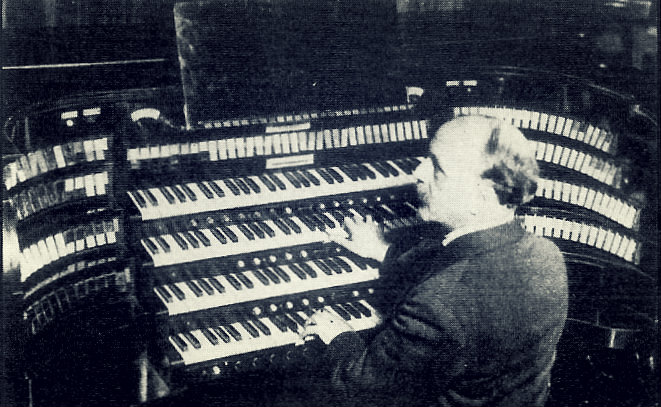
    On June 2, 1937, Louis Vierne had just concluded his 1,750th organ recital, which eyewitnesses claimed had been as fine a concert as he had ever given. He was just about to launch into two improvisations on submitted themes, and had already selected the stops, when all at once he pitched forward. As he collapsed, his foot hit the low E pedal, and the sustained note resounded throughout the vast cathedral. Whether it was a heart attack or a stroke that ended his life is unclear. What matters is that Vierne went out the way he said he had always wanted: he died at the console of the great organ of Notre-Dame de Paris.

    This Thursday, October 8th, will mark the sesquicentenary of the birth of this colossus of the console, and representatives of the organ world will be pulling out all the stops as they celebrate his artistry.

    Organist Christopher Houlihan will anchor a “Vierne at 150” festival, TODAY through October 8th. The four-day event will include online interviews with Notre-Dame organist Olivier Latry, noted scholar and organist Rollin Smith, author of “Louis Vierne: Organist of Notre-Dame Cathedral,” and artist manager Phillip Truckenbrod, who will talk about his 50-year career.

    The series will culminate in a recital of Vierne’s works, with Houlihan at the organ of Trinity College in Hartford, Connecticut, where he serves as organist and director of chapel music. Also included among of the festivities will be a pre-concert lecture and demonstration, a live Q&A, and some archival concert recordings.

    All events will begin at 7:00 p.m. EDT. A complete schedule and streaming information are available at http://www.christopherhoulihan.com.

    Closer to home, on the actual anniversary, Princeton University Organist Eric Plutz will undertake a mammoth organ marathon, offering all of Vierne’s symphonies for the king of instruments on the Skinner organ at Princeton University Chapel. Each of the six works will be presented, in succession, at the top of every hour, beginning Thursday at 4:00 p.m. Again, this is a free event that will be live-streamed.

    You can watch the entire marathon here: https://www.facebook.com/SevenEightArtists.

    An interview with Plutz about “The Vierne Project” appeared yesterday in the organ journal Vox Humana:

    https://www.voxhumanajournal.com/plutz2020.html?fbclid=IwAR3RAvZBN_LZgXUldvdUOcQ-OZppfRHHbTsMPhC4Jp0p5p9jfkzACqjKnYA

    It looks as if we have a boxed set of Plutz recordings of all the Vierne symphonies to look forward to, produced by Princeton’s own Affetto Records!

    COVID may have limited access to live performances, but the internet endures. Get yourself some good bookshelf speakers or an HDMI cord and run it through your television set.

    The manner of Vierne’s demise proved a fitting capstone to a turbulent life. Vierne served as organist of Notre-Dame de Paris for roughly 37 years. Among his students were Nadia Boulanger and Maurice Duruflé. In fact, Duruflé was at his side at the moment of his dramatic leave-taking.

    For years, the legendary organ had been in a sorry state. It was Vierne who undertook a grand tour of the United States in order to raise funds for the instrument’s restoration. Among his stops was the Wanamaker Department Store in center city Philadelphia.

    Vierne was born nearly blind, as a result of congenital cataracts, in 1870. When he came to notate his music, he did so by using outsized manuscript paper. Later, as his eyesight continued to deteriorate, he employed Braille. He endured a painful divorce from his wife, who had left him for his best friend. He also lost a brother and a son during the First World War.

    A street accident resulted in compound fractures to his left leg. The injuries were so bad that for a time it was thought that the limb would have to be amputated. But the leg healed, and Vierne began the arduous process of relearning his pedal technique.

    At a point, he traveled to Switzerland in the hope of improving his eyesight. There, he underwent an advanced treatment that included living in a completely darkened room for six months. Alas, it proved to be unsuccessful.

    He was also a three-pack-a-day smoker, addicted to tranquilizers and sleeping pills, and used ether as a sedative. But for all he went through, and for all he achieved, I think we can forgive Vierne his vices.

    Heroically, he managed to ride out every adversity, and he continued to compose prolifically in nearly all forms. Of course, he is most renowned for his organ works, of which the symphonies serve as essential milestones.

    Celebrate Louis Vierne this week. Here’s a link to his rarely-heard Symphony in A minor (conceived for orchestra this time), composed between 1907 and 1908.

    Joyeux anniversaire, mon vieux!

    Christopher Houlihan, organist
    Eric Plutz: The Vierne Project
    Seven Eight Artists
    Princeton Pro Musica
    Affetto Records
    #Vierne150

  • Broadway Composers Go Classical

    Broadway Composers Go Classical

    Sure, it’s artistically satisfying to perform with the New York Philharmonic and to have one’s works choreographed by Léonide Massine and George Balanchine – but at the end of the day, there’s really nothing like a good popular hit to keep food on the table.

    This Sunday night on “The Lost Chord,” we’ll enjoy concert music by two artists more frequently associated with the musical theater.

    Vernon Duke may be remembered for standards like “April in Paris” and “Autumn in New York,” with his greatest stage success being the Broadway musical “Cabin in the Sky.” However, his early ambition was to become a “serious” composer.

    Born Vladimir Dukelsky in what in now Belarus in 1903, Duke studied composition with Reinhold Gliere. His music was championed by Serge Koussevitzky and admired by Sergei Prokofiev. Indeed, Duke continued to write works for the concert hall (as Dukelsky) right up into the 1950s.

    In 1921, he arrived in New York City, where he was befriended by George Gershwin. It was Gershwin – himself born Jacob Gershowitz – who suggested Dukelsky’s nom de plume. Thereafter, Duke/Dukelsky lived a double-life, Duke writing for popular consumption and Dukelsky composing symphonies.

    Dukelsky’s Piano Concerto was requested of the 19 year-old by none other than Arthur Rubinstein. Allegedly, Rubinstein and Gershwin were delighted with the piece when they heard it in its two-piano form. Unfortunately, so was impresario Serge Diaghilev. When Diaghilev heard Dukelsky play through it in Paris (with Georges Auric on the second piano), he immediately offered the talented young man a commission to write “Zephyr et Flore” for the Ballets Russes. This led to further offers from London’s West End. As a result, Dukelsky never got around to orchestrating the piece. It was left to pianist Scott Dunn to do so, in advance of some Gershwin centennial concerts in 1999.

    Meredith Willson is best remembered for “The Music Man” and “The Unsinkable Molly Brown.” However, before his success in musical theater, he had been a flutist in the Sousa Band and with the New York Philharmonic. He worked as an orchestrator on Charlie Chaplin’s “The Great Dictator.” He was also a gifted conductor, author, librettist, and humorist. His autobiography, “And There I Stood with my Piccolo,” became a bestseller.

    Willson composed two symphonies, both of them extended love letters to California landmarks. His Symphony No. 1 pays tribute to San Francisco. The Symphony No. 2, the one we’ll hear this evening, is evocative of the missions of Southern California, with individual movements devoted to Junipero Serra, San Juan Bautista, San Juan Capistrano, and El Camino Real.

    I hope you’ll join me for “Broad Talents from Broadway” – musical theater composers hang on to their day jobs – this Sunday night at 10:00 EDT, on WWFM – The Classical Network and wwfm.org.


    Dawn Upshaw sings “Autumn in New York”

    Count Basie performs “April Paris”

    Basie welcomes Sheriff Bart

    “The Music Man,” Overture/Rock Island

    “76 Trombones” – for 76 trombones!


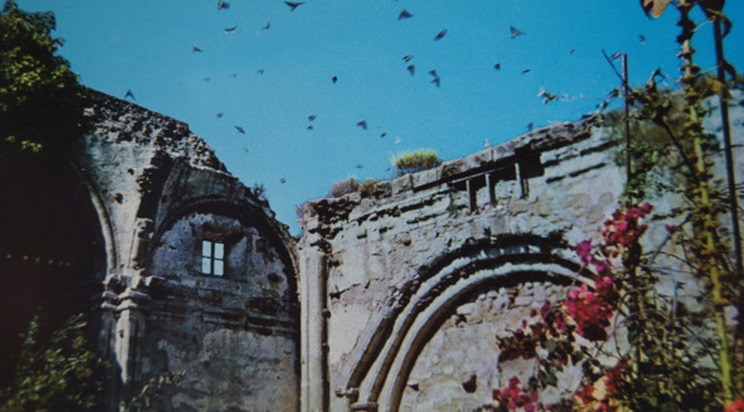
    PHOTO: Are these menacing vampire bats, flittering about the ruins of Castle Dracula? No, they’re just the swallows, come back to Capistrano.

  • October Crossword Sci-Fi Music Puzzle

    October Crossword Sci-Fi Music Puzzle

    October. No other month makes the fantastic seem more tangible. The silvery light, the crisp autumn air, the lengthening shadows spur one to activity, creativity, and reflection. With Halloween as their mastering spirit, the 31 days are by turns ebullient, prankish, and frolicsome. Earth and trees are decked in motley. Life and landscape are transformed.

    This month’s Classic Ross Amico crosswords will celebrate music and the imagination, beginning today with a hot cider toast to the astonishing influence of science fiction.

    To fill out the puzzle, follow the link and select “solve online” at the bottom of the page. You’ll then be able to type directly into the squares. Once you feel you’ve exhausted the puzzle, you’ll find the solutions by clicking on “Answer Key PDF.”

    Klaatu barada nikto! Test your knowledge of “Hi-Fi Sci-Fi” here:

    https://www.armoredpenguin.com/crossword/Data/2020.10/0407/04073509.417.html

  • Circus Movie Music Vampire Circus & More

    Circus Movie Music Vampire Circus & More

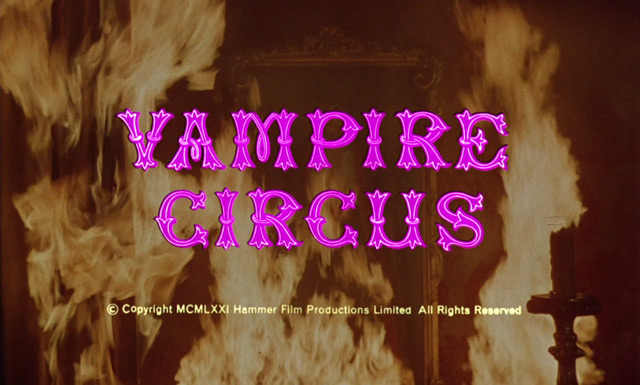
    And you thought clowns were scary! Join me for a suite from David Whitaker’s score for “Vampire Circus,” on this week’s “Picture Perfect.”

    It’s part of an hour of music from movies set under the Big Top, including “The Greatest Show on Earth” (Victor Young), “Trapeze” (Malcolm Arnold), “La Strada” (Nino Rota), “Big Top Pee-Wee” (Danny Elfman), and “7 Faces of Dr. Lao” (Leigh Harline).

    That’s a clown car full of calliopes! The circus train rolls into town this week, on “Picture Perfect” – now at a new time – SATURDAY EVENING AT 6:00 EDT, on WWFM – The Classical Network and wwfm.org

Tag Cloud

Aaron Copland (93) Beethoven (95) Composer (114) Film Music (137) Film Score (143) Film Scores (255) Halloween (94) John Williams (195) KWAX (229) Leonard Bernstein (103) Marlboro Music Festival (125) Movie Music (152) Mozart (88) Opera (208) Philadelphia Orchestra (89) Picture Perfect (174) Princeton Symphony Orchestra (108) Radio (88) Ross Amico (244) Roy's Tie-Dye Sci-Fi Corner (290) The Classical Network (101) The Lost Chord (268) Vaughan Williams (103) WPRB (396) WWFM (881)

DON’T MISS A BEAT

Receive a weekly digest every Sunday at noon by signing up here


RECENT POSTS