Category: Daily Dispatch

  • Rachmaninoff’s Francesca da Rimini Online

    Rachmaninoff’s Francesca da Rimini Online

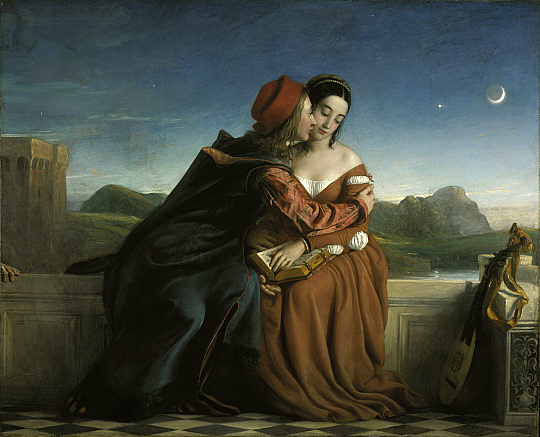
    As a kind of addendum to its month of Sunday operas, The Princeton Festival is offering, for today only, Sergei Rachmaninoff’s rarely-heard one-acter “Francesca da Rimini,” streamed as part its special COVID-imposed “Virtually Yours” season.

    When “Francesca” was presented at McCarter Theatre in 2012, it was as the first half of a double-bill with Puccini’s “Gianni Schicchi” – clever programming, since both works have ties to Dante.

    As always with the Princeton Festival, the production was well-performed and staged, with, in this instance, evocative medieval sets and costumes. Also, in its vision of Hell, I remember thinking at the time that it was very much of a piece with the famous paintings and illustrations inspired by “Inferno.”

    The lighting is a bit dim in this archival video, but it’s still worth watching, and certainly worth hearing. All in all, a good opera to get you in the spirit for St. John’s Eve…

    https://princetonfestival.org/digital-event/rachmaninoffs-francesca-da-rimini/

    Here’s a preview I wrote for the Trenton Times:

    https://www.nj.com/times-entertainment/2012/06/princeton_festivals_operatic_t.html

    The last of this year’s Princeton Festival operas, “The Flying Dutchman,” featuring bass-baritone Mark Delavan, will stream this Sunday at 1 p.m. EDT. For more information and a complete schedule, look online at princetonfestival.org.

  • Gogol St. John’s Eve Summer Reading

    Gogol St. John’s Eve Summer Reading

    So Saturday was the first day of summer?

    The calendar I’m using this year doesn’t have any holidays printed on it, which I suppose is only appropriate for life in Coronaworld, where every day runs into another.

    Be that as it may, the seasons are not governed by the calendar, and like a creature of the wild, I know it’s summer when my blood pressure begins to rise with the sun. Surely, this is something the ancients also felt, which is why we have St. John’s Eve.

    It was the Romans who marked the summer solstice as June 24th. This meant the night of the 23rd was yet another excuse for a great big toga party. Pagans throughout the empire lit bonfires against evil spirits, and even dragons, and folk traditions sprang up related to prognostication and fertility.

    Later, the Church coopted the 24th for its observance of the Feast Day of St. John. This worked out very nicely, since St. Luke suggested that the birthday of John the Baptist fell six months before that of Jesus. As with Hallowe’en, a pagan festival was hitched to a holy one (in that case, All Saints Day). Sometimes diverting a stream is easier than outright dam(n)ing it.

    As a classical music lover, for years I have been curious about “Evenings on a Farm Near Dikanka,” as the title is usually translated. Nikolai Gogol’s collection of tales, steeped in Ukrainian folklore, are overstuffed with devils, witches, water nymphs, and roistering Cossacks. The stories formed the basis for operas by Modest Mussorgsky (“Sorochinsky Fair”), Nikolai Rimsky-Korsakov (“May Night” and “Christmas Eve”), and Peter Ilych Tchaikovsky (“Cherevichki”).

    Well, this year I finally got around to reading it, and it wasn’t quite what I expected. Amusingly, the supernatural elements, which are plenty, are offset by frequent satirical observations and earthy farce. There’s a lot of drinking and a lot of hiding from husbands in coal sacks. Even lusty devils receive their comeuppance. All the same, there are one or two shockingly gruesome moments.

    Gogol can be wry. He can certainly be garrulous. But he is also very much a poet, as evidenced by his lyrical observations on the Dnieper and soft Ukrainian summer nights. That said, one of the stories takes place on Christmas Eve. At least two are set on St. John’s Eve.

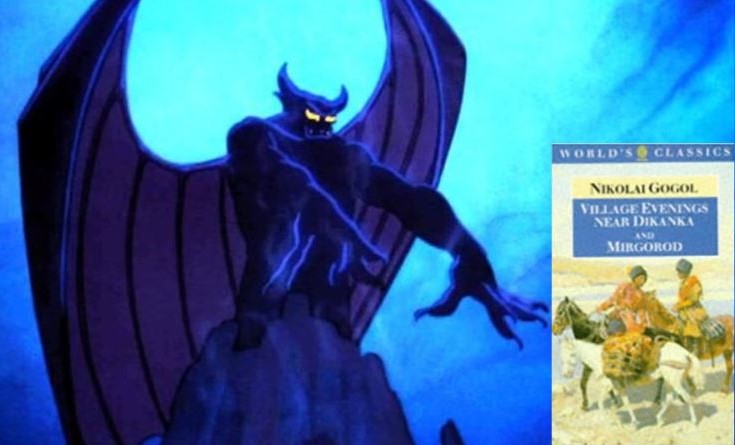
    It wasn’t easy to find an affordable copy of this Oxford paperback (pictured), which has gone out of print. I’ve been fond of these World’s Classics editions since reading Oxford’s “The Count of Monte Cristo,” “The Three Musketeers,” and “Queen Margot,” which were full of helpful notes. (Oxford’s “The Pickwick Papers,” I must say, was much more slovenly notated.) In this instance, there’s not really a lot you need to know that isn’t on the page. I don’t read Russian, it’s true, but the translation “sounds” very well, and it seems idiomatic.

    The Oxford edition also includes the collection “Mirgorod,” which I have yet to tackle. Its most famous tale is “Taras Bulba,” which became the basis for the orchestral rhapsody by Leoš Janáček.

    I should probably also mention that while there is nothing in “Dikanka” that is outright antisemitic, Gogol never misses an opportunity to single out Jews – to be fair, by way of his admittedly rustic characters. And while there is nothing openly derogatory in their treatment, it is evident that they are regarded as outsiders. They are always referred to as “a Jew” or “the Jew.” This is, after all, the world of the Cossacks. But, remarkably, there appears to be no disdain. Certainly, the Poles and the Tatars come in for a lot worse!

    For as entertaining as I found the collection, with its unexpected humor, the experience really underscored how much Mussorgsky, Rimsky, and Tchaikovsky fleshed out Gogol’s narratives with their music. All three composers managed to conjure the author’s poetic flights in a way no libretto possibly could.

    Interestingly, the most famous music connected to the book is “A Night on Bald Mountain,” a comparatively youthful work, written when Mussorgsky was 28 years-old. The composer completed the piece, about a witches’ sabbath on St. John’s Eve, ON St. John’s Eve in 1867. It then went through several versions, as it was inserted into the collaborative opera-ballet “Mlada” and then “Sorochinsky Fair,” inspired by the Gogol story. Sadly, despite his obvious affection for this music, Mussorgsky never heard it performed, in any of its incarnations, during his lifetime.

    Following the composer’s death, however, Rimsky-Korsakov further shaped the material, and arranged the well-known orchestral fantasy, employing as raw material Mussorgsky’s final version, as it appeared in “Sorochinsky Fair.” It is in Rimsky’s revision that it became Mussorgsky’s best-known music – at least until Leopold Stokowski got a hold of it and did his own arrangement for Disney’s “Fantasia.”

    This is a perfect example of just how effective music can be at conjuring a palpable atmosphere of menace, or even terror, as compared to words on a page. There’s not even a Bald Mountain in Gogol’s original, though the supernatural element that looms over the collection as a whole more than justifies Mussorgsky’s artistic license.

    All in all, it’s a book worth getting to know – with the shutters secured and a bucket of horilka at your side. Happy St. John’s Eve!
  • Met Opera Streams: Why Cendrillon is a Must-See

    Met Opera Streams: Why Cendrillon is a Must-See

    My pick of the week from the current batch of Metropolitan Opera HD encores may seem like a slight one – especially in a week full of notable diversions – but I’m going with Jules Massenet’s “Cendrillon.”

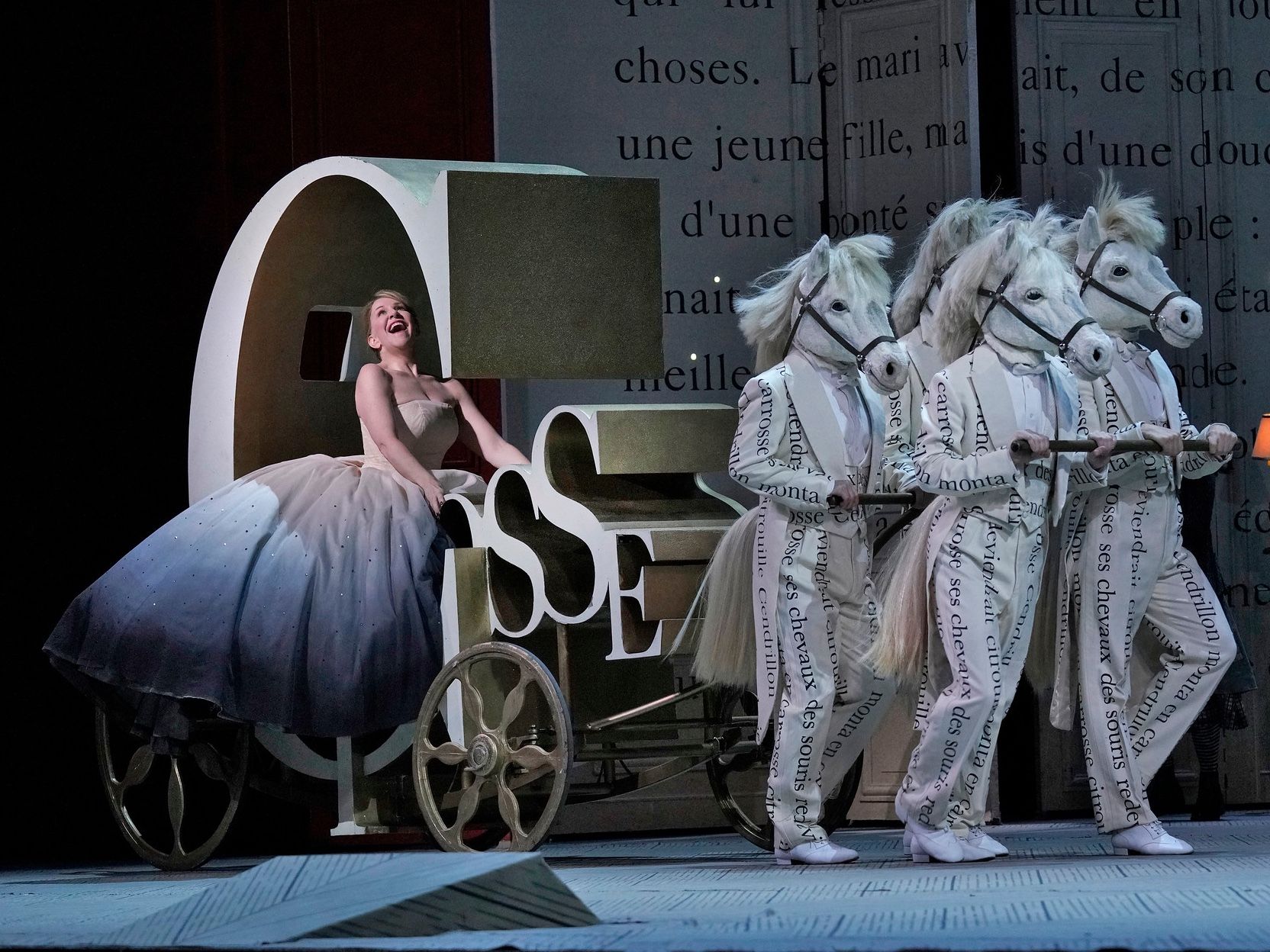
    This Cinderella springs from the page, with literal writing on the walls and a team-and-carriage rendered in typeset. Also, a playfully-imagined gallery of fairy tale grotesques in the supporting cast. There is a charm to Laurent Pelly’s staging that I find refreshing in an era when seemingly everything has to trend toward the dark. If you’re a fan of classic children’s book illustrations, don’t miss this one. With Joyce DiDonato in the lead – and Stephanie Blythe as the wicked stepmother – it’s difficult to resist.

    Massenet is star of the week, apparently, since there also happens to be a “Manon” – admittedly side-by-side with John Adams’ “Doctor Atomic,” and Pavarotti and Kathleen Battle in Donizetti’s “L’Elisir d’Amore.”

    The Met has pledged to stream free opera for the duration of the house’s shutdown. Each opera is accessible for approximately 23 hours, starting every day around 7 p.m. EDT. Philip Glass’ “Satyagraha” streams through 6 p.m. today, at metopera.org.

    Here’s a complete schedule of this week’s offerings. You’ll find teasers and bonus materials when following the link:

    https://www.metopera.org/user-information/nightly-met-opera-streams/week-15/

    Monday, June 22
    Verdi’s La Traviata
    Starring Sonya Yoncheva, Michael Fabiano, and Thomas Hampson, conducted by Nicola Luisotti. From March 11, 2017.

    Tuesday, June 23
    John Adams’s Doctor Atomic
    Starring Sasha Cooke, Thomas Glenn, Gerald Finley, and Richard Paul Fink, conducted by Alan Gilbert. From November 8, 2008.

    Wednesday, June 24
    Saint-Saëns’s Samson et Dalila
    Starring Elīna Garanča, Roberto Alagna, Laurent Naouri, Elchin Azizov, and Dmitry Belosselskiy, conducted by Sir Mark Elder. From October 20, 2018.

    Thursday, June 25
    Massenet’s Manon
    Starring Lisette Oropesa, Michael Fabiano, Carlo Bosi, Artur Ruciński, Brett Polegato, and Kwangchul Youn, conducted by Maurizio Benini. From October 26, 2019.

    Friday, June 26
    Donizetti’s L’Elisir d’Amore
    Starring Kathleen Battle, Luciano Pavarotti, Juan Pons, and Enzo Dara, conducted by James Levine. From November 16, 1991.

    Saturday, June 27
    Massenet’s Cendrillon
    Starring Kathleen Kim, Joyce DiDonato, Alice Coote, Stephanie Blythe, and Laurent Naouri, conducted by Bertrand de Billy. From April 28, 2018.

    Sunday, June 28
    Mozart’s Die Zauberflöte
    Starring Golda Schultz, Kathryn Lewek, Charles Castronovo, Markus Werba, Christian Van Horn, and René Pape, conducted by James Levine. From October 14, 2017.

  • WWFM Shows Return Thanks to Rachel Katz

    WWFM Shows Return Thanks to Rachel Katz

    Since the COVID tsunami broke across central New Jersey, I have not been able to get in to the station to upload webcasts from my two specialty shows, “Picture Perfect” and “The Lost Chord.” So for months, the most recent shows archived on the WWFM website dated from around St. Patrick’s Day – or roughly the time I began cultivating my coronabeard.

    That now has been remedied, to some extent, thanks to production manager Rachel Katz, who has been working from home, but, every once in a while, has had to don the hazmat suit in order to enter the college and ensure everything continues to fire as it should. Searching for and uploading audio from my overcrowded folder takes time, as does making sure that all the settings are correct, so that the material can be accessed from the WWFM website.

    Rachel has also been instrumental in ensuring that encore broadcasts of “Picture Perfect” and “The Lost Chord” have continued at all, as I have been sending her lists of shows in five-week increments, and again, it is she who has been hunting them down and loading them into the system.

    Most of June (excluding this past weekend) is now available on the station’s webcast page, as is all of May. As far as I can tell, there are only a few weeks – the last two of March, and a couple in April – that are still missing.

    To listen to the shows, follow the links below, select the one you’d like to hear, and click on the “listen” button.

    PICTURE PERFECT

    https://www.wwfm.org/programs/picture-perfect-ross-amico

    THE LOST CHORD

    https://www.wwfm.org/programs/lost-chord-ross-amico

    Again, many thanks to Rachel!

    If you enjoy “Picture Perfect” or “The Lost Chord” or anything else you hear on The Classical Network, please remember that we are coming up on the end of our fiscal year. If what we do enriches the quality of your days, please consider renewing your membership, becoming a new member, or making an additional gift before June 30.

    We understand that times are tough, but any little bit helps. Our survival, and to what degree we are able to rebuild, depends to large extent on the dedication and generosity of our listener-members.

    https://wwwfm.secureallegiance.com/wwfm/WebModule/Donate.aspx?P=DEFAULT&PAGETYPE=PLG&CHECK=vOU2bz5JCWmgCDbf53nm9ezWDeZ%2BeA1M&fbclid=IwAR2jrLX9uQdBGePKuycNVLIxABZRKX5orE0_PzHa9sIfgPUusaO2zyyI_gM

    Thank you, as always, for your ongoing support of WWFM – The Classical Network and wwfm.org!

  • Father’s Day Sports Music on The Lost Chord

    Father’s Day Sports Music on The Lost Chord

    Happy Father’s Day! This Sunday night on “The Lost Chord,” we pay tribute to Dad, with an hour of music about sports.

    I realize it’s a possibility that not all dads necessarily like sports. However, it’s been my experience that Sunday afternoons and Monday nights have always been off-limits, as far as the family television is concerned. For me personally, that meant that after Abbott and Costello or the Bowery Boys, it was football, golf, or “Wide World of Sports,” and that I never saw “MAS*H” during its first run.

    Be that as it may, it’s Dad’s day, so we’re going to give him what he wants – an hour of rough-and-tumble, the thrill of victory, and the agony of defeat.

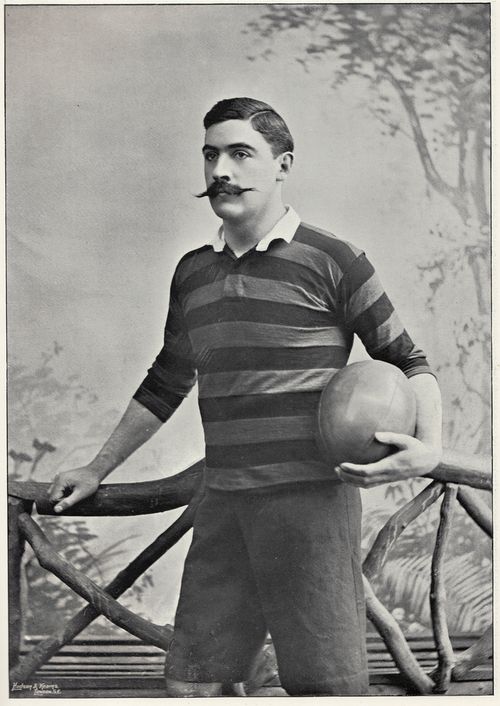
    We’ll hear “Rugby” by Arthur Honegger, “Half-Time” by Bohuslav Martinu,” “The Yale-Princeton Football Game” by Charles Ives, and highlights from the baseball opera “The Mighty Casey” by William Schuman.

    Combine with a La-Z-Boy and a cold beer, and it’s a recipe for dad contentment. I hope you’ll join me for “Good Sports,” this Sunday night at 10:00 EDT, on WWFM – The Classical Network and wwfm.org.

Tag Cloud

Aaron Copland (93) Beethoven (95) Composer (114) Film Music (137) Film Score (143) Film Scores (255) Halloween (94) John Williams (195) KWAX (229) Leonard Bernstein (103) Marlboro Music Festival (125) Movie Music (152) Mozart (88) Opera (208) Philadelphia Orchestra (89) Picture Perfect (174) Princeton Symphony Orchestra (108) Radio (88) Ross Amico (244) Roy's Tie-Dye Sci-Fi Corner (290) The Classical Network (101) The Lost Chord (268) Vaughan Williams (103) WPRB (396) WWFM (881)

DON’T MISS A BEAT

Receive a weekly digest every Sunday at noon by signing up here


RECENT POSTS