If the weather’s unstable where you are, just be glad you’re not on Mars!
Here’s Roy and my hashing-over of the cult classic “Robinson Crusoe on Mars.” SPOILER ALERT: We reveal the fact that Adam West dies within the opening minutes of the show. Holy inconsideration, Batman!
Roy’s Tie-Dye Sci-Fi Corner live-streams on Facebook most every Friday and Sunday at 7 pm EDT. I hasten to add that Roy will be taking off tomorrow night. We will reconvene next Friday to talk about the mission-to-Mars conspiracy thriller “Capricorn One!”
Today is the 100th anniversary of the birth of Charlie Parker. Immortalized in jazz history as one of the progenitors of bebop, more to the point for his listeners is the virtuosity, invention, and soul he brought to his playing.
This album was a little bit of a curveball for Bird, but it works marvelously. Here Parker performs with an ensemble made up of members of the NBC Symphony, the Pittsburgh Symphony, and the Minneapolis Symphony Orchestras, joined by Stan Freeman (piano), Ray Brown (bass), and Buddy Rich (drums). The arrangements were by Ray Carroll, and the album was produced by Mitch (“Sing Along…”) Miller, who played oboe and English horn.
You’ll be able to marvel at both this evening, on another Classic Ross Amico double-feature.
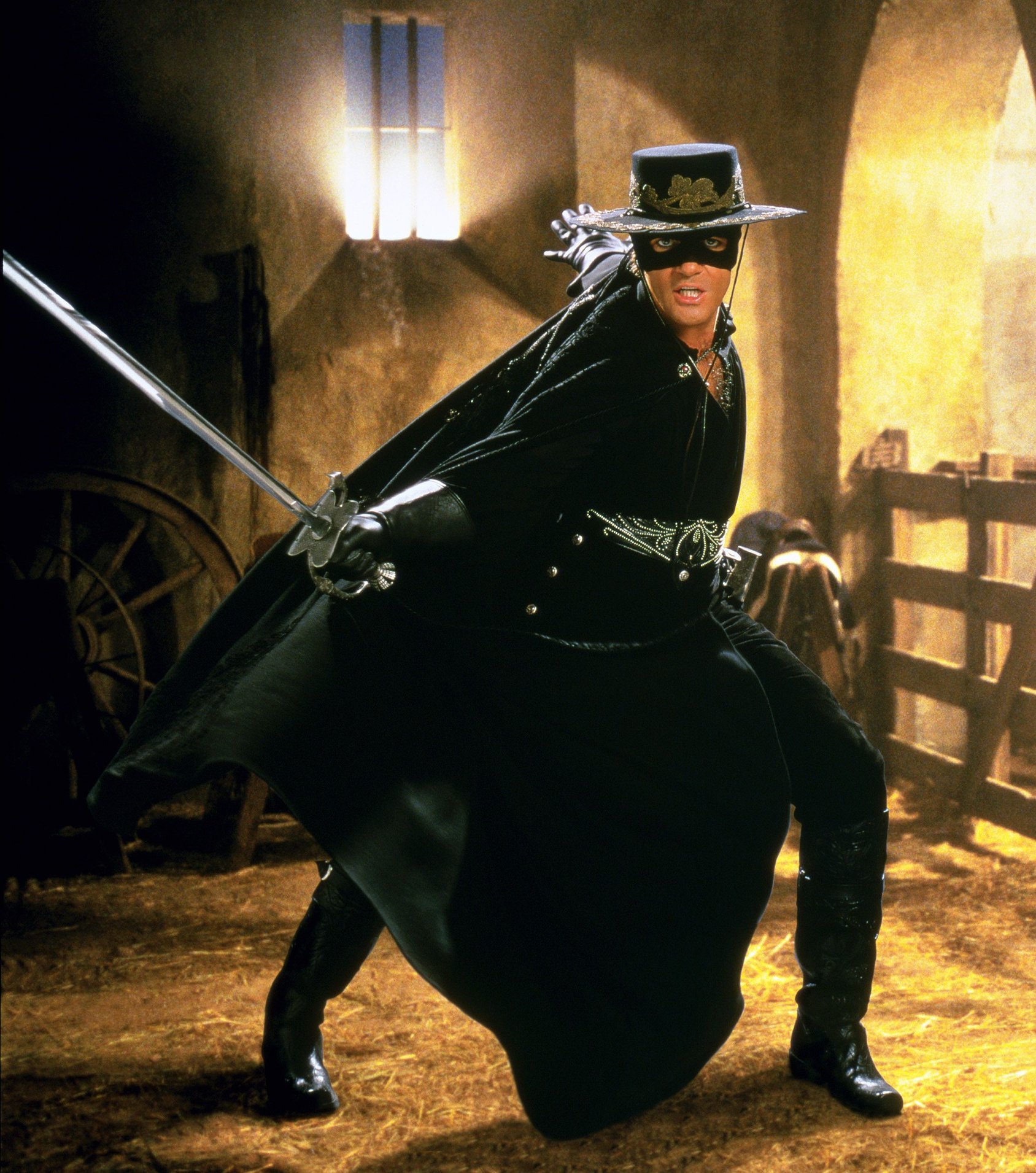
First, Antonio Banderas sends-up his Zorro persona in “Puss in Boots.” We’ll enjoy music from the film, composed by Henry Jackman, alongside selections from James Horner’s score for “The Mask of Zorro.” The balance of the hour will be devoted to Alfred Newman’s music for the Tyrone Power vehicle “Captain from Castile” and Max Steiner’s score for the Errol Flynn classic, “The Adventures of Don Juan.” Gen-Xers may recognize some of the latter from its use in “The Goonies!” Enjoy it this week, on “Picture Perfect,” music for the movies, this Friday evening at 6:00 EDT, on WWFM – The Classical Network and wwfm.org.
Then Roy Bjellquist and I will talk ourselves red-in-the-face about the Red Planet, and “Robinson Crusoe on Mars.” Paul Mantee (who took his stage name from Humphrey Bogart’s Duke Mantee), Victor Lundin (who abandoned an operatic career to become a film actor), and Adam West (soon to be TV’s Batman) test their mettle on a foreign world. But that’s okay, since apparently there’s food and oxygen. As the poster states: “This film is SCIENTIFICALLY AUTHENTIC… It’s only one step ahead of present reality!”
FUN FACT: Barney the Woolly Monkey was outfitted with a fur diaper so that he could effectively play female space simian Mona.
Join us for the Facebook live-stream, and be prepared to exchange comments, at Roy’s Tie-Dye Sci-Fi Corner, tonight at 7:00 EDT!
Due to a mix-up last week, in which my Ennio Morricone show was aired in place of the swashbuckler program I had earlier promoted, “Latin Swords” will be broadcast this evening at 6:00 EDT, on WWFM – The Classical Network and wwfm.org.
Tune in for rousing selections from “Captain from Castile” (Alfred Newman), “The Mask of Zorro” (James Horner), “Puss in Boots” (Henry Jackman), and “The Adventures of Don Juan” (Max Steiner).
On the other hand, if Morricone sounds like the very thing you’ve been hankering for, feel free to pile your plate high with spaghetti westerns at any time, by visiting the “Picture Perfect” webcast page.
Select the show, and then click on the “listen” icon:
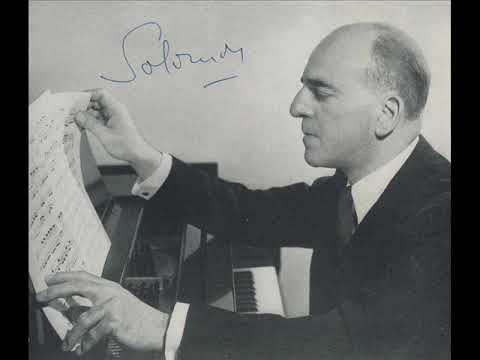
While no doubt wise, this is really Solomon the poet. Solomon of the Song of Songs.
Solomon Cutner was one of those rare classical musicians to be recognized by a single name. A child prodigy who studied with Mathilde Verne, herself a pupil of Clara Schumann, Solomon made his London debut at the age of eight. Verne pushed him hard – perhaps too hard – so that at nine, he was playing Beethoven’s Piano Concerto No. 3 and Liszt’s “Hungarian Fantasy.” At twelve, he appeared on no less than six Prom concerts, as soloist in concertos by, among others, Grieg and Tchaikovsky. The concertos of Schumann and Brahms followed.
Eventually, Verne’s motives were called into question. As the head of her own piano school, she stood to profit from the boy’s preternatural success. However, the relentless pace drove Solomon to exhaustion, anxiety, and a nervous breakdown. Once his five-year contract with her expired, he refused to have any contact with her ever again. In his 70s, he would reflect on how miserable his childhood had been.
Simon Rumschinsky, a pupil of Theodor Leschetizky, helped Solomon to rebuild his technique – and his confidence – so that he was able to pursue further studies in Paris and relaunch his adult career. Solomon’s acclaimed recitals took him far from his native London, to the United States, Australia, South Africa, South America, and Japan. Perhaps he never totally shook the specter of Verne, since he continued to practice for eight or nine hours a day.
Solomon gave the world premiere of Sir Arthur Bliss’ Piano Concerto at Carnegie Hall in 1939 (on the same program that introduced Vaughan Williams’ “Five Variants of Dives and Lazarus” and Sir Arnold Bax’s Symphony No. 7). The concert was presented in conjunction with “British Week” at the New York World’s Fair. He also entertained British troops throughout World War II, in such far-flung locations as North Africa, Palestine, India, Singapore, and Bangkok.
As an interpreter, he was particularly renowned for his Beethoven. Sadly, while in the midst of recording a complete cycle of the sonatas, in 1956, he suffered a stroke that deprived him of the use of his right arm. Though he lived another 32 years, Solomon never recorded or performed in public again. For a pianist who died as recently as 1988, it’s sobering to reflect, little of his repertoire was documented in stereo.
Broadly speaking, Solomon’s was a non-interventionist approach. It was his desire not to place himself too much between the composer and the audience. Therefore, his interpretations can sometimes come across as having more polish than personality. But at his best, he was a great poet of the keyboard.
Here, Solomon performs possibly my favorite Beethoven piano sonata, and an appropriate one, I think, for a late-summer afternoon. I’ve always been particularly fond of the exquisite third movement.