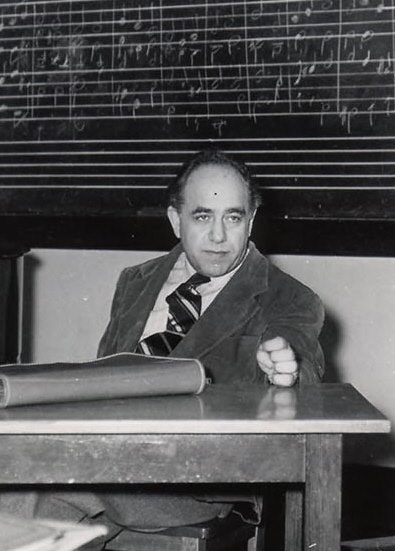
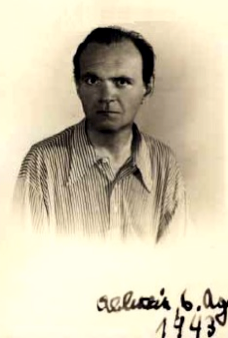
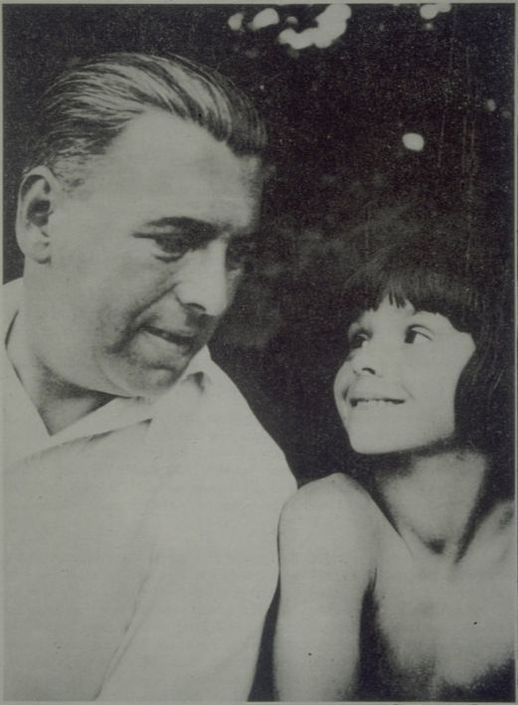
Jewish composer Eric Zeisl fled Austria following the Anschluss in 1938. He went first to Paris, and then New York City. He finally settled in Hollywood, where he found work on a studio assembly line, contributing (often uncredited) to film scores like “The Postman Always Rings Twice” and “Abbott and Costello Meet the Invisible Man.”
At last, he was able to secure some academic appointments that allowed him to return to serious composition. Zeisl’s uplifting “Requiem Ebraico” (1944-5), a setting of Psalm 92, is dedicated to the memory of his “dear father and other victims of the Jewish tragedy in Europe.”
The piece is about 22 minutes in length, but is posted on YouTube in multiple segments. The files should run continuously, one into another, when you follow the link. Hopefully you won’t be bedeviled by ads.
Marcel Tyberg was a forgotten casualty of the Holocaust. A devout Catholic, Tyberg was targeted because one of his grandmother’s great-grandfathers was Jewish (comprising a mere 1/16th of his genetic make-up). The fact was made known only when his mother registered with the German authorities then occupying their hometown, Abbazia, in what was then northern Italy (now Opatija, Croatia).
It’s unclear whether Tyberg himself had any prior knowledge of his great-great grandfather’s ethnicity, but four generations’ remove was not enough to pacify the Nazis. Tyberg was transported to Auschwitz, where his death was recorded on New Year’s Eve, 1944.
Tyberg’s music alone should not have attracted unfavorable notice from the authorities. There is nothing in his compositional output that might have frightened the Führer. Quite apart from the modernism being explored by many of the composers interned in the “artists’ camp” of Terezin – the kind of music the Nazis branded “degenerate” – Tyberg’s symphonies are very much in the Austro-German romantic tradition.
With the likelihood of arrest looming, Tyberg entrusted his manuscripts to his friend, Milan Mihich, an Italian doctor and music-lover. Mihich in turn passed them on to his son. In 2005, Dr. Enrico Mihich, then a specialist at the Roswell Park Cancer Institute in Buffalo, NY, brought the scores to the attention of JoAnn Falletta, music director of the Buffalo Philharmonic Orchestra.
Falletta, in her examination of the manuscripts, discerned what she thought to be real musical worth and gave the first performance of Tyberg’s Symphony No. 3 in 2008. She has since also performed and recorded the Second Symphony – unheard since Rafael Kubelik conducted it back in the 1930s.
Tyberg’s Third Symphony should appeal especially to admirers of Bruckner and Mahler; yet it stands alone as a work of outstanding beauty and, somehow, especially when colored by a knowledge of its history, an expression of hope.
Ilse Weber was a Czech poet who published several books of fairy tales before being interned at Theresienstadt (Terezin) in 1942. There, she began to compose songs, which she sang in the camp’s children’s hospital. Like so many artists who were exploited for propaganda purposes, Weber was later transported to Auschwitz, where she and her son were killed in 1944. It’s said that she sang her lullaby, “Wiegala,” as she voluntarily accompanied children to the gas chamber.
The final lines read:
Viegala, viegala, vill,
Now is the world so still!
No sound disturbs
the sweet calm.
Sleep, my little child,
Sleep too.
Viegala, viegala, vill,
How the world is so still!
Here it is in three different versions:
Sung by Anne-Sophie von Otter
In an arrangement for violin, guitar and double bass
International Trombone Week meets Yom HaShoah, a day of Holocaust remembrance.
At first glance, it may seem wildly incongruous to present music by Erwin Schulhoff – a composer whose life ended in a concentration camp at the age of 48 – with whimsical images of Buster Keaton and Fatty Arbuckle. But in remembering composers who perished in the Holocaust, we risk a tendency to think of them, reductively, as victims, which can inadvertently have the effect of diminishing their overall achievements. These were not artists who created and lived their lives with the expectation of being memorialized for their senseless deaths. I mean no disrespect with this observation. Schulhoff was one of the great musical losses of the Holocaust. But a broader appreciation of his work, if anything, deepens our understanding of what was taken from this world too soon – a vital, creative being, snuffed out, because of a “solution” formulated by a monstrous ideology.
“The Syncopater’s Peter” (1934) for trombone, with Buster Keaton footage
Schulhoff’s String Quartet No. 1 (1924)
The Dada ballet “Die Mondsüchtige,” or “Moonstruck” (1925). The scenario describes a somnambulist dancing across the roofs of Prague with a figure identified as “The Moon Dandy.”
Concertino for Flute, Viola and Double Bass (1925):
Yom HaShoah, an international day of Holocaust remembrance, begins tonight at sunset. Since the day also commemorates heroism and resistance – the observation is linked to the anniversary of the Warsaw Ghetto uprising – it would seem to be appropriate not only to remember those musicians who lost their lives in the camps or as a result of Nazi persecution, but also those who survived to contribute great beauty to the world. Not all of them were Jewish. Some were deemed to be politically, economically, artistically, intellectually, or ethnically undesirable.
The kind of mentality and social instability that made the Holocaust possible is not a thing of past. Unethical leadership, an angry rabble, and a passive citizenry are a dangerous combination. Always remember, and be vigilant.