This week on “The Lost Chord,” we’ll have our final say on the long, gluttonous holiday weekend with Knudåge Riisager’s ballet “Slaraffenland” (usually translated as “Fool’s Paradise”).
Inspired by Bruegel’s painting “The Land of Cockaigne,” the scenario imagines a Promised Land “where roasted pigeons fly around in the air with knives and forks in their backs, and the streets are paved with marzipan and chocolate.” The plot concerns a silly boy who wanders into the country of King Sauce and becomes ill from overindulgence. Along the way, he encounters Robin Hood, the Three Musketeers, Captain Fear, Fountains of Liqueur, Cigarettes, and the Candy Princess.
Riisager was born in 1897 to Danish parents living in Estonia. He studied music at Copenhagen University and then in Paris with Albert Roussel. Though he was a prolific composer, with some 400 works to his name, including symphonies, concertos, chamber music, and songs, he is probably best known, if at all, for his ballets.
Rouse yourself for one last dose of musical tryptophan. Join me for “Fool’s Paradise” – Knudåge Riisager’s “Slaraffenland,” on “The Lost Chord,” now in syndication on KWAX, the radio station of the University of Oregon!
——–
Clip and save the start times for all three of my recorded shows:
PICTURE PERFECT, the movie music show – Friday at 8:00 PM EST/5:00 PM PST
SWEETNESS AND LIGHT, the light music program – Saturday at 11:00 AM EST/8:00 AM PST
THE LOST CHORD, unusual and neglected rep – Saturday at 7:00 PM EST/4:00 PM PST
Stream them, wherever you are, at the link!
https://kwax.uoregon.edu/
——–
IMAGE: A very Bruegel Thanksgiving
Category: Daily Dispatch
-

One Last Dose of Musical Tryptophan on “The Lost Chord”
-

On “Sweetness and Light”: The Thanks That Keeps on Giving
Okay, we survived Thanksgiving. Although, of course, in the 21st century, the celebration has been compounded in a way that would have horrified any 17th century Pilgrim. With the neologistic appendices of Fakesgiving and Friendsgiving, will the “giving” never end?
This week on “Sweetness and Light,” the bounty endures. I’ll be piling the turkey sandwiches high with cranberry sauce for breakfast, as we savor musical delights reflective of the long, long Thanksgiving weekend.
Some of the works will be evocative of what’s in the ‘fridge. All will be American in origin. Some will be specifically connected to New England.
The playlist, etched in mashed potatoes, will include music by John Williams, Edward MacDowell, Craig Russell, Leonard Bernstein, Morton Gould, and pianist/rodeo champion David Guion.
I’ll be wringing out the last of the cornucopia with an hour of Thanksgiving leftovers, on “Sweetness and Light.” Join me in shoveling in the pumpkin pie and whipped cream, this Saturday morning at 11:00 EST/8:00 PST, exclusively on KWAX, the radio station of the University of Oregon!
Stream it wherever you are at the link:
https://kwax.uoregon.edu/ -
Once Upon a Time and Happily Ever After on “Picture Perfect”
This week on “Picture Perfect,” we’ll play on the inherent nostalgia of the holidays by recalling the magic of childhood, by way of our collective and personal interactions with the world of fairy tales.
George Pal’s “The Wonderful World of the Brothers Grimm” (1962) was filmed in Cinerama and features the producer-director’s trademark stop motion effects. Among the all-star cast are Laurence Harvey, Claire Bloom, Barbara Eden, Russ Tamblyn, and Buddy Hackett. The narrative incorporates a number of familiar Grimm tales, while relating the brothers’ “real-life” struggles.
The music is by Leigh Harline. Harline was an integral part of the Disney team that scored an earlier fairy tale adaptation, “Snow White and the Seven Dwarfs.” He would win two Academy Awards for his work on “Pinocchio,” including one for Best Original Song, for “When You Wish Upon a Star.”
“The Company of Wolves” (1984), one of Neil Jordan’s earlier films, explores the psychological underpinnings of the tale of “Little Red Riding Hood,” here presented as an allegory of adolescence and the loss of innocence. Angela Carter co-wrote the screenplay, based on a selection of her original short stories. The film features Angela Lansbury, any number of werewolves, and Terence Stamp as the Devil. The music is by George Fenton.
With the advent of computer animation, a snarkier, post-modern take on the fairy tale predominates, most notably with the “Shrek” series, beginning in 2001. The “Shrek” films were so successful, they led to a spin-off, centered on the character of “Puss in Boots” (2011).
Voiced by Antonio Banderas, Puss provides ample opportunity to vamp on the actor’s swashbuckler image, especially as portrayed in “The Mask of Zorro.” Likewise, the composer, Henry Jackman, chooses to rib James Horners’ “Zorro” score.
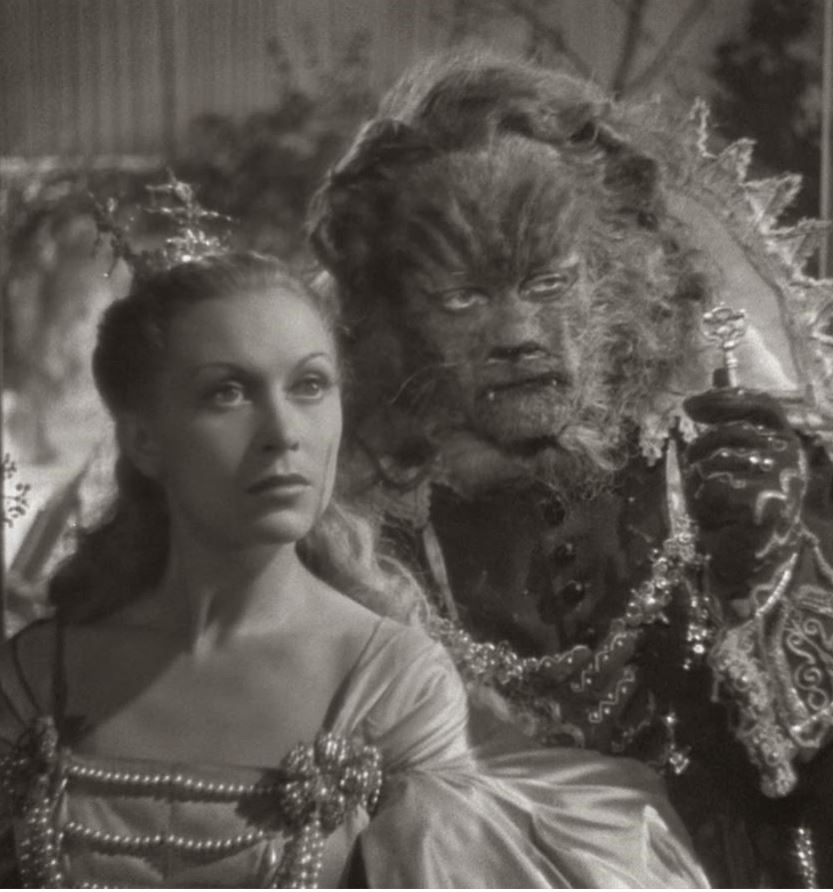
Finally, we’ll hear selections from perhaps the finest fairy tale ever committed to film, Jean Cocteau’s “La Belle et la Bête” – “Beauty and the Beast” (1946). Moody, atmospheric, dreamy, clever, hypnotic, funny, and romantic, and sporting production design that looks like something Gustav Doré might have dreamed up in a haze of Dutch Masters cigars, Cocteau’s masterpiece stars Jean Marais and Josette Day.
The alternately mysterious and majestic score is by Georges Auric. Cocteau, you’ll recall, was the one-man publicity machine that propelled Auric and his composer-colleagues, Francis Poulenc, Darius Milhaud, Arthur Honegger, Germaine Tailleferre, and Louis Durey, to fame in Paris, circa 1920, dubbing them “Les Six.”
I hope you’ll join me for an hour of once-upon-a-time and happily-ever-after, on “Picture Perfect,” music for the movies, now in syndication on KWAX, the radio station of the University of Oregon!
——–
Clip and save the start times for all three of my recorded shows:
PICTURE PERFECT, the movie music show – Friday at 8:00 PM EST/5:00 PM PST
SWEETNESS AND LIGHT, the light music program – Saturday at 11:00 AM EST/8:00 AM PST
THE LOST CHORD, unusual and neglected rep – Saturday at 7:00 PM EST/4:00 PM PST
Stream them, wherever you are, at the link!
https://kwax.uoregon.edu/ -

Thanksgiving 2025: Don’t Let the Bastards Get You Down
No time for a thought piece today. Suffice it to say, we may be living through troubling times, but there’s still much to be thankful for. Look around you, be appreciative, and enjoy it while you can.
-

100 Years and 88 Keys of Eugene Istomin
Although he recorded extensively as a soloist for Columbia Records (now Sony Classical), his career as a concert pianist never really seemed to catch fire. Or perhaps I should say, he never captured the public’s imagination quite to the extent of some of his more publicity-friendly contemporaries. This was certainly not for lack of skill or interpretive depth. He just wasn’t interested in playing the fame game. It could be argued that Eugene Istomin found his most comfortable fit away from the spotlight, as a conversational performer and equal voice in one the premier chamber ensembles of his time.
With violinist Isaac Stern and cellist Leonard Rose – as the Istomin-Stern-Rose Trio – he really seemed to find his niche. The trio was an unlikely creation, an all-star ensemble greater than the sum of its parts. And its parts were pretty great. All three musicians were known quantities, “name” soloists who worked very hard to shed their larger-than-life predilections and explore a shared intimacy in chamber music of the masters. Their recordings of the complete Beethoven piano trios, in particular, a Grammy Award winner in 1970, is still highly regarded. Too bad they couldn’t come up with a catchier name for the group.
On his own, Istomin, a contemporary of Leon Fleisher and Gary Graffman, never seemed to excite the way the other two pianists did. This, despite professional associations with Eugene Ormandy, Bruno Walter, Leonard Bernstein, Fritz Reiner, George Szell, Leopold Stokowski, and Pablo Casals. (Istomin later married Casals’ widow.) For one thing, he was more interested in the Viennese classics than he was the Russian showpieces that set audiences aflame. Not that he didn’t love those too. His recording of the Rachmaninoff 2nd with Ormandy and the Philadelphia Orchestra demonstrates that, when he wanted to be, he could be very much the virtuoso. Of course, Fleisher and Graffman’s careers were curtailed by focal dystonia, a repetitive stress malady that effects the fingers and is all-too-common among hard-driving classical performers, with their unforgiving practice regimens.
Istomin had, by his own admission, “pretentious” tastes. He was interested in the music he was interested in, even if it didn’t fit the paradigm of what critics thought he should be tackling at a given stage of his career. (Surely, he was too young to be playing Beethoven and Brahms. This is the time he should be playing Tchaikovsky and Rachmaninoff!) He was also an avid reader and a book collector, at one point hired by Harcourt Brace Jovanovich as an advisor on the publication of facsimile editions of works by Joseph Conrad, Thomas Hardy, and others.
Yet he also had a common touch. An ardent fan of the Detroit Tigers, he toured the Midwest with a twelve-ton truck full of his own Steinway pianos. He wanted to be sure to make the music he loved available to the people.
It’s said that his relationship with Rose, who could be touchy and unforgiving even under the best of circumstances, was damaged when Istomin maneuvered behind the scenes with Columbia to get a shot at a concerto recording at a time when he was supposed to be documenting all the Beethoven sonatas for violin and cello with his companions in the trio. The fact that these were left incomplete because of the resulting rift with the label left Rose with a festering resentment. But nothing was simple between Rose and Istomin. They suited one another perfectly, playing together beautifully, as long as they kept their mouths shut. But they also held very strong convictions and weren’t shy about expressing them. Clearly, they remained intimates, but Rose carried hard feelings over the Beethoven debacle for the rest of his life.
Unquestionably, Istomin found depth in the Viennese masters and fire in the Russians, but it was always on his own terms. He also commissioned and performed works by living composers, including Roger Sessions (his piano concerto), Henri Dutilleux, and Ned Rorem. Again, Istomin was more interested in the substance of music-making than in the publicity machine.
Like Josephine Baker and Jerry Lewis, it’s possible he found greater appreciation in France, where he was the recipient of the Légion d’honneur in 2001.
Istomin died in 2003, 16 days before his 78th birthday. He was a terrific pianist, if perhaps not the most enduringly famous. Remembering him today, with gratitude, on the 100th anniversary of his birth.
Tag Cloud
Aaron Copland (94) Beethoven (95) Composer (114) Film Music (149) Film Score (143) Film Scores (255) Halloween (99) John Williams (197) KWAX (232) Leonard Bernstein (105) Marlboro Music Festival (125) Movie Music (164) Mozart (91) Opera (215) Philadelphia Orchestra (90) Picture Perfect (174) Princeton Symphony Orchestra (110) Radio (90) Ross Amico (244) Roy's Tie-Dye Sci-Fi Corner (290) The Classical Network (101) The Lost Chord (269) Vaughan Williams (107) WPRB (397) WWFM (881)