Category: Daily Dispatch

  • Elgar’s Third: A Symphony Realized

    Elgar’s Third: A Symphony Realized

    What can I say? I’m a man of contradictions.

    Still fairly close on the heels of last Saturday’s post in which I expressed my reservations surrounding the completion of Mahler’s Tenth Symphony, here I am, celebrating the realization of Elgar’s sketches for an unfinished Third.

    This Sunday night on “The Lost Chord,” we’ll have a remarkably vivid piece of wishful thinking.

    Sir Edward Elgar produced no major works following the death of his wife in 1920. It was his friend and champion, George Bernard Shaw, who, in an attempt to keep one of England’s greatest composers from withering on the vine, persuaded the BBC to commission from Elgar a Third Symphony.
    Elgar, who died in 1934, worked at the piece during the last year of his life, jotting down his ideas – some merely a few bars in length; others, pages in full score. As his health deteriorated, he realized he would never be able to complete the work, and he made contradictory remarks concerning his intentions over the fate of the sketches.

    Another of his friends, the violinist W.H. Reed, passed many hours playing through what existed of the piece, with the composer at the piano. After Elgar’s death, Reed published 40 pages worth of sketches into a memoir, which kept the work at the periphery of the public consciousness.

    Several attempts were made over the decades to make something more of the sketches, but musicians and musicologists were always stopped short by the Elgar estate.

    The composer Anthony Payne became interested in the fragments in 1972. For many years, he worked at a realization of the piece, again meeting resistance from Elgar’s heirs, until it became apparent that, due to the publication of the sketches in Reed’s book, the material would soon fall into the public domain. The family opted to capitalize on what control it had left and finally authorized Payne’s efforts.

    His realization was given its premiere in 1998 and granted broad exposure through performances by major orchestras, particularly in England and the United States (including the Philadelphia Orchestra), and the piece has been recorded at least four times.

    The formal title is “Edward Elgar: The Sketches for Symphony No. 3, Elaborated by Anthony Payne” – known for short as the “Elgar/Payne Symphony No. 3.” You’ll have a chance to hear it tonight.

    I guess the reason I am so forgiving of Elgar’s Third is because at no level is anyone trying to pass it off as Elgar’s actual symphony. Rather, it is a fascinating amalgam that manages both to recall Elgar and bring out the best in Payne. The two creative voices mix remarkably well to form a cohesive work of art.

    I hope you’ll join me for “No Payne, No Gain,” this Sunday night at 10:00 EDT, on WWFM – The Classical Network and wwfm.org.


    PHOTOS: A Payne on Elgar’s side

  • Christopher Rouse Pulitzer Winner Dies at 70

    Christopher Rouse Pulitzer Winner Dies at 70

    The American composer Christopher Rouse has died. Rouse was the recipient of the Pulitzer Prize for Music in 1993 for his Trombone Concerto. His final work, his Symphony No. 6, will be given its world premiere by the Cincinnati Symphony Orchestra on October 18-19. A life-long Baltimore resident, Rouse was 70 years-old.

    https://www.broadwayworld.com/bwwclassical/article/Composer-Christopher-Rouse-Dies-At-Age-70-20190921

    Jasmine Choi plays Rouse’s Flute Concerto:

  • Elegies for the Old West: Western Film Scores

    Elegies for the Old West: Western Film Scores

    With summer winding down and the shadows lengthening, it’s a good time to think about moseying off into the sunset. This week on “Picture Perfect,” it’s an elegy for the Old West.

    By the 1960s, the cinematic western was becoming a victim of its own success. The western had been a popular genre since the silent era, with dozens, of variable quality, released every year. Seemingly the genre hit its peak in the 1950s. One might say, the western suffered the fate of the actual American West, with its mythic resonance choked into clichés by too many settlers.

    Also, current events began to color filmmakers’ perceptions of the West, the turbulence surrounding the Vietnam War, the assassinations of both Kennedys and King, and increased suspicion of government making for violent, bloodier and more nihilistic visions of Manifest Destiny. The shift gave rise to the revisionist western, which embraced new realities of dirt, corruption, and moral ambiguity in the West. At the same time, there was a rise in more wistful, elegiac westerns, which seem to bid farewell to beloved western icons like Joel McCrea, Kirk Douglas and John Wayne.

    Common characteristics include the obsolescence of the gunfighter; the free-ranging cowboy fenced off by barbed wire; the encroachment of corporations in the form of railroad and mining interests; horses replaced by automobiles; the six-shooter superseded by the Gatling gun – the land of limitless possibility and moral certitude, subdivided and spoiled by industrialization. Once-heroic figures ride slowly into the sunset, or are killed, their qualities unrecognized, perhaps even willfully rejected, by those who come after.

    We’ll hear selections from four elegiac westerns, including “Cheyenne Autumn” (1964), with music by Alex North; “The Shootist” (1976), with music by Elmer Bernstein; “The Wild Bunch” (1969), with music by Jerry Fielding; and “Monte Walsh” (1970), with music by John Barry.

    Autumn comes to the Old West, on “Picture Perfect,” this Friday evening at 6:00 EDT, on WWFM – The Classical Network and wwfm.org.


    PHOTO: John Wayne and Ron Howard take aim in “The Shootist”

  • Pettersson, Tomlinson: Light & Dark Music

    Pettersson, Tomlinson: Light & Dark Music

    Into every life, a little existentialism must fall. It is for this reason that God invented British Light Music.

    Today is the birthday of Allan Pettersson, a composer who never had a happy day in his life.

    Pettersson grew up in Södermalm, today a gentrified, bohemian neighborhood, but then viewed as the slum of Stockholm. And there, he more or less remained. His father was a raging alcoholic blacksmith, but his mother was pious and attentive to her children.

    Somehow, he managed to attend the conservatory of the Royal Swedish Academy of Music, where he studied violin and viola. He also took private lessons in composition on the side. Then he traveled to Paris for roughly 15 months for further studies with Rene Leibowitz, Arthur Honegger, Olivier Messiaen, and Darius Milhaud.

    In the early 1950s, he was diagnosed with rheumatoid arthritis. By the time he completed his Fifth Symphony, in 1962, his mobility had become so compromised that he was forced to dictate many of his subsequent compositions. It took him four years to write his Sixth Symphony. After completing his Ninth, he was hospitalized for nine months. He began his Tenth on his sickbed, in an apartment he seldom left. For the final decade of his life he was assigned to state living quarters, but at no point did his productivity wane. He died in 1980 at the age of 68, leaving in his wake seventeen symphonies.

    I’ve now managed to collect most of them, thanks to Princeton Record Exchange. Don’t ask me why. I guess I’m saving them to temper the happiest day of my life, should it ever occur.

    Pettersson’s symphonies are never less than ambitious, each one a saga of despair crafted by Sweden’s reigning bard of bleakness. The longest of these spans some 70 minutes. To maintain interest, the composer carefully calibrates his soundscapes, arriving at unique solutions to the question of form. The emotional range runs the entire Scandinavian gamut, from grimness to anger to violence. Don’t go into a Pettersson symphony expecting the “Pastoral Suite.”

    At the other end of the spectrum, we have Ernest Tomlinson, whose birthday is also today. Judging purely on the basis of his music, Tomlinson never had a sad day in his life. Sure, he was color-blind, but I think Pettersson would agree, color-blindness beats the hell out of rheumatoid arthritis.

    Tomlinson was a master of light music and bright arrangements. His output consists of overtures, suites, rhapsodies, and miniatures. I’d be surprised if any of them are even in a minor key.

    In 1984, Tomlinson learned that the BBC was planning to dispose of its light music archive. In response, he founded The Library of Light Orchestral Music, preserving in a barn on his property some 50,000 pieces, many of which otherwise would have been lost.

    Tomlinson died in 2015, at the age of 90.

    Which is healthier, I wonder – to lay bare the horrors of the void, in all its cruel indifference, over agonizing, epic spans, or to defy them by creating three- and four-minute miniatures of distilled happiness and purified beauty?

    A question of prophet vs. profit? You decide.


    The juxtaposition of Pettersson and Tomlinson totally puts me in mind of “Strindberg and Helium,” a series of videos from back in the days of the Wild West of the internet, when everyone still had desktop computers, with Pettersson as Strindberg (naturally) and Tomlinson as Helium.

    Each episode is around a minute long, so it’s easy to meet your daily fortification of despair.

    https://www.youtube.com/channel/UCO1tKMjYxYSJI9jLA6Jf3Mw

    Pettersson, Symphony No. 7

    Tomlinson, “The Fairy Coach”

  • Late Summer Sounds: Women Composers & More

    Late Summer Sounds: Women Composers & More

    As we continue to savor this precious late-summer’s day, here’s what I’ve got planned musically – as if, in my hubris, there is anything I can do to enhance an already-perfect afternoon.

    I’ll continue to highlight the contributions of women composers, during this month in which we celebrate the bicentennial of Clara Schumann. To this end, we’ll hear a suite from “La liberazione di Ruggiero” by Francesca Caccini, on her birthday. This was the first opera composed by a woman and probably the first by an Italian to be performed abroad.

    It’s also the anniversary of the births of the great English eccentric and polymath Lord Berners and the Australian composer Arthur Benjamin. Benjamin wrote his most popular piece, “Jamaican Rumba,” for the duo-piano team of Joan and Valerie Trimble. It makes sense, then, to also program Joan’s irresistible “Suite for Strings.”

    As if all that weren’t enough, I’ll risk gilding the lily with the inclusion of a charming faux-Baroque dance suite, the conveniently titled “The Nobility of Women,” by Philadelphia composer Kile Smith.

    At 6:00, it’s another “Music from Marlboro.” This week, we’ll enjoy three quirky quartets by Mozart, Weber, and Bernard Garfield, as always in performances from the archive of the legendary Marlboro Music Festival.

    Tap your toes and take your quartets in the threes. There’s nothing unusual in that, is there? Help yourself to some more tea, from 4 to 7 p.m. EDT, on WWFM – The Classical Network and wwfm.org.


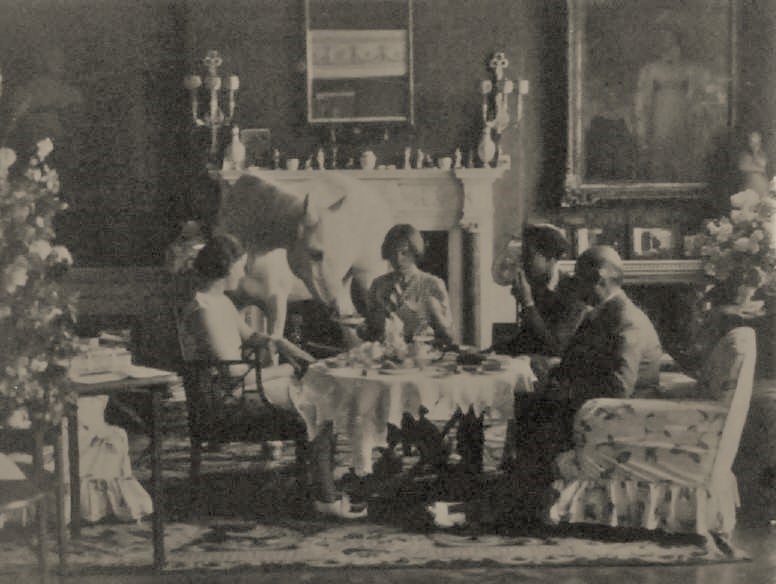
    PHOTO: A classic Berners tea party (note the horse)

Tag Cloud

Aaron Copland (93) Beethoven (95) Composer (114) Film Music (137) Film Score (143) Film Scores (255) Halloween (94) John Williams (195) KWAX (229) Leonard Bernstein (103) Marlboro Music Festival (125) Movie Music (152) Mozart (88) Opera (208) Philadelphia Orchestra (89) Picture Perfect (174) Princeton Symphony Orchestra (108) Radio (88) Ross Amico (244) Roy's Tie-Dye Sci-Fi Corner (290) The Classical Network (101) The Lost Chord (268) Vaughan Williams (103) WPRB (396) WWFM (881)

DON’T MISS A BEAT

Receive a weekly digest every Sunday at noon by signing up here


RECENT POSTS