Category: Daily Dispatch

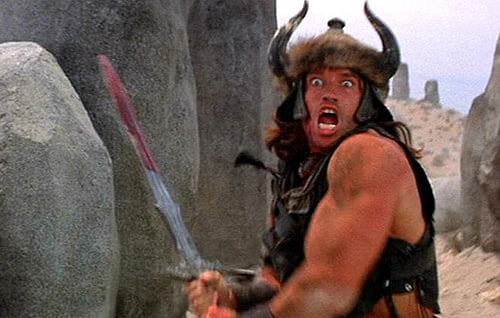
  • Howard’s Barbarians Great Movie Music

    Howard’s Barbarians Great Movie Music

    In “Conan the Destroyer” (1984), one of Conan’s companions speculates, “I suppose nothing hurts you.”

    To which Conan replies, “Only pain.”

    Discriminating viewers may feel a little pain themselves watching these silly, cheesy, violent films, all of which were inspired by the writings of pulp master Robert E. Howard. Howard created the warrior Conan in 1932. The character became the center of a series of lucrative stories first published in “Weird Tales” magazine.

    It would be a half century before Conan made the leap to the big screen, under the direction of John Milius. “Conan the Barbarian” (1982) propelled Arnold Schwarzenegger, already a legend in the field of bodybuilding, to international superstardom. While “Conan” isn’t exactly “Citizen Kane,” it does have its pleasures. The intensity of the violence can be a little disturbing, but the ponderous tone is a blast. “Conan” is a film that takes itself just seriously enough to make it occasionally hilarious.

    Another thing “Conan” has going for it is the fact that it was made on a blockbuster budget. The first-rate production values extend to the music by Basil Poledouris, who employs a full symphony orchestra to impressive ends. In fact, the “Conan” score was one of the strongest of the decade. It’s amazing that anyone would find so much inspiration in such a mediocre film, but Poledouris’ music intersperses Borodin-style Central Asia lyricism with brawny, thrilling action music.

    Sadly, the sequel, “Conan the Destroyer,” betrays signs of penny-pinching, so that it often winds up feeling like a direct-to-video effort. Poledouris was forced to make do with a smaller orchestra, which sounds a bit too much like a television ensemble. Still, he gave it his all, and there’s something to be said for the fact that it is an original score, rather than a mere retread of the original.

    Another one of Howard’s creations, Kull of Atlantis, was given the big screen treatment as “Kull the Conqueror” (1997). Kevin Sorbo, TV’s Hercules, plays the title role. The composer, Joel Goldsmith (son of Jerry Goldsmith), was asked to incorporate heavy metal riffs into his orchestral underscore. I haven’t actually seen this one, but for some reason I don’t feel like I’m missing anything.

    The astoundingly prolific Ennio Morricone – who has more than 500 motion picture and television scores to his name – has an uncanny knack for spinning garbage into gold. His music for “Red Sonja” (1985) lends the film an aura of ‘80s cheese ball fun, perhaps more so than it deserves. This is the film that introduced Brigitte Nielsen as the chain-mailed barbarian beauty. Schwarzenegger appears in the supporting role of Lord Kalidor.

    In the ‘80s, even bad films had great scores. I hope you’ll give “Conan the Barbarian” a chance this week, on “Picture Perfect” – music for movies inspired by the writings of Robert E. Howard – this Friday evening at 6:00 EDT, on WWFM – The Classical Network and wwfm.org.

    BONUS! Tune in a little early (before 6) to hear selections from a virtuoso organ transcription of “Conan the Barbarian” by Philipp Pelster!

  • John Cage Freedom Maverick of Sound

    John Cage Freedom Maverick of Sound

    It’s ironic that a man named Cage would be all about freedom.

    A pioneer of aleatory or chance-controlled music, electroacoustic music, nonstandard use of musical instruments (like the prepared piano), making music with found objects, and finding the music in everyday sounds, John Cage was a titan of 20th century music.

    It’s possible to not know a single work he ever “wrote,” or at any rate conceived, and still be exposed to his influence constantly. Cage taught us new ways to think about sound and the nature of music, opening our ears to an infinite variety of new worlds for exploration. His genius lay in recognizing that which had always been invisible before our eyes and silent to our ears.

    To honor him on his birthday, I might insert objects between the caps lock and shift key of my laptop, or roll dice to determine which letters or combinations of letters to hit, or allow my cat to walk across the keyboard or spill a cup of coffee across the keys.

    Or I could write nothing at all and allow the peripheral impressions you receive from your own environment determine how you experience my blank post.

    You don’t have to like Cage any more than you like the hum of the refrigerator, or a creaking chair, or a tree falling in the woods. If you’re there to hear it, once in a while you should be made to do so. Me, I’ll have 4’ 33” on infinite repeat all day.

    Happy birthday, John Cage (1912-1992). There are plenty who would scoff at the Emperor’s New Clothes, but you were one hell of a tailor.


    “I can’t understand why people are frightened of new ideas. I’m frightened of the old ones.” – John Cage

    “Discovery consists of seeing what everybody else has seen and thinking what nobody has thought.” – Albert Szent-Györgyi

    Cage’s most notorious piece, 4’ 33”:

    Cage performs “Water Walk” on national television:

    complete appearance

    composition only, in better quality

    Cage for people who don’t like Cage:

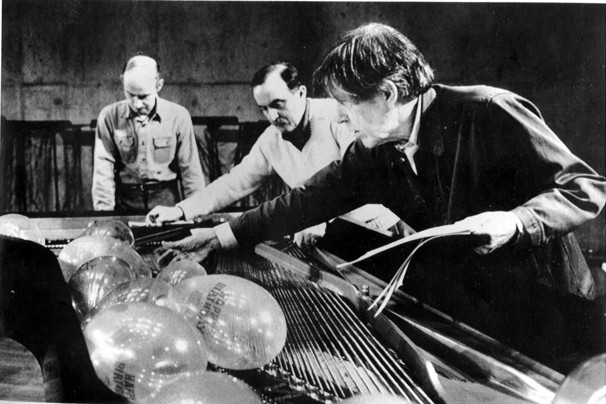
    PHOTO: What’s a birthday without balloons?

  • Dvořák’s Early Genius at Marlboro Music Festival

    Dvořák’s Early Genius at Marlboro Music Festival

    It was in the autumn of 1877 that a 36 year-old Antonin Dvořák included his “Moravian Duets” with his application for an Austrian State grant for “young, talented and poor artists.” Still little known outside of his native Bohemia, Dvořák caught the interest of Johannes Brahms, who sat on the board of adjudication. Recognizing the younger man’s talent, Brahms recommended Dvořák to his German publisher, Fritz Simrock.

    Simrock’s edition of Dvořák’s duets proved to be so popular that it went into a second printing. (Even so, he did not pay the composer!) When that sold out, he requested that Dvořák write something akin to Brahms’ wildly successful “Hungarian Dances.” The resultant “Slavonic Dances” cemented Dvořák’s international fame.

    On this week’s “Music from Marlboro,” Dvořák pays his dues, with two early works that reveal his genius in utero.

    The Piano Quartet No. 1 in D major, Op. 23, was composed over a span of just eighteen days during the summer of 1875. Dvořák was 33 and probably already at work on the “Moravian Duets.”

    Though a product of his early maturity, Dvořák’s quartet is already imbued with the composer’s soon-to-be familiar “Czech national sound.” Not nearly as well known as the “American” String Quintet or the Piano Quintet in A major, it is nevertheless unmistakably from the same pen, with no shortage of memorable melodies and brimming with his indelible charm. The work didn’t hit print until 1880 (around the time of the second run of the “Moravian Duets”). Tellingly, it was not published by Simrock, but rather by Schlesinger, a Berlin rival.

    We’ll hear it performed at the 1969 Marlboro Music Festival by pianist and Marlboro co-founder Rudolf Serkin, violinist Shmuel Ashkenasi, violist Martha Strongin Katz, and cellist Robert Sylvester.

    The “Moravian Duets” grew out of songs Dvořák wrote specifically for domestic performance by a wealthy merchant and his wife, who also happened to be amateur singers. At the merchant’s request, Dvořák began by arranging Moravian national songs, but quickly segued into providing wholly original music for the traditional folk texts.

    Delighted with the results, the merchant paid for the duets’ first printing in Prague, prior to Christmas 1876. Further songs followed. The complete cycle of 23, for two voices and piano accompaniment, appeared as three separate sets, assigned to different vocal ranges, between 1875 and 1881.

    We’ll round out the hour with the four songs of the first of these, collected under Op. 20, in its final form, performed in Czech by soprano Mary Burgess and tenor John Humphrey, with pianist Luis Batlle – a commercial recording made for Columbia Masterworks as an offshoot of the 1966 Marlboro Music Festival.

    One of the advantages of being a “provincial” composer is that Dvorak was already a master by the time he was discovered. Discover these works from his early maturity on the next “Music from Marlboro,” this Wednesday evening at 6:00 EDT, on WWFM – The Classical Network and wwfm.org.

    Marlboro School of Music and Festival: Official Page

  • Celebrating Women Composers

    Celebrating Women Composers

    September 13th marks the 200th anniversary of the birth of Clara Schumann. In celebration of this remarkable pianist, teacher, composer, wife, and mother of eight, I’ll be especially conscious of honoring the achievements of women in music all month long on The Classical Network, with works by female composers, ranging from the 12th century to the present.

    Of course, with few exceptions, women did not enjoy the same advantages as men, in terms of education and acceptance, so it is unlikely that many fulfilled their natural promise.

    Barbara Strozzi (1619-1677) and Francesca Caccini (1587-after 1641) were notable exceptions, at least to some extent.

    Today’s Noontime Concert on The Classical Network will be devoted to music by these two remarkable women. “Enchanting Voices: Music of Barbara Strozzi & Francesca Caccini” will be performed by the Canzonetta Duo, Elissa Edwards, soprano, and Richard Kolb, theorbo and archlute.

    The concert was presented on November 15, 2018, at St. Bartholomew’s Church, 325 Park Avenue, in Midtown Manhattan, where free concerts are held every Thursday at 1:15 p.m. The 2019-2020 season gets underway this Thursday, as The Vivaldi Project will perform a program of classical string trios.

    These concerts are made possible in part by Gotham Early Music Scene, or GEMS. GEMS is a non-profit corporation that supports and promotes artists and organizations in New York City devoted to Early Music. For more information and a look at GEMS’ events calendar, visit gemsny.org.

    Following today’s broadcast concert, stick around for an afternoon of works by musical women.

    Julia Wolfe was awarded the Pulitzer Prize for Music for “Anthracite Fields” in 2015. The oratorio, composed for the Bang on a Can All-Stars and the Mendelssohn Club Chorus, was given its premiere in Philadelphia the previous year. “Anthracite Fields” examines the plight of Northeastern Pennsylvania coal miners, a topic of particular interest to me, since my father’s father’s family labored in the mines of Pittston. The work was presented at the Roebling Wire Works in Trenton by Westminster Choir in 2017. On this day after Labor Day, we’ll hear a complete performance of the piece in its world premiere recording.

    We’ll also enjoy a very impressive Serenade in D – really more of a symphony – by composer and hell-raising suffragette Dame Ethel Smyth. Smyth served time in prison for putting out the windows of politicians who opposed a woman’s right to vote. When Sir Thomas Beecham went to visit her in jail, he found her conducting her associates through the bars of her window with a toothbrush as they sang “The March of the Women,” also composed by Smyth, while gathering for exercise in the prison courtyard.

    These women were nothing if not composed. Join me for musical contributions by women, all month long. They’ll punctuate my programming, beginning this afternoon from 12 to 4 p.m. EDT, on WWFM – The Classical Network and wwfm.org.


    CLOCKWISE FROM LEFT: Clara Schumann, Barbara Strozzi, Julia Wolfe, and Ethel Smyth (under arrest)

  • Labor Day Paul Robeson Sings Joe Hill

    Labor Day Paul Robeson Sings Joe Hill

    Labor Day. Princeton’s own Paul Robeson sings “Joe Hill.”

Tag Cloud

Aaron Copland (93) Beethoven (95) Composer (114) Film Music (137) Film Score (143) Film Scores (255) Halloween (94) John Williams (195) KWAX (229) Leonard Bernstein (103) Marlboro Music Festival (125) Movie Music (152) Mozart (88) Opera (208) Philadelphia Orchestra (89) Picture Perfect (174) Princeton Symphony Orchestra (108) Radio (88) Ross Amico (244) Roy's Tie-Dye Sci-Fi Corner (290) The Classical Network (101) The Lost Chord (268) Vaughan Williams (103) WPRB (396) WWFM (881)

DON’T MISS A BEAT

Receive a weekly digest every Sunday at noon by signing up here


RECENT POSTS