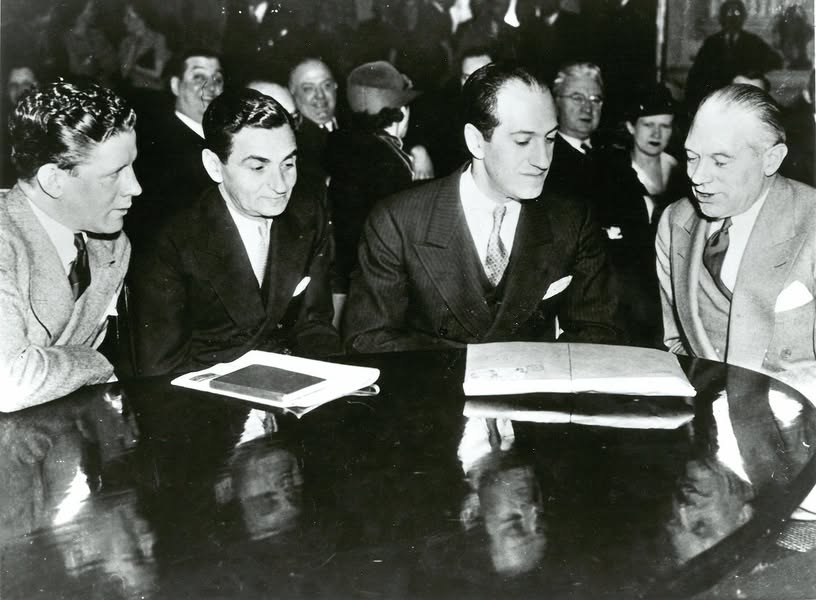
Happy birthday, George Gershwin! Here, from 1932, Gershwin plays “Fascinating Rhythm,” “Liza,” the Prelude No. 2, and “I Got Rhythm,” and participates in a quick, evidently-scripted Q&A with host Rudy Vallée on his radio show, “The Fleischmann Hour” (sponsored by Fleischmann’s Yeast).
PHOTO: Rudy Vallée, Irving Berlin, and Gershwin with ASCAP president Gene Buck
On Dmitri Shostakovich’s birthday, here’s a wonderful document of Leonard Bernstein saluting the composer in Moscow in 1959, prior to a performance of the “Leningrad Symphony.” A modest man accustomed to stepping very carefully in a totalitarian state (also, he didn’t speak English), Shostakovich isn’t quite sure how to react, but ultimately approaches the stage to shake Bernstein’s hand. Stick around for the end of the video as Bernstein speaks the truth, and lament afresh those who devote their lives to undermining our potential as a species.
Shostakovich composed the symphony, his seventh, as an emblem of hope and defiance during the Nazi siege of Leningrad in 1941. The work was given its premiere in Moscow, by the Bolshoi Theatre Orchestra. It was next performed in the West, in London (by Henry Wood) and New York City (by Toscanini), after the score was smuggled out of the Soviet Union on microfilm, by way of Tehran!
The symphony was performed in Leningrad itself on August 9, 1942, with the concert blasted on loudspeakers into the enemy lines after three thousand high-caliber shells had been lobbed into the Germans. Furthermore, Shostakovich employed a grotesque quotation from Hitler’s favorite operetta, “The Merry Widow,” to mock the Nazi “invasion.”
The “Leningrad Symphony” enjoyed tremendous popularity during the war years, but in the decades since, its musical merits have tended to be overshadowed by its propagandistic origins.
One of Bernstein’s most shattering recordings of his later years was of this very work, taken from a live performance with the Chicago Symphony Orchestra in 1988 and issued on the Deutsche Grammophon label. The recording was recognized with a Grammy Award in 1990 – the year of Bernstein’s death at 72 – for Best Orchestral Performance. Shostakovich died in 1975 at the age of 68.
In 1966, Bernstein paid tribute to Shostakovich for the composer’s 60th birthday, with another characteristically insightful introduction, for one of his televised “Young People’s Concerts,” which again featured a selection from the “Leningrad Symphony” and the complete Symphony No. 9.
Happy birthday, Bernstein-style, Dmitri Shostakovich!
PHOTO: Same tour, different concert: Shostakovich and Bernstein share an ovation after a performance of Shostakovich’s Symphony No. 5 at the Great Hall of the Moscow Conservatory on August 22, 1959
Oh, where do the years go? It seems only yesterday that I was marking the 75th birthday of John Rutter. Now here we are, at fourscore.
Rutter, of course, is one of England’s most successful choral composers and conductors. It’s impossible to get through the Christmas season without hearing oodles of his work. The bigger pieces can be a little hit and miss (the “Gloria” gets a little too close to Walton at times, and “big” is not really Rutter’s forte), but when he hits, as in the lovely “Requiem,” he is well-nigh irresistible – at least for someone with a cotton candy soul like myself.
Perhaps his music is not your cup of tea, but the choir he built, the Cambridge Singers (founded in 1981), sounds like nobody else. For better or worse, like Ormandy’s Philadelphians, they bring their distinctive sound to everything they touch. The soft glow inspires contentment.
As a young man, Rutter collaborated with the legendary Sir David Willcocks on four volumes of the extraordinarily successful “Carols for Choirs” anthology series, now the most widely used source of carols in the British Anglican tradition, and very popular among choral societies. Willcocks went so far as to describe Rutter as the most gifted composer of his generation. Certainly, his gift for melody has proven inexhaustible.
Rutter was honored with a knighthood in February. What took so long? He’s man and an artist who’s brought a lot of beauty into the world. In today’s climate, it’s a quality that’s become even more precious. He’s the kind of person who deserves to be celebrated.
Happy birthday, Sir John Rutter, and many happy returns.
Rutter’s “Requiem” (1985), the perfect music for autumn, with the Cambridge Singers. Accept no substitutes.
“Candlelight Carol” (1984)
The composer offering insights into his “Requiem,” in 11 segments:
Shana tova! Wishing a sweet 5786 to all who celebrate.
As a classical music radio host, I’ve had many opportunities to broadcast selections from a fascinating 50-CD box set assembled from the Milken Archive of American Jewish Music for Naxos Records. (I believe these were also issued separately.) I do not own the box, but over the years, I’ve managed to collect most of the individual discs for my own library. Of course, the set was not intended to be comprehensive – how could it be? – but Milken (founded in 1990) continues its mission to document, preserve, and disseminate a vast body of music related to the American Jewish experience – including, among others, historical and traditional music associated with synagogue and seder, songs of a more secular nature for the Yiddish theater, and classical concert music.
One Milken revelation was a string quartet by Darius Milhaud, best known in classical music circles as one of the group of iconoclastic French composers that gained notoriety in Paris in the 1920s as “Les Six.” This loose collective followed in the footsteps of Erik Satie in subverting the pretensions of the concert hall. Les Six pushed back against miasmic Wagnerism of the fin de siècle era, employing the lighter textures and lucid forms of neoclassicism, and often emulating the breezy, contemporary ambience of café, boulevard, and circus. In Milhaud’s case, he also really leaned into the popular music of Brazil, which he encountered while serving as secretary to ambassador Paul Claudel. Another enthusiasm was the music of his native Provence (hence, the “Suite provençale”).
Less well-known is his connection to his Jewish heritage. Milhaud was born into a long-established family of the Comtat Venaissin (County of Venaissin, an enclave surrounding the city of Avignon), with roots traceable to the Middle Ages. The Comtat’s Carpentras synagogue, built in the 14th century, is the oldest in France. Interestingly, Milhaud’s lineage on his father’s side was neither Ashkenazi nor Sephardi, but rather uniquely Provençal – possessing its own historical and cultural traditions – as the settlement dates to the early Common Era. Milhaud’s mother was partly Sephardi on HER father’s side, by way of an Italian forebear.
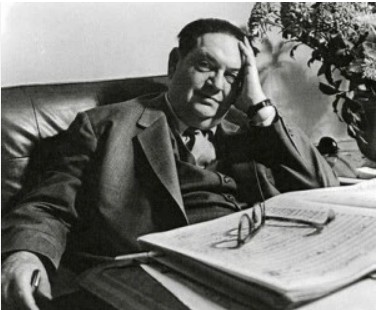
Milhaud wrote several works on Jewish themes. His “Études sur des themes liturgiques du Comtat Venaissin” (“Studies on Comtat Venaissin Liturgical Themes”) incorporates melodies from the region’s Rosh Hashanah and Yom Kippur observances. It was composed on a commission from the Braemer Foundation of Philadelphia. In light of his unusual heritage, Milhaud was asked to distill his memories of family celebrations and services at the synagogue in Aix-en-Provence into a string quartet. The work received its premiere at Congregation Adath Jeshurun in Elkins Park, just outside Philadelphia, in 1973. Milhaud died in 1974 at the age of 81.
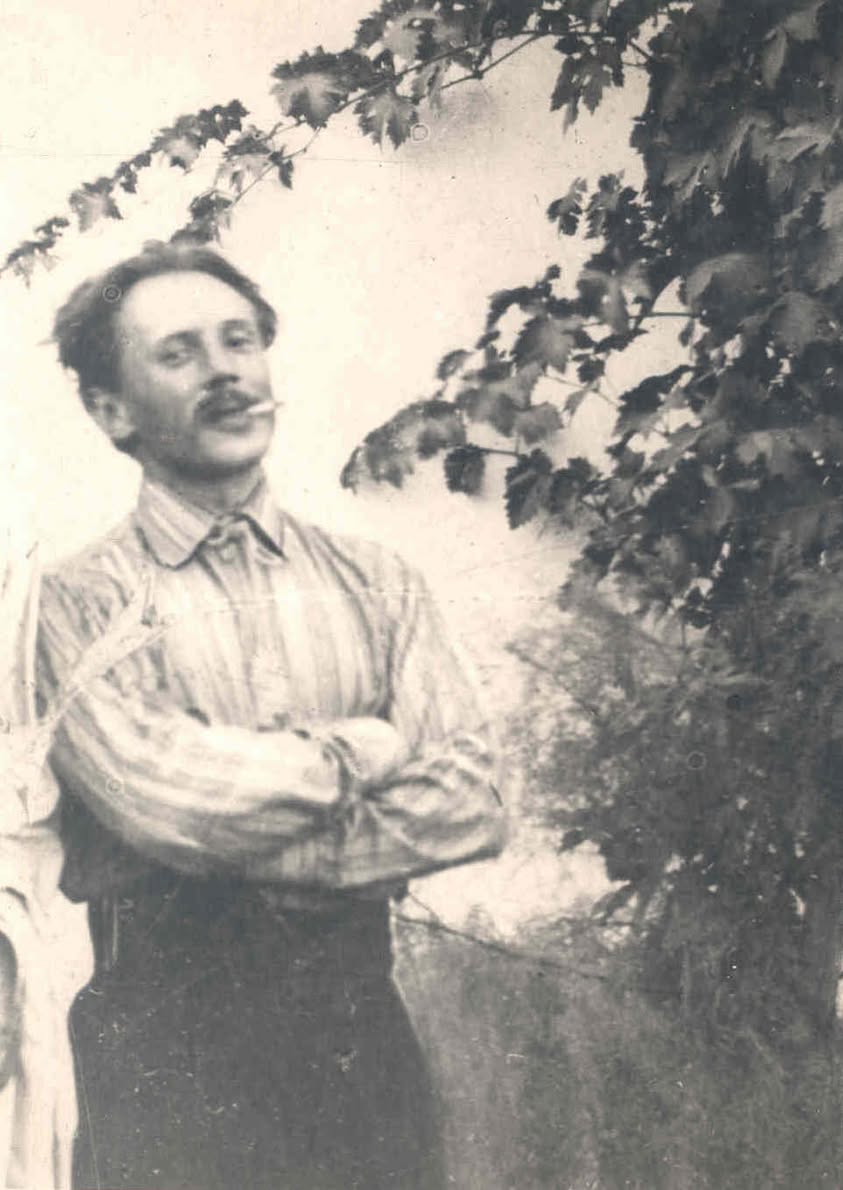
Lo and behold! It’s the 150th birthday of Mikalojus Čiurlionis!
It doesn’t seem right that someone so talented in one discipline should be equally if not more talented in another. But that’s precisely the case with Čiurlionis, a composer of opulent tone poems who also happened to be a major Symbolist painter. Oh yeah, he could write, too. In a creative effusion that lasted less than a decade, he managed to compose 400 pieces of music and to create about 300 paintings.
Čiurlionis was born into a Polish-speaking family in the Lithuanian village of Senoji Varėna on this date in 1875. He studied at the Warsaw Conservatory and then the Warsaw School of Fine Arts.
A passionate figure in the Romantic mold, he lived his life at a fever pitch. He was interested in photography, geology, history, chemistry, geometry, physics, astronomy, astrology, mythology, philosophy, dead and modern languages, and Eastern and Western religions.
He enthusiastically embraced the Lithuanian national movement. He was the first composer to collect and publish Lithuanian folk music. He organized and participated in the first three exhibitions of Lithuanian artists. He was one of 19 founding members of the Lithuanian Artists Union. He declared to his brother that he intended to dedicate all of his past and future works to Lithuania.
In 1909, he married the art critic Sofija Kymantaitė. Their time together would be brief. At the age of 33, Čiurlionis fell into a profound depression and was admitted to a psychiatric hospital in Marki, northeast of Warsaw. While recovering, he contracted pneumonia on a walk and died without ever having met his daughter.
Čiurlionis was a synesthete, his perception of music and color inextricably linked. A number of his paintings bear musical titles. His music teeters between Romanticism and Modernism, and his paintings between Symbolism and Abstract Expressionism.
Happy 150th birthday to this intense, doomed artist.