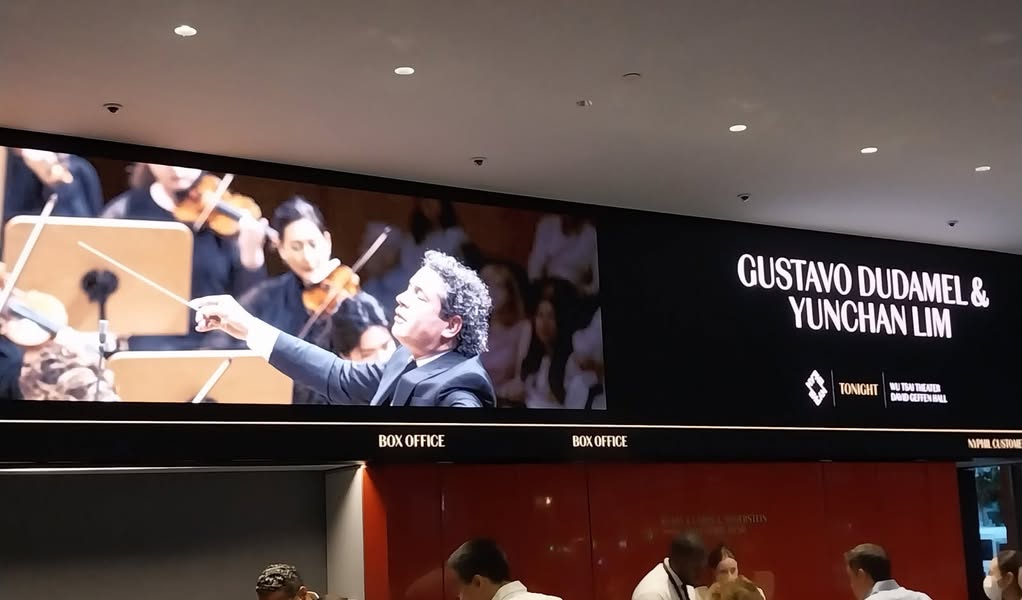
My expectations were high for last night’s concert of the New York Philharmonic (which included Béla Bartók’s Piano Concerto No. 3, with supernova soloist-du-jour Yunchan Lim, and one of my favorites, Charles Ives’ Symphony No. 2, with Gustav Dudamel on the podium), so I thought it prudent to dial it down a bit, on my drive in, by listening to the most torturous performance of the Ives I know – Bernard Herrmann’s turgid account from 1972. (I love you, Benny, and you were a genius as a composer, but my, did you make some bad records as a conductor.)
I’m not kidding about the Herrmann. Listening to it again made me feel psychologically and physically awful. Everything about it is just so wrong – it’s stodgy, interminable, and astonishingly ill-conceived, so much so that you wonder if Herrmann the conductor had any familiarity with any of the music that Ives stitched into this crazy quilt of hymns, folk songs, patriotic tunes, parlor melodies, and classical music standards that should come together as a musical self-portrait of the artist as a young man – but I keep it as a party record and also because, for as bad as it is, it reveals a lot about the music you don’t hear in other recordings.
Anyway, after Herrmann’s Ives, I knew even a tepid performance would be less disappointing. Thankfully, Dudamel exceeded all expectations.
Ives’ symphony offers so many allusive layers that it’s easy to get lost in the details – straining to identify a certain wisp of melody and where you may have heard it before – at the expense of a true appreciation of the composer’s broader, structural brilliance. It’s kind of like he took a pile of weathered lumber and hammered it onto the sturdy frame of a New England barn. It’s only after years of listening to the piece that I began to recognize its formal accomplishment. The counterpoint alone should signal that Ives’ learned his academic exercises well (under Horatio Parker at Yale), now twisting them and bending them to his will. The foundation is set in tradition, but it’s all beneath the ground.
Conversely, if a conductor gets too caught up in the structural aspects of the piece, as does, to some extent, Herrmann, and as did Leon Botstein at Carnegie Hall last season, conducting The Orchestra Now, the work, which should be a moving and uplifting charmer, can turn into a real slog.
I wonder too if, in certain respects, the symphony would have had greater resonance with listeners of earlier generations, when the songs of Stephen Foster were still sung in music class and Popeye was clobbering foes to “Columbia, the Gem of the Ocean.” Audiences still brighten in recognition of Ives’ quotation of “America the Beautiful” – even the Asian listeners around me last night perked up – and certainly classical music people will know the snippets of Brahms, Beethoven, and Wagner. But you really have to be steeped in American musical lore to wring everything out of it. Even I, who have heard the work countless times over four decades, am still wringing, as last night I heard things I hadn’t noticed before.
One of my principal concerns with Dudamel conducting Ives was that, as he is not an American (he was born in Venezuela and his home is in Madrid), he would not be familiar with a lot of the source material. It would be like a conductor born and bred in the United States attempting an analogous work in South America, with only a superficial grasp of the native culture. But the Dude acquitted himself marvelously. (He recorded the Ives symphonies a few years ago, but I have yet to hear those recordings.) Last night, he kept the textures lucid, and the mood buoyant. In fact, so comfortable was he with his command of the idiom that he conducted without a score. In the last movement, he was so loosey-goosey that he communicated one passage quoting “Turkey in the Straw” using only his torso (shades of Bernstein conducting the last movement of Haydn’s Symphony No. 88 with his eyes)!
I also want to add that the work is beautifully, warmly, and affectionately orchestrated. That might not be at first apparent with all the symphony’s other bells and whistles. Members of the wind and string sections have opportunities to charm and move with their various solos and duets. Toward the end of the second movement, a snare drum crackles like the reports of fireworks.
One final observation: for most of the symphony, Ives keeps his avant-garde impulses in check, right up, that is, until the final note, which out-surprises Haydn’s “Surprise” Symphony, and I’m happy to report Dudamel unleashed one hell of a raspberry – the best I’ve heard, probably, since Bernstein’s classic recording from the late 1950s.
It occurred to me that if I were a music director with Dudamel-like power, an interesting program might couple Ives’ 2nd with Dvořák’s “New World” Symphony, separated by an intermission, with perhaps George Whitefield Chadwick’s “Jubilee” as the curtain-raiser. With programming acumen like that, it’s probably good that I will never be music director!
On the evidence of last night’s concert – the last of a season-opening weekend series – the orchestra is in very good hands. Sceptics may grumble about the cult of Dudamel and his PR machine, but one should never discount the power of celebrity. On the merits of what I experienced, the hype, such that it is, is a self-fulfilling prophecy, as the energy in the room was exceptional, and musicians feed off that. Despite my having to break the piggy bank for a seat in the last row of the top tier, the evening proved to be worth every penny. The combination of repertoire and performers, and the audience response, made the concert for this commuter from Princeton unmissable. It was a lovefest from start to finish, with riotous applause and hoots for Dudamel and his soloists, for the pianist Yunchan Lim, and even for composer Leilehua Lanzilotti, who received quite the curtain call for her new piece – not that I thought the work itself, fine as it was, was all that. It was just an extraordinarily receptive crowd. Dudamel Fever is real!
Lim has his own kind of charisma, which is harder to explain. He’s like a Pied Piper of the piano. He plays so well that even us rats in the top back row will follow him anywhere. Bartók’s piano works can sometimes be prickly and percussive. Not so the Piano Concerto No. 3. If you harbor fears of this composer, this one is good therapy. Written toward the end of the composer’s life, when he was battling terminal leukemia, he crafted a radiant exit in this neoclassical, folk-inflected farewell. It’s a tuneful, life-affirming work, reflective, but not without passages of fiery virtuosity. Lim’s touch was light and lithe – there was real poetry in outer sections of the “Adagio religioso” second movement (interrupted by a whirl of bird song) – but the third built to a concluding run that worked the crowd, and they responded as if they had been listening to Tchaikovsky.
Lim is an artist without flash – even his bows are charmingly awkward and a tad self-conscious – but on the piano bench he mesmerizes. I can’t imagine that such humility could be affected. May he never fully believe he is as good as he is!
Astonishingly, when he finally sat down to silence the applause with an encore, it was with Ennio Morricone’s theme from “Love Affair” (the Warren Beatty-Annette Bening remake you’ve probably already forgotten).
I have Lim’s recordings of Liszt’s “Transcendental Etudes” (captured live at the Cliburn competition; it’s so good, it’s terrifying) and Chopin’s “Etudes,” and he is the real deal, one of those all-too-rare phenomena that makes me hopeful – enthusiastic even – for the continuing health of the art form. Somewhere down the line, I hope he gives us a recording of his encores.
The concert opened with an attractive work by Philadelphia-born Hawaiian native Leilehua Lanzilotti. Allowing some slack for the now-tired cliché of the all-lower-case title, “of light and stone” is agreeable music dressed up with an unnecessary dog-and-pony show, as in one of the central sections, the brass players blow into their instruments without playing any tones. It’s just the sounds of their exhalations, while a percussionist runs a pair of brushes over a snare drum, when combined suggestive of the Hawaiian surf. How much of this is music, and how much just sound effects? Elsewhere, the percussionist plays a Zen pyramid, a relative of the triangle, that sounds all the world like a bell. What can I say? It was interesting.
In common with Bartók and Ives, Lanzilotti assimilates native materials in her attempt to communicate universally. Drawing its inspiration from the history of her native land, “of light and stone” reflects on music actually composed by members of Hawaii’s royal families, especially Queen Liliʻuokalani, who was deposed and imprisoned by imperial forces for her attempts to abrogate the Bayonet Constitution (a document as slimy as it sounds). There is no anger in Lanzilotti’s music, only meditation and at times a certain mournfulness. The audience didn’t appear to have any reservations. They loved it.
Lending to my enjoyment of the evening was the chance placement of my seat, next to that of a young law student from Taiwan, with whom I enjoyed some nice conversation before the concert and between pieces. A violinist from the age of 5, he spoke impeccable, accent-free English (perhaps attributable to the fact that his grandparents had lived in the United States). We talked about Chopin and Bach and Henryk Szerying (his favorite interpreter of the Bach violin sonatas). It knocked me backward that he even knew who Szeryng was. I would think he’s hardly a widely-recognized name anymore – no aspersions on his excellence – save perhaps to aficionados. At intermission, I offered him a hasty introduction to Charles Ives, in the hope of increasing his appreciation of the symphony. We also swapped email information, parting with a pledge that he would check out Ives’ violin sonatas. We may try to meet up for another concert later in the season.
I arrived early, at a time I knew I could snag a free parking spot considerably north of Lincoln Center. That gave me time to grab a coffee, have dinner, and read a few chapters. For an hour or more before the concert, there was a company of dancers, dressed informally, out on the plaza. I don’t know if they were students, but I assume they were. It is a strange set of circumstances when New York City suddenly seems like the center of normalcy. Pedestrians still may not meet your gaze on the streets, but gather a few dozen talented kids from a variety of backgrounds and ethnicities to express themselves gracefully to Bach, and it still draws a crowd and people react warmly. Even in New York – ESPECIALLY in New York – people hunger for hope and beauty. No one who knows me would ever accuse me of being kumbaya, but isn’t this how life should be?
It also occurred to me in watching the orchestra how much it has changed over the years. When you watch the Young People’s Concerts with Bernstein, you see a bunch of middle-aged white men in suits and glasses. Undoubtedly they brought the goods, but they all looked like a bunch of dentists. Now the violins are mostly women. The orchestra sounded great and seemed to be in high spirits – not always the case with this notoriously fickle band. Let’s hope the honeymoon with Dudamel – who will return several times this season, before officially assuming musical and artistic directorship next year – continues. We can use all the positive energy we can get.
NOTE: Yunchan Lim will perform the Bartók concerto with Marin Alsop and the Philadelphia Orchestra at the Kimmel Center for the Performing Arts, October 3-5.