• Felicity Lott: Aptly Named, She Will Be Missed

    Felicity Lott:  Aptly Named, She Will Be Missed

    by 

    in
    2 responses

    I am saddened to learn of the death of Dame Felicity Lott.

    I never saw the English soprano live, and yet somehow from her recordings, performance videos, and vivacious interviews, I came to adore her. She seemed like a genuinely nice person and an inextinguishable spirit. Now, only days after revealing a terminal cancer diagnosis, she is gone.

    “Flott,” as she was known to her colleagues and fans, earned her BA in French and Latin from Royal Holloway, University of London. During the course of her studies, she spent a year in France – and she certainly put it to good use, as she was always very much at home in French chansons.

    She also excelled in Britten and Richard Strauss, in opera and recital, in drama and comedy. It seemed there was nothing she could not do well. Often, she performed in tandem with Graham Johnson, her accompanist since her student years.

    Lott died on Friday at the age of 79. Only a few days before, she gave an interview on BBC Four, exuding her usual warmth, candor, humor and grace, in which she shared her terminal status. She said she had known about it for nearly a year.

    “I’m just so happy at the moment,” she said. “I don’t want anybody to be sad, because I’m having a ball. I can’t understand it, because I’m not very well.

    “I’ve known about being ill for almost a year and, my goodness, it was a shock. But here I am for a bit longer, and I’ve had time to look back and think, “Golly, you lucky thing… you’ve met all these wonderful people and had a wonderful life. You’ve been all over the world!”

    Time and again, critics and admirers have cited the beauty and humanity of her characterization of the Marschallin in Strauss’ “Der Rosenkavalier.”


    Of her many recordings I have broadcast over the years, this is one of my favorites. Ernest Chausson’s “Poèmes de l’amour et de la mer” (“Poems of Love and the Sea”) incorporates two texts by Maurice Bouchor. The poems, “The Flowers of the Waters” and “The Death of Love,” are separated by a brief orchestral interlude.


    Lott as Helen of Troy… with sheep!

    https://www.youtube.com/watch?v=0KI_IhUEdTU

    Everything on this album, “Felicity Lott s’amuse,” is a delight, as may be divined from her Satie. By coincidence, today is Satie’s birthday.


    Concert performance of closing scene from Strauss’ “Capriccio” (with spoken introduction by Elisabeth Söderström)

    https://www.youtube.com/watch?v=mmfrsUsRw1Q

    Rest in peace, Dame Felicity.


  • In the Open Air with Marc Blitzstein on “The Lost Chord”

    In the Open Air with Marc Blitzstein on “The Lost Chord”

    by 

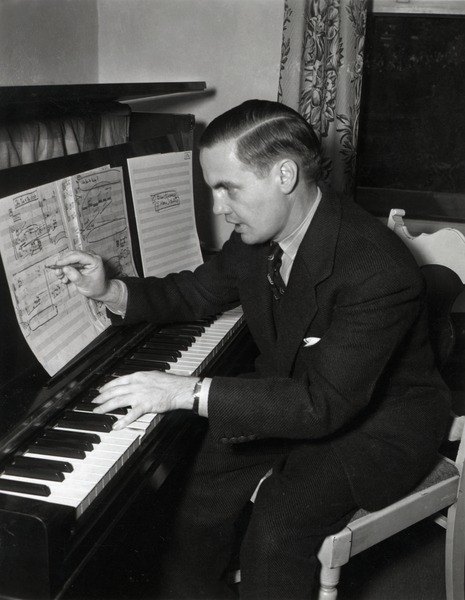
    This week on “The Lost Chord,” to coincide with Armed Forces Day, we’ll listen to Marc Blitzstein’s “Airborne Symphony.”

    The programmatic work, a quasi-oratorio, was written on a commission from the U.S. Army, while the composer was serving in its Air Force. It traces the evolution of flight from its conception in theory to its use in modern warfare.

    The piece was envisaged by Blitzstein as a big symphony on the theme of “the sacred struggle of airborne free men of the world… to crush the monstrous fascist obstructionist in their path.” Begun in 1943, at the height of World War II, it would not be completed until 1946, after the conflict had ended.

    Leonard Bernstein, a lifelong admirer of the composer (he mounted a performance of Blitzstein’s pro-labor musical, “The Cradle Will Rock,” while still at student at Harvard, and dedicated his own opera, “Trouble in Tahiti,” to him), conducted the premiere virtually while the ink was still wet on the page.

    He recorded the piece twice. We’ll hear the second of those recordings, from 1966, with Orson Welles the narrator, vocal soloists, the New York Philharmonic, and the men of the Choral Arts Society.

    It may not be the most profound of Bernstein’s recordings, but it surely is one of the most unusual. I hope you’ll join me for “Flight of Fancy” on “The Lost Chord,” now in syndication on KWAX Classical Oregon!

    ——–

    Clip and save the start times for all three of my recorded shows:

    PICTURE PERFECT, the movie music show – Friday at 8:00 PM EDT/5:00 PM PDT

    SWEETNESS AND LIGHT, the light music program – Saturday at 11:00 AM EDT/8:00 AM PDT

    THE LOST CHORD, unusual and neglected rep – Saturday at 7:00 PM EDT/4:00 PM PDT

    Stream them, wherever you are, at the link!

    https://kwax.uoregon.edu

    ——–

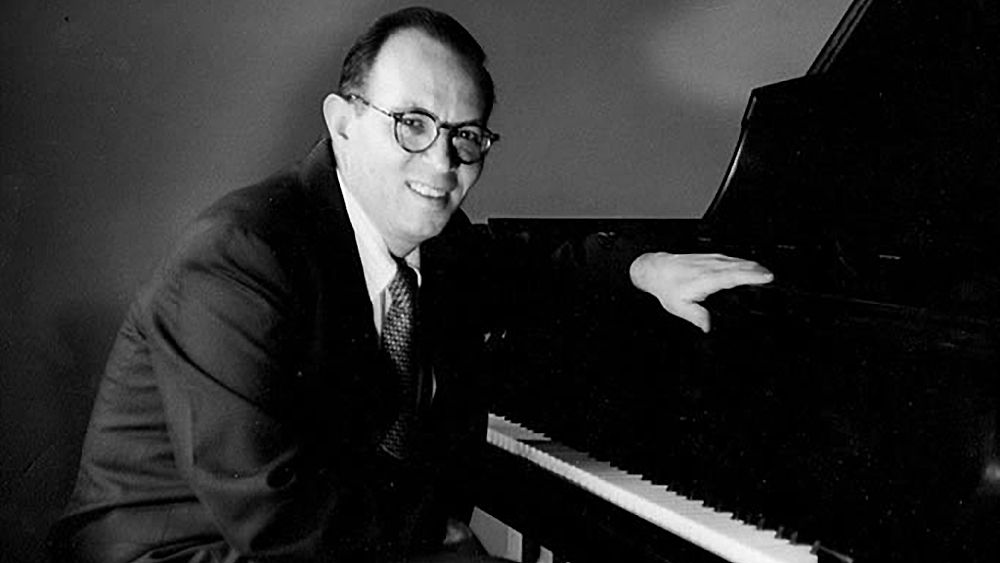
    PHOTO: Blitzstein and Bernstein, dining al fresco


  • Woodland Walks on “Sweetness and Light”

    Woodland Walks on “Sweetness and Light”

    by 

    It’s well into May, the birds are singing, and the trees are vibrant and cheering (at least from where I type, in the Northern Hemisphere). All in all, the conditions are perfect for a musical walk in the woods this morning on “Sweetness and Light.”

    We’ll visit the forests of Sherwood and Arden, respectively, courtesy of Frederic Curzon’s “Robin Hood Suite” and William Walton’s music for a 1936 film version of “As You Like It.” In between, we’ll enjoy a trip to the Vienna woods with Johann Strauss II and explore the lush forests of Lithuania with Mikalojus Čiurlionis. We’ll even partake in a woodland revel courtesy of George Melachrino, oh my!

    No need to put on a hat or tuck your pants into heavy socks. The ticks and snakes will be most amicable on “Sweetness and Light,” this Saturday morning at 11:00 EDT/8:00 EDT, exclusively on KWAX Classical Oregon!

    Stream it, wherever you are, at the link:

    https://kwax.uoregon.edu/

    ——-

    PAINTING: “A Walk in the Forest” (1869) by Ivan Shiskin


  • All Aboard! Taking the Train on “Picture Perfect”

    All Aboard!  Taking the Train on “Picture Perfect”

    by 

    Trains have always been very good for drama. They are symbols of departures and arrivals. They are conveyors of prisoners and vehicles of escape. They are objects of romance and objects to “hobo around” on. They are harbingers of civilization, and they are transports be robbed. You can fight on top of them. You can make out with Eva Marie Saint, or you can protect Marie Windsor so that she can testify against the mob. You can shuffle off to Buffalo.

    From the beginning, trains have provided good escapist fun at the movies. This week on “Picture Perfect,” we’ve got an hour of music from four memorable films in which trains play an important role.


    In “Strangers on a Train” (1951), arguably Alfred Hitchcock’s most underrated film of the 1950s, Farley Granger plays a tennis pro who unwittingly becomes involved in a double-murder plot (criss-cross!) through a chance encounter on a passenger train with a psychopath named Bruno (probably Robert Walker’s finest performance). The music is by Dimitri Tiomkin, who scored four films for Hitch – including “Shadow of a Doubt,” “I Confess,” and “Dial M for Murder.”


    Burt Lancaster stars in a film titled, simply, “The Train” (1964), as a reluctant railroad inspector who is persuaded to join the French Underground’s efforts to delay the transport of masterpieces looted from the museums of Paris by the Nazis, since Allied liberation of France is imminent. Paul Scofield plays the art-loving German officer determined to move the art at all costs. Real trains were destroyed in the making of the film, real dynamite was employed, and Lancaster, as was often the case, did all his own stunts. The score is by Maurice Jarre.


    “Murder on the Orient Express” (1974) is based on one of the best-known Agatha Christie vehicles involving her recurring character, celebrated detective Hercule Poirot. Albert Finney portrays Poirot most memorably in this, the first and best of the all-star Christie thrillers, set on a long-distance passenger train connecting Paris to Istanbul. The list of suspects includes Lauren Bacall, Martin Balsam, Ingrid Bergman, Sean Connery, John Gielgud, Anthony Perkins, Richard Widmark, and Michael York. The unforgettable score is by Richard Rodney Bennett.


    Finally, we turn to the lighthearted caper “The Great Train Robbery” (1979), starring Sean Connery, Donald Sutherland, and Leslie-Anne Down. Michael Crichton wrote the screenplay, after his own novel, which in turn was based on an actual historical incident – an 1855 heist, in which an unbelievable amount of gold disappeared from a moving train. Crichton also directed the film. The music is by the great Jerry Goldsmith.

    All aboard! We’ll be taking the train today, on “Picture Perfect,” music for the movies, now in syndication on KWAX Classical Oregon!

    ——–

    Clip and save the start times for all three of my recorded shows:

    PICTURE PERFECT, the movie music show – Friday at 8:00 PM EDT/5:00 PM PDT

    SWEETNESS AND LIGHT, the light music program – Saturday at 11:00 AM EDT/8:00 AM PDT

    THE LOST CHORD, unusual and neglected rep – Saturday at 7:00 PM EDT/4:00 PM PDT

    Stream them, wherever you are, at the link!

    https://kwax.uoregon.edu


  • Verklempt for Klemp

    Verklempt for Klemp

    by 

    in
    8 responses

    Otto Klemperer was as monumental as his music-making. At 6-foot-6, he wore a look of granitic intensity. Seat him in front of a camera, and he assumed the gaze of a raptor staring down a field mouse.

    An associate, friend, and disciple of Gustav Mahler, Klemperer championed new works by Schoenberg, Stravinsky, and Hindemith. He tolerated no coughing or sneezing from his audience. When the New York Philharmonic failed to offer him a music directorship after 14 weeks as guest conductor, he fired off a scathing missive: “That the society did not reengage me is the strongest offense, the sharpest insult to me as artist, which I can imagine… This non-reengagement will have very bad results not only… in New York but in the whole world.” He settled in London, where a new orchestra, the Philharmonia, was created specifically for him.

    Klemperer’s power of indestructibility is legendary. No one and nothing could stop him. Not Hitler. Not the U.S. State Department (that refused to renew his visa). Not even a brain tumor. He made Rasputin look like a mayfly.

    His catalogue of misfortunes would have destroyed a lesser man. He suffered from severe cyclothymic bipolar disorder. He underwent surgery to remove a brain tumor, a meningioma “the size of a small orange.” When placed in an institution, he escaped. (He was characterized by the police as “dangerous and insane.”) Later, he took a severe spill, requiring him to conduct from a chair. When he set himself on fire – while smoking in bed – he tried to douse the flames with spirits of camphor.

    I’m not sure what kind of a woman would have the courage to get anywhere near him, but there’s no explaining charisma. Somehow he managed to sire actor Werner Klemperer (a.k.a. Colonel Klink). A daughter, Lotte, became his assistant and caretaker. Once, Georg Solti knocked at the door of his dressing room, and when Otto Klemperer answered, he was in his boxers and covered in lipstick.

    In 1912, he was horsewhipped at the Hamburg Opera following a performance of Wagner’s “Lohengrin.” The perpetrator was the husband of soprano Elisabeth Schumann, who was apoplectic after his wife had run off with the conductor. Klemperer was taken off guard, but quickly recovered. According to soprano Lotte Lehmann, he clambered out of the pit “like a huge black spider.” When the two men were finally pried apart, Klemperer collected himself and turned to address the audience. “This man has attacked me because his wife loves me,” he said. “Good evening!”

    Klemperer’s career was capped by a glorious Indian summer that spanned some 20 years (roughly 1952 to 1972). Half-paralyzed, he maintained control of his players with piercing eyes and a baton sometimes held in his left hand. It’s rumored that he actually fell asleep during the recording sessions for Schumann’s “Rhenish” Symphony, and rather than rouse an angry god, the orchestra just kept on playing. This juggernaut of the podium finally ground to a halt at the age 88. Like the man, his recordings are built to last.

    Happy birthday, Otto Klemperer.

    ———–

    Klemperer in Philadelphia


    Live Bruckner from 1947, quite at variance with the glacial recordings of the elder Klemperer


    Klemp conducting Beethoven’s 7th at 85


    “Klemperer the Immoralist”


Tag Cloud

Aaron Copland (93) Beethoven (95) Composer (114) Film Music (136) Film Score (143) Film Scores (255) Halloween (94) John Williams (195) KWAX (229) Leonard Bernstein (103) Marlboro Music Festival (125) Movie Music (151) Mozart (88) Opera (207) Philadelphia Orchestra (89) Picture Perfect (174) Princeton Symphony Orchestra (108) Radio (88) Ross Amico (244) Roy's Tie-Dye Sci-Fi Corner (290) The Classical Network (101) The Lost Chord (268) Vaughan Williams (103) WPRB (396) WWFM (881)

DON’T MISS A BEAT

Receive a weekly digest every Sunday at noon by signing up here


RECENT POSTS