Tomorrow is Independence Day, so it seems appropriate this week on “Picture Perfect” to treat the subject of music from movies related to the birth of our nation.
We’ll hear selections from the 2000 Mel Gibson film, “The Patriot,” in which slow-burning pacifist Mel is pushed too far by ruthless British officer Jason Isaacs and reverts to his bloody French and Indian War ways. By the end of the film, he is literally waving the flag to John Williams’ triumphant score.
Then we’ll hear a suite from the 1942 Jack Benny-Ann Sheridan fixer-up comedy, “George Washington Slept Here,” based on the play by Moss Hart and George S. Kaufman – not really about the Revolution, beyond the fact that the ramshackle Pennsylvania farm house purchased by a transplanted New York couple is alleged to have been a resting place for the Continental Army’s most famous general. The music is by Adolph Deutsch.
The 1985 film, “Revolution,” seemed to have everything going for it. The director was Hugh Hudson, whose “Chariots of Fire” was the big winner at the 1981 Academy Awards; its star was Al Pacino; and its composer was John Corigliano, who went on to win the Pulitzer Prize for Music for his Symphony No. 2 and an Academy Award for “The Red Violin.” Yet “Revolution” bombed horribly – so horribly that Pacino gave up making movies for the next four years. James Galway plays the flute and pennywhistle on the film’s soundtrack.
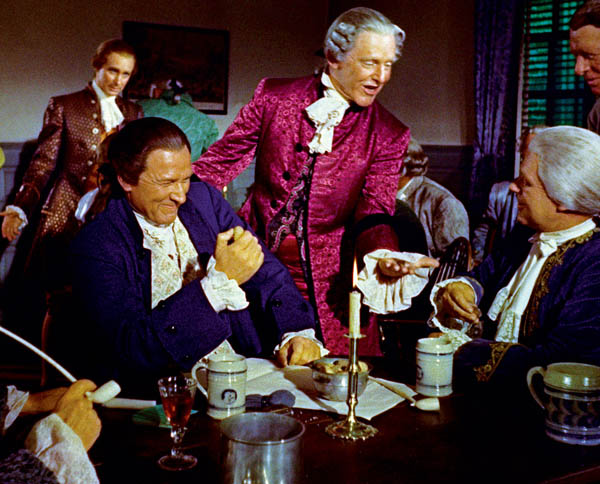
Finally, we’ll hear music from the longest continuously-shown film in cinematic history, “Williamsburg: The Story of a Patriot,” created exclusively for the tourist attraction of Colonial Williamsburg. The film features future “Hawaii Five-O” star Jack Lord, and the score is by none other than Bernard Herrmann. Peppered with recognizable patriotic tunes from the Revolutionary era, the charming suite includes quotations from “Yankee Doodle” and the William Billings hymn “Chester.”
Stick a feather in your hat and call it macaroni. Then join me for “Picture Perfect,” music for the movies, now in syndication on KWAX!
——-
Clip and save the start times for all three of my recorded shows:
PICTURE PERFECT, the movie music show – Friday at 8:00 PM EDT/5:00 PM PDT
SWEETNESS AND LIGHT, the light music program – Saturday at 11:00 AM EDT/8:00 AM PDT
THE LOST CHORD, unusual and neglected rep – Saturday at 7:00 PM EDT/4:00 PM PDT
Stream them, wherever you are, at the link!
https://kwax.uoregon.edu
——-
PHOTO: George Washington wagers he can crack a walnut with his bare hand in “Williamsburg: The Story of a Patriot”
-
250 Years of Independence, and All I Got Was “Picture Perfect”
by
-
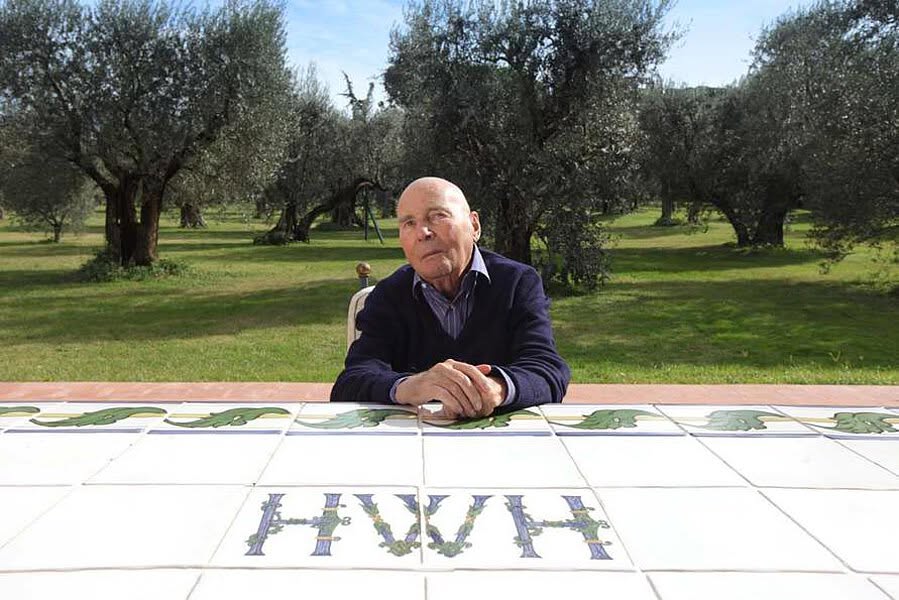
A Hundred Years of Henze
by
The first time I encountered Hans Werner Henze’s music, I think it was “The English Cat,” one of a series of Deutsche Welle operas relayed by WFMT out of Chicago. I thought, what the hell is this?
Since then, as a crazed record collector, I’ve accumulated a fair amount of Henze’s music on recordings. Also, as a classical music radio host, I’ve actually had to listen to some of it, in order to learn if there was anything he composed that wouldn’t frighten the horses (or the cats, for that matter), when it came time to mark his birthday anniversaries.
First, I unearthed his totally innocuous, charming even, “Telemanniana,” after Baroque master Georg Philipp Telemann (the title gives it away). Hardly characteristic, but it serves its purpose.
Then I got my hands on the Deutsche Grammophon recording – a 2-CD set – of his ballet “Undine,” a musical telling of Fouqé’s fantastic tale of star-crossed love between a water nymph and a mortal. The score is so eclectic, if you think you don’t like it, hang in there, because in a few minutes, it’s going to turn into something else. I mean, it’s modernist, but it’s not just some gray miasma.
Less congenial for weekday radio, perhaps, is “The Bassarids,” after Euripides’ “The Bacchae,” although it seems to be musically and dramatically effective. I’m just not going to blindside anyone at work with a two-and-a-half-hour opera (for as much as I would relish conveying the synopsis, with its frenzied dismemberment and severed head). The English libretto, by W.H. Auden and Chester Kallman, explores the conflict between Pentheus, King of Thebes (representative of human rationality and emotional control) and the god Dionysus (unbridled passion). The work scored Henze one of his greatest successes.
Henze himself was a very interesting character. His father was a teacher at a progressive school in Germany who somehow fell under the sway of Nazi propaganda, so that he enrolled his older boys (including Hans) as Hitler Youth! Naturally, this led to some friction in the family. You have to hand it to the old man, though. Eventually, he came around to the fact that Hans was never going to be a Nazi ideologue and became supportive of his musical studies. Then Dad rejoined the army (he was a World War I veteran) and died on the Eastern front. Toward the end of the war, Hans was conscripted, interrupting his studies, and he served as a radio operator until he was captured by the British.
Post-war, he attended the Darmstadt New Music Summer School, soaking up a lot of contemporary music, and became immersed in avant-garde techniques. He began experimenting with serialism.
Then the Sadler’s Wells Ballet visited Hamburg, and he started writing music for the stage. He found work conducting a ballet company in Wiesbaden, and his output includes a dozen ballets.
While he was still in his 20s, he decided he’d had enough of Germany, which he found boorish and intolerant and was full of traumatic memories. He took an advance from his publisher and beat it to Italy, settling for a few years on the island of Ischia, where he was welcomed by fellow expats William Walton and his wife, Susana.
Musically, Henze was always curious, seeking, assimilating, and adapting – he had a questing intellect and a Protean output – but he was also true to himself. And it frequently got him into trouble. He was a homosexual in a much less tolerant era. His embrace of communism also proved controversial. He wrote pieces honoring Ho Chi Minh and Che Guevara. When he placed a red flag on stage during a performance of his Guevara requiem, “The Raft of the Medusa,” the effect proved so incendiary that a riot broke out.
His later works were less inflammatory, though he continued to be inspired by political and social themes. His musical language traversed the paths of serialism, atonality, neoclassicism, Italian and Arabic influences, jazz, and even some rock and popular music.
In 2005, he suffered a nervous breakdown, during which he barely spoke, and for two months he refused to eat. Then suddenly he recovered, and his partner of some 40 years, Fausto Moroni, died of cancer. Henze himself died in Dresden in 2012 at the age of 86.
He was a prominent composer in his day, but I’m not sure how much of his music is being played now. Today is the 100th anniversary of his birth, so listen up.
———
“Telemanniana”
“Undine”
Teaser for “The English Cat”
“The Bassarids”
-
Circling But Never Meeting Robert Manno
by
8 responses
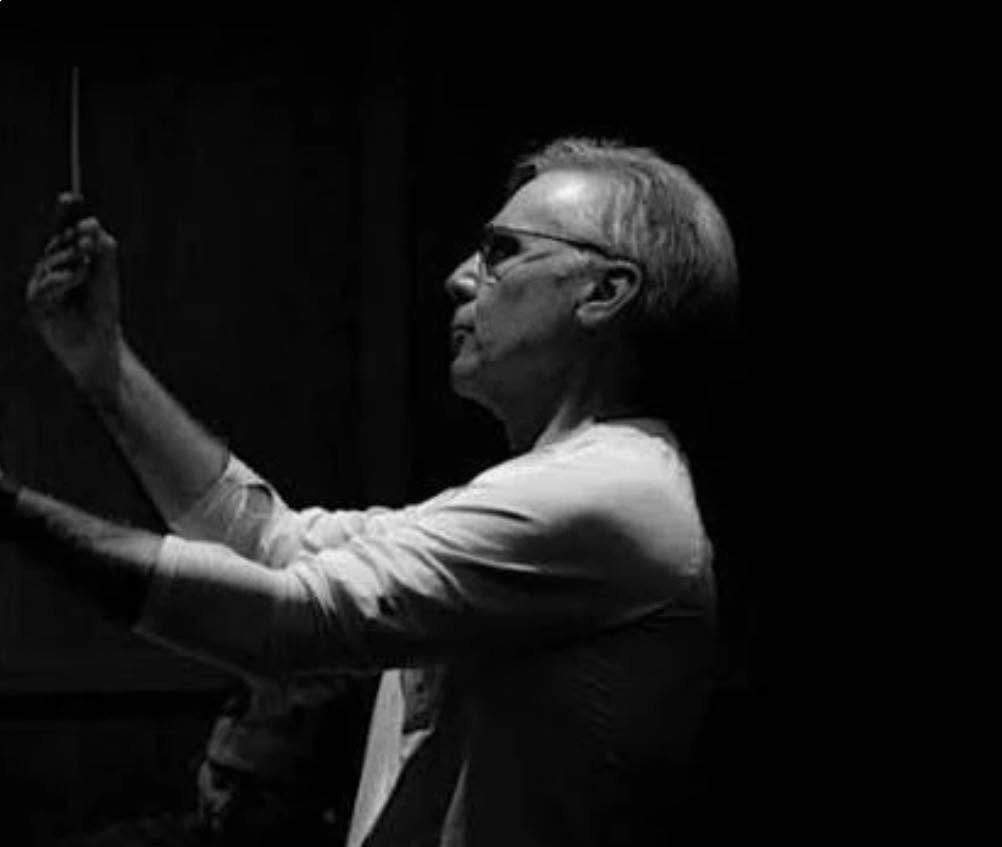
I am very sorry to learn of the passing of Robert Manno. Although I never met him personally, he was a follower of my page, and we enjoyed some exchanges in the comments and through private messaging in relation to certain composers and concerts he conducted.
Manno was co-founder of the Windham Chamber Music Festival and was a former assistant conductor and chorister at the Met. Born in Bryn Mawr, PA, he had a lot of local connections and we seem to have inhabited the same worlds, although perhaps at different times, so that there are a number of instances in which we were separated by two degrees – some of his acquaintances also being mine.
According to his biographical information, he enjoyed a brief career as a jazz pianist in Philadelphia. Later, he moved to New York to study the art with John Mehegan and Steve Kuhn. He received classical training from Dolores Ferraro, with whom he studied voice (he was a baritone who sang in the choruses of the Metropolitan and New York City Operas and as a soloist in concerts and recitals), and Romeo Cascarino, with whom he studied composition. He also studied with composers Donald Erb and Mario Davidovsky. He received degrees in voice from the Manhattan School of Music and composition from NYU.
He married Met violinist Magdalena Golczewski. Together they founded the Windham Chamber Music Festival, a long-running concert series in the Northern Catskills. Manno was kind enough to send me some of their CDs. One, in particular, with harpist Jacqueline Kerrod and flutist Eva Ding in music by Debussy, Hanson, Sibelius, Vaughan Williams, and others, I’ve enjoyed listening to over and over again. His live concert recordings were also included on broadcasts of American Public Media’s “Performance Today.”
When some followers disappear, sometimes they just drop out for a while and then at some point drift back and start liking posts and commenting again. Others I never hear from again. When I think of them, I always wonder about their health, or even their mortality. One of the ways in which social media is so peculiar is that we develop these online acquaintances with people, sometimes to the point it even feels as if we get to know them a little bit, they become familiar, and since so few grow beyond that, when things go silent for a time, we start to wonder about them.
I learned of Manno’s passing in an email I received from Ferraro yesterday. As I say, I didn’t really “know” him, but the news still came as a shock. He died on June 12 at the age of 81. May he rest in peace.
———-
In concert
Conducting a couple of his song cycles (and Tchaikovsky)
His website
http://www.robertmanno.com/main.shtml
-
Leroy Anderson and Bernard Herrmann: American Masters
by
6 responses
The composers Leroy Anderson and Bernard Herrmann rose to prominence, in their respective ways, through their invaluable contributions to American popular culture.
Anderson (1908-1975), whose fluency in foreign languages (especially those of Scandinavia) made him an asset to the U.S. Army during the Second World War, was more or less staff composer for the Boston Pops.
His early work for the Pops was as an arranger. It was Arthur Fiedler who recognized his talent and began requesting original work. Good call. Anderson turned out to be the Irving Berlin of American light orchestral music, producing hit after hit after hit: “Blue Tango,” “The Typewriter,” and “Plink! Plank! Plunk!” among them. Johnny Mathis scored a gargantuan success with his vocal rendition of “Sleigh-Ride,” for more than half a century a holiday staple. Anderson’s “The Syncopated Clock,” a favorite from the start, became further entrenched in the popular consciousness as the theme music for “The Late Show,” a showcase for the CBS late night movie.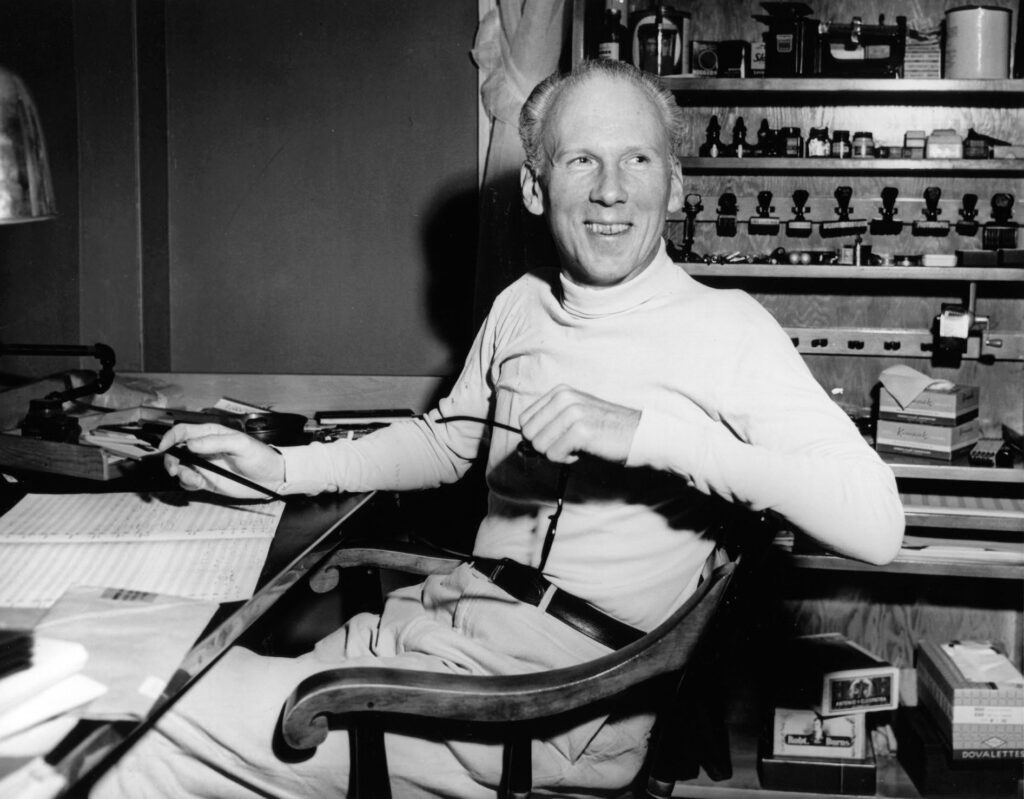
Herrmann (1911-1975) was staff conductor for CBS radio. In this role, he introduced American audiences to an impressive array of comparatively arcane music for the era, including works by Charles Ives, Nikolai Myaskovsky, Gian Francesco Malipiero, Edmund Rubbra, and Richard Arnell.
He fell in with Orson Welles, with whom he worked on radio shows such as “Mercury Theatre on the Air” (including Welles’ notorious adaptation of “War of the Worlds”). When Welles went to Hollywood, Herrmann went with him, to write the music for “Citizen Kane.” This would be the first of decades worth of finely-crafted film scores, always orchestrated by Herrmann himself (an unusual practice in Hollywood) and always perfectly suited to the images on screen, or their psychological underpinnings.
Of course, Herrmann is best-known for his collaborations with Alfred Hitchcock (including “Vertigo,” “North by Northwest,” and “Psycho”), but he also wrote top-notch, ear-opening scores for producer Charles Schneer and special effects artist Ray Harryhausen (most notably “Jason and the Argonauts”). Amazingly, he won only a single Oscar, for his work on “The Devil and Daniel Webster,” in 1941. Herrmann died of a heart attack shortly after completing the recording sessions for Martin Scorsese’s “Taxi Driver,” in 1975.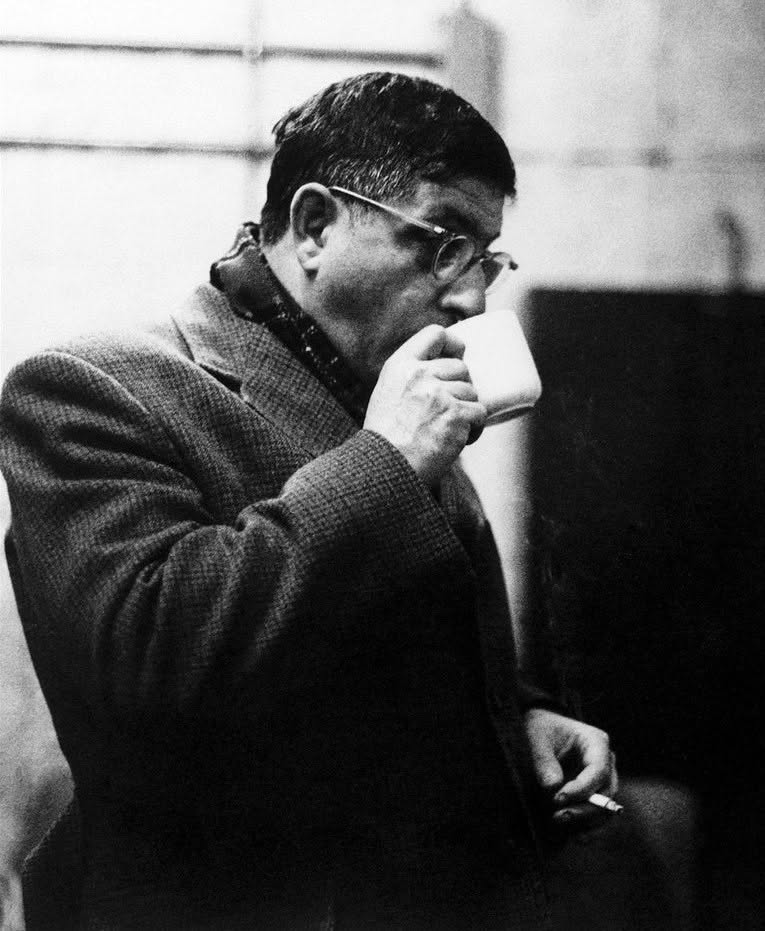
Happy birthday, gentlemen! Thanks for all the music.
————-
Staying up late with “The Syncopated Clock”
“North by Northwest”————-
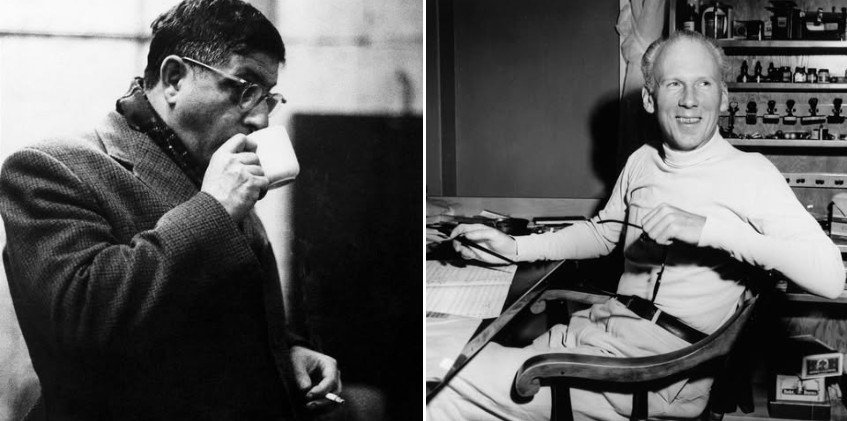
PHOTOS: Cranky Herrmann needs caffeine; sunny Anderson remembers his royalty checks
-
The 2000 Year Old Man Is 100
by
6 responses
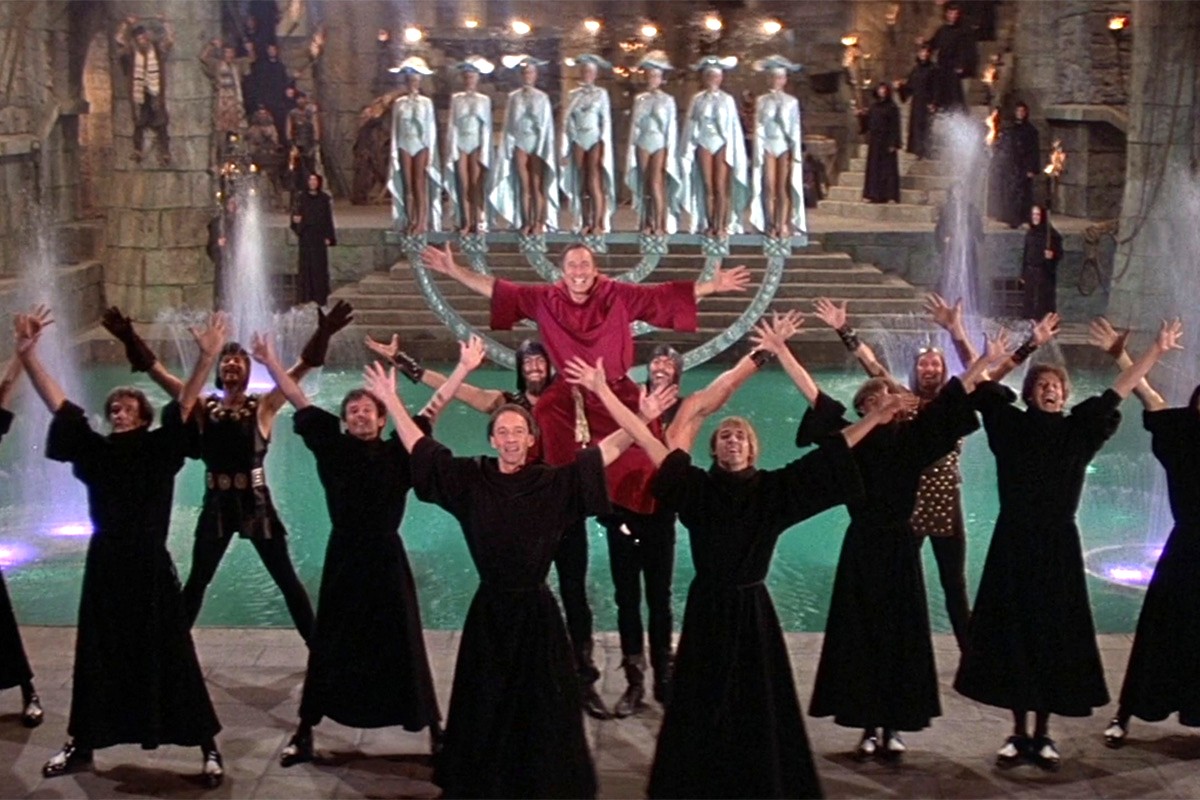
Mel Brooks is 100 today. Here he is at his most tasteless – and most hilarious. (View the sequence in full at the link below.) Is there anything about it that isn’t genius? The slide, the choreography, the patter, the mallets, the slot machine, the handspring, the Busby Berkeley nuns. Yet it should be one of the most offensive sequences in the history of motion pictures. Instead, it’s the funniest bit from “History of the World, Part I.” This is “Springtime for Hitler” taken to the nth degree. If the entire movie were at this level, it would be THE mainstream comedy classic everyone would be afraid to screen.
But by 1981, anyone who went to the cinema to see a Mel Brooks movie knew to check their pearls at the front door. “Blazing Saddles” trafficked in racial tension with taboo situations and slurs, and “The Producers” trivialized the Thousand-Year Reich by introducing showgirls clad in Bavarian pretzels and a Nazi kickline. NO ONE would have the guts to mount anything like it today, or would get away with it. But Mel tackled controversial subjects with the precision of a scalpel and the conviction of a wielded sledge hammer. Fascinatingly, in the end, it was always the laugh that was the most important.
Also, it was a different world, remember. Brooks didn’t come up with all this stuff out of thin air. He was born Melvin Kaminsky on a Brooklyn tenement kitchen table. His grandparents and his mother were Jewish immigrants, who came to this country fleeing hardship and persecution and hoping for a better, safer life. So the ethnicity – the culture, the accents, and the injustices – were all ingrained. He had a humble start and also some bad luck. When he was two years old, his father died of tuberculosis at the age of 34.
Yet as a first-generation American, he was born at an exciting time, one ripe with potential for upward mobility, when aspiring artists and entertainers in all fields were seizing their moment0 and shaping the country.
But first he would have to defend it, drafted into World War II at the age of 18, and unlike many entertainers, he wasn’t just doing USO shows. He was at the Battle of the Bulge, and he saw a lot of horrific things. He had important responsibilities as a forward artillery observer and a combat engineer. He was often perilously close to the enemy, and he was tasked with clearing booby-traps and defusing landmines. This is one comedian who saw a lot of life. His sense of humor kept him sane, and it brought levity to those around him.
After the war, he found work as a musician in the Catskills. Then he was pushed on stage to do stand-up. He also did summer stock and radio. Within a few years he had crashed television. He had met Sid Caesar for the first time while working at a Borscht Belt hotel when the two were still in their teens. Later, he buffeted Caesar with gags until he was hired as a writer on “Your Show of Shows.” At 24, he was working with Neil Simon, Woody Allen, Larry Gelbart, and lifelong friend Carl Reiner.With Reiner, he introduced his popular character, the 2000 Year Old Man, which soon found its way onto a hit record. With Buck Henry, he created the television series “Get Smart.” Then he wrote the screenplay for “The Producers.” The failure of his film “The Five Chairs” led to the success of “Blazing Saddles,” “Young Frankenstein,” and many others.
He channeled some of the profits into producing, quietly (so that they would be taken seriously) underwriting David Lynch’s “The Elephant Man,” “Frances” (with Jessica Lange), “The Fly,” and “84 Charing Cross Road” (which starred his wife, Anne Bancroft).
In his 70s, he made a late-in-life stab for the Great White Way – always a Brooksian ideal, as evidenced by the frequent, staged musical numbers in his movies – when he adapted “The Producers” for Broadway.
What I didn’t fully appreciate when I was younger was just how ballsy the movie “The Producers” was. Yes, there was still shock value when I saw it for the first time in the 1970s. Even when I was a kid, I knew Hitler was no laughing matter. But at the time the movie was released in 1967, it had only been roughly two decades since the end of the war. Millions of people had largely unfunny experiences with, and memories of, the Nazis. Countless lives had been destroyed. People who fought in the war were only entering middle age. All in all, Brooks’ conceit of two Broadway impresarios’ get-rich-quick scheme, mounting a Broadway musical so outrageous (about Hitler, of course) that the show would be forced to close on opening night – unexpectedly backfiring when it becomes a runaway hit – was an unlikely premise for a screen comedy.
By the time the movie was adapted into an honest-to-goodness Broadway musical in 2001, Nazism must have seemed like a conquered evil of the past. And now here we are, a quarter century on, and the hydra of antisemitism and neo-Nazism is sprouting new heads. But Brooks always maintained that the best way to defang evil was to mock it.
Of course, on a more basic level, he also reveled in sending up conventions and just being plain silly. He was a champion of Borscht Belt schtick and Yiddish theater zaniness. Rewatching his Hitchcock parody “High Anxiety” only last week, after many years, I found myself absurdly entertained by an onscreen psychiatric session that devolves into a boxing match between Brooks’ character and his mentor, played with Freudian gusto by Howard Morris (also of “Your Show of Shows), with Harvey Korman peeling off his jacket to reveal the striped shirt and black bowtie of a referee. It is a moment of inspired insanity that would have done the Marx Brothers proud.
Likewise, in the aforementioned (and below-linked) Inquisition number, Brooks’ juxtaposition of the cruelty and horrors of persecution and torture with the buoyant razzle dazzle of John Morris’ floorshow arrangements and orchestrations is deliriously ludicrous.
It’s not that he’s insensitive. Brooks once theorized that a lot of his humor is based on anger or hostility. If so, it’s actually a very healthy way to process. Society’s earnest attempts to rise above its baser qualities can sometimes come across as more ridiculous than any Brooks comedy, and a lot less entertaining. Progress comes easier when you can make people laugh than when you try to lead them by the nose. It’s a lesson that’s been lost, unhappily, and it’s entirely possible there’s a lot more friction and division in the world because of it.
C0omedy can’t be expected to mend all our faults, but Brooks has succeeded in making a lot of people lighter of spirit. Along the way, he’s also flown in the teeth of racism, atrocity, and historical tragedy by making us all roar at outrage. Ridicule can make the horrific risible. It’s fascinating how Brooks can be subversive as hell, and yet at the same time he’s always been one of the establishment’s greatest comics.
He is one of only 28 entertainers to achieve EGOT status – the recipient of four Emmys, three Grammys, an Oscar, and multiple Tonys (for his stage musical of “The Producers”). And yet, somehow, he has always been somewhat underrated.
And now, here he is, 100 years old and filming another “Spaceballs.”
Happy birthday, Mel. Sincere thanks for a lifetime of service. Every time you’ve made someone laugh, you’ve made the world a better place.
Now that you’re hopefully in the right frame of mind, dear reader, if you’re ready for the Inquisition, click the link.
Tag Cloud
Aaron Copland (93) Beethoven (95) Composer (114) Film Music (144) Film Score (143) Film Scores (255) Halloween (94) John Williams (195) KWAX (229) Leonard Bernstein (104) Marlboro Music Festival (125) Movie Music (159) Mozart (90) Opera (212) Philadelphia Orchestra (89) Picture Perfect (174) Princeton Symphony Orchestra (109) Radio (88) Ross Amico (244) Roy's Tie-Dye Sci-Fi Corner (290) The Classical Network (101) The Lost Chord (269) Vaughan Williams (105) WPRB (397) WWFM (881)
2 responses