When I first heard Carl Nielsen’s Symphony No. 3, I was sweating it out in a one-room efficiency in West Philadelphia that I shared with two of my classmates, while making up a math course I had flubbed at Temple University.
It was the summer of ’85, there was no air conditioning, and I studied and slept in a netted hammock suspended from two bicycle hooks I had screwed into the door frames to prevent being surprised by mice. There was always movement in the lone trash bag that sat exposed on the linoleum in the corner of the kitchenette, and to prove a point once I lobbed a sneaker into it, from the safety of my resting place, so that the rodents poured out of it and scurried around the apartment, sending one of my roommates, the one whose name was on the lease, shrieking into his bunk. He had a job canvasing for a political organization, so he was gone all day and would stagger back every night after last-call to sketch with intensity under a bright, exposed lightbulb that shone down in my face. Somewhere along the way, he brought home a turtle, which he kept in the bathtub and fed raw hamburger, until I couldn’t take its imprisonment any longer and finally released it into Fairmount Park.
The other roommate had the good sense to get a girlfriend, so he was never there. His contribution was a makeshift bunk bed hastily assembled from planks he had plucked from the garbage. The top bunk was usually vacant, due to his absence, and the bottom bunk was where my politically-motivated, alcohol-fueled, musky, mulchy-footed friend slept between me and the sole window fan.
Occasionally, I’d glimpse a cockroach making its way down one of the ropes of my hammock, and I’d start rocking about, trying to dislodge it. More than once, one of the bike hooks let go. The roaches were everywhere. There were even roaches in the freezer.
It was under these circumstances, one boxed-in, sweltering afternoon, that I first experienced Carl Nielsen’s Symphony No. 3, subtitled “Sinfonia espansiva.” It was broadcast on WFLN, Philadelphia’s classical music station for nearly 50 years (sadly, now defunct). Nielsen’s aspirational music opened up horizons for me and offered glimpses of larger things.
The recording was conducted by Leonard Bernstein. For those of you who aren’t familiar with him, Carl Nielsen is Denmark’s most celebrated composer. Yet, internationally, his music has struggled to take root in the shadow of that other great bard of the North, Jean Sibelius. This is a shame, since, far from being a Sibelius knock-off, Nielsen forged his own, immediately-recognizable style. Bernstein believed Nielsen’s rightful place was as Sibelius’ equal.
“I think many people are in for pleasant surprises as they get to know Nielsen,” he said at a centennial celebration of the composer’s birth, “his rough charm, his swing, his drive, his rhythmic surprises, his strange power of harmonic and tonal relationships – and especially his constant unpredictability – all these are irresistible. I feel confident that Nielsen’s time has come.”
Hey, he was right about Mahler. But that was in 1965, and Lenny’s prophetic lightning failed to strike twice. Sixty-one years on, with many more recordings and performances to choose from, Nielsen’s music remains, stubbornly, an acquired taste, if a rewarding one. There really is nothing else quite like it – the puckish wit, the ambiguities, the quirky juxtaposition of seemingly disparate melodies, harmonies, and key signatures, all very often shot through with a sense of hope and optimism that rises above the chaos.
I only lived in that hell hole for about a month, one summer session, thankfully, just long enough to make-up my credits, and then it was off to the greenery of my hometown to detox. But I was in the process of selling my soul for a piece of parchment, a degree, so in the fall it was back to Philadelphia.
After the purchase of my first CD-player, in order to feed my habit, I took a part-time job as a clerk at Sam Goody, a record shop then located at 11th and Chestnut Streets, which at the time had the most extensive classical music section in the city. (This was before the arrival of Tower Records.) It was there that I acquired Neeme Järvi’s Prokofiev cycle, Bernard Haitink’s Shostakovich cycle, Adrian Boult’s Vaughan Williams cycle, and my first recording of Nielsen’s Symphony No. 3. Essentially, I signed my paycheck back over to the company in exchange for CDs. I remember my frustration that so much of the good stuff was still only on LP.
The Nielsen recording was not the classic Leonard Bernstein performance I had heard on the radio – which had yet to be transferred to compact disc – but a newer, digital recording with Myung-Whun Chung and the Gothenburg Symphony Orchestra, on the BIS label. And I have to say, giving all credit to Bernstein for his advocacy of Nielsen’s music, I believe Chung’s recording outshines his in every way. To this day, I find it to be one of the most satisfying Nielsen recordings. It must have been within my first ten CD purchases. I remember when I had so few, I could keep them all in a shoebox. Now I’ve got a library of a good 10,000. You might say it has gone “espansiva.”
What exactly did Nielsen mean by that choice of subtitle? Robert Simpson wrote that the use of “espansiva” suggests an “outward growth of the mind’s scope.” There is certainly a sensation of expanding horizons about the piece, which includes a pastoral slow movement complete with wordless solos for soprano and baritone. According to Nielsen, the symphony concludes with “a hymn to work and the healthy activity of living.” All I know is that it fills me with optimism and happiness.
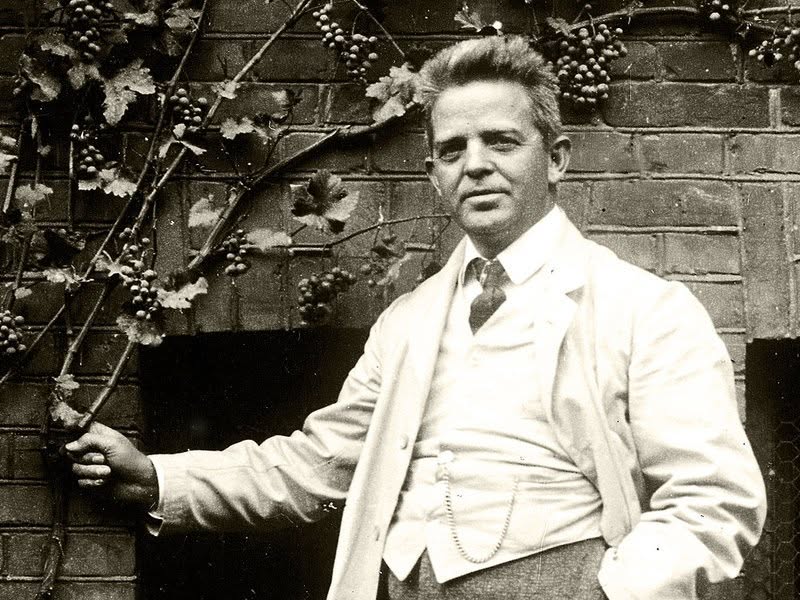
A tip of the blond brush cut to Carl Nielsen on his birthday. Perhaps his time will come. For me, it arrived in a very different climate from that of Copenhagen, in tropical West Philadelphia, in the summer 1985.
——–
Leonard Bernstein conducts the Royal Danish Orchestra on its own turf
https://www.youtube.com/watch?v=VNNP_4TYnV4
Myung-Whun Chung and the Gothenburg Symphony
https://www.youtube.com/watch?v=IS_-K_w9wdM
“Espansiva: A Portrait of Carl Nielsen”
https://www.youtube.com/watch?v=r0a1CPcTDEA&t
-
Expanding My Horizons with Carl Nielsen
by
-
Robert Schumann’s “Dedication” (with a Dedication to Liszt)
by
One response
The other day I was pulling together selections for my annual “June Weddings” show on “Sweetness and Light” (my light music program, which streams Saturday mornings at 11:00 EDT/8:00 PDT from KWAX Classical Oregon), and one of the pieces that sprang to mind – that I was unable to include – was Robert Schumann’s “Widmung,” or “Dedication,” after a poem of Friedrich Rückert. Schumann wrote the song for his bride, Clara.
The couple had wanted to marry for years, but Clara’s father – Friedrich Wieck, Robert’s former teacher – bitterly opposed the match, so violently in fact that the matter landed everyone in court.
At the time of their first meeting, Robert was 20 years-old and was invited into the Wieck household as a live-in student. Clara was 11. Clearly circumstances were problematic.
The minute Clara turned 18, she accepted Robert’s proposal of marriage. The elder Wieck declined to grant his permission, and the young couple was compelled to bring suit against him. In the end, the judge ruled in the lovers’ favor, and the two were at last able to wed, in 1840, one day before Clara’s 21st birthday – at which point she would no longer have needed her father’s consent!
Ah well. In the interim, after he had been tossed out of the house, Robert’s passion for Clara was sublimated into ardent love letters and bursts of creative energy. He composed reams of piano music at white heat up until the year of their marriage. Thereafter, he wrote for piano and orchestra, always with Clara in mind.
The two maintained a joint diary, and the entries are frequently touching. The Schumanns, like any married couple, had their issues, but they clearly loved one another very much. They became one of the great power couples of their time, with Robert a composing dynamo and Clara one of the outstanding concert pianists of her day. More than 20 years after Robert’s death, she became a professor at the Hoch Conservatory in Frankfurt. Her 61-year concert career played a huge role in molding public taste in so far as what we have come to expect, down to the present day, from a piano recital.
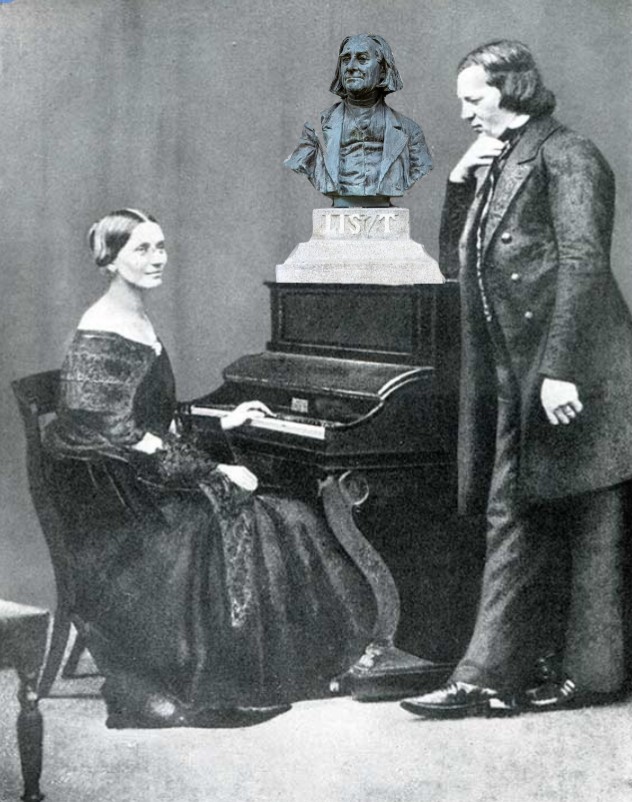
“Widmung” caught the fancy of Franz Liszt, who always liked the Schumann’s a great deal more than they liked him. For whatever reason, he really rubbed Clara the wrong way. Essentially, everything about his approach to music ran counter to what she and her husband believed the art form should be. But it wasn’t always the case.
Clara first met Liszt in 1838, prior to her marriage, when she was 19 years-old. Like everyone else, she was in awe of the pianist’s superhuman technique, but it also made her feel inadequate, especially when they played piano four-hands.
For his part, Liszt was very complimentary. In a letter to his mistress, Marie d’Agoult, he wrote, “Her compositions are truly remarkable, especially for a woman. They contain a hundred times more inventiveness and real feelings than all former and present fantasias by Thalberg.” Sigismond Thalberg was one of Liszt’s chief rivals. But this wasn’t simply “trash talk.” Liszt was consistently impressed by both Schumanns.
In 1840, he dedicated his “Transcendental Etudes” to Clara. She continued to include his music on her concert programs until 1847. Sadly, familiarity bred contempt, and increasingly she came to find everything about him abhorrent. She didn’t like that he was a showboat. She recoiled when he took liberties with the scores he played. And she was totally put off by the indelicacy with which Liszt described her husband’s Piano Quintet as “typically Leipzig.”
Liszt, clueless, continued to make friendly overtures, championing Robert’s music. Robert, for his part, responded cordially. Liszt published a long essay in praise of the artistry of both Schumanns in 1855, but Clara remained implacable.
As the War of the Romantics began to heat up in 1860, with heightened antagonism between the Brahmsians (including the Schumanns) and the New German School (followers of Liszt and Wagner), contact became rare.
In 1884, Clara wrote to Liszt with the aim of copying the correspondence he maintained with her husband, who had died in 1856. Liszt responded that he hadn’t saved any of the letters. That essentially ended all interaction between them.
45 years earlier, in 1839, Schumann completed his “Fantasie in C major,” during the period when Clara’s father forbade any contact between them. Schumann wrote to Clara, “The first movement is the most passionate I have ever composed; it is a profound lament on your account.”
Ironically, it was Liszt who received the dedication. Liszt returned the favor by dedicating his own Piano Sonata in B minor to Schumann in 1854.
Clara confided to her diary, “Today, Liszt sent me a Sonata dedicated to Robert and some more pieces, together with a polite note. But those pieces are so creepy! Brahms played them to me and I felt really miserable… This is only blind noise – no more healthy thoughts, everything is confused, one cannot see any clear harmonies! And, what is more, I still have to thank him now – this is really awful.”
Of course, Robert, at 44, had already lost his grip on sanity and was by then confined to an asylum.
Here’s the wedding gift he composed for Clara, from the collection “Myrthen,” or “Myrtles,” Op. 25.
And what Liszt made of it – much to Clara’s horror, I’m sure – played by Van Cliburn in 1958.
A year into the marriage, Clara reciprocated with an anniversary present for Robert, “Liebst du um Schönheit” (“If you love for beauty”), also after Rückert, included in her Lieder, Op. 12.
It’s Robert Schumann’s birthday, so do enjoy his Fantasie in C major.
Such dedication in these dedications!
-
Celebrating 800 followers with Richard Arnell’s “Gorilla” Symphony

by
One response
Wow. My post about Klaus Tennstedt Saturday for his centenary put me up over 800 followers. I can’t even keep up with responses to the comments. Thanks, everybody! I always try to post good or interesting material, but you know, if a tree falls in the woods, etc.
To keep it musical, as today’s 800-pound gorilla, I’d like to share the Symphony No. 5 by Richard Arnell, which the composer subtitled the “Gorilla” – a humorous analogy between the work and a gorilla he visited at the London Zoo. It has a great tune in the last movement, derived from the music hall, that Arnell’s father used to sing and whistle.
It’s a live performance by the Arizona-based MusicaNova Orchestra, which has done so much to champion Arnell’s music over the years (and neglected repertoire in general).
You can learn more about them here:
https://www.musicanovaaz.org/
Then join me in celebrating 800 followers with Arnell’s “Gorilla” Symphony.
On to 900!
-
Stunning Radvanovsky Worth the Wait, After Rain Delay at the Princeton Festival
by
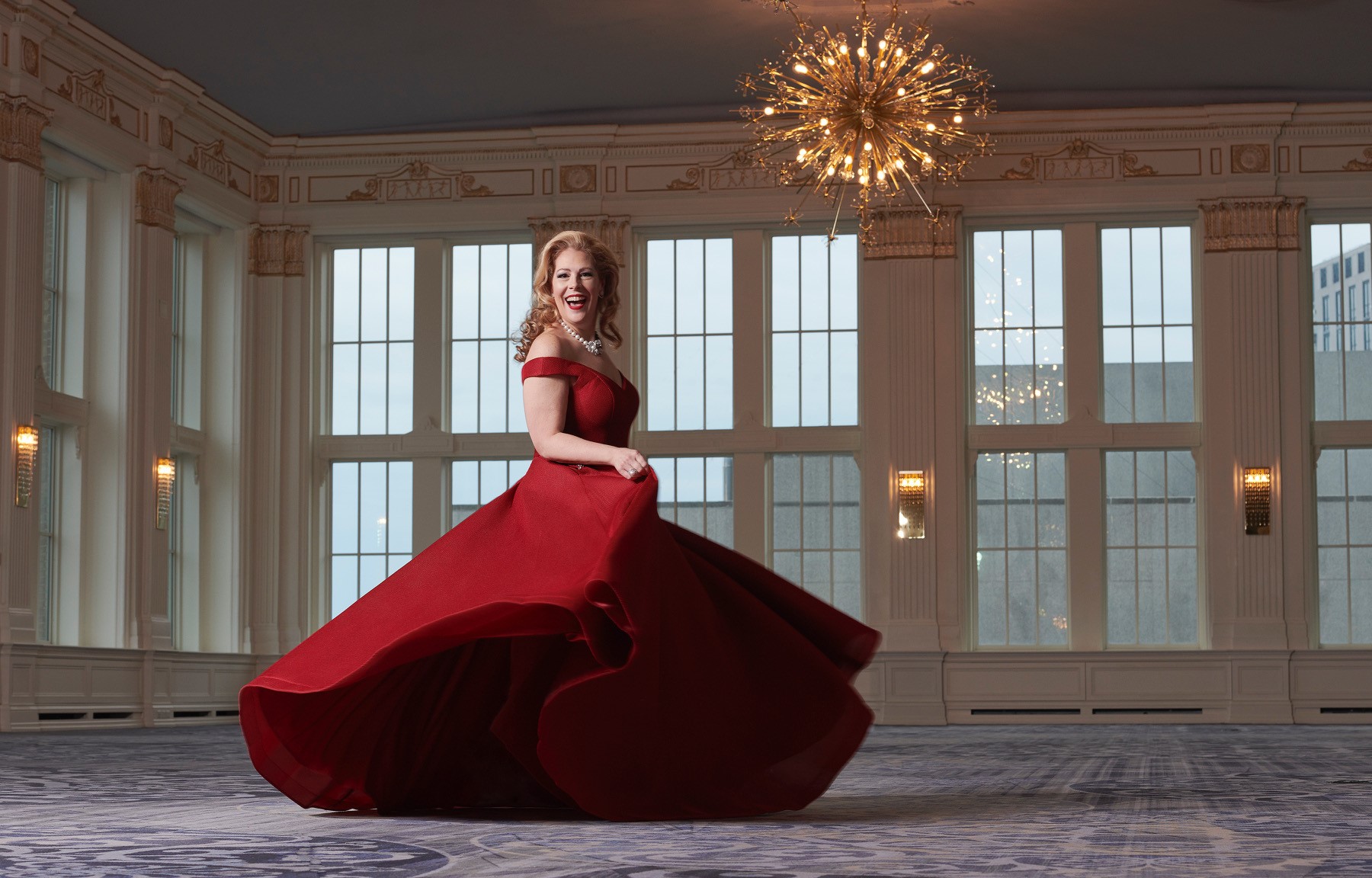
Because of safety concerns regarding the ill-timed thunderstorms that battered the region last night not long before curtain, it was nearly 9:00 before soprano Sondra Radvanovsky took the stage of the performance pavilion at Morven Museum & Garden for the second night of The Princeton Festival. But boy, when she did, did she deliver.
The program was perfectly tailored to suit her voice, with selections by Verdi (“La forza del destino”), Giordano (“André Chénier”), and Puccini (“Tosca” – which she’ll be singing at the Met next season – and an imperious Turandot). Her control was riveting, her dramatic presence hypnotic, and when she was under full sail, she flooded the tent with a magisterial voice that stirred overwhelming emotion.
She was joined by rising tenor Victor Starsky, a Princeton Festival veteran, who sang Cavaradossi in last year’s production of “Tosca” and will return next week as Pinkerton in “Madama Butterfly.” Starsky had his time in the spotlight with “Celeste Aida” and that old standby, “Nessun Dorma.” Nothing sets a crowd wild like a tenor in full voice.
But even more compelling, for me, personally, were his duets with Radvanovsky (from “Un Ballo in maschera” and “Manon Lescaut”), which allowed his passion to bubble over. I was left shaken by their concluding “Vicino a te s’acqueta,” from “André Chénier,” in which the couple anticipates fulfillment of their love in their impending death at the guillotine (“Viva la morte insiem!”) – so much so that, as I was chatting with some people behind me afterward, I nearly broke down.
No doubt there would have been encores, but it was already pushing 11:00. I’m sure a lot of contracted employees are going to be getting overtime.
Rossen Milanov conducted The Princeton Symphony Orchestra, in support of the singers, but also supplied the overtures and interludes by Verdi, Mascagni, and Leoncavallo. It was a late night, so I was thankful for having imbibed a strong cold brew beforehand. Even so, I think it would have been impossible to nod. It was definitely worth sweating it out in the car for an hour, waiting for the thunder and lightning to subside.
Today is the festival’s Community Day, with Yoga in the Garden (to live musical accompaniment) already underway. That will be followed this afternoon by family friendly activities, including an instrument “petting zoo,” a musical story time, a quilting exhibition, “Harriet Powers: American Icon,” with the Princeton Sankofa Stitchers Modern Quilt Guild, and American Repertory Ballet‘s 30-minute “Swan Lake Experience,” an accelerated story of the ballet with audience participation, from 12-3 p.m.
This evening, Milanov and the PSO will return to join the dancers for a program that will feature pas de deux from Tchaikovsky’s “Swan Lake” and “The Sleeping Beauty,” Samuel Barber’s “Adagio for Strings,” and a world premiere choreographed to music by Pulitzer Prize winner Caroline Shaw. But especially interesting to me will be a ballet set to Jean Françaix’s Piano Concerto, with Steven Beck the soloist. The event will commence in the performance pavilion on the Morven grounds at 7 p.m.
Morven Museum & Garden is located at 55 Stockton Street (Route 206) in Princeton, NJ.
The Princeton Festival runs through July 21. For tickets and information, visit princetonsymphony.org/festival.
——–
I didn’t take any pictures last night. I’ll add a more pertinent photo once the Princeton Festival makes one available!
-
Italian Dressing on “The Lost Chord”
by
12 responses
It seems as if it was only a matter of time before any Baroque musician of merit would become embroiled in a musical duel.
In the case of Domenico Scarlatti, he was challenged by none other than George Frideric Handel, in Rome. The resulting contest led to Handel being judged superior to his rival on the organ; however, on the harpsichord Scarlatti was deemed to be supreme. In fact, Scarlatti’s unusual facility at the keyboard has had artists “keyed up” for centuries.
Born in Naples in 1685 – the same year as Handel and Bach – Scarlatti spent much of his career in the service of the Portuguese and Spanish royal families. He wrote 555 keyboard sonatas, which have been admired by composer-performers from Frederic Chopin to Marc-André Hamelin.
This week on “The Lost Chord,” we’ll enjoy several works written in tribute to this Baroque master.
Charles Avison, whose life overlapped Scarlatti’s own (he was born in 1709, when Scarlatti was 23 years-old), arranged a number of his elder colleague’s keyboard works into a set of 12 concerti grossi. We’ll sample one of those, Avison’s Concerto No. 10 in D.
Then we’ll turn to American composer Norman Dello Joio. Dello Joio was the recipient of the Pulitzer Prize for Music in 1957 for his “Meditations on Ecclesiastes.” From 1979, we’ll hear his four-movement piano work, “Salute to Scarlatti.”
Dmitri Shostakovich arranged two of Scarlatti’s keyboard sonatas for small wind ensemble and percussion. We’ll enjoy performances of these by members of the former USSR Ministry of Culture Symphony Orchestra conducted by Gennady Rozhdestvensky.
Finally, Alfredo Casella’s 1926 suite for piano and orchestra, “Scarlattiana,” draws its inspiration from dozens of Scarlatti sonatas. Though unquestionably high-spirited, it was not originally intended for the dance – but since it unabashedly recalls Stravinsky’s “Pulcinella,” it is hardly surprising that some clown decided to choreograph it.
I hope you’ll join me for a mixed salad of Scarlatti tributes, on “Italian Dressing,” on “The Lost Chord,” now in syndication on KWAX Classical Oregon!
——-
Clip and save the start times for all three of my recorded shows:
PICTURE PERFECT, the movie music show – Friday at 8:00 PM EDT/5:00 PM PDT
SWEETNESS AND LIGHT, the light music program – Saturday at 11:00 AM EDT/8:00 AM PDT
THE LOST CHORD, unusual and neglected rep – Saturday at 7:00 PM EDT/4:00 PM PDT
Stream them, wherever you are, at the link!
https://kwax.uoregon.edu
——-
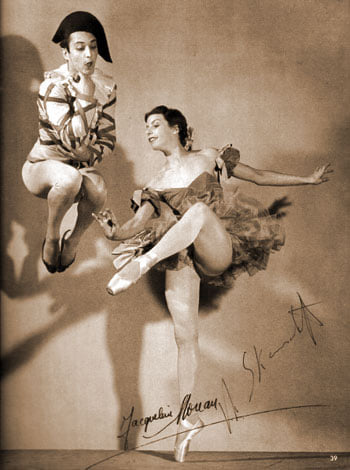
PHOTO: Wladimir Skouratoff (levitating) and Jacqueline Moreau in a 1954 production of “Scarlattiana”
Tag Cloud
Aaron Copland (93) Beethoven (95) Composer (114) Film Music (144) Film Score (143) Film Scores (255) Halloween (94) John Williams (195) KWAX (229) Leonard Bernstein (104) Marlboro Music Festival (125) Movie Music (159) Mozart (90) Opera (212) Philadelphia Orchestra (89) Picture Perfect (174) Princeton Symphony Orchestra (109) Radio (88) Ross Amico (244) Roy's Tie-Dye Sci-Fi Corner (290) The Classical Network (101) The Lost Chord (269) Vaughan Williams (105) WPRB (397) WWFM (881)
12 responses