• Plimpton, Bernstein, and Tchaikovsky

    Plimpton, Bernstein, and Tchaikovsky

    by 

    in
    4 responses

    After posting about Tchaikovsky’s “Little Russian” Symphony this morning, on the 150th anniversary of the work’s first performance, I recollected an anecdote once shared by the writer George Plimpton.

    Plimpton, of course, was most famous for his forays into “participatory journalism” – getting his hands dirty, with the occasional gash or broken bone, in pursuit of a better understanding of the subject he happened to be writing about, whether it be what it would be like to box with Archie Moore, train to be a goalie with the Boston Bruins, or to play quarterback with the Detroit Lions.

    The guy had guts, without the posturing of a Hemingway or a Mailer, and he wasn’t afraid to look foolish. Or if he was, he made pride subservient to the experience. It was an endearing quality in a man who spoke with a patrician accent, cofounded The Paris Review, and could trace his lineage to the Mayflower.

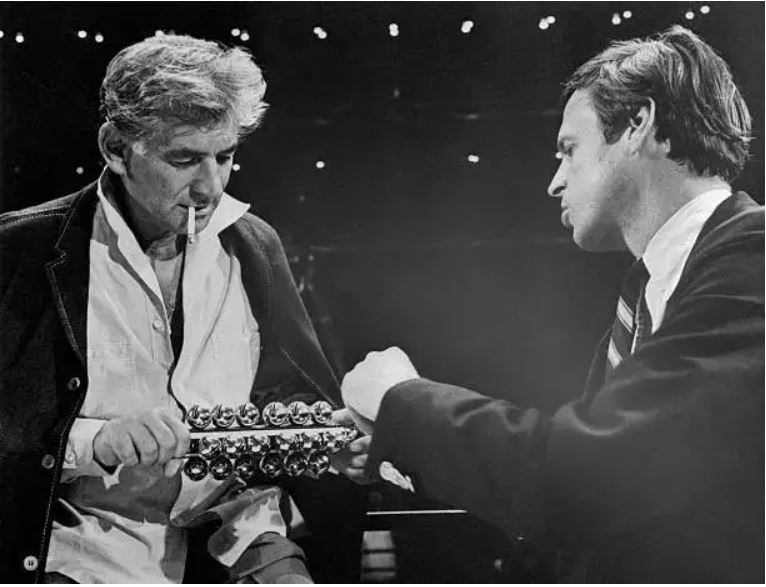
    When Plimpton took an interest in what it would be like to be an orchestra musician, he was allowed to tag along with the New York Philharmonic as a percussionist on its Canadian tour. In this capacity, he played the sleigh bells in the opening movement of Mahler’s Symphony No. 4 – very badly, it turned out, which infuriated the conductor, Leonard Bernstein.

    But Plimpton redeemed himself when he was assigned the gong in Tchaikovsky’s “Little Russian” Symphony. He was so keyed-up in the work’s final movement, as his big moment approached, that when he received his cue from the podium, he struck with such force that he claimed he could see the shock wave travel across the rows of stunned musicians to Bernstein himself, whose eyes widened in surprise. The conductor had to wait for the sound to decay before he could launch into the symphony’s final bars. Bernstein was so pleased with the result that he invited Plimpton to be on the recording of the piece that he and the orchestra subsequently made.

    But I’m only paraphrasing from the words of a very capable writer. Here’s the story from Plimpton’s own lips. Enjoy!

    https://www.c-span.org/video/?c4539798/user-clip-george-plimpton-joins-york-philharmonic


    PHOTO: Plimpton (right) with Bernstein and the Mahler 4 sleigh bells


  • Grammy Winners Coming to Princeton Festival

    Grammy Winners Coming to Princeton Festival

    by 

    in
    4 responses

    Really, I could care less about the Grammys. The broadcast has shown slight regard for classical music for decades.

    However, for a classical music artist, to win a Grammy still has some cachet. The Grammy is basically the Oscar of the music biz, the most widely recognized of the mainstream music awards. So in that regard, it’s very nice for a musician to win one.

    This year, in particular, my antennae are up, since so many of the winners are slated to appear in Princeton over the coming year.

    The trio Time for Three, made up of violinists Nicholas Kendall and Charles Yang and double-bassist Ranaan Meyer, were honored last night for Best Classical Music Instrumental Solo, for their album “Letters from the Future,” a Deutsche Grammophon release of two triple concertos, one by Kevin Puts, composer and the other by Jennifer Higdon, with the Philadelphia Orchestra conducted by Xian Zhang.

    Time for Three will return, following last year’s memorable, freewheeling appearance, to open this summer’s The Princeton Festival on June 9. The ensemble will also “solo” in Puts’ concerto on a concert of the Princeton Symphony Orchestra next March. Puts’ concerto, titled “Contact,” was also recognized with this year’s Grammy for Best Contemporary Classical Composition.

    And just think, I used to listen to these guys horse around in Rittenhouse Square when they were still students at the Curtis Institute.

    Parenthetically, Higdon is a Philadelphia resident and Zhang is music director of the New Jersey Symphony.

    The Attacca Quartet was honored with this year’s Grammy for Best Chamber Music/Small Ensemble Performance for their album “Evergreen,” made up of five works by Caroline Shaw. The Attacca Quartet too will appear at this summer’s Princeton Festival on June 17. Caroline Shaw’s “Entr’acte” will be heard next season on a concert of the PSO in November.

    Of course, Puts and Shaw are already Pulitzer Prize winners – Puts for his opera “Silent Night” in 2012 and Shaw for her a cappella masterpiece “Partita for 8 Voices” in 2013. Shaw, who was in the graduate program here in Princeton, became the youngest composer ever to be recognized with a Pulitzer, at age 30. Her work “Narrow Sea” garnered a Grammy for Best Contemporary Classical Composition in 2022.

    Baritone Will Liverman will present a recital at the Princeton Festival on June 19. Liverman is one of the principals on a recording of Terence Blanchard’s “Fire Shut Up in My Bones,” winner of this year’s Grammy for Best Opera Recording. The work opened the 2021-22 Metropolitan Opera season. In the recording, Liverman sings opposite Angel Blue, who you’ll recall stepped up at the eleventh hour to substitute for an ailing Pretty Yende to deliver a miraculous concert with the PSO only last month. Blanchard is the recipient of five previous Grammys in the Awards’ jazz categories.

    Offering further shout-outs to our neighbors in Philadelphia, Yannick Nézet-Séguin is the conductor on “Fire Shut Up in My Bones.” His recording with Renée Fleming (in which he appears as pianist), “Voice of Nature: The Anthropocene,” was also honored last night in the Best Classical Solo Vocal Album category. Nézet-Séguin, the Met’s music director, has just extended his contract as music and artistic director of the Philadelphia Orchestra through 2030.

    Finally, Philadelphia-based choir The Crossing was recognized in the category of Best Choral Performance for their album “Born.” The ensemble’s conductor, Donald Nally, only recently returned to his alma mater, Westminster Choir College, for a six-week residency.

    This year’s Princeton Festival will take place June 9-25, largely on the grounds of Morven Museum & Garden. Concerts of the Princeton Symphony Orchestra are held at Princeton University’s Richardson Auditorium. For more information about the festival and next season’s concerts, visit princetonsymphony.org.

    Congratulations to all, with appreciation from Princeton!


  • Allentown Symphony Weekend Lehigh Valley Music

    by 

    in
    7 responses

    This weekend: @[100057996013792:2048:Mimi Stillman] plays music by @[100056202085826:2048:Zhou Tian, composer] with the @[100063545561737:2048:Allentown Symphony Orchestra]! Also on the program: William Grant Still’s “Ennanga” for harp and strings and Dvořák’s “New World” Symphony. Show them some love, Lehigh Valley!


  • Ida Rubinstein Sultry Sugar Heiress

    Ida Rubinstein Sultry Sugar Heiress

    by 

    in
    8 responses

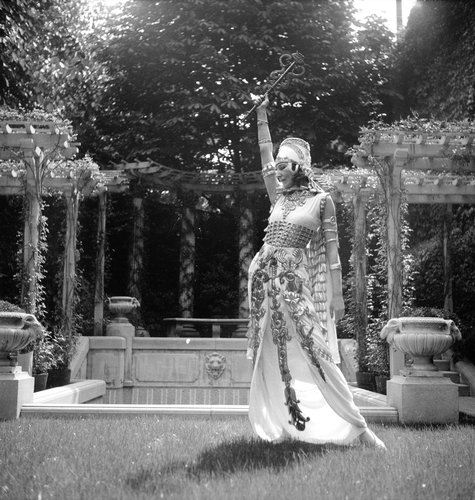
    The actor and dancer Ida Rubinstein specialized in strong, often sultry heroines. A remarkable figure, this sugar heiress from a family of Ukrainian Orthodox Jews essentially willed herself onto the Parisian stage, where her acting ability and natural magnetism more than compensated for her limited ability as a dancer.

    She was welcomed into the Ballets Russes in 1909, where she assumed the roles of Cleopatra and Scheherazade. Later, for her own company, she introduced Ravel’s “Bolero” and Stravinsky’s “Le Baiser de la fée” (“The Fairy’s Kiss”).

    She gained notoriety for her often racy sensuality, stripping naked for the “Dance of the Seven Veils” in a production of Oscar Wilde’s “Salome” in 1908. Her performance in the title role in Gabriele d’Annunzio and Claude Debussy’s “The Martyrdom of Saint Sebastian” generated further scandal in 1911. The Archbishop of Paris prohibited all Catholics from attending, on account of Saint Sebastian being portrayed by a woman and a Jew.

    This Sunday night on “The Lost Chord,” we salute Rubinstein with music that supported two of her lesser-known characterizations.

    In 1924, she appropriated the symphonic variations “Istar,” by Vincent d’Indy. Originally composed in 1896, the subject was a natural fit for the Rubinstein image, with the Assyrian goddess of love and war descending into the underworld to rescue her lover. Along the way, she passes through seven doors. At each door, she removes a piece of jewelry or an article of clothing, until, as she passes through the last, she stands unadorned. So does the music arrive finally at a complete statement of the theme, turning the usual structure of theme and variations on its head to suit the narrative.

    We’ll also hear “Sémiramis,” from 1934. This time Rubinstein played an Assyrian queen with insatiable carnal appetites. The music was by Arthur Honegger, and the instrumentation is quite striking: female narrator, vocal soloists, five-part mixed chorus, with orchestra including double bass clarinet, saxophone, two harps, two pianos, celesta, and two ondes Martenot – electronic keyboard instruments sounding very much like a couple of theremins.

    This was the fifth commission the composer was to receive from Rubinstein. The sixth and last brought forth his magnum opus, “Jeanne d’Arc au Bûcher” (“Joan of Arc at the Stake”).

    “Sémiramis” was not a success, and the work remained unpublished during Honegger’s lifetime. In particular, a 15-minute monologue toward the climax, written by Paul Valéry, took all the air out of the room. This spoken interlude has been omitted from the recording we’ll hear of the piece’s first modern performance in 1992.

    I hope you’ll join me as we celebrate Ida Rubinstein, with “Ida Danced All Night,” this Sunday night at 10:00 EST, on WWFM – The Classical Network and wwfm.org.


    PHOTO: Diaphanous dancer Ida Rubinstein


  • FutureDude & Space 1999 on Roy’s Sci-Fi Corner

    FutureDude & Space 1999 on Roy’s Sci-Fi Corner

    by 

    in
    6 responses

    It was our great pleasure to welcome Jeffrey Morris last night on Roy’s Tie-Dye Sci-Fi Corner. Morris, the founder and CCO of FutureDude Entertainment, is a true Renaissance man, with a seemingly inexhaustible supply of ideas, talent, and achievement.

    His latest project, scheduled to begin production next month, is “The Eagle Has Landed,” a documentary about the iconic “Space: 1999” transporter. Nick Tate, who played Alan Carter on the cult series, is set to narrate, with award-winning effects artist Brian Johnson also committed to participate.

    We also got to hear about some of Morris’ other projects – “Parallel Man, “Oceanus,” and “Persephone” – and their continuing evolution over various media. In addition, he spoke about, among other things, his extraordinary parents and his experiences with Prince!

    There’s even more information at futuredude.com. You can check out last night’s show here:

    Next week, the internet gods willing, we’ll finally welcome Patrick Read Johnson, who had to reschedule from January 27 because of connectivity issues. We’ll talk about coming of age in the 1970s, the transformative impact of “Star Wars,” experiments in Super-8 filmmaking, and Johnson’s subsequent adventures in Hollywood, including the making of his new film 5-25-77. (In case you don’t know, “Star Wars” was released on May 25, 1977.)

    Both these gentlemen, Morris and Johnson, for me, are like roads not taken. There were a lot of parallels in our childhoods and development, but somehow they figured out how to follow their dreams, channel their talents, and seize the day.

    There will be plenty more film, sci-fi, and nostalgia, as we welcome Patrick Read Johnson, when we livestream on Facebook, YouTube, etc., next Friday evening at 7:30 EST.

    https://www.facebook.com/roystiedyescificorner


Tag Cloud

Aaron Copland (93) Beethoven (95) Composer (114) Film Music (145) Film Score (143) Film Scores (255) Halloween (94) John Williams (195) KWAX (229) Leonard Bernstein (104) Marlboro Music Festival (125) Movie Music (160) Mozart (91) Opera (213) Philadelphia Orchestra (89) Picture Perfect (174) Princeton Symphony Orchestra (109) Radio (88) Ross Amico (244) Roy's Tie-Dye Sci-Fi Corner (290) The Classical Network (101) The Lost Chord (269) Vaughan Williams (105) WPRB (397) WWFM (881)

DON’T MISS A BEAT

Receive a weekly digest every Sunday at noon by signing up here


RECENT POSTS