• Jerry Fielding Centennial Celebration

    Jerry Fielding Centennial Celebration

    by 

    in
    5 responses

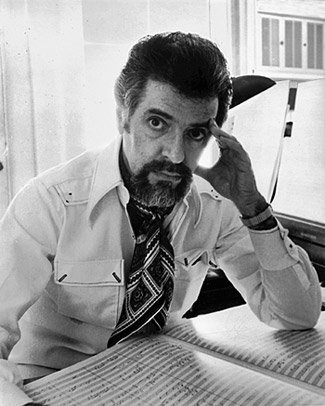
    Today marks the 100th anniversary of the birth of Jerry Fielding.

    Fielding was Sam Peckinpah’s composer of choice, though things didn’t always go smoothly between them. (Fielding claimed they resolved their differences with their fists.) Fielding is probably most celebrated for his score to Peckinpah’s landmark revisionist western “The Wild Bunch” (1969), for which he received his first Academy Award nomination. He was also nominated for his work on Peckinpah’s “Straw Dogs” (1971) and his first collaboration with Clint Eastwood, “The Outlaw Josey Wales.” (1976).

    Another frequent collaborator was director Michael Winner, whose biggest hit was “Death Wish” (which Fielding did not score). For Winner, he wrote music for “Lawman” (1971), the first jazz-inflected western, the period drama “The Nightcomers” (1971), in which Marlon Brando shares a cigarette with an ill-fated frog, and “The Big Sleep” (1976), with Robert Mitchum.

    Other notable films included “Scorpio” (1973), “The Bad News Bears” (1976), “The Demon Seed” (1977), “The Gauntlet (1977), and “Escape from Alcatraz” (1979).

    Fielding was born Joshua Itzhak Feldman to Russian immigrant parents who settled in Pittsburgh. By 1930, “Joshua Itzhak” had already been discarded, but it was in 1947, when he went to work for Jack Paar, that he was asked to change his surname, which he was told was too Jewish. Fielding later stated he was frequently conscious of anti-Semitic prejudice while working in the entertainment industry, which is ironic since many of his employers and colleagues were Jewish.

    In high school, he picked up the trombone, then switched to clarinet. He did well enough that he earned a scholarship to the Carnegie Institute of Instrumentalists. However, his attendance there was cut short by a mysterious illness that left him bedridden for two years. The radio was a constant companion, and he developed preferences for big band and Bernard Herrmann (who was then music director at CBS). Decades later, Fielding’s Oscar nomination for “Outlaw Josey Wales” placed him in direct competition with his early hero, as Herrmann was also nominated for his scores to Brian De Palma’s “Obsession” and Martin Scorsese’s “Taxi Driver.” Both composers lost to Jerry Goldsmith for “The Omen,” Goldsmith’s only Oscar.

    Fielding began working as a freelance musician in Pittsburgh, where he played in a pit band with the likes of Henry Mancini, Errol Garner, and Billy May, and cut his teeth as an arranger. He left Pittsburgh to work for Alvino Rey’s swing band. When war broke out, he was deemed too frail for service. Instead, he became the chief arranger for Kay Kyser, whom he followed to radio.

    He became the band leader for several shows. He worked with Groucho Marx as his music director on “You Bet Your Life,” both on radio and television. Though he himself was never a communist, he was called to testify before the House Un-American Activities Committee. He later joked that all the committee really wanted was to get him to name Groucho Marx as a communist, which he refused to do. Instead, he took the Fifth, and he was blacklisted. He suspected the real reasons for the Committee’s hostility had to do with his support for FDR, his joining the Radio Union (which all radio performers did), and his hiring of racially-integrated musicians for his bands. He survived the next decade, and even thrived, by playing regularly in Vegas, touring, and recording.

    It was Betty Hutton, with the backing of Desilu Productions (i.e. Lucille Ball), who insisted on hiring him as music director for “The Betty Hutton Show.” Otto Preminger, who had escaped Nazism and possessed no love for the methods of the Committee, made it a point to hire blacklisted artists. Fielding gained entrance into motion pictures when Preminger asked him to score “Advise and Consent” (1962).

    This also got him back onto television. Among his other TV credits were “McHale’s Navy” and “Kolchak: The Night Stalker.” He scored a couple of “Star Trek” episodes, including “The Trouble with Troubles.” He also wrote the theme music for “Hogan’s Heroes” and “The Bionic Woman.”

    Fielding died of a heart attack in 1980 at the age of 57.

    Hats off to Jerry Fielding on what would have been his 100th birthday.


    “The Wild Bunch”

    “The Nightcomers”

    “Scorpio”

    “The Outlaw Josey Wales”

    “Hogan’s Heroes”

    “The Bionic Woman”

    Blacklisted Jerry throws a dance party

    Rare interview with Jerry Fielding


  • Stravinsky Disney’s Rite of Spring Dinosaur

    Stravinsky Disney’s Rite of Spring Dinosaur

    by 

    in
    6 responses

    The composer who spent most of his life driving himself to evolve, terrified of turning into a dinosaur, first became known to many of us from the dinosaur segment in Disney’s “Fantasia.”

    Happy birthday, Igor Stravinsky! Fight for your “Rite” to party!

    How Walt Disney got “Rite of Spring” right:

    https://www.washingtonpost.com/entertainment/theater_dance/how-walt-disney-got-rite-of-spring-right/2013/06/19/8d008e78-d895-11e2-a9f2-42ee3912ae0e_story.html

    “Rite of Spring”: A classic “Fantasia” segment, whether Stravinsky liked it or not:

    https://www.yourclassical.org/story/2015/10/05/rite-spring-fantasia


    PHOTOS: (left) Disney and Stravinsky; (top to bottom) “The Rite of Spring” segment from “Fantasia;” George Balanchine, Stravinsky, and Disney with Pteranodon model; and Stravinsky caricature by Disney


  • E.T. at 40 A Sentimental Education

    E.T. at 40 A Sentimental Education

    by 

    in
    5 responses

    A four-handkerchief science fiction fantasy? Steven Spielberg managed it 40 years ago, and audiences went for it in a big way. “E.T. The Extra-Terrestrial” has been touching hearts with a great big glowing finger since the film’s release on June 11, 1982. And thank God for it. In a world that very badly needs to remember what it’s like to embrace its humanity, we could use more movies, more stories, more music like it. Never mind Flaubert. “E.T.” is a crash course in sentimental education.

    We’ll talk about it tomorrow night on “Roy’s Tie-Dye Sci-Fi Corner.” I confess, even though I was the one to suggest it, I am also a little reluctant to discuss it. But Roy and I certainly didn’t want the 40th anniversary of this cinematic milestone to pass unremarked. It’s the one movie where, depending on where the discussion goes, I may have to turn off my video. And maybe even the audio. If you have any baggage, “E.T.” will unpack it in a hurry.

    Spielberg and screenwriter Melissa Mathison draw on everything from the Bible to “Peter Pan” to craft an emotionally honest bedtime story that taps into eternal truths about childhood, love, and parting. Remarkably uncynical, full of hope, and just downright beautiful on every level, “E.T.” is a blockbuster with heart. It’s also a remarkably vibrant time capsule of what it was it like to grow up in the 1980s.

    Kudos to Carlo Rambaldi for his animatronic puppetry. Rewatching the film last night, I marveled at what they used to be able to accomplish before CGI became the default.

    And John Williams has never been better. In terms of storytelling, the last 15 minutes of “E.T.” is as good as it gets at the movies. Reportedly Spielberg shut off the projector at the recording session in order to give Williams maximum flexibility in conducting the orchestra, and fine-tuned the sequence later, reediting the images, the better to allow the music to fully breathe.

    This is the film that unhorsed “Star Wars” as the highest-grossing of all time and held the top slot for 15 years.

    Is it Spielberg’s greatest movie? Yes. Yes, it is. I’ll argue why, on the next Roy’s Tie-Dye Sci-Fi Corner. So bring your Reese’s Pieces to the comments section. We’ll be chasing rainbows and clapping our hands for fairies when we livestream on Facebook, this Friday evening at 7:00 EDT.

    https://www.facebook.com/roystiedyescificorner

    If you are one of those obstinate folk who has avoided “E.T.” all these years, and you plan to tune in for our conversation, for the love of movies, do watch it before we spoil it!

    May “E.T.” live long in our hearts!


  • Broadway’s Classical Music Mashups

    Broadway’s Classical Music Mashups

    by 

    in
    7 responses

    There is an interesting subgenre of the Broadway musical that owes its existence to some of classical music’s most shameless melodists. And it is largely attributable to the team of Robert Wright and George Forrest.

    Wright and Forrest, who were lifelong partners, both professionally and personally, knew a good tune when they heard one, and they were quick to appropriate the most insinuating of them as threads to be woven into the tapestries of some rather enduring musicals.

    Perhaps the most famous of these is “Kismet” (1953), which draws on the seductive lyricism of Alexander Borodin. I’m sure you’re familiar with its hit tunes, “Baubles, Bangles and Beads” and “Stranger in Paradise.”

    But there was also “Gypsy Lady” (1946) after Victor Herbert, and “Anya” (1965) after Rachmaninoff. Most ambitious of all was “Magdalena” (1948), a collaboration with Brazil’s still (at the time) very-much-alive and irrepressible Heitor Villa-Lobos.

    Wright and Forrest owed much to Edwin Lester, impresario of the Los Angeles Civic Light Opera, who first commissioned a number of these, which were presented as operettas. LACLO also revived works by of Sigmund Romberg, Victor Herbert, and Oscar Straus. The organization made its debut in 1938 with a revival of “Blossom Time,” a 1916 Viennese pastiche operetta after the music of Franz Schubert.

    Wright and Forrest were natural choices to retool “The Great Waltz,” after Johann Strauss II, which they did for a 1949 production by LACLO. This is the version that was used for a 1970 London stage revival and a 1972 motion picture remake.

    The original musical was conceived by Hassard Short, who also directed “Carmen Jones,” after Bizet, in 1943. (For once, Wright and Forrest had nothing to do with it.) Moss Hart wrote the original book. The lyrics were by Desmond Carter. This in turn was adapted from a 1930 pastiche operetta by Erich Wolfgang Korngold and Julius Bittner, “Waltzer aus Wien” (“Waltzes from Vienna”). A film adaptation from 1938 sported a screenplay and new lyrics by Oscar Hammerstein. The two films, which focus on different periods of Strauss’ life, are actually quite distinct.

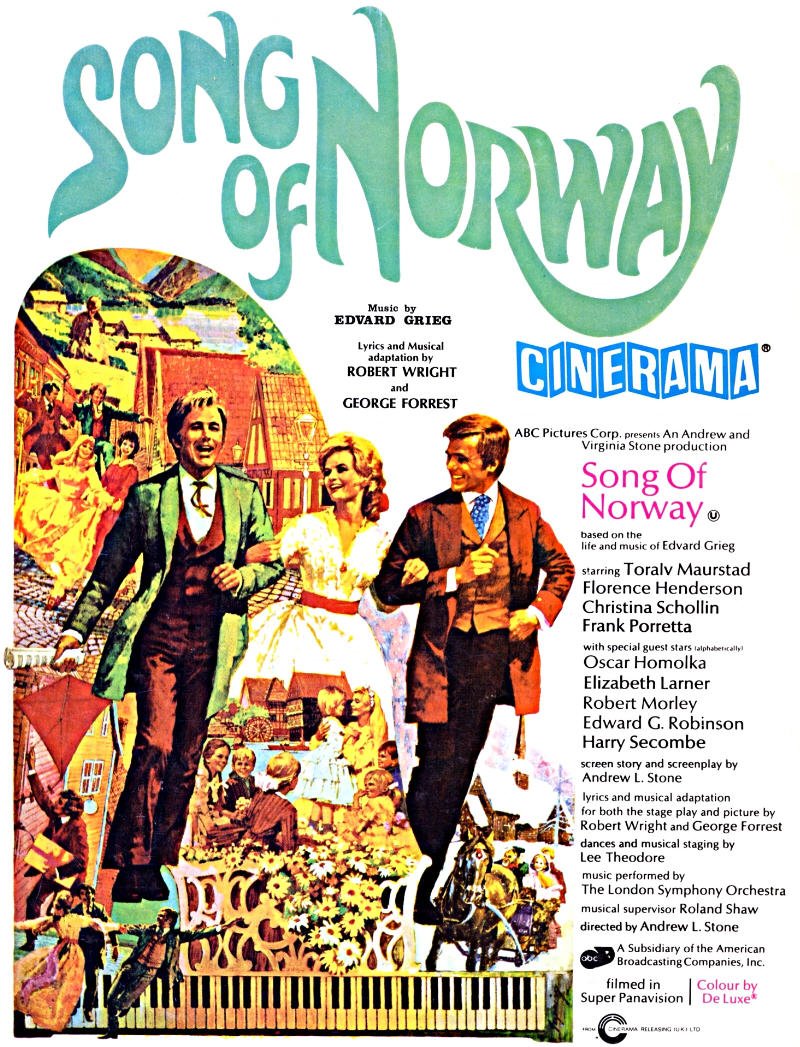
    But before Wright and Forrest’s work on any of these came “Song of Norway” (1944), after Edvard Grieg, who was born on this date in 1843. The team cannily recognized that one hummable melody after another virtually poured from the sleeves of Norway’s most famous composer, whose music must have been very much in the air during his centenary.

    The show is a fictionalized account of the lives of three childhood friends: Grieg, his sweetheart Nina Hagerup, and the “poet” Rikard Nordraak. In reality, Nordraak was also a composer – in fact the composer of Norway’s national anthem! – but presumably, to keep it clear for American audiences, there was room in Bergen and Troldhaugen for only one.

    “Song of Norway” was a hit on Broadway and ran for 860 performances. George Balanchine provided the choreography for the original production. The dancers were members of the Ballet Russe de Monte-Carlo, including Maria Tallchief, who married Balanchine during the show’s run.

    A film was announced for 1950, but didn’t materialize for another 20 years. Florence Henderson, by then a familiar presence in American living rooms as Mrs. Brady on “The Brady Bunch,” played Nina. Grieg was portrayed by Norwegian actor Toralv Maurstad, and Nordraak was played by American tenor Frank Porretta. Porretta retired from the stage in his early 40s, but not before leaving an indelible mark on American opera. He spent the second half of his career as choir director at St. John’s Church in Darien, Connecticut.

    A transparent attempt to capitalize on the popularity of “The Sound of Music,” the film of “Song of Norway” did not succeed. It did, however, give Edward G. Robinson another unlikely opportunity to play a Norwegian, 25 years after “Our Vines Have Tender Grapes.”

    Here are the opening credits, restored, and in their proper aspect ratio. I suppose if you’re going to give it a chance, this is the way it should be seen. That’s pianist John Ogdon on the soundtrack.

    But perhaps you’re satisfied with a muddy, cropped, substandard TV print – even though the film was originally presented in theaters in Cinerama.

    A condensed version on radio, brought to you by the American railroad!

    In real life, Nordraak met Grieg in Copenhagen in 1864, and the two became fast friends. For a time, Nordraak had resigned himself to a career in business at the behest of his father, but gradually his musical interests prevailed. Grieg encouraged him to join him in forging a Norwegian national sound. Sadly, the following year, Nordraak was studying abroad when he was stricken by tuberculosis. He died in Paris at the age of 23.

    Due to his early demise, he composed only about 40 pieces, many of them songs, works for male choir, and piano works. He also wrote incidental music for a play, “Mary Stuart in Scotland.” Interestingly, Grieg was of Scottish descent, on his father’s side. His great-grandfather settled in Norway in 1770.

    Nordraak, “Scherzo Capriccio”

    Nordraak, “Purpose” from “Mary Stuart in Scotland”

    https://www.youtube.com/watch?v=PrA1GXG_qrg

    Nordraak, Norwegian National Anthem

    Grieg, “Funeral March for Rikard Nordraak”

    Nina sings Nordraak’s “Holder du af mig” (“If you love me”) in 1889. She was 43 or 44 at the time. It’s possible that that’s Grieg himself at the keyboard.

    https://www.youtube.com/watch?v=Q5XCnIVud1c

    Unquestionably Grieg

    Wright and Forrest were always credited equally as composer-lyricists, but it was really Forrest who worked with the music. ”Kismet” earned them a Tony Award for Best Musical in 1954, and in 1995 they were honored with an ASCAP Foundation Richard Rodgers Award.

    Grieg compositions that were used in “Song of Norway” include the Piano Concerto in A minor (“Prelude & Legend”), the “Norwegian Dance No. 2” (“Freddy and His Fiddle”), the Violin Sonata No. 2 and “Waltz” from the “Lyric Pieces” (“Now”), “Wedding Day at Troldhaugen” (“Strange Music”), “One Balmy Summer Eve” from “Five Poems,” Op.26, and Scherzo in E from the “Lyric Pieces” (“Midsummer’s Eve”), and “I Love You” from “Melodies of the Heart,” Op.5.

    The fjords are alive with the sound of Edvard Grieg! Happy birthday to Norway’s most-beloved composer!


  • Philly Record Store Memories

    Philly Record Store Memories

    by 

    in
    4 responses

    As someone who lived and purchased records in Philadelphia for some 32 years, I hope you will enjoy reading this as much as I did. Anyone else remember Simon Roberts, who held court in the basement of Nathan Muchnik’s? I was just thinking about him the other day, recollecting his withering putdown of “deranged Bruckner fanatics,” even though it must be decades since he uttered it. How wonderful record shopping in Philadelphia used to be. Thank you, Princeton Record Exchange, for keeping the spark alive!

    At the core of this blog post, at the first link, is a reminiscence by Mark Obert-Thorn. If you’re unfamiliar with him, look more closely at the credits of any vintage reissues in your collection. Philadelphia-born Obert-Thorn and Ward Marston have dominated the field of historical restoration for decades. I believe Obert-Thorn’s musings, reprinted here, originally ran in the Philadelphia Inquirer in 2016.

    https://digital.nepr.net/music/2016/08/05/shopping-for-classical-music-a-remembrance/

    More about Obert-Thorn

    https://www.naxos.com/historical/engineer_thorn.htm

    His colleague, Ward Marston

    https://www.naxos.com/historical/engineer_marston.htm

    With the impending close of F.Y.E., this elegy for Center City record stores also ran in the Inky in 2016. I believe Peter Dobrin means the Schwann Catalog, not Schaum. I’m linking to Yahoo News, because the article in its Inquirer incarnation is paywalled.

    https://news.yahoo.com/era-ends-last-center-city-120000315.html?guccounter=1&guce_referrer=aHR0cHM6Ly93d3cuZ29vZ2xlLmNvbS8&guce_referrer_sig=AQAAABikwJRcqcCs-gn9RlrwCyTycUO20vdJn73UTAzuSYYzt-NTEgv1Vm215BIDdj5LO719-N_arZC67smrwjJ6wasInymoz8gqddSJhxBXPYLtg4tv2JGb71yc4V4m_vnpK-eVu4eEID5ruR6Kgcoy3jsImyIE3m0iBSZZdWXJULe9

    Personally, I found F.Y.E. a mite soulless. You had to brave whatever head-splitting commercial swill they were pumping into the cavernous primary sales floor in order to reach the classical oasis in the back (once it was ejected from upstairs to make way for DVDs). I did, however, meet Wolfgang Sawallisch there and hear a mini-Liszt recital performed by Lang Lang. Come to think of it, that may have been when the store, located at Broad & Chestnut, was still Tower Records. As it was, that Tower never filled the hole in my heart left by the Tower Records Classical Annex at 6th & South. When that store closed, part of me went with it.

    The line in Dobrin’s article that for me most resonates:

    “Back when music was harder to get, listeners valued it more. When you spent a lot of time hunting for something, you reveled in the triumph of finding it.”

    How many hours I spent on my back as a teenager, just listening to LPs and gazing at the cardboard sleeves, with their liner notes and eye-catching cover art. I learned as much about painting as I did about music back then, I think. When I only had a couple of crates of records, I knew every nuance, every crackle and pop so intimately. And intelligent classical music programming that honored the integrity of the music by broadcasting it in its entirely was available on the radio 24 hours a day. I miss those days so very, very much.


Tag Cloud

Aaron Copland (93) Beethoven (95) Composer (114) Film Music (145) Film Score (143) Film Scores (255) Halloween (94) John Williams (195) KWAX (229) Leonard Bernstein (104) Marlboro Music Festival (125) Movie Music (160) Mozart (91) Opera (213) Philadelphia Orchestra (89) Picture Perfect (174) Princeton Symphony Orchestra (109) Radio (88) Ross Amico (244) Roy's Tie-Dye Sci-Fi Corner (290) The Classical Network (101) The Lost Chord (269) Vaughan Williams (105) WPRB (397) WWFM (881)

DON’T MISS A BEAT

Receive a weekly digest every Sunday at noon by signing up here


RECENT POSTS