• Flag Day Vintage Recordings Sousa & US Marine Band

    Flag Day Vintage Recordings Sousa & US Marine Band

    by 

    in
    3 responses

    It’s Flag Day! Here are three vintage recordings for Old Glory:

    The U.S. Marine Band performs “True to the Flag” (actually of German origin) in 1922

    John Philip Sousa, “Riders for the Flag” in 1929

    Sousa introduces and conducts “Stars and Stripes Forever” in 1929


    IMAGE: Jasper Johns, “Three Flags” (1954)


  • Princeton Festival: Schubert’s “Death and the Maiden”

    Princeton Festival: Schubert’s “Death and the Maiden”

    by 

    in
    8 responses

    The Princeton Festival continues, as commentator Rob Kapilow, host of the popular radio show “What Makes It Great?,” explores Franz Schubert’s String Quartet in D minor, “Death and the Maiden.” Kapilow will deconstruct key passages from the piece with live musical illustrations, to reveal what makes the music so extraordinary. On the second half of the program will be a complete performance of the work by the Signum Quartett. Tonight’s event is presented in partnership with WWFM – The Classical Network, and will be broadcast live at 89.1 FM and wwfm.org.

    “Death of the Maiden” stands near the pinnacle of the Romantic string quartet repertoire. If you’re an ardent Schubertophile, you’ll also want to be on hand for tomorrow evening’s concert, which will round out a complete cycle of the composer’s late quartets, with the Signum playing both the “Rosamunde” and the monumental Quartet in G major. Both concerts, tonight and tomorrow, will begin at 7 pm.

    This year, nearly all festival events take place in a specially-constructed outdoor 10,000 square foot state-of-the-art performance tent on the grounds of Morven Museum & Garden on Route 206 (55 Stockton Street), not far from the Princeton Battle Monument.

    Drop by early, before this evening’s concert to enjoy empanadas, available for purchase from the Hotpanada truck. Tables and chairs will be available for picnicking, or bring your own blanket.

    Tomorrow, enjoy a preconcert talk by Schubert scholar Charles Fisk of Wellesley College, who will chat about Schubert’s later years, with a special emphasis on the final quartets. The talk will take place at Morven’s Stockton Education Center, located on the grounds, at 5 pm.

    For Schubert, of course, “late” came early, as he died in 1828 at the age of 31. His productivity, and the depth and range of his music, is staggering.

    The Princeton Festival runs through June 25, with musical events in a variety of genres presented every evening: opera, jazz, cabaret, musical theater, chamber music, classical and Broadway pops. Baroque music concerts will be presented across the street at Trinity Episcopal Church.

    Indulge in free pre-concert talks, a poetry workshop, an on-site bar, and abundant lawn space at Morven for picnicking prior to the concerts. For a complete schedule, visit princetonsymphony.org/festival.

    Direct link to tickets for tonight’s concert

    https://princetonsymphony.org/performances/what-makes-it-great/2022-06-13

    With the balance of the quartet cycle tomorrow evening

    https://princetonsymphony.org/performances/schuberts-late-string-quartets/2022-06-14


    Signum in concert with “Death and the Maiden”

    Empanadas in the truck from Hotpanada

    https://hotpanada.com/


  • Princeton Record Exchange Film Score Haul

    Princeton Record Exchange Film Score Haul

    by 

    in
    4 responses

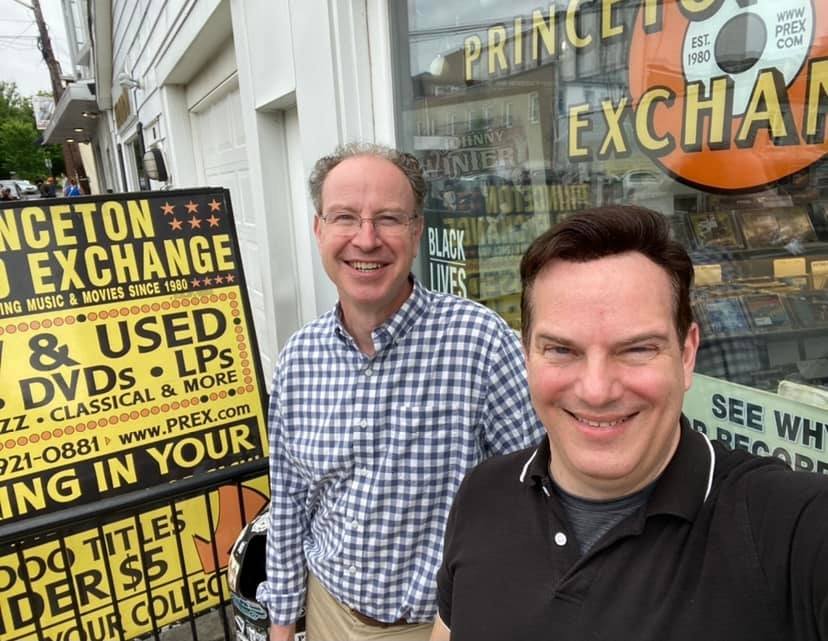
    Roy made the trek down to Princeton yesterday. I showed him around the town and campus and introduced him to Princeton Record Exchange, the Holy of Holies for savvy record collectors. Even just to get through the classical music section can sometimes take me a couple of hours, if I comb through everything, so there’s often little energy left to check out the other sections.

    Yesterday, even though I felt the perspiration beading on my forehead, I deliberately didn’t look too closely as we passed through. However, I had to fight hard not to grow roots when I happened to glance at the soundtracks and noticed a mother lode of classic film scores!

    Not wanting to waste our time together, I came back later and cleaned the place out. I filled up a bag with Max Steiner, Franz Waxman, Alfred Newman, Dimitri Tiomkin, David Raksin, Hugo Friedhofer, Victor Young, George Duning, Alex North, André Previn, Bronislau Kaper, Elmer Bernstein, Ernest Gold, Laurence Rosenthal, John Barry, Ron Goodwin, Ennio Morricone, Mario Nascimbene, Pino Donaggio, and Jerry Goldsmith (among others). I even found a suite from “The Skull” by Elisabeth Lutyens, some French scores for the films of Marcel Carné, and Alessandro Cicognini’s music for Kirk Douglas’ “Ulysses!”

    Roy, you’re my good luck charm!


  • Górecki’s Fourth: A Tansman Tribute

    Górecki’s Fourth: A Tansman Tribute

    by 

    in
    One response

    A performance of his Symphony No. 3 sold over a million copies, making it one of the best-selling classical records of all time.

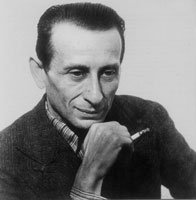
    This Sunday night on “The Lost Chord,” we’ll hear the last major work by Polish composer Henryk Górecki – his Symphony No. 4, subtitled “Tansman Episodes.” The piece was written in tribute to his compatriot, Alexandre Tansman, who lived most of his life in Paris. Górecki was cajoled into writing the work by the organizer of an annual Tansman Festival, held in Łódź, the city of Tansman’s birth.

    The astounding success of his Symphony No. 3 was actually a source of consternation for Górecki. The celebrity and scrutiny thrust upon him had the effect of disrupting his routine and stirred up anguish about his future path. Remember, the Symphony No. 3 was composed in 1976. Most of the world had never even heard of Górecki before he skyrocketed to fame in 1992. That was the year that Nonesuch Records released its recording, which featured soprano Dawn Upshaw, and was conducted by David Zinman. However, in the 16 years or so between the work’s composition and its sudden, staggering popularity, Górecki had understandably moved on and continued to develop as an artist.

    The sudden recognition caused him, rather Sibelius-like, to agonize over his next symphony. The work wasn’t completed in short score until 2006. The composer died in 2010 without having orchestrated the piece. However, he did leave indications of his intentions and had played through the work at the piano for his son, Mikolaj Górecki, also a composer. It was Mikolaj who took up the task of fleshing it out into full score following his father’s death.

    The symphony was given its first performance on April 12, 2014, by the forces we’ll hear, the London Philharmonic Orchestra conducted by Andrey Boreyko, in its world premiere recording.

    Rather than reference any of Tansman’s actual music, Górecki decided to play on the letters of the composer’s name, devising a musical cipher made up of corresponding notes to act as a recurring theme. In the second movement, he also quotes Karol Szymanowski’s “Stabat Mater.” There are passing references to Stravinsky and John Adams in the work, as well, and an appearance by Wagner’s “Siegfried” theme toward the end. In general, he trades the mesmerizing lyricism of his Third Symphony for a more aggressive brand of minimalism in his Fourth.

    I thought we’d preface Górecki’s symphonic tribute with some music by Tansman himself, who was born on this date 125 years ago. We’ll hear the “Partita for Cello and Piano,” written in 1954 and 1955 for the famed Spanish cellist Gaspar Cassadó. It will be performed by the Cracow Duo – Kalinowski & Szlezer, Jan Kalinowski, cello, and Marek Szlezer, piano.

    I hope you’ll join me for “Repeating Episodes” – Henryk Górecki’s Symphony No. 4 “Tansman Episodes,” etc. – this Sunday night at 10:00 EDT, on WWFM – The Classical Network and wwfm.org.


    POLE POSITIONS: Alexandre Tansman (left) and Henryk Górecki


  • E.T. & Benevolent Movie Aliens

    E.T. & Benevolent Movie Aliens

    by 

    in
    9 responses

    I’m one of those people who will dissolve into tears at the movies for no good reason. So when “E.T. The Extra-Terrestrial” opened on this date 40 years ago, I was a total mess. This simple story about the friendship between a boy and a stranded botanist from another world is elevated by John Williams’ most moving score. By turns tender, buoyant, and touching, Williams’ music provides the emotional underpinning of what may very well be Steven Spielberg’s best film. It earned its composer a much-deserved fourth Academy Award.

    In terms of box office, “E.T” was the first film to surpass “Star Wars” to become the highest grossing of all time. The entire moviegoing world, and certainly the entire country, was unified by this emotionally honest bedtime story that tapped into eternal truths about childhood, love, and parting. Remarkably uncynical, full of hope, and just downright beautiful on every level, “E.T.” lit up the screens in 1982 like no other. It was a blockbuster with heart. I don’t know that, in the 21st century, a movie quite like it will ever land again.

    This week on “Picture Perfect,” we recollect kinder, gentler times, with selections from films about benevolent visitors from other worlds. Friendly extraterrestrials have been out of fashion for quite a while now, as we seem to be mired in paranoia, conspiracy theories, and apocalyptic visions. But back in 1982, “E.T.” took the 1950s clichés of invaders from Mars and body snatchers from outer space and almost singlehandedly turned everything on its head.

    Spielberg himself would take a crack at old school alien invasion, for sure, when he remade H.G. Wells’ “The War of the Worlds” in 2005. But during the Reagan Era, with the Cold War winding down, terrorism not yet so much in the news, and Americans not so openly contemptuous of their neighbors, cinematic E.T.’s were benevolent at best, or at worst, just trying to do their thing. They were there to be misunderstood and even imperiled by man until a warm, fuzzy, often poignant finale.

    In Spielberg’s prior exploration of the concept of kindly visitors from another world, “Close Encounters of the Third Kind” (1977), there is an ambiguity for much of the film as to what exactly the aliens’ intentions are. In fact, there is at least one sequence that could very well give a child nightmares, and maybe parents too. Whatever tension is generated dissolves in the euphoric finale, centered around the communicative power of music. Like so many movies back then and so few now, “Close Encounters” doesn’t so much exhaust the viewer as leave him or her with a feeling of hope.

    John Williams’ approach couldn’t be more different than that for “E.T.” For “Close Encounters,” the avant garde syntax of the early, eerier sequences dissolves into unabashed lyricism for the film’s transcendent finale.

    Looking back a quarter century, Klaatu, the “friendly” alien of “The Day the Earth Stood Still” (1951), may come in peace, but it is a message delivered with tough love. If mankind refuses to abide, his giant robot, Gort, will destroy the planet. At a time when Martians invariably meant trouble, this was actually progressive.

    Bernard Herrmann’s score is one of his best, and certainly one of his most interesting. Always an eccentric orchestrator, Herrmann’s concept of extraterrestrial music incorporates violin, cello, electric bass, two theremins, two Hammond organs, a large studio electric organ, three vibraphones, two glockenspiels, two pianos, two harps, three trumpets, three trombones and four tubas. Overdubbing and tape-reversal techniques were also employed.

    Finally, Ron Howard’s “Cocoon” (1985) is one of the more worthwhile of the seemingly endless procession of extraterrestrial films to be released in the wake of “E.T.” At least this one took a different approach by bringing aliens into contact with a Florida retirement community, with the unexpected result of rejuvenating its inhabitants. A modern take on the fabled Fountain of Youth, the film is a showcase for veteran actors Hume Cronyn, Jessica Tandy, Jack Gilford, and Don Ameche (who won an Academy Award). James Horner’s score is much sought after by collectors.

    Klaatu barada nikto! Join me for the touchdown of benevolent extraterrestrials! We come in peace, so forget the tanks and bring a box of tissues, on “Picture Perfect,” music for the movies, this Saturday evening at 6:00 EDT, on WWFM – The Classical Network and wwfm.org.

Tag Cloud

Aaron Copland (93) Beethoven (95) Composer (114) Film Music (145) Film Score (143) Film Scores (255) Halloween (94) John Williams (195) KWAX (229) Leonard Bernstein (104) Marlboro Music Festival (125) Movie Music (160) Mozart (91) Opera (213) Philadelphia Orchestra (89) Picture Perfect (174) Princeton Symphony Orchestra (109) Radio (88) Ross Amico (244) Roy's Tie-Dye Sci-Fi Corner (290) The Classical Network (101) The Lost Chord (269) Vaughan Williams (105) WPRB (397) WWFM (881)

DON’T MISS A BEAT

Receive a weekly digest every Sunday at noon by signing up here


RECENT POSTS