• Neeme Järvi: Champion of Forgotten Music

    Neeme Järvi: Champion of Forgotten Music

    by 

    in
    4 responses

    How great a debt do we record collectors owe to Neeme Järvi?

    Järvi must be one of the most prolific recorded conductors of all time. He certainly stands out in his choice of repertoire, thanks in no small part to enterprising and supportive independent labels like Chandos and BIS (the latter for which he recorded the complete works of Jean Sibelius, more or less).

    Of course, Järvi also recorded for Deutsche Grammophon, but by then he was able to use his influence to gently nudge this most mainstream of classical music record labels closer to the fringes of the repertoire.

    From Järvi, you could always expect first-rate performances of music relegated to the lower drawers. It was from him that I learned all the Prokofiev symphonies, when all anyone else wanted to record was 1 & 5. It was his performances that convinced me that Glazunov was actually a fairly decent composer. He’s the only conductor to persuade me that Joachim Raff’s Fifth Symphony can be a compelling work. He also managed a thrilling and idiomatic recording of Duke Ellington’s “Harlem.”

    Frankly, there are too many composers who have benefited from Järvi’s advocacy to list them all here. Among those who are now much better-know internationally, thanks to him, are Arvo Pärt, Wilhelm Stenhammar, Niels Wilhelm Gade, and Eduard Tubin.

    Järvi excels in music of the Romantic era and the 20th century, and appears to be able to assimilate scores fairly quickly. And the more opulent, the better. His set of orchestral music from the operas of Rimsky-Korsakov is another highlight. His Strauss tone poems mesmerize. His recording of Prokofiev’s “Alexander Nevsky” is a knockout.

    How about his Beethoven? Who cares? Järvi is one of the rare talents in his field who managed to buck the tradition of having to prove his metal against the core Austro-Germanic repertoire. Frankly, I’m much more interested to hear his Halvorsen.

    A native of Tallin, Estonia (he emigrated to the United States in 1980 and has been an American citizen since 1985), Järvi trained under the Soviet system. His teachers included Yevgeny Mravinsky and Nikolai Rabinovich.

    He went on to helm such orchestras as the Estonian National Symphony Orchestra (1963-79), the Gothenburg Symphony Orchestra (1982-2004), the Royal Scottish National Orchestra (1984-88), the Detroit Symphony Orchestra (1990-2005), the New Jersey Symphony (2005-2009), the Resident Orchestra of the Hague (2005-12), and the Orchestre de la Suisse Romande (2012-15).

    As a performer, he’s a real throwback. Aside from his superb recordings, he also frequently excels in concert. On a good night, when he catches fire, his performances are marked by a romantic spontaneity and passion. The results can be thrilling. No other conductor, at least since the days when Dennis Russell Davies was a presence, would have been able to sway the Philadelphia Orchestra to perform Hans Rott’s Symphony in E – on the second half of the program, no less.

    Of course, the orchestra loved him for having stepped up to conduct Tchaikovsky on a joint concert with the New York Philharmonic during an orchestra strike in 1996. The program was prepared in one rehearsal. Jarvi donated his services for the concert and received no fee – an unpopular move with management, but one that made him a hero to musicians.

    All his children have entered the family business. His sons, Paavo and Kristjan, are also conductors, and his daughter, Maarika, is a flutist. According to the most recent information, he resides with his wife in New York City.

    While personally I never met him, he did respond to my request to sign some CDs of Estonian music to be used as “thank you” gifts during a radio membership drive for “The Lost Chord,” and into the bargain he also sent me a recording of Artur Kapp’s oratorio “Job,” with a very nice letter.

    Is it possible everything he’s recorded can be considered “great music?” Of course not. But is it interesting and historically significant? You bet! It would be a very boring world indeed, and a less enlightening one, if all we ever heard was Mozart’s “Jupiter” Symphony.

    Järvi is 85 today. Happy birthday, Maestro, and many, many more!


    Järvi in conversation with Bruce Duffie

    http://www.bruceduffie.com/jarvi.html

    Edvard Grieg, “Symphonic Dances”

    Eduard Tubin, Symphony No. 4 “Sinfonia Lirica”

    Alexander Glazunov, “Stenka Razin”

    Wilhelm Stenhammar, “Serenade”

    Arvo Pärt, Symphony No. 3

    Joachim Raff, Symphony No. 5 “Lenore”

    Zdenek Fibich, Symphony No. 2

    Sergei Prokofiev, “Alexander Nevsky ”

    Duke Ellington, “Harlem”

    Jean Sibelius, “Andante Festivo” (in concert)

  • Remembering Vincent Persichetti

    Remembering Vincent Persichetti

    by 

    in
    4 responses

    Vincent Persichetti was born in Philadelphia on this date in 1915. He died there in 1987. Although he seems to have had more of a lasting influence as a teacher – having molded legions of budding composers through his work at Combs College of Music, the Philadelphia Conservatory, and the Juilliard School – his own compositions are invariably well-crafted and certainly well worth listening to.

    Somewhere, I’ve got one of his manuscripts in a box of musical collectibles I acquired at Freeman’s Auction House, back in the day when, if no one bid on a lot, it would go down to a dollar. It may have been in with a box of conductor James De Preist’s homework. I ought to make a point to dig that out. Nothing major, maybe a fanfare or something, a short work for brass.

    The Philadelphia Orchestra used to play his work from time to time, but I haven’t seen any of Persichetti’s music on their programs for years. There is a document from the Muti era, on New World Records, a CD of live performances of the Symphony No. 5 for strings and the Piano Concerto, with Robert Taub as soloist. Frankly, I prefer this symphony, recorded by Ormandy and posted here in four movements:

    I. https://www.youtube.com/watch?v=Ajw4Ayhd1AA

    II. https://www.youtube.com/watch?v=2hkAvb3Gx7A

    III. https://www.youtube.com/watch?v=7BASajjHG08

    IV. https://www.youtube.com/watch?v=_rONwSSdlDE

    A 1983 documentary on Persichetti

    An interview with Bruce Duffie

    http://www.bruceduffie.com/persichetti.html

    An afternoon with Tim Page

    https://www.wnyc.org/story/an-afternoon-with-vincent-persichetti/

    Happy birthday, Vincent Persichetti!


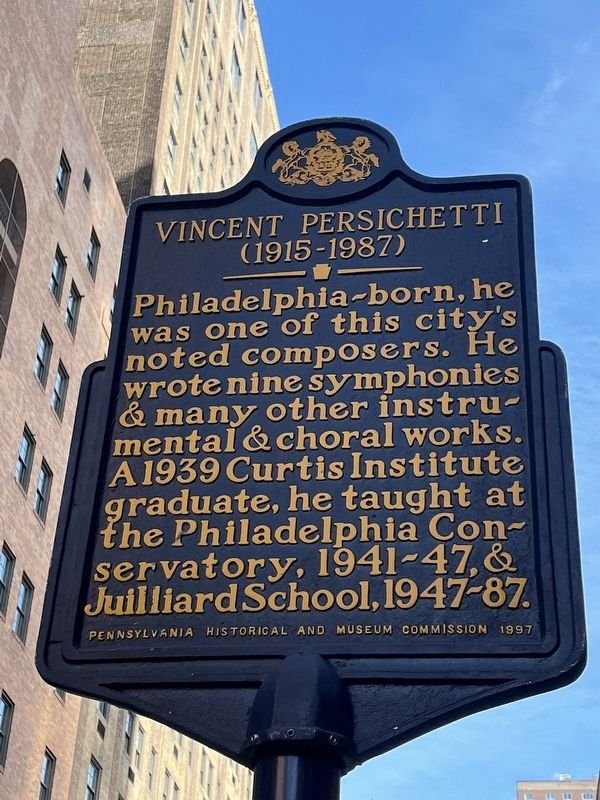
    PHOTO: The Vincent Persichetti historical marker outside the Curtis Institute of Music, from which he graduated in 1939


  • Aram Khachaturian’s Birthday Celebrate the Sabre Dance

    Aram Khachaturian’s Birthday Celebrate the Sabre Dance

    by 

    in
    4 responses

    Today is the birthday of Aram Khachaturian. You know, the guy who wrote that frenetic music that makes you want to spin plates on sticks.

    Here’s the “Sabre Dance,” with Khachaturian conducting:

    Liberace gives it a whirl:

    Mstislav Rostropovich, the soloist, with again the composer conducting (and highly-decorated), in Khachaturian’s “Concerto-Rhapsody”

    Adagio from the ballet “Spartacus”

    https://www.youtube.com/watch?v=wXsDsLHasWo

    Cristian Macelaru and the West German Radio Symphony Orchestra in a mesmerizing visual fantasy on the Romance from Khachaturian’s “Masquerade Suite”

    Khachaturian at the piano!

    Happy birthday, Aram Khachaturian!


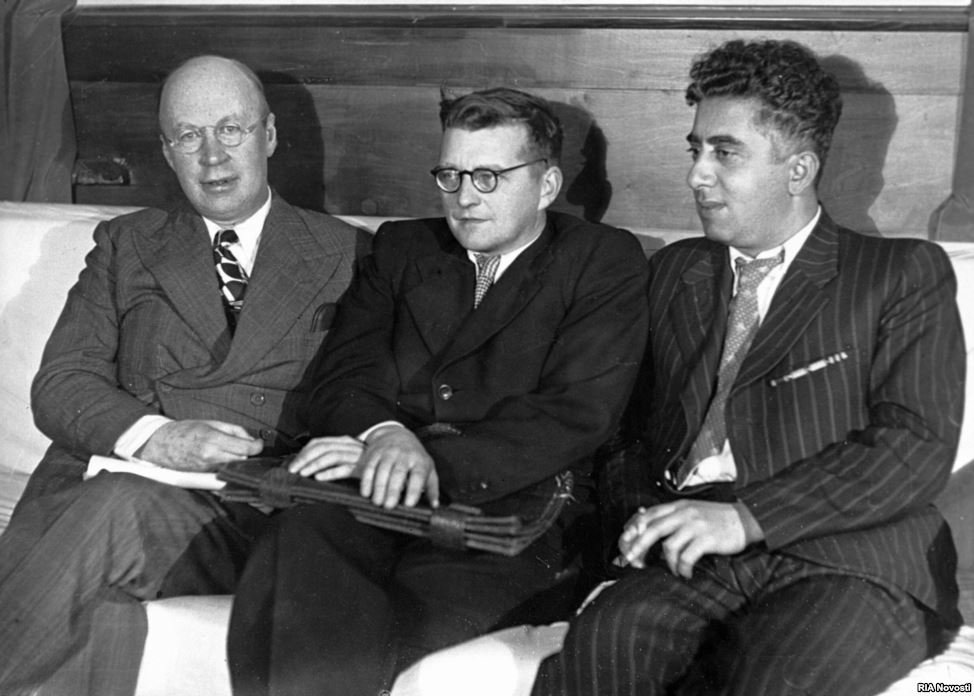
    PHOTO: Troika! (Right to left) Khachaturian with Shostakovich and Prokofiev


  • Rusalka Week Water Spirits on “The Lost Chord”

    Rusalka Week Water Spirits on “The Lost Chord”

    by 

    in
    4 responses

    What precautions have you taken against Rusalka Week? None, you say? (Crosses self)

    There are innumerable pieces of music written about water spirits – sirens, naiads, lorelei, undines, mermaids, and melusinas. This Sunday night on “The Lost Chord,” we’ll sample just a couple of these for Rusalka Week. Rusalka Week begins on Pentecost, 50 days after Easter (i.e. today).

    In Slavic mythology, a rusalka is a spirit that dwells at the bottom of a river or a lake. She lures unsuspecting men with her song, invariably resulting in a watery doom. Rusalki are never more dangerous than in early June, when the spirits roam free. Those who die in the week leading up to Pentecost are especially prone to becoming rusalki.

    Rusalka Week plays a role in Rimsky-Korsakov’s opera, “May Night,” drawn from Nikolai Gogol’s collection, “Evenings on a Farm Near Dikanka.” Alexander Dargomizhsky’s opera, “Rusalka,” is based on a dramatic poem by Pushkin. And the best known of the bunch, Dvorak’s “Rusalka,” was inspired by Czech fairy tales of Karel Jaromir Erben and Bozena Nemcova.

    But we won’t be listening to any of these. (We’ve treated Rimsky and Dargomizhsky in the past.) Instead, we’ll have a flute sonata from 1882 by Carl Reinecke that bears the subtitle “Undine,” an allusion to a novella by Friedrich de la Motte Fouqué, very popular among the Romantics. Fouqué’s “Undine” tells the tale of a water spirit who marries a knight in order to gain a soul.

    Then we’ll hear the complete ballet, “Les Sirènes,” from 1946, by Lord Berners. Berners, notorious for his sense of the absurd (a horse was a regular guest at his indoor tea parties) was a talented composer, writer, and painter. “Les Sirènes,” after a scenario by Frederick Ashton, features mermaids combing their hair and singing on rocks at a seaside resort, while on shore, sirens of another sort behave coquettishly.

    I hope you’ll join me – you shouldn’t be out wandering during Rusalka Week anyway – for “Come on in, the Water’s Fine,” this Sunday night at 10:00 EDT, on WWFM – The Classical Network and wwfm.org.


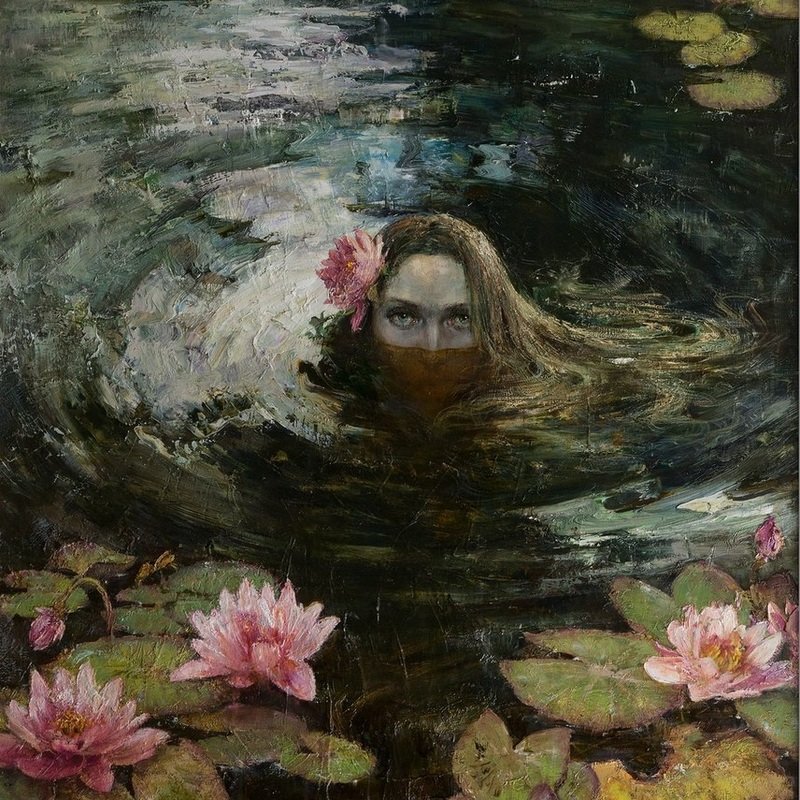
    IMAGE: “Rusalka” by Anna Vinogradova


  • 1982 Summer of Fun Star Trek E.T. Anniversary

    1982 Summer of Fun Star Trek E.T. Anniversary

    by 

    “Star Trek II: The Wrath of Kahn” opened on this date 40 years ago, as did Steven Spielberg’s “Poltergeist.” Even so, it was really “E.T. The Extra-Terrestrial,” released the following week, I was most looking forward to. 1982 was, truly, the Summer of Fun.

    On Thursday, Roy and I got to reminisce a little bit about our theatrical “Trek” and treks that summer, which bloomed gloriously during a brief, halcyon span between our sophomore and junior years of high school, when summers were still very much summer, full of possibility, laughter, and adventure.

    Enjoy the full Khan-versation here. And be sure to stick around for the end, when we acknowledge my second anniversary on the show and join in a group “KHAAAAAAAAAAAAAAAAAAAN!”

    When next we convene, the subject will indeed be “E.T. The Extra-Terrestrial.” That should give your tear ducts time to replenish after a poignant farewell to Spock. Turn on your heartlights in the comments section, when we livestream on Facebook. Our celebration of the Summer of Fun continues IN TWO WEEKS, FRIDAY, JUNE 17, at 7 PM EDT, on Roy’s Tie-Dye Sci-Fi Corner!

    https://www.facebook.com/roystiedyescificorner


Tag Cloud

Aaron Copland (93) Beethoven (95) Composer (114) Film Music (145) Film Score (143) Film Scores (255) Halloween (94) John Williams (195) KWAX (229) Leonard Bernstein (104) Marlboro Music Festival (125) Movie Music (160) Mozart (91) Opera (213) Philadelphia Orchestra (89) Picture Perfect (174) Princeton Symphony Orchestra (109) Radio (88) Ross Amico (244) Roy's Tie-Dye Sci-Fi Corner (290) The Classical Network (101) The Lost Chord (269) Vaughan Williams (105) WPRB (397) WWFM (881)

DON’T MISS A BEAT

Receive a weekly digest every Sunday at noon by signing up here


RECENT POSTS