• Celebrating Salieri: Beyond Mozart Rivalry

    Celebrating Salieri: Beyond Mozart Rivalry

    by 

    in
    7 responses

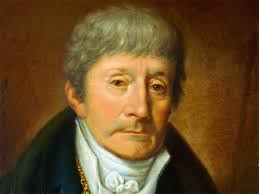
    Happy birthday, Antonio Salieri! I hope you’ll join me in celebrating 270 years of “mediocrity.”

    Salieri lives on in the popular imagination, of course, as the envious rival of Wolfgang Amadeus Mozart. But was he really?

    Rumors of Salieri’s involvement in Mozart’s death were seized upon by Alexander Pushkin as early as 1831, when he came to write the tragedy “Mozart and Salieri,” which appeared only few years after Salieri himself had passed. This was later set as an opera, in 1898, by Nikolai Rimsky-Korsakov.

    Of course, the slander has been kept alive and given even broader currency thanks to Peter Schaffer’s play, “Amadeus,” and the even more widely seen film, directed by Milos Forman. While I have no objection to dramatic license (Shakespeare would not be Shakespeare without it), it is too bad that such a generous figure – and a fine composer to boot – should live on, for the most part, in infamy.

    Salieri was a generous teacher, who fostered Beethoven, Schubert, Liszt, and even the son of the genius he was rumored to have poisoned. Franz Xaver Mozart was born four months after his father’s alleged murder.

    Salieri’s first act, when he was appointed Austrian Imperial Kapellmeister in 1788, was to revive Mozart’s “The Marriage of Figaro.” He was responsible for arranging first performances of his alleged nemesis’ Piano Concerto No. 22, the Clarinet Quintet, and the Symphony No. 40, and he had nothing but praise for “The Magic Flute.”

    Sadly, he found no one to return the favor. Already during his later years, his own enormous compositional output (37 operas, in addition to orchestral works, concertos, chamber music, and sacred pieces) gradually faded from public memory. Ironically, it is the scandalmongers who kept his name alive.

    But, as the saying goes, there is no such thing as bad publicity. In a way, “Amadeus” was the best thing to happen to Salieri in nearly 200 years. How many people remember Mozart’s string quartet partners (with Haydn), Carl Ditters von Dittersdorf and Jan Křtitel Vaňhal, both also talented and prolific composers? I’m sure they would agree – with apologies to Wilde – that the only thing worse than being talked about is not being talked about.

    Happy birthday, Patron Saint of Mediocrity!

    Russian film version of Rimsky’s “Mozart and Salieri” (without subtitles): https://www.youtube.com/watch?v=ilw7oIkrDj4

    In English, if a bit fuzzy:

    Salieri’s Concerto for Flute, Oboe and Orchestra:

    A Mozart and Salieri collaborative effort, the cantata “Per la ricuperata salute di Ofelia,” only recently rediscovered:

    “I absolve you.”


  • Martian Chronicles Dissected Stargate Special Effects

    by 

    in
    4 responses

    In case you missed it (and I know you did), here’s Roy and my epic dissection of the 1979-1980 miniseries after Ray Bradbury’s “The Martian Chronicles,” which turned out to be nearly as long as the series itself (although, I think you’ll agree, much more entertaining).

    Roy’s Tie-Dye Sci-Fi Corner streams live on Facebook every Friday and Sunday at 7 pm EDT. We’ll actually be taking a break this Friday (it’s Roy’s wife’s birthday), but the week after that, we’ll be discussing “Robinson Crusoe on Mars.”

    This Sunday, Roy’s special guest will be Bruce Woloshyn, special effects supervisor on television shows such as “Stargate SG-1” and “Stargate: Atlantis.” Among his other, big screen credits are “Abraham Lincoln: Vampire Hunter,” “Mission to Mars,” and “Night at the Museum.”

    Tune in for the conversation this Sunday at 7 pm:

    https://www.facebook.com/roystiedyescificorner/


  • Classical Myths Music Crossword Challenge

    Classical Myths Music Crossword Challenge

    by 

    in
    4 responses

    There’s classical, and then there’s “classical.”

    It’s all about classical myths in classical music, in this week’s Classic Ross Amico crossword.

    To fill out the puzzle, follow the link and select “solve online” at the bottom of the page. You’ll then be able to type directly into the squares. Once you feel you’ve exhausted the puzzle, you’ll find the solutions by clicking on “Answer Key PDF.”

    Strap on your thinking cap and your goat leggings, and then head on over here:

    https://www.armoredpenguin.com/crossword/Data/2020.08/1608/16082045.682.html


  • Kipling’s Muse Koechlin & Martinu

    Kipling’s Muse Koechlin & Martinu

    by 

    in
    7 responses

    Many composers have been inspired by the writings of Rudyard Kipling, but few more so than Charles Koechlin.

    Koechlin is probably better recognized these days as the orchestrator who assisted Fauré and Debussy than for any of his own music. He was fascinated by the movies and wrote works inspired by a number of cinematic celebrities. This yielded, among other things, his “Seven Stars Symphony,” with movements dedicated to Douglas Fairbanks, Charlie Chaplin and others. The figure he most adored is the now largely-forgotten actress Lillian Harvey, who he admired from afar and honored with a number of compositions.

    In addition, Koechlin was an amateur astronomer and an accomplished photographer. He became quite the athlete, in order to keep up his strength after a youthful brush with tuberculosis. As I know I’ve pointed out before, he also had one of the most enviable beards in all of classical music.

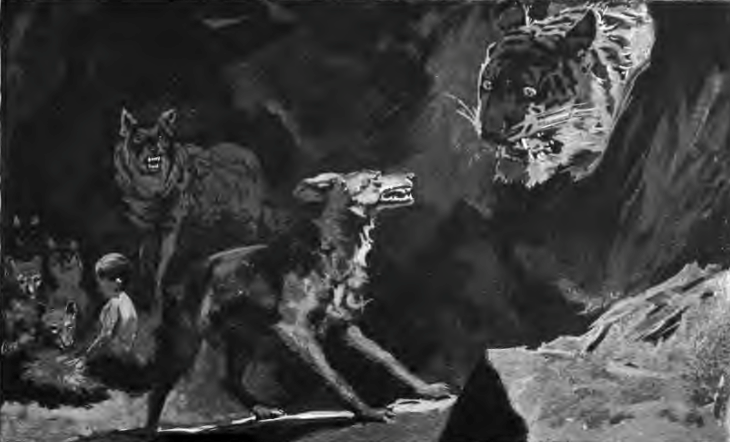
    Like Percy Grainger, Koechlin harbored a lifelong affection for Kipling’s “The Jungle Book,” and returned to the subject often throughout his career – beginning with some song settings in 1899 and running through the symphonic poem “The Bandar-Log,” completed in 1940.

    This Sunday night on “The Lost Chord,” we’ll hear his symphonic poem, “The Law of the Jungle.” Then we’ll turn to the ballet, “The Butterfly that Stamped,” by the Czech composer Bohuslav Martinu.

    Like Koechlin, Martinu was prolific by anyone’s standards. And like Koechlin there is so much Martinu nobody has ever heard. In addition to six symphonies, which at least get some play, he wrote concertos of every stripe, as well as 15 operas, a large body of orchestral, chamber, vocal and instrumental works, and – believe it or not – 14 ballets.

    “The Butterfly that Stamped” was inspired by a tale from Kipling’s “Just So Stories.”

    Get ready to go wild! It’s a Kipling double-bill. Join me for “Kipling Coupling” – this Sunday night at 10:00 EDT, on WWFM – The Classical Network and wwfm.org.


  • Martian Chronicles Livestream Tonight

    Martian Chronicles Livestream Tonight

    by 

    in
    3 responses

    Due to technical difficulties on Friday night, it’s nearly time for Take 2, as Roy and I prepare to “Rock” the NBC miniseries “The Martian Chronicles,” on the next Roy’s Tie-Dye Sci-Fi Corner, to be live-streamed on Facebook, tonight at 7:00 EDT.

    https://www.facebook.com/roystiedyescificorner/

    PHOTO: Rock Hudson and the first Martian hand buzzer


Tag Cloud

Aaron Copland (93) Beethoven (95) Composer (114) Film Music (145) Film Score (143) Film Scores (255) Halloween (94) John Williams (195) KWAX (229) Leonard Bernstein (104) Marlboro Music Festival (125) Movie Music (160) Mozart (91) Opera (213) Philadelphia Orchestra (89) Picture Perfect (174) Princeton Symphony Orchestra (109) Radio (88) Ross Amico (244) Roy's Tie-Dye Sci-Fi Corner (290) The Classical Network (101) The Lost Chord (269) Vaughan Williams (105) WPRB (397) WWFM (881)

DON’T MISS A BEAT

Receive a weekly digest every Sunday at noon by signing up here


RECENT POSTS