• Scarlatti’s Legacy: Musical Duels & Tributes

    Scarlatti’s Legacy: Musical Duels & Tributes

    by 

    in
    4 responses

    It seems as if it was only a matter of time before any Baroque musician of merit would become embroiled in a musical duel.

    In the case of Domenico Scarlatti, he was challenged by none other than George Frideric Handel, in Rome. The resulting contest led to Handel being judged superior to his rival on the organ; however, on the harpsichord Scarlatti was deemed to be supreme. In fact, Scarlatti’s unusual facility at the keyboard has had artists “keyed up” for centuries.

    Born in Naples in 1685 – the same year as Handel and Bach – Scarlatti spent much of his career in the service of the Portuguese and Spanish royal families. He wrote 555 keyboard sonatas, which have been admired by composer-performers from Frederic Chopin to Marc-André Hamelin.

    This Sunday night on “The Lost Chord,” we’ll enjoy several works written in tribute to this Baroque master.

    Charles Avison, whose life overlapped Scarlatti’s own (he was born in 1709, when Scarlatti was 23 years-old), arranged a number of his elder colleague’s keyboard works into a set of 12 concerti grossi. We’ll sample one of those, Avison’s Concerto No. 10 in D.

    Then we’ll turn to American composer Norman Dello Joio. Dello Joio was the recipient of the Pulitzer Prize for Music in 1957 for his “Meditations on Ecclesiastes.” From 1979, we’ll hear his four-movement piano work, “Salute to Scarlatti.”

    Dmitri Shostakovich arranged two of Scarlatti’s keyboard sonatas for small wind ensemble and percussion. We’ll enjoy performances of these by members of the former USSR Ministry of Culture Symphony Orchestra conducted by Gennady Rozhdestvensky.

    Finally, Alfredo Casella’s 1926 suite for piano and orchestra, “Scarlattiana,” draws its inspiration from dozens of Scarlatti sonatas. Though unquestionably high-spirited, it was not originally intended for the dance – but since it unabashedly recalls Stravinsky’s “Pulcinella,” it is hardly surprising that some clown decided to choreograph it.

    I hope you’ll join me for a mixed salad of Scarlatti tributes, on “Italian Dressing,” this Sunday night at 10:00 EDT, on WWFM – The Classical Network and wwfm.org.


    PHOTO: Wladimir Skouratoff (levitating) and Jacqueline Moreau in a 1954 production of “Scarlattiana”

  • Conan’s Score How Music Elevates Silly Films

    Conan’s Score How Music Elevates Silly Films

    by 

    in
    2 responses

    How a good film score can improve a very silly movie: Basil Poledouris conducts “Battle of the Mounds” from “Conan the Barbarian,” with the film, in Spain, on July 22, 2006. Poledouris, who always got a charge out of conducting this music, would succumb to cancer less than four months later.

    For anyone who actually tuned in a little before “Picture Perfect” yesterday hoping to hear an amazing organ transcription of Poledouris’ “Conan,” as advertised, I apologize. The disc actually disappeared into the bottom of my radio bag, and I thought I had forgotten it at home. Fortunately, that too can be found on YouTube.

    “Crom, I have never prayed to you before. I have no tongue for it. No one, not even you, will remember if we were good men or bad. Why we fought, or why we died. All that matters is that two stood against many. That’s what’s important! Valor pleases you, Crom… so grant me one request. Grant me revenge! And if you do not listen, then to HELL with you!”


  • Howard’s Barbarians Great Movie Music

    Howard’s Barbarians Great Movie Music

    by 

    in
    5 responses

    In “Conan the Destroyer” (1984), one of Conan’s companions speculates, “I suppose nothing hurts you.”

    To which Conan replies, “Only pain.”

    Discriminating viewers may feel a little pain themselves watching these silly, cheesy, violent films, all of which were inspired by the writings of pulp master Robert E. Howard. Howard created the warrior Conan in 1932. The character became the center of a series of lucrative stories first published in “Weird Tales” magazine.

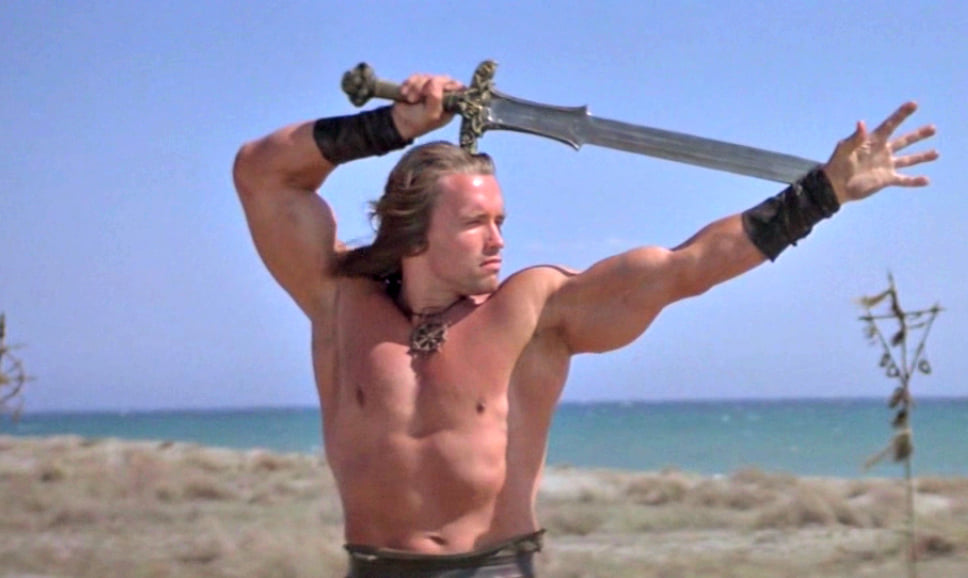
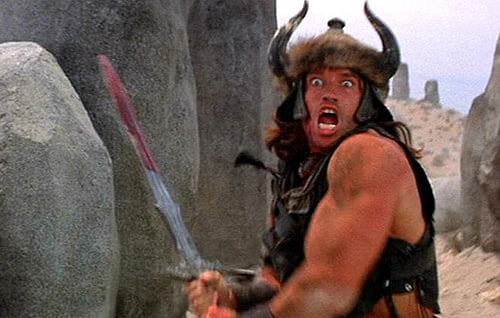
    It would be a half century before Conan made the leap to the big screen, under the direction of John Milius. “Conan the Barbarian” (1982) propelled Arnold Schwarzenegger, already a legend in the field of bodybuilding, to international superstardom. While “Conan” isn’t exactly “Citizen Kane,” it does have its pleasures. The intensity of the violence can be a little disturbing, but the ponderous tone is a blast. “Conan” is a film that takes itself just seriously enough to make it occasionally hilarious.

    Another thing “Conan” has going for it is the fact that it was made on a blockbuster budget. The first-rate production values extend to the music by Basil Poledouris, who employs a full symphony orchestra to impressive ends. In fact, the “Conan” score was one of the strongest of the decade. It’s amazing that anyone would find so much inspiration in such a mediocre film, but Poledouris’ music intersperses Borodin-style Central Asia lyricism with brawny, thrilling action music.

    Sadly, the sequel, “Conan the Destroyer,” betrays signs of penny-pinching, so that it often winds up feeling like a direct-to-video effort. Poledouris was forced to make do with a smaller orchestra, which sounds a bit too much like a television ensemble. Still, he gave it his all, and there’s something to be said for the fact that it is an original score, rather than a mere retread of the original.

    Another one of Howard’s creations, Kull of Atlantis, was given the big screen treatment as “Kull the Conqueror” (1997). Kevin Sorbo, TV’s Hercules, plays the title role. The composer, Joel Goldsmith (son of Jerry Goldsmith), was asked to incorporate heavy metal riffs into his orchestral underscore. I haven’t actually seen this one, but for some reason I don’t feel like I’m missing anything.

    The astoundingly prolific Ennio Morricone – who has more than 500 motion picture and television scores to his name – has an uncanny knack for spinning garbage into gold. His music for “Red Sonja” (1985) lends the film an aura of ‘80s cheese ball fun, perhaps more so than it deserves. This is the film that introduced Brigitte Nielsen as the chain-mailed barbarian beauty. Schwarzenegger appears in the supporting role of Lord Kalidor.

    In the ‘80s, even bad films had great scores. I hope you’ll give “Conan the Barbarian” a chance this week, on “Picture Perfect” – music for movies inspired by the writings of Robert E. Howard – this Friday evening at 6:00 EDT, on WWFM – The Classical Network and wwfm.org.

    BONUS! Tune in a little early (before 6) to hear selections from a virtuoso organ transcription of “Conan the Barbarian” by Philipp Pelster!


  • Women Composers Leonarda Tower & More

    Women Composers Leonarda Tower & More

    by 

    in
    4 responses

    With the Clara Schumann bicentennial only a week away, we’ll continue to celebrate the legacy of female composers. (This month, by the way, also sports the birthdays of Amy Beach and Nadia Boulanger!)

    Today, we salute Baroque composer Isabella Leonarda and Joan Tower, who turns 81, on the anniversary of their births. We’ll also hear a concerto by Australian composer Peggy Glanville-Hicks. Their music will be among my featured selections, from 4 to 6 p.m. EDT.

    Then descend into the man cave for scores from barbarian films inspired by the writings of pulp master Robert E. Howard on “Picture Perfect” at 6.

    Enjoyment of worthwhile music always transcends perceived gender differences, on WWFM – The Classical Network and wwfm.org.


    CLOCKWISE FROM TOP: Joan Tower, Isabella Leonarda, and Peggy Glanville-Hicks (moonlighting as a music critic at the New York Herald-Tribune)


  • John Cage Freedom Maverick of Sound

    John Cage Freedom Maverick of Sound

    by 

    in
    2 responses

    It’s ironic that a man named Cage would be all about freedom.

    A pioneer of aleatory or chance-controlled music, electroacoustic music, nonstandard use of musical instruments (like the prepared piano), making music with found objects, and finding the music in everyday sounds, John Cage was a titan of 20th century music.

    It’s possible to not know a single work he ever “wrote,” or at any rate conceived, and still be exposed to his influence constantly. Cage taught us new ways to think about sound and the nature of music, opening our ears to an infinite variety of new worlds for exploration. His genius lay in recognizing that which had always been invisible before our eyes and silent to our ears.

    To honor him on his birthday, I might insert objects between the caps lock and shift key of my laptop, or roll dice to determine which letters or combinations of letters to hit, or allow my cat to walk across the keyboard or spill a cup of coffee across the keys.

    Or I could write nothing at all and allow the peripheral impressions you receive from your own environment determine how you experience my blank post.

    You don’t have to like Cage any more than you like the hum of the refrigerator, or a creaking chair, or a tree falling in the woods. If you’re there to hear it, once in a while you should be made to do so. Me, I’ll have 4’ 33” on infinite repeat all day.

    Happy birthday, John Cage (1912-1992). There are plenty who would scoff at the Emperor’s New Clothes, but you were one hell of a tailor.


    “I can’t understand why people are frightened of new ideas. I’m frightened of the old ones.” – John Cage

    “Discovery consists of seeing what everybody else has seen and thinking what nobody has thought.” – Albert Szent-Györgyi

    Cage’s most notorious piece, 4’ 33”:

    Cage performs “Water Walk” on national television:

    complete appearance

    composition only, in better quality

    Cage for people who don’t like Cage:

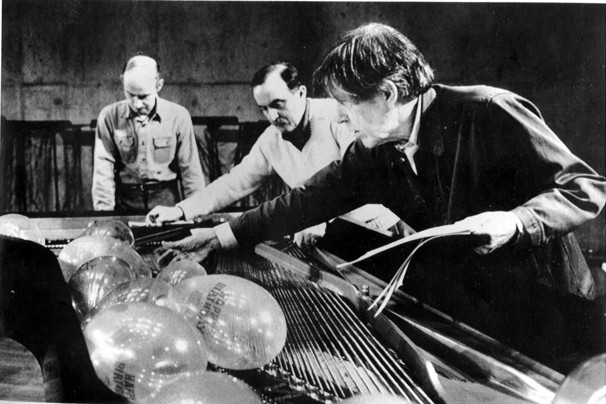
    PHOTO: What’s a birthday without balloons?


Tag Cloud

Aaron Copland (93) Beethoven (95) Composer (114) Film Music (145) Film Score (143) Film Scores (255) Halloween (94) John Williams (195) KWAX (229) Leonard Bernstein (104) Marlboro Music Festival (125) Movie Music (160) Mozart (91) Opera (213) Philadelphia Orchestra (89) Picture Perfect (174) Princeton Symphony Orchestra (109) Radio (88) Ross Amico (244) Roy's Tie-Dye Sci-Fi Corner (290) The Classical Network (101) The Lost Chord (269) Vaughan Williams (105) WPRB (397) WWFM (881)

DON’T MISS A BEAT

Receive a weekly digest every Sunday at noon by signing up here


RECENT POSTS