• Dvořák’s Early Genius at Marlboro Music Festival

    Dvořák’s Early Genius at Marlboro Music Festival

    by 

    in
    4 responses

    It was in the autumn of 1877 that a 36 year-old Antonin Dvořák included his “Moravian Duets” with his application for an Austrian State grant for “young, talented and poor artists.” Still little known outside of his native Bohemia, Dvořák caught the interest of Johannes Brahms, who sat on the board of adjudication. Recognizing the younger man’s talent, Brahms recommended Dvořák to his German publisher, Fritz Simrock.

    Simrock’s edition of Dvořák’s duets proved to be so popular that it went into a second printing. (Even so, he did not pay the composer!) When that sold out, he requested that Dvořák write something akin to Brahms’ wildly successful “Hungarian Dances.” The resultant “Slavonic Dances” cemented Dvořák’s international fame.

    On this week’s “Music from Marlboro,” Dvořák pays his dues, with two early works that reveal his genius in utero.

    The Piano Quartet No. 1 in D major, Op. 23, was composed over a span of just eighteen days during the summer of 1875. Dvořák was 33 and probably already at work on the “Moravian Duets.”

    Though a product of his early maturity, Dvořák’s quartet is already imbued with the composer’s soon-to-be familiar “Czech national sound.” Not nearly as well known as the “American” String Quintet or the Piano Quintet in A major, it is nevertheless unmistakably from the same pen, with no shortage of memorable melodies and brimming with his indelible charm. The work didn’t hit print until 1880 (around the time of the second run of the “Moravian Duets”). Tellingly, it was not published by Simrock, but rather by Schlesinger, a Berlin rival.

    We’ll hear it performed at the 1969 Marlboro Music Festival by pianist and Marlboro co-founder Rudolf Serkin, violinist Shmuel Ashkenasi, violist Martha Strongin Katz, and cellist Robert Sylvester.

    The “Moravian Duets” grew out of songs Dvořák wrote specifically for domestic performance by a wealthy merchant and his wife, who also happened to be amateur singers. At the merchant’s request, Dvořák began by arranging Moravian national songs, but quickly segued into providing wholly original music for the traditional folk texts.

    Delighted with the results, the merchant paid for the duets’ first printing in Prague, prior to Christmas 1876. Further songs followed. The complete cycle of 23, for two voices and piano accompaniment, appeared as three separate sets, assigned to different vocal ranges, between 1875 and 1881.

    We’ll round out the hour with the four songs of the first of these, collected under Op. 20, in its final form, performed in Czech by soprano Mary Burgess and tenor John Humphrey, with pianist Luis Batlle – a commercial recording made for Columbia Masterworks as an offshoot of the 1966 Marlboro Music Festival.

    One of the advantages of being a “provincial” composer is that Dvorak was already a master by the time he was discovered. Discover these works from his early maturity on the next “Music from Marlboro,” this Wednesday evening at 6:00 EDT, on WWFM – The Classical Network and wwfm.org.

    Marlboro School of Music and Festival: Official Page


  • Celebrating Women Composers

    Celebrating Women Composers

    by 

    in
    5 responses

    September 13th marks the 200th anniversary of the birth of Clara Schumann. In celebration of this remarkable pianist, teacher, composer, wife, and mother of eight, I’ll be especially conscious of honoring the achievements of women in music all month long on The Classical Network, with works by female composers, ranging from the 12th century to the present.

    Of course, with few exceptions, women did not enjoy the same advantages as men, in terms of education and acceptance, so it is unlikely that many fulfilled their natural promise.

    Barbara Strozzi (1619-1677) and Francesca Caccini (1587-after 1641) were notable exceptions, at least to some extent.

    Today’s Noontime Concert on The Classical Network will be devoted to music by these two remarkable women. “Enchanting Voices: Music of Barbara Strozzi & Francesca Caccini” will be performed by the Canzonetta Duo, Elissa Edwards, soprano, and Richard Kolb, theorbo and archlute.

    The concert was presented on November 15, 2018, at St. Bartholomew’s Church, 325 Park Avenue, in Midtown Manhattan, where free concerts are held every Thursday at 1:15 p.m. The 2019-2020 season gets underway this Thursday, as The Vivaldi Project will perform a program of classical string trios.

    These concerts are made possible in part by Gotham Early Music Scene, or GEMS. GEMS is a non-profit corporation that supports and promotes artists and organizations in New York City devoted to Early Music. For more information and a look at GEMS’ events calendar, visit gemsny.org.

    Following today’s broadcast concert, stick around for an afternoon of works by musical women.

    Julia Wolfe was awarded the Pulitzer Prize for Music for “Anthracite Fields” in 2015. The oratorio, composed for the Bang on a Can All-Stars and the Mendelssohn Club Chorus, was given its premiere in Philadelphia the previous year. “Anthracite Fields” examines the plight of Northeastern Pennsylvania coal miners, a topic of particular interest to me, since my father’s father’s family labored in the mines of Pittston. The work was presented at the Roebling Wire Works in Trenton by Westminster Choir in 2017. On this day after Labor Day, we’ll hear a complete performance of the piece in its world premiere recording.

    We’ll also enjoy a very impressive Serenade in D – really more of a symphony – by composer and hell-raising suffragette Dame Ethel Smyth. Smyth served time in prison for putting out the windows of politicians who opposed a woman’s right to vote. When Sir Thomas Beecham went to visit her in jail, he found her conducting her associates through the bars of her window with a toothbrush as they sang “The March of the Women,” also composed by Smyth, while gathering for exercise in the prison courtyard.

    These women were nothing if not composed. Join me for musical contributions by women, all month long. They’ll punctuate my programming, beginning this afternoon from 12 to 4 p.m. EDT, on WWFM – The Classical Network and wwfm.org.


    CLOCKWISE FROM LEFT: Clara Schumann, Barbara Strozzi, Julia Wolfe, and Ethel Smyth (under arrest)


  • Labor Day Paul Robeson Sings Joe Hill

    Labor Day Paul Robeson Sings Joe Hill

    by 

    in
    5 responses

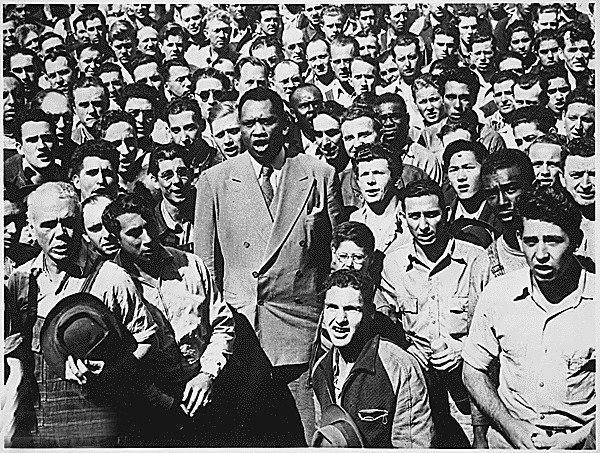
    Labor Day. Princeton’s own Paul Robeson sings “Joe Hill.”


  • Summer Road Trip Music Labor Day Special

    Summer Road Trip Music Labor Day Special

    by 

    in
    5 responses

    It may be the First of September, but there’s still time for one last summer road trip.

    This Sunday night on “The Lost Chord,” it’s an hour of quintessentially American music about travel by car.

    Frederick Shepherd Converse’s “Flivver Ten Million” traces the Ford Motor Company’s affordable assembly line automobile, from its creation in a Detroit factory to the manifest destiny of America’s roadways.

    John Adams’ “Road Movies” has nothing at all to do with Bob Hope and Bing Crosby, alas. What it is, however, is a violin sonata written firmly within the American tradition, with a special affinity at its core with Aaron Copland’s Violin Sonata.

    Virgil Thomson’s “Filling Station,” written for Leon Kirstein’s Ballet Caravan, may have the distinction of being the only ballet set at a gas station. The work’s success gave Copland the confidence to follow through on another Caravan commission, which resulted in “Billy the Kid.”

    Finally, we’ll hear one of Michael Daughtery’s most performed works, the exuberant “Route 66,” inspired by the storied “Main Street of America.”

    Put the pedal to the metal. American composers hit the road for Labor Day, on “The Last Roads of Summer,” this Sunday night at 10:00 EDT, on WWFM – The Classical Network and wwfm.org.


  • 3 Day Weekend Fun Ideas

    3 Day Weekend Fun Ideas

    by 

    in
    2 responses

    It’s a three-day weekend. Live it up.


Tag Cloud

Aaron Copland (93) Beethoven (95) Composer (114) Film Music (145) Film Score (143) Film Scores (255) Halloween (94) John Williams (195) KWAX (229) Leonard Bernstein (104) Marlboro Music Festival (125) Movie Music (160) Mozart (91) Opera (213) Philadelphia Orchestra (89) Picture Perfect (174) Princeton Symphony Orchestra (109) Radio (88) Ross Amico (244) Roy's Tie-Dye Sci-Fi Corner (290) The Classical Network (101) The Lost Chord (269) Vaughan Williams (105) WPRB (397) WWFM (881)

DON’T MISS A BEAT

Receive a weekly digest every Sunday at noon by signing up here


RECENT POSTS