• Sha Na Na at Woodstock? Grease for Peace

    Sha Na Na at Woodstock? Grease for Peace

    by 

    in
    8 responses

    Woodstock organizer Michael Lang had wanted Roy Rogers to conclude his now-iconic festival with a performance of “Happy Trails.” (Needless to say, Rogers declined.) But that’s far from the strangest thing about Woodstock.

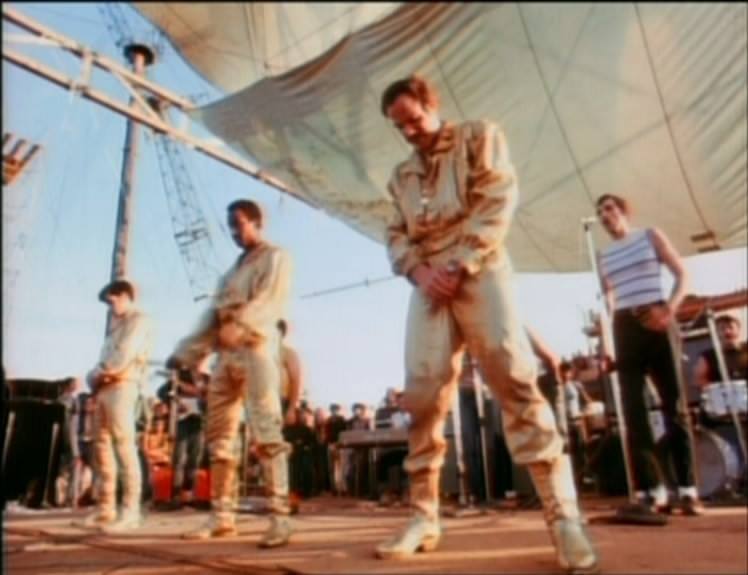
    Consider the festival’s penultimate act, presented at 7:30 on Monday morning, August 18. Sandwiched between the Paul Butterfield Blues Band (at 6) and Jimi Hendrix (at 9) was – Sha Na Na??!!

    What was a fifties tribute band doing at Woodstock? A lot of caffeine, apparently (at best).

    There at the request of Hendrix, all that gold lamé must have confused a lot of hippies.

    The group’s high-energy performance of “At the Hop” makes it sound like a proto-punk anthem. Their instant notoriety kicked off or tapped into a tsunami of fifties nostalgia that left in its wake “American Graffitti,” “Grease,” “Happy Days,” and the band’s own syndicated variety show. Not too shabby, considering “At the Hop” was only 12 years-old.

    Woodstock commenced with Richie Havens at 5:07 p.m. EDT, 50 years ago today. (Sweetwater, the group originally scheduled to open the festival, was delayed by the police.)

    Grease for peace!


  • Hindemith’s Octet: An Endurance Test

    Hindemith’s Octet: An Endurance Test

    by 

    in
    3 responses

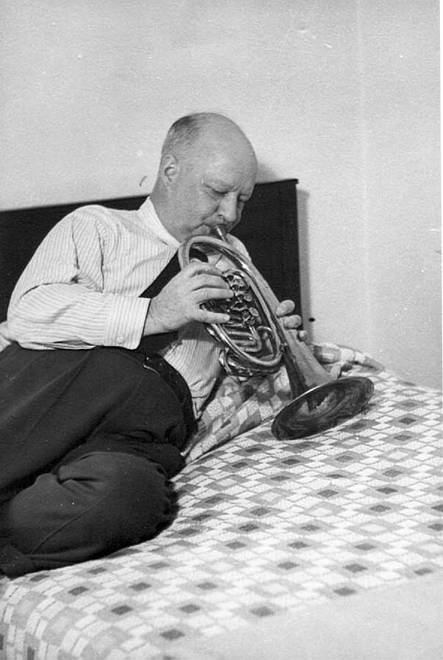
    There’s Hindemith on a good day. Then there’s the Hindemith of the Octet for Winds and Strings.

    At 27 minutes, Hindemith’s Octet is something of an endurance test for performers, and perhaps even more so for listeners. The piece is ugly, grey, cranky, and noodly – gebrauchsmusik at its worst. And I say this as a Hindemith fan. There are times when Hindemith’s music can be glorious, thrilling, or transcendent, even. And then there are those when he just makes you feel like you’ve been reading a newspaper in the back seat on a too-long car trip.

    This is not a piece I would attempt to share under the glare of a sunny summer’s day. But there are thunderstorms in the forecast, so let the good times roll.

    Eight talented musicians make of it what they can, on this week’s “Music from Marlboro.” We’ll hear as fine a performance of the piece as you’re ever likely to encounter, from the 1983 Marlboro Music Festival.

    Then, by way of apology, I’ll do the best that I can to repair our friendship with Beethoven’s wholly delightful Serenade in D major, Op. 25. Beethoven’s Serenade is a late entry in the 18th century divertimento craze. Its date of composition is uncertain, but recent scholarship places it around the time Beethoven wrote his popular Septet. We’ll hear a performance from Marlboro in 1980, with flutist Christine Nield, violinist Young Uck Kim, and violist Michael Tree (of the legendary Guarneri Quartet).

    Hindemith may have had Beethoven and Schubert in mind when he embarked on his Octet. But beyond that, I have no idea what he was thinking. Form is no substitute for content, on this week’s “Music from Marlboro,” this Wednesday evening at 6:00 EDT, on WWFM – The Classical Network and wwfm.org.

    Marlboro School of Music and Festival: Official Page


    HINDEMITH: Whatever pops into my head is gold


  • Korngold’s Symphony on The Classical Network

    Korngold’s Symphony on The Classical Network

    by 

    in
    3 responses

    The Tuesday noon concert is on hiatus for the remainder of the summer. So I’ll have a blank slate this afternoon, on The Classical Network.

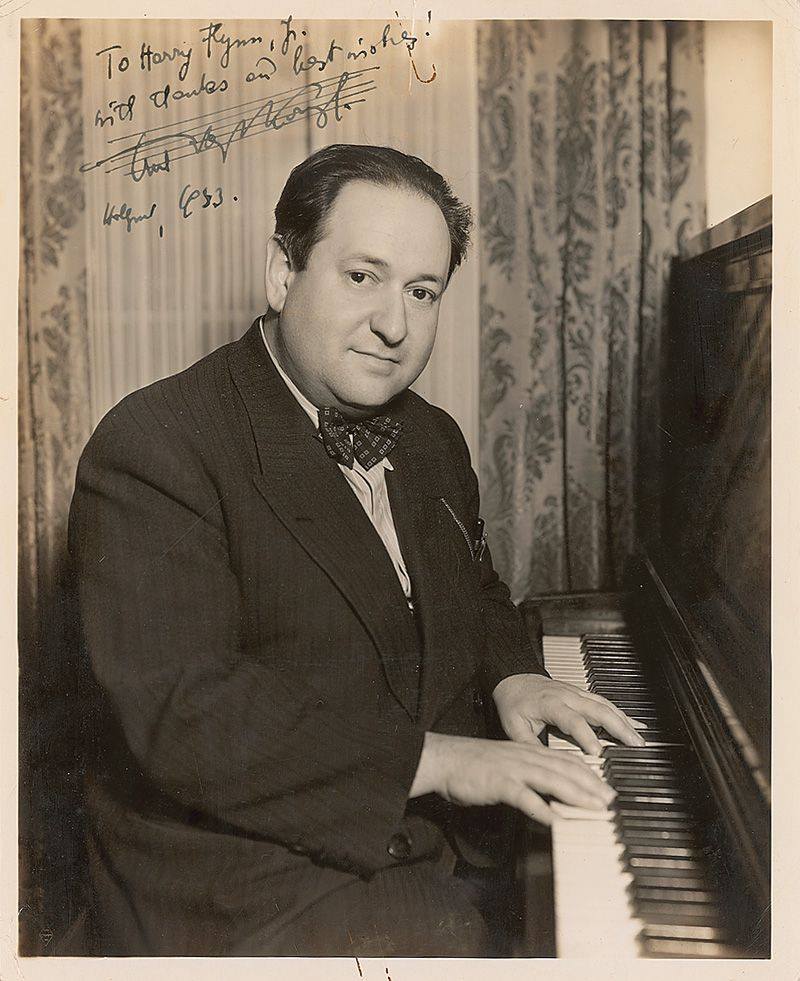
    With another stormpocalypse bearing down on the Trenton-Princeton area (maybe), I’ll present, among my featured highlights, Erich Wolfgang Korngold’s Symphony in F-sharp, the composer’s emotional and artistic reaction to war-torn Vienna.

    As a Jew, Korngold lived as an exile in Hollywood following the Anschluss, earning fame and fortune through his film scores for Errol Flynn. In fact, he once quipped that Robin Hood had saved his life. Korngold may have survived the war, but by 1945 the world he had known was gone forever. When he attempted to reestablish his career back home, he found himself regarded as an uncomfortable reminder of shame, guilt, and destruction, and the late Romantic syntax of his music had come to seem like the product of a bygone era. To lend perspective, John Cage unveiled his 4’33” in 1952, the same year that Korngold completed his symphony.

    The Symphony in F-sharp is not by any means “film music,” though it does allude to some of the scores he wrote for Warner Brothers – “Juarez,” “The Private Lives of Elizabeth and Essex,” “Captain Blood,” and “Kings Row.” The work includes an obligatory Korngoldian happy ending, but the overall mood is one of loss and ruination. It was performed only thrice during the composer’s lifetime. The first performance was so under-rehearsed that the composer tried (unsuccessfully) to put a halt to it.

    Over a decade after Korngold’s death, the score was rediscovered by conductor Rudolf Kempe in the library of the Munich Philharmonic. Kempe set down the world-premiere recording for RCA in 1972. Alongside RCA’s Classic Film Scores Series and a new recording of “Die Tote Stadt,” it set the ball rolling, slowly but inexorably, toward a reassessment of Korngold’s music, which gradually picked up pace in the 1990s, as musicians and record companies began to look further afield with the realization that everyone had already replaced their LPs of the standard repertoire on compact disc.

    The conductor Dmitri Mitropoulos once wrote of Korngold’s symphony, “All my life I have searched for the perfect modern work. In this symphony I have found it.” Unfortunately, Mitropoulos died before he could realize his plan to perform it.

    Korngold was a good man – he shared the wealth of his success in Hollywood to help family and displaced friends in need – but he was not a religious man. Nor was he very much tied up in his heritage. He commented that he and his family had always thought of themselves as Viennese; it was Hitler who made them Jewish. Korngold dedicated his symphony to the memory of Franklin Delano Roosevelt, president of the country that had become his second home. Korngold died in Los Angeles in 1957.

    Tune in this afternoon to hear Korngold’s Symphony in F-sharp, among my featured works, between 12 and 4 p.m. EDT, on WWFM – The Classical Network and wwfm.org.


    NOTE: The symphony will be performed on Saturday night at the Fisher Center at Bard, as part of the second weekend of this year’s Bard Music Festival, held at Bard College, “Korngold and His World.” More information is available at fishercenter.bard.edu.


  • Biber Salzburg’s Brilliant Violinist

    Biber Salzburg’s Brilliant Violinist

    by 

    in
    3 responses

    Heinrich Ignaz Franz von Biber had talent – and names – to burn. Arguably Salzburg’s most brilliant musician prior to the birth of Mozart, Biber was an outstanding violinist – perhaps the best of his age (at least music historian Charles Burney thought so) – and an innovative composer.

    Born in Bohemia in 1644, Biber settled in Salzburg at the age of 16, when during a trip to negotiate the purchase of some instruments on behalf of his employer, Karl II von Liechtenstein-Kastelkorn, Bishop of Olmütz, based in Kroměříž (where much of “Amadeus” would later be filmed), he found a better job working for Maximilian Gandolph von Kuenberg, Archbishop of Mozart’s future home town. Fortunately, the bishops were friends, so Biber avoided any serious repercussions.

    Some of Biber’s experiments with clashing rhythms and layers of sound – most famously in his programmatic battle piece, “Battalia” – anticipate those of Charles Ives by several centuries. In fact, a number of his works are programmatic, with musical effects intended to convey extra-musical objects and ideas.

    He also experimented with scordatura, the tuning of stringed instruments to unconventional intervals. His “Mystery Sonatas” (sometimes referred to as the “Rosary Sonatas”) have featured increasingly in concerts and recordings. Its monumental passacaglia for solo violin is one of the earliest known pieces of its kind.

    We’ll hoist a Heineken for Heinrich today, among our featured composers, between 4 and 7 p.m. EDT on WWFM – The Classical Network and wwfm.org.


  • Howard Hanson’s Bold Island Inspiration

    Howard Hanson’s Bold Island Inspiration

    by 

    in
    5 responses

    For many people, the prospect of having to work through vacation could be a real drag; but for the creative artist, getting away can provide an opportunity to really get things done.

    This Sunday night on “The Lost Chord,” we’ll hear three pieces associated with Bold Island, Maine, the summer home of Howard Hanson.

    For 40 years, Hanson was the director of the Eastman School of Music. In that capacity he nurtured and championed innumerable American composers, giving literally thousands of premieres at the helm of the Eastman-Rochester Orchestra, an ensemble he founded. The lucky ones found their way onto records issued on the Mercury label.

    Hanson, of course, was himself a composer. He was awarded the Pulitzer Prize for Music in 1944, for his Symphony No. 4 “Requiem,” written in memory of his father. But his best known music, undoubtedly, is his Symphony No. 2 “Romantic,” composed in 1930.

    The famous “Hanson sound” is one of heart-on-the-sleeve romanticism, characterized by glowingly nostalgic melodies, though he also had his severe side. After all, he was born in Wahoo, Nebraska, to Swedish immigrants, and a certain Nordic austerity can be detected, especially in his later works.

    His Symphony No. 6, of 1967, is more tightly argued than his earlier, more famous symphonies, structured in six brief movements, built on a recurring motif. At times, it can sound a bit like Sibelius, though Hanson very much remains his own man. Hanson being Hanson, he doesn’t really skimp on the lyricism, but he doesn’t exactly indulge it to the same extent he does in the earlier works. Still, predictably, the symphony was derided as old-fashioned by the genuinely austere musical establishment of the day.

    The Bold Island connection is through Hanson’s “Summer Seascape No. 2,” written a few years earlier, and clearly the blueprint for the symphony. In fact, the opening of the symphony is identical.

    The first “Summer Seascape” was the centerpiece of the “Bold Island Suite,” a separate work composed in 1961. The suite also contains movements with the descriptive titles “Birds of the Sea” and “God in Nature.”

    The North Atlantic inspires some august music, on “August Hanson,” this Sunday night at 10:00 EDT, on WWFM – The Classical Network and wwfm.org.


    PHOTO: Not-very-austere Puffins off the coast of Maine

Tag Cloud

Aaron Copland (93) Beethoven (95) Composer (114) Film Music (145) Film Score (143) Film Scores (255) Halloween (94) John Williams (195) KWAX (229) Leonard Bernstein (104) Marlboro Music Festival (125) Movie Music (160) Mozart (91) Opera (213) Philadelphia Orchestra (89) Picture Perfect (174) Princeton Symphony Orchestra (109) Radio (88) Ross Amico (244) Roy's Tie-Dye Sci-Fi Corner (290) The Classical Network (101) The Lost Chord (269) Vaughan Williams (105) WPRB (397) WWFM (881)

DON’T MISS A BEAT

Receive a weekly digest every Sunday at noon by signing up here


RECENT POSTS