Tag: Composer

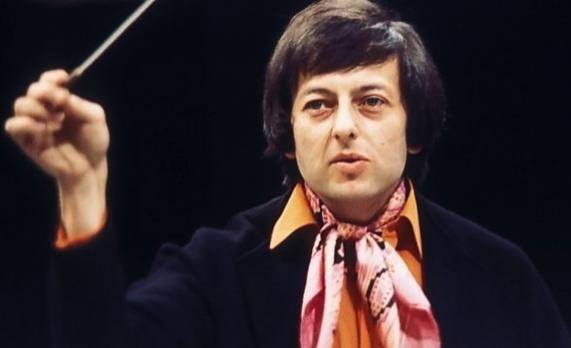
  • Remembering André Previn a Musical Giant

    Remembering André Previn a Musical Giant

    It’s been impressive and heartwarming to observe the outpouring of affection for André Previn the past couple of days. Previn, of course, died on Thursday at the age of 89.

    A fabulous and frequently stunning musician, he was not only a top conductor, but also a fine pianist – fluent in both the classical and jazz worlds – a talented composer, totally without pretense, a crackerjack writer of film scores and musical arrangements, an author, an entertaining raconteur, and a sly wit. He was a true Renaissance man, like Leonard Bernstein, though he tended to play his cards a little closer to the vest. His love life could be a little over the top – he was married five times – and who knows, if he had come up in the age of Twitter, maybe he would have taken more of a beating.

    Previn never achieved the level of public adulation that Lenny did, which is why the tsunami of love from all quarters kind of comes as a surprise to me. A pleasant surprise, granted. Criticisms of some of his musical performances were akin to damning with faint praise. On the other hand, when he was on, he was really on. The man could conduct the tar out of Rachmaninoff, Vaughan Williams, Prokofiev, Shostakovich, and William Walton, and he could surprise in his easy mastery of composers such as Richard Strauss.

    I was lucky enough to see him conduct live twice. In 1995, he led a luminous performance of Vaughan Williams’ Symphony No. 5, with the Curtis Symphony Orchestra, which he recorded with the ensemble shortly thereafter. As is generally the case – Curtis is one of the top conservatories in the world – the students played like gods.

    Later, I saw him lead the Philadelphia Orchestra, in 2009. On the program was Mozart’s Piano Concerto No. 24 and Strauss’ “Symphonia Domestica.” It was a shock to realize at that point that Previn was 80, and it was with concern that I watched as he stepped with evident care onto the stage, as if he were living the famous Danny Kaye routine. It was painful to see, and one of those instances where you wonder if the conductor is even going to make it to the podium.

    The Mozart may not have been transcendent, but it was still a joy to hear him play (he conducted from the keyboard), even if some of the facility was diminished; but the Strauss, which he conducted from a chair, was as assured as it had been when he made his knock-out recordings of the complete tone poems with the Vienna Philharmonic.

    I was also fortunate enough to interact with him twice. The first time was wholly by chance. It was in the early ‘90s, a day like any other day, and I walked out of my apartment building in Philadelphia to encounter André Previn passing on the street. Startled, I said the first thing that popped into my head – which was, I am embarrassed to report, “Maestro! Good to see you!” To which he replied with a wry smile, “Good to see you, too.”

    It was on 18th Street, below Spruce. He was heading south into a residential neighborhood, where he must have been staying, because at the time there was nothing else in that direction. Of course, I lived a block and half from the Curtis Institute.

    The second time was an actual conversation, in which we got to talk music. It was in the late ‘90s or early 2000s, and Previn was engaged in recording a couple of Korngold albums. I know it was after he did the symphony, but it may have been before he recorded the film scores, both for Deutsche Grammophon. He remarked that he would love to record the complete “Die tote Stadt” with Renée Fleming, but it was a matter of getting their schedules to mesh. Can you imagine? Unfortunately, it never came to pass. I also asked him why he didn’t include the overture in his otherwise fine recording of Korngold’s “Much Ado About Nothing.” His answer, again with that smile: “I didn’t know there was an overture!”

    Because of the timing of his death, it’s been hard to engineer a proper tribute, but I will be working Previn’s recordings into my air shifts over the coming week. So you’ll have a good chance of encountering his artistry if you tune in on Monday from 4 to 7 p.m., Tuesday from 1 to 4 p.m., and Wednesday from 4 to 6 p.m. In fact, I am planning to make the playlist on Tuesday all-Previn, encompassing his talents as conductor, pianist, and composer.

    On Friday at 6 p.m., “Picture Perfect” will focus on his work in the film industry. He was involved with 50 movies, and on top of everything else won four Oscars.

    Then next Sunday night, February 10, on “The Lost Chord,” I’ll present an hour of his original concert music, at 10 p.m.

    All times are EST, and all shows can be heard on WWFM – The Classical Network and at wwfm.org.

    Finally, Patrick Jonathan reminded me of this classic Morecambe and Wise sketch with “Mr. Preview” conducting the Grieg Piano Concerto. As an American, it is my only exposure to Morecambe and Wise, but it has the reputation of being the ne plus ultra of the team’s career.

  • Dominick Argento Pulitzer-Winning Composer Dies

    Dominick Argento Pulitzer-Winning Composer Dies

    The American composer Dominick Argento has died.

    Argento, who won the Pulitzer Prize for his song cycle “From the Diary of Virginia Woolf” in 1975, is remembered principally for his 14 operas, including “Postcard from Morocco,” “The Voyage of Edgar Allan Poe,” “Miss Havisham’s Fire,” “Casanova’s Homecoming,” “The Aspern Papers,” and “The Dream of Valentino.”

    Another song cycle, “Casa Guidi,” on texts of Elizabeth Barrett Browning, received a Grammy Award in 2004 for Best Contemporary Classical Composition.

    Though he was born in York, PA, to Sicilian immigrant parents, he flourished in Minneapolis, where he was a professor of music at the University of Minnesota and one of the founders of what is now Minnesota Opera.

    Argento died yesterday at the age of 91.

    https://www.washingtonpost.com/local/obituaries/dominick-argento-composer-who-was-a-modern-master-of-opera-dies-at-91/2019/02/21/909b7f90-35f3-11e9-854a-7a14d7fec96a_story.html?noredirect=on&utm_term=.70a41204924f

  • Remembering Oscar Levant’s Genius

    Remembering Oscar Levant’s Genius

    “Happiness isn’t something you experience; it’s something you remember.”

    Bearing in mind the words of Oscar Levant, I hope that you had a happy Christmas.

    Levant was born in Pittsburgh on this date in 1906 to Orthodox Jewish parents from Russia. It was his father’s desire that his sons become either doctors or dentists. Ever the contrarian, Levant opted to become everything else instead.

    A preternaturally talented musician, Levant studied in New York with the great Polish pedagogue Zygmunt Stojowski. By his early 20s, he was in Hollywood, where he met and befriended George Gershwin. With Gershwin’s death, Levant became regarded as the foremost interpreter of the composer’s piano music.

    Levant himself was a composer of talent. In Hollywood, he scored over 20 films. He also wrote and co-wrote popular songs, including the enduring “Blame It on My Youth.” Determined to become a “serious” composer, he sought out and undertook private studies with Arnold Schoenberg. He also found work as a Broadway composer and conductor.

    But it was likely through his memorable appearances on radio and television that he became best known, as a brilliant panelist possessed of impeccable timing and an acid wit. His remarks were invariably off the cuff, and this spontaneity would sometimes throw the sponsors into a panic. A show was cancelled after he remarked, “Now that Marilyn Monroe is kosher, Arthur Miller can eat her.”

    Now a certified – some would say certifiable – celebrity himself, Levant appeared in a number of feature films, including “An American in Paris” (1951) and “The Band Wagon” (1953). He played himself in the Gershwin biopic “Rhapsody in Blue” (1945). He would receive a star on the Hollywood Walk of Fame in recognition of his recording career.

    On top of everything else, Levant wrote three books: “A Smattering of Ignorance” (1940), “The Memoirs of an Amnesiac” (1965), and “The Unimportance of Being Oscar” (1968).

    Levant was as famous for his neuroses and hypochondria as he was for any of his actual talents. He smoked prolifically, became addicted to prescription drugs, and was frequently in and out of mental institutions. He died of a heart attack in 1972, at the age of 65.

    “There is a fine line between genius and insanity,” he once quipped. “I have erased this line.”

    Happy birthday, Oscar Levant – even if only in remembrance.


    Levant plays Gershwin:

    Levant on “The Tonight Show” with Jack Paar:
    https://www.youtube.com/watch?v=nVOl49AHD6Q

    Levant plays his Sonatina:

    Levant in “An American in Paris:”

  • Facebook Fail Ennio Morricone Tribute Delayed

    Evil, time-sucking Facebook isn’t allowing me to post with a photo today, so I am putting this up as a place-holder until I can get it to accept my Ennio Morricone 90th birthday tribute. In the meantime, I shake my fist at you, Facebook!

  • Felix Weingartner Composer Conductor

    Felix Weingartner Composer Conductor

    Felix Weingartner (1863-1942) is best-recognized as a conductor. However, he considered himself equally, if not more so, a composer. He was one of a number of prominent conductors of the day who fit the Mahler paradigm. However, the works of Wilhelm Furtwängler, Otto Klemperer and any number of other famed figures of the podium are very seldom heard.

    Weingartner held many conducting posts over the years. He succeeded Mahler as principal conductor of the Vienna Hofoper, from 1908 to 1911. He led the Vienna Philharmonic in an official capacity until 1927. He was later chief conductor of the Vienna Volksoper.

    He thought very deeply about the problem of the symphony. I remember reading a book he wrote in which he examined the strengths and weaknesses of all the major symphonies written in the shadow of Beethoven, down to the dawn of the 20th century.

    He himself composed seven symphonies, among other symphonic works, and thanks to the enterprising cpo.de – classic production osnabrück label (CPO for short), all of them have been recorded. This Sunday night on “The Lost Chord,” we’ll hear the Symphony No. 2, from 1901, a fascinating mix of old and new, evidently romantic in disposition, yet very much of its time. The recording will feature the Basel Symphony Orchestra, which Weingartner himself directed from 1927 to 1934.

    As a conductor, Weingartner was particularly well-regarded as a Beethoven interpreter. He’d been conducting the Beethoven symphonies as a cycle since at least 1902, and he was the first to complete an integral set of recordings. We’ll have time to sample the scherzo from the Symphony No. 9 from his superlative recording of 1935.

    I hope you’ll join me as we raise a glass to Felix Weingartner. That’s “Wine from Weingartner,” this Sunday night at 10:00 EDT, on WWFM – The Classical Network and at wwfm.org.

    Click to view full image

Tag Cloud

Aaron Copland (92) Beethoven (95) Composer (114) Film Music (123) Film Score (143) Film Scores (255) Halloween (94) John Williams (187) KWAX (229) Leonard Bernstein (101) Marlboro Music Festival (125) Movie Music (138) Opera (202) Philadelphia Orchestra (89) Picture Perfect (174) Princeton Symphony Orchestra (106) Radio (87) Ralph Vaughan Williams (85) Ross Amico (244) Roy's Tie-Dye Sci-Fi Corner (290) The Classical Network (101) The Lost Chord (268) Vaughan Williams (103) WPRB (396) WWFM (881)

DON’T MISS A BEAT

Receive a weekly digest every Sunday at noon by signing up here


RECENT POSTS