Tag: Composer

  • Discovering Robert Moran A Philadelphia Story

    Discovering Robert Moran A Philadelphia Story

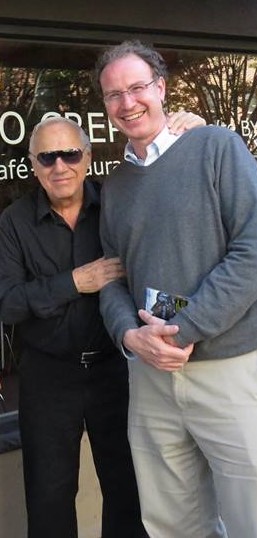
    I first encountered Robert Moran’s music while browsing through the bins at Tower Records Classical Annex, then located at 6th & South Streets in Philadelphia. As was the custom, new recordings would be played over the sound system on the sales floor. On this particular occasion, one of the clerks put on “Arias, Interludes and Inventions,” a suite from the opera “Desert of Roses,” Bob’s take on the Beauty and the Beast fairy tale, premiered at Houston Grand Opera in 1992. Before I was wholly aware of what was happening, my heart had melted all over the polished hardwood floor. I floated to the counter to inquire what it was we were listening to, and an instant sale was made.

    I first encountered Robert Moran in person a few years later, when he wandered into my original bookshop on South 17th Street. I didn’t recognize who he was until he handed me his credit card. “Robert Moran?” I said. “Any relation to the composer?” That kind of question has led to its share of enduring friendships. It turns out people like being recognized. (The exception was a certain principal of the Philadelphia Orchestra, who slinked out as soon as he could, never to return again!)

    Although a small business owner, with all of the nightmarish zoning and tax obligations that entailed, I was also still very much a bohemian, with my living space extending off the back of the building, all German Expressionist-like, at the end of a long, crooked hallway, separated from the sales floor only by a magic curtain. On certain winter afternoons, you could smell the crock pot percolating in the kitchenette, not far from a mass of black mold that had formed around one of the many leaks in the stucco ceiling. (No stucco in the immaculately redone retail space.)

    My record collection, already substantial, was rather modest by comparison to today’s library (which continues to expand with a tenacity any mold would envy). I laid my hand on Bob’s CD and was back in a flash.

    He took the booklet and inscribed in his florid hand:

    For Ross –
    What a lovely
    Surprise!! Wonderful
    Luck – your
    splendid Bookstore –
    Robert Moran
    Oct. 15, 1997
    Phila

    Bob gained notoriety in the late 1960s and early ‘70s through a series of “events” incorporating, respectively, the cities of San Francisco (“39 Minutes for 39 Autos”), Bethlehem, PA (“Hallelujah”), and Graz, Austria (“Pachelbel Promenade”). These involved tens of thousands of performers.

    For “39 minutes for 39 Autos,” he enlisted skyscrapers, airplanes, radio stations, musicians, dancers, and yes, automobiles, to create a one-of-a-kind, purely-of-the-moment spectacular of light and sound. Sooner or later, such a thing was bound to occur to a composer living in San Francisco in 1969.

    But he actually could could write music, too. Classical music’s merry prankster studied twelve-tone technique with Hans Erich Apostel in Vienna, before being accepted into a composition class of four at Mills College, where he was taught by Darius Milhaud and Luciano Berio. His classmates included Steve Reich, Phil Lesh, and Tom Constanten. Lesh and Constanten went on to play for The Grateful Dead. And Reich? Who knows what happened to that guy.

    Bob was also influenced by Minimalism and became a friend and collaborator of Philip Glass. (On my wall is a signed poster for their collaborative opera “The Juniper Tree.”)

    Last year, he composed a monodrama for God – yes, you read that correctly (in case you’re interested, God is a baritone) – and a 20-minute choral work, “Circles of Iron.”

    He continues to experiment with aleatory, or chance elements. With Robert Moran, you never know what you’re going to get. In his more puckish moments, he might write for 39 autos, giant puppets, or an electric popcorn popper. But then there are times when his natural gift for lyricism will melt your heart.

    Happy birthday, Bob! Let Bob eat cake!


    Lo and behold, Robert Moran is the subject of today’s Composers Datebook, broadcast on classical music stations nationwide. Listen here.

    https://www.yourclassical.org/episode/2024/01/08/more-on-moran

    An aria from Bob’s opera “Desert of Roses”

    Selections from “Trinity Requiem,” for the tenth anniversary of 9/11

    Flying high over Albania

    “Alice” for Scottish Ballet

    Looking groovy and introducing his “Lunchbag Opera” for the BBC

    “Buddha Goes to Bayreuth,” Part 1

    “Buddha Goes to Bayreuth,” Part 2

    “Modern Love Waltz” by Philip Glass, arranged by Robert Moran for accordion and cello

    “Waltz. In Memoriam Maurice Ravel”

  • Alice Parker Celebrated Choral Composer Dies

    Alice Parker Celebrated Choral Composer Dies

    In eulogizing composer Ron Nelson and hornist Hermann Baumann earlier today, I failed to notice Alice Parker has also died. Parker, the eminent choral composer, director, and teacher, wrote more than 500 arrangements and original compositions. With her music in the repertoire of churches and choral societies everywhere, she was one of the most frequently performed and heard of contemporary composers, with weekly auditors in the thousands.

    A native New Englander, Parker largely ignored contemporary trends in composition, instead often drawing inspiration from folk music and hymn tunes. As a composer for voice, she was also attracted to poetry. Her musical output was enormous. Among her original works were 11 song-cycles, 11 works for chorus and orchestra, 33 cantatas, 47 choral suites, and more than 40 hymns. She also composed four operas and authored at least five books.

    Parker saw music as a unifying force. Her final work, “On the Common Ground,” completed in 2020, was an appeal to a country deeply divided by politics and values.

    “Beauty awakens the sense, in us, of our vulnerability as human beings,” she commented in 2017. “It’s why you feel like crying when you see a gorgeous sunset, or hear a Bach solo cello suite, or a gorgeous melody, or a little kid singing.”

    “When we sing something perfectly lovely together… and it really clicks, you have this marvelous feeling of brotherhood in the room,” she stated elsewhere. “We are all human beings. We are all feeling this emotion together at the same time. And this is uniting us. We are not separate.”

    Parker died on Christmas Eve. She was 98 years-old.

    I borrowed some of this information from an appreciation in today’s Washington Post.

    https://www.washingtonpost.com/obituaries/2023/12/29/alice-parker-composer-choral-dies/

  • Weelkes: The Rock Star of Classical Music

    Weelkes: The Rock Star of Classical Music

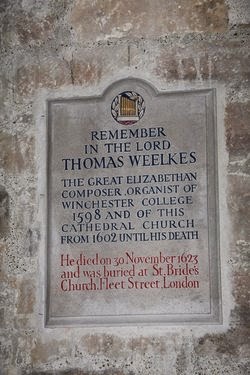
    It is the greatest irony that classical music is so often viewed as “elitist,” and even a little prissy, when its greatest practitioners could be as antiestablishment and badly behaved as the most celebrated rock star. Take the case of composer Thomas Weelkes, who died 400 years ago today.

    Weelkes served first as organist of Winchester College, where concurrently he began writing the madrigals on which much of his lasting fame rests. Then, after two or three years, he was hired as organist and choirmaster at Chichester Cathedral. Somewhere along the way, Weelkes discovered alcohol.

    By 1616, he was “noted and famed for a comon drunckard [sic] and notorious swearer & blasphemer.” Also around this time, he was fined for urinating on the Dean from the organ loft during Evensong. But even that wasn’t enough to get him fired. He was dismissed for drunkenness and rough language during divine service. A short while later, he was rehired, and he did it all over again.

    “Dyvers tymes & very often come so disguised eyther from the Taverne or Ale house into the quire as is muche to be lamented, for in these humoures he will bothe curse & sweare most dreadfully, & so profane the service of God… and though he hath bene often tymes admonished… to refrayne theis humors and reforme hym selfe, yett he daylye continuse the same, & is rather worse than better therein.”

    He also impregnated at least one woman out of wedlock. Not a big deal now, but surely scandalous behavior back then. However, he made the best of a “bad” situation and married her (Elizabeth Sandham, from a wealthy family) and the child was born six months later. Perhaps it was a happy marriage, as the couple went on to produce two further children. Elizabeth died in 1622. Weelkes met his Maker a year later. He was roughly 47 years-old.

    True, a great composer’s legacy frequently transcends his human frailty. When the creator is dust, his or her creations live on. The hellraiser is elevated and those he offended are vaguely recollected by historians and specialists, at best. None of it matters in the end but the work. Or as we like to say, it all comes out in the wash.

    How talented was Weelkes? Face it, he routinely showed up to work drunk, was disruptive during religious services, and literally urinated on his boss. Yet 400 years after his death, he is still celebrated for his madrigals and church music. Weelkes wrote more Anglican services than any other major composer of his time.

    Raise your lighters to Thomas Weelkes, rock star!


    Weelkes madrigal in praise of tobacco

    “To Shorten Winter’s Sadness,” complete with fa-la-las.

    In a loftier mode, the anthem “When David Heard”

    Further anthems

  • Alexander Borodin Chemist Composer Extraordinaire

    Alexander Borodin Chemist Composer Extraordinaire

    The connection between music and science has been much remarked upon. In the case of Alexander Borodin, he was a doctor and chemist.

    Borodin was born on this date in 1833. As a boy he had had piano lessons, but he received his formal education at the Medical-Surgical Academy in St. Petersburg. He then served as a surgeon in a military hospital before undertaking three years of advanced scientific study in Western Europe.

    In 1862, he returned to his alma mater to teach. There, he managed to establish courses for women. In 1872, he founded a school of medicine for women. He devoted the remainder of his scientific career to research. He is co-credited with the discovery of the aldol reaction, a means of forming carbon-carbon bonds in organic chemistry.

    Around the time of his return to the Academy, he met Mily Balakirev, the persuasive advocate of Russian nationalism in music, who took the chemist under his wing and supervised the composition of his Symphony No. 1. Borodin began work on his Symphony No. 2 in 1869. Since regarded as a particularly successful blend of Slavic drama and lyricism with European classical form, it was not a particular success at its premiere in 1877.

    Borodin became sidetracked while working on the piece by his absorption in an opera on the subject of Prince Igor. This was to become his most significant musical contribution and one of the most important Russian historical operas. Because of his other commitments and repeated distractions, the work was left unfinished at the time of his death. It was completed by his friends and colleagues, Nikolai Rimsky-Korsakov and Alexander Glazunov.

    The big show-stopper, of course, is his “Polovtsian Dances,” which has been used to sell everything from records to cleanser.

    Borodin was yet another beneficiary of the exceeding generosity of Franz Liszt, whose contributions in this regard are not widely enough acknowledged. It was Liszt’s advocacy as a conductor that brought Borodin to the attention of European audiences. In gratitude, the composer dedicated “In the Steppes of Central Asia” to Liszt in 1880.

    Borodin was also embraced by the French Impressionists, who admired his unusual harmonies. Of course, he achieved even greater renown when melodies from his works became the basis for the musical “Kismet” in 1953. In 1954, he was honored with a posthumous Tony Award!

    Since for Borodin music was basically an avocation, something to which he devoted himself mostly during holidays or when he was otherwise unable to report to work, it became a running gag among his friends that they’d wish him poor health.

    “In winter I can only compose when I am too unwell to give my lectures,” he wrote. “So my friends, reversing the usual custom, never say to me, ‘I hope you are well’ but ‘I do hope you are ill.’”

    He had plenty of experience with illness. The composer survived cholera and suffered several heart attacks. He finally dropped dead during a ball at the Academy in 1887.

    Happy birthday, Alexander Borodin!


    PHOTO: Alexander Borodin: chemistry to burn

  • Rediscovering Weingartner Composer and Conductor

    Rediscovering Weingartner Composer and Conductor

    Felix Weingartner (1863-1942) is best-recognized as a conductor. However, he considered himself equally, if not more so, a composer. He was one of a number of prominent conductors of the day who fit the Mahler paradigm. However, the works of Wilhelm Furtwängler, Otto Klemperer, and most others of his profession are very seldom heard.

    This week on “The Lost Chord,” as we’ll have a chance to enjoy Weingartner’s Symphony No. 2, from 1901, a fascinating mix of old and new, evidently romantic in disposition, yet very much of its time. The recording will feature the Basel Symphony Orchestra, which he himself directed from 1927 to 1934.

    Weingartner held many conducting posts over the years. He succeeded Mahler as principal conductor of the Vienna Hofoper, from 1908 to 1911. He led the Vienna Philharmonic in an official capacity until 1927. He was later chief conductor of the Vienna Volksoper.

    He thought very deeply about the problem of the symphony. I remember reading a book he wrote in which he examined the strengths and weaknesses of all the major symphonies written in the shadow of Beethoven, down to the dawn of the 20th century.

    He himself composed seven symphonies, with other orchestral works, and thanks to the enterprising cpo.de – classic production osnabrück label (CPO for short), all of them have been recorded.

    As a conductor, Weingartner was particularly well-regarded as a Beethoven interpreter. He’d been conducting the Beethoven symphonies as a cycle since at least 1902, and he was the first to complete an integral set of recordings. To round out the hour, we’ll have time to sample the scherzo from the Symphony No. 9, from his superlative recording of 1935.

    I hope you’ll join me in raising a glass to Felix Weingartner. That’s “Wine from Weingartner,” on “The Lost Chord,” now in syndication on KWAX, the radio station of the University of Oregon!


    Remember, KWAX is on the West Coast, so there’s a three-hour difference for the Trenton-Princeton area. Here are the respective air-times of my recorded shows (with East Coast conversions in parentheses):

    PICTURE PERFECT, the movie music show – Friday on KWAX at 5:00 PACIFIC TIME (8:00 PM EDT)

    THE LOST CHORD, unusual and neglected rep – Saturday on KWAX at 4:00 PACIFIC TIME (7:00 PM EDT)

    Stream them here!

    https://kwax.uoregon.edu/


    PHOTO: Weingartner gets busted in Basel in 1927

Tag Cloud

Aaron Copland (92) Beethoven (95) Composer (114) Film Music (123) Film Score (143) Film Scores (255) Halloween (94) John Williams (187) KWAX (229) Leonard Bernstein (101) Marlboro Music Festival (125) Movie Music (138) Opera (202) Philadelphia Orchestra (89) Picture Perfect (174) Princeton Symphony Orchestra (106) Radio (87) Ralph Vaughan Williams (85) Ross Amico (244) Roy's Tie-Dye Sci-Fi Corner (290) The Classical Network (101) The Lost Chord (268) Vaughan Williams (103) WPRB (396) WWFM (881)

DON’T MISS A BEAT

Receive a weekly digest every Sunday at noon by signing up here


RECENT POSTS