I am very sorry to learn that the American composer Ned Rorem has died, only weeks after my extensive write-up in celebration of his 99th birthday. If you missed it, hopefully you’ll be able to get there by clicking the link.
Composer Ned Rorem has a famous bit, wherein he sorts everything in the world into two categories, French and German. He’s repeated it, with variations, many times over the years, perhaps most definitively in his autobiography, “Knowing When to Stop,” published in 1996:
“It is a truth universally acknowledged that the entire solar system is torn between two aesthetics: French and German. Virtually everything is one or the other. Blue is French, red is German. ‘No’ is French, ‘yes’ is German. Formal gardens are French, oceans are German. The moon is French, the sun German. Gay men are French, lesbians are German. Crows’ feet are French, pigs’ knuckles are German. Schubert on his good days is French, Berlioz is forever German. Jokes are French, the explanation of jokes is German. If ‘French’ is to be profoundly superficial, like Impressionism, which depicts a fleeting vision of eternity, then ‘German’ is to be superficially profound, as when Bruckner’s music digs ever deeper into one narrow hole. If you agree with all this, you’re French. If you disagree, you’re German.”
Rorem signed my copy after a reading at Borders in Philadelphia. I must have caught him in a good mood. He was very pleasant and conversational, even after I told him I was German.
Rorem is notorious for his candid (some would say bitchy) diaries and musical assessments. He had a lively intelligence and a razor wit. Also, he must have had an aging portrait in an attic somewhere, transfigured by his abundant sins. At the time of the signing, he was in his 70s, but he could have easily been mistaken for someone twenty years younger.
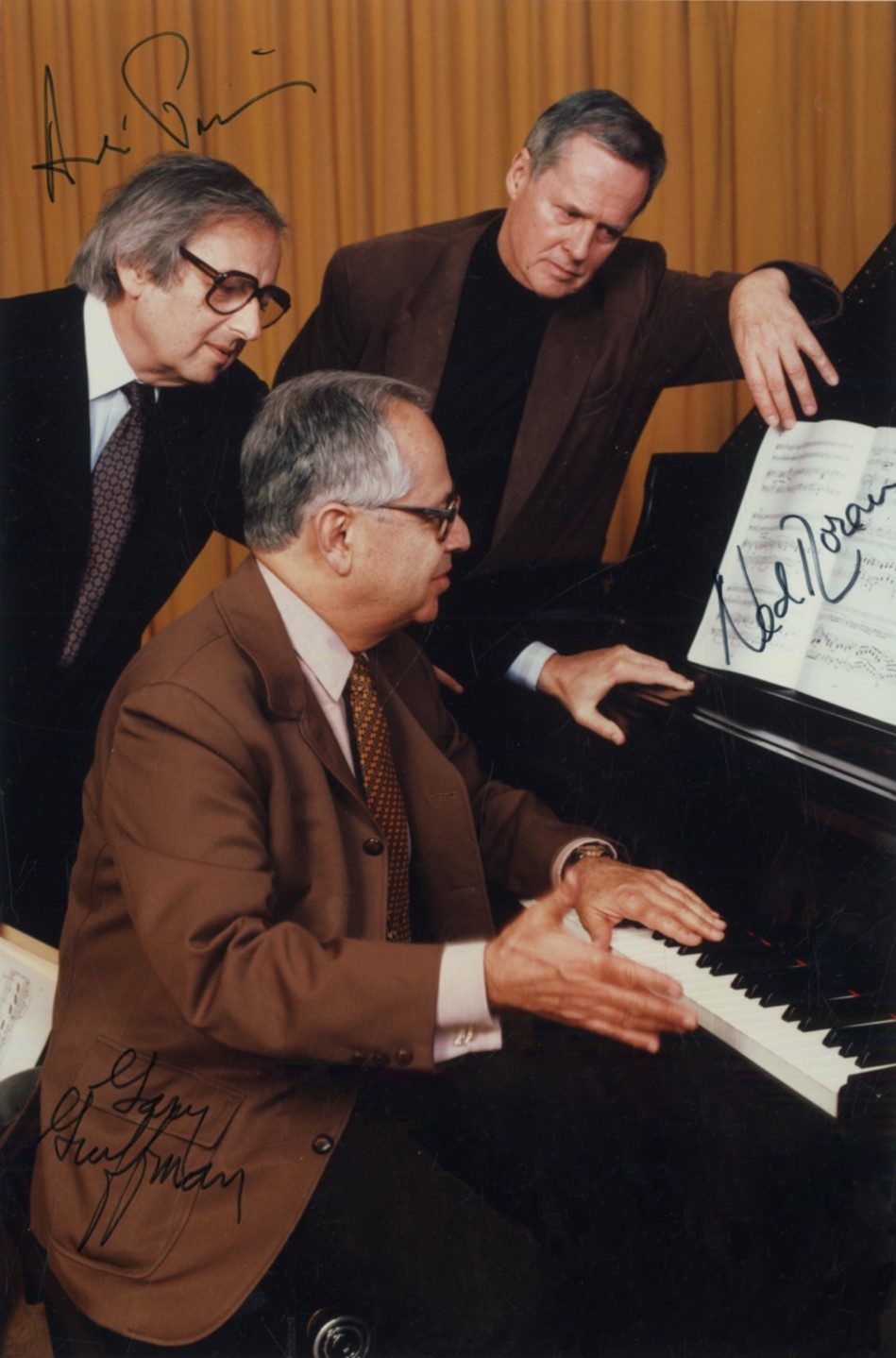
He was still teaching composition at the Curtis Institute of Music in those days. Philadelphia has always been a small town masquerading as a big city, and wouldn’t you know it, Rorem was also the uncle of the (equally-ageless) woman who managed an architecture and design bookstore at which I worked in my early 20s. Rorem would come in to the shop occasionally to have some things framed. I also saw him at student concerts at Curtis and attended the world premiere of his Piano Concerto for Left Hand and Orchestra, written for Curtis’ then-director, Gary Graffman.
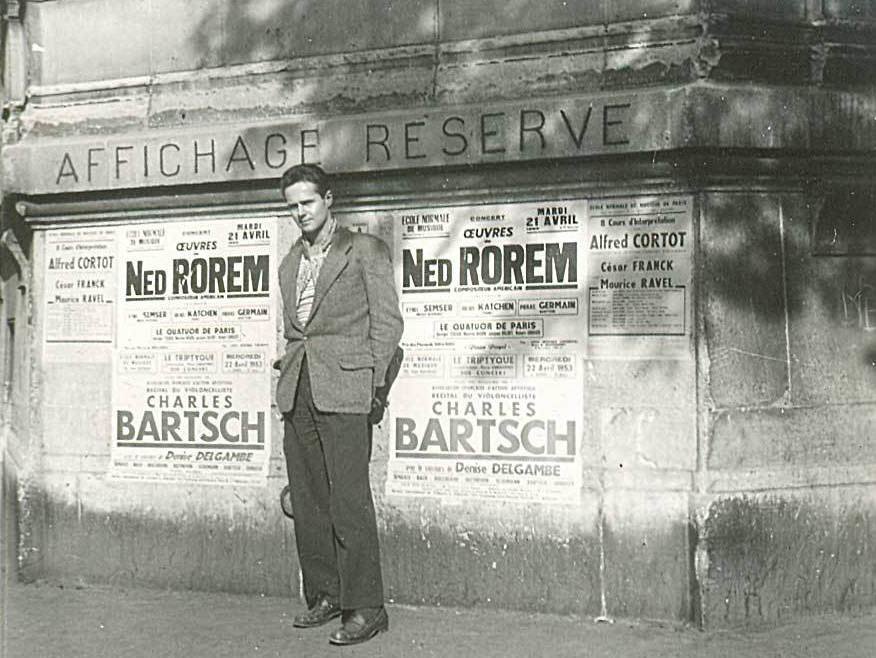
Rorem has composed in all forms – symphonies, concertos, chamber music, opera – but he has always been most highly regarded for his art songs. Here’s a lovely piece of nostalgia, called “Early in the Morning.” It’s easy to see how Rorem, who spent his formative years in Paris, would connect to the text, by Robert Hillyer.
Early in the morning
Of a lovely summer day,
As they lowered the bright awning
At the outdoor café,
I was breakfasting on croissants
And café au lait
Under greenery like scenery,
Rue François Premier.
They were hosing the hot pavement
With a dash of flashing spray
And a smell of summer showers
When the dust is drenched away,
Under greenery like scenery,
Rue François Premier.
I was twenty and a lover
And in Paradise to stay,
Very early in the morning
Of a lovely summer day.
Although Rorem also worked in larger forms, his true genius was for the miniature. Even when he tackled longer works, it was not unusual for them to be built out of smaller individual units. In the case of his Piano Concerto for Left Hand and Orchestra, there are eight short movements – as opposed to three epic statements in the grand German tradition. Very French, you might say.
At his most lyrical, I always thought Rorem shared an affinity with Francis Poulenc. But you need to get to the middle movements to appreciate that. Especially the one that starts about 22 minutes in. I always thought the approach to the theme that opens the work – and returns in the last movement – as kind of like scat-singing. I was present in the hall for this recording, made at the work’s world premiere at Philadelphia’s Academy of Music in 1993.
Happy birthday, Ned Rorem, 99 years-old today!
PHOTO: (counterclockwise from top) Rorem, André Previn, and Gary Graffman rehearse the Piano Concerto for Left Hand and Orchestra. In support of my “aging portrait” theory, Rorem is five years older than Graffman, and 5 1/2 years older than Previn!
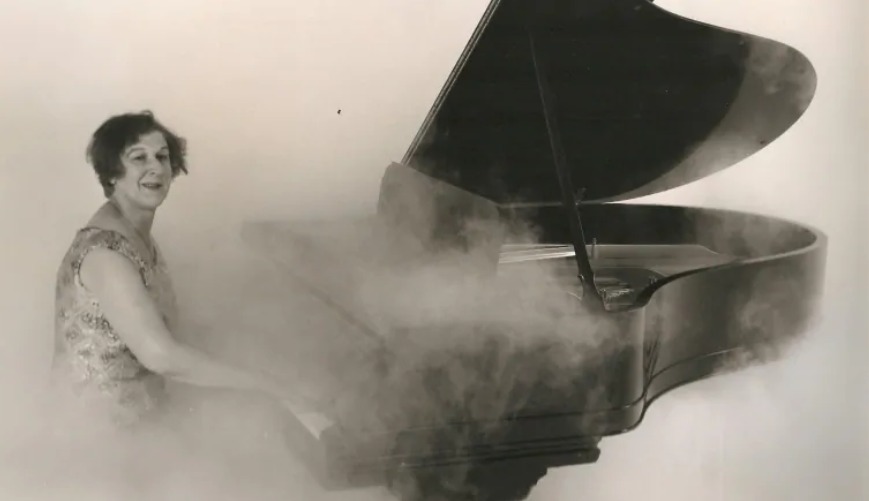
On the birthday of Franz Liszt, I conjure Rosemary Brown. Brown was the English spiritualist who claimed that the great composers were still very much active and dictating posthumous works to her.
At the age of 7 (circa 1923), Brown maintained she was confronted by a curious specter with long white hair and a flowing cassock. The specter prognosticated that one day he would make her famous. It was ten years before she stumbled across an old photograph and realized that what she had encountered was no less than the shade of Liszt.
Brown was born into a family of alleged psychics. Both her parents and grandparents claimed extrasensory powers. Brown took up the piano at the age of 15. Her period of study is unclear, as she seems to have changed her story over the decades, but she would have us believe she was basically a dilettante with little formal training.
Then, in 1964, the ghost of Liszt reappeared and she began “transcribing” new works by the great composers – Bach, Mozart, Beethoven, Schubert, Schumann, Chopin, Brahms, Grieg, Debussy, Rachmaninoff, and Stravinsky. And Liszt, of course. These included two symphonies she attributed to Beethoven, a new “Fantaisie-Impromptu” by Chopin, and a 40-page sonata by Schubert.
She claimed that some of the composers directed her hands on the keyboard (Chopin and Liszt); others sang (Schubert) or dictated notes (Bach and Beethoven). All of them communicated in English.
Skeptics abounded. A number of critics and musicologists dismissed the new compositions as substandard pastiches, claiming that the great composers tended to reinvent themselves and push boundaries, while these freshly “dictated” works offered nothing of the sort.
Some psychologists attributed the phenomena to extraordinary activity on the part of Brown’s subconscious, with the medium essentially reworking and synthesizing all the music she had been exposed to as a child.
Still, they had to admit it was impressive. Over the course of her life, Brown produced hundreds of such pieces. One expert described it as “the most convincing case of unconscious composition on a large scale.”
Respected concert pianists Howard Shelley, Peter Katin, Cristina Ortiz, and John Lill have all included these perhaps spurious works on their programs.
Brown died in 2001. Whether or not she herself is now dictating is anyone’s guess.
Rosemary Brown plays a piece allegedly transmitted to her by Liszt
Brown meets the Amazing Kreskin. (She makes her appearance 9 minutes in; she plays at 12:30.) She claims Liszt helped her son with his homework!
“To achieve great things, two things are needed: a plan and not quite enough time.”
Leonard Bernstein ought to have known. He had only 72 years to become this country’s most visible, extraordinarily versatile classical musician, as a conductor, composer, pianist, Broadway luminary, educator, author, and humanitarian. (I’m sure I left something out.)
Happy birthday, Lenny. Thanks for making the most of the time you were given.
Bernstein talks Beethoven at the piano with Maximilian Schell – and ever-present cigarette
“Rhapsody in Blue” from the keyboard, with the fearless Stanley Drucker on clarinet
Bernstein conducts “Prelude, Fugue and Riffs” on “Omnibus” in 1955
Bernstein and Aaron Copland create demo record of “Fancy Free” for Jerome Robbins. Stick around for commentary at the end, with self-incriminating interjection by Copland!
Bernstein’s sensational eleventh-hour debut with the New York Philharmonic, at 25, in 1943
Bernstein’s European conducting debut, with the Czech Philharmonic in 1946
An entire playlist of Bernstein rarities!
Conducting Shostakovich in Tokyo
Conducting Haydn – with his face
Lauren Bacall sings “The Saga of Lenny,” lyrics by Stephen Sondheim (with apologies to Kurt Weill), for Bernstein’s 70th birthday celebration
Bernstein’s death reported on ABC News in 1990
Bernstein conducts his recently-composed “Candide Overture” on a televised Young People’s Concert in 1960
Bernstein conducts Mahler’s “Resurrection Symphony” as a memorial tribute, broadcast live, two days after the assassination of President Kennedy in 1963