Happy birthday to the Master, 91 years-old today. I wish I could forget the horrible movie, because John Williams truly is the Last Jedi. Is there any doubt? Here’s a taste of what we can expect this summer.
John Williams is a living reminder of when the movies still had magic and soul. I will be forever grateful for everything this man has contributed to our entertainment and dreams of a better world.
Thanks for everything, and a very happy birthday, Maestro!
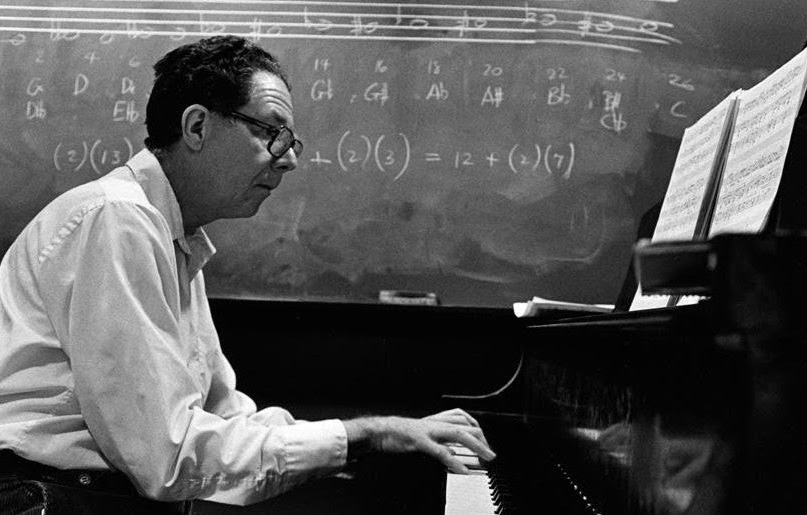
A black day for admirers of Easley Blackwood. The composer, pianist, theorist, and teacher has died at the age of 89. Blackwood, who taught at University of Chicago for 40 years, studied with Olivier Messiaen, Paul Hindemith, and Nadia Boulanger. He was a founding pianist of the chamber group Chicago Pro Music, otherwise made up of musicians from the Chicago Symphony Orchestra. Among his original compositions are five symphonies, sundry concertos, and “Twelve Microtonal Etudes for Electronic Music Media.” His book, “The Structure of Recognizable Diatonic Tunings,” was published by Princeton University Press. A cross-section of his music and recordings of his performances of other composer’s piano works are available on Cedille Records. And yes, his father was the famed contract bridge player. R.I.P.
Symphony No. 2, with George Szell and the Cleveland Orchestra
Microtonal Compositions
String Quartet No. 3
Chaconne for Carillon!
Blackwood’s arrangement of Rimsky-Korsakov’s “Capriccio espagnol”
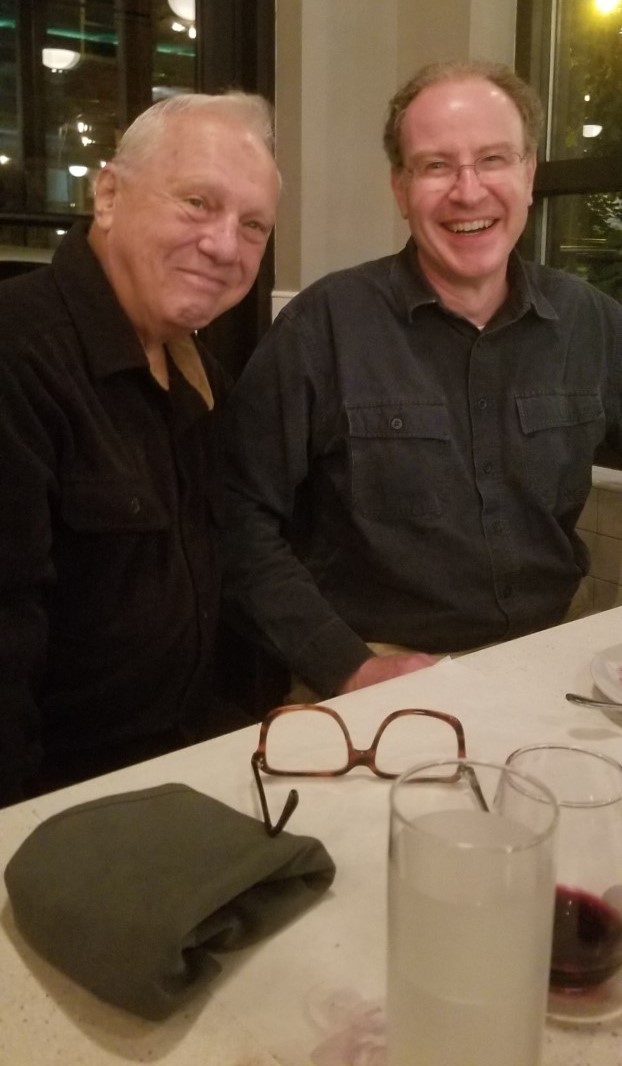
Robert Moran is the only composer I’ve ever interviewed to produce two sizable wine glasses and proceed to top them off (several times) with chilled vodka from his freezer. It was quite the interesting conversation. Fortunately we were talking about his mystery play-cum-puppet pageant, “Game of the Antichrist.” Bob, a good friend for many years now, turns 86 today. Happy birthday, Bob! Keep on flying high (over Albania).
An aria from Bob’s opera “Desert of Roses”
Selections from “Trinity Requiem,” for the tenth anniversary of 9/11
“Alice,” after Lewis Carroll, for Scottish Ballet
Looking groovy and introducing his “Lunchbag Opera” for the BBC
“Buddha Goes to Bayreuth”
The Antichrist Summons a Musician
“Modern Love Waltz” by Philip Glass, arranged by Robert Moran for accordion and cello
In 1997, I was sitting behind the desk in my bookshop in Philadelphia, when an older couple wandered in. The man was evidently careful about his movements, understandable, even under the best of circumstances, since one had to navigate a foyer with some stairs and then usually a dog when entering the space.
After some time browsing, they approached the desk, and the man asked to see a piece of ephemera he noticed, a booklet on the composer and critic Virgil Thomson, that I had on low shelf beside me, waiting to be priced. This started a conversation, in the course of which it was revealed that he himself was a composer. When he told me his name, he seemed especially gratified that I knew who he was.
But John Duffy’s Emmy Award-winning music for the PBS television documentary “Heritage: Civilization and the Jews” was played quite often on the local classical music station, especially around the Jewish holidays. (Duffy himself was Irish Catholic.) He and I had a lovely exchange, and when he asked me how much I wanted for the book, I told him it was on the house.
The Duffys were in Philadelphia for the premiere of his new opera, “Black Water” (on a libretto by Princeton writer Joyce Carol Oates), at Plays and Players Theater, which was two blocks away from the shop. Perhaps in reciprocation for my generosity, he offered to comp me into the show.
This was on a weekday. At the time, I was working the weekend mornings at WWFM in Trenton-Princeton, so it would be around 1:30 or 2:00 by the time I got back to Philadelphia and found parking on a Saturday or Sunday afternoon.
That Saturday, I returned, and a friend of mine, who regularly sat the store in my absence, said that a kindly old gentleman had stopped by and dropped off something for me. John Duffy had gone to Tower Records and picked me up a copy of his CD “Freedom Works.” It was the only disc in stock that had selections from “Heritage.”
With the CD he left the following note, rendered in a shaky hand:
“Dear Ross: I wanted you to have a copy of FREEDOM WORKS. Tracks 6, 7 & 8 are based on my HERITAGE score. All best, John Duffy
“P.S. I hope you found BLACK WATER absorbing. Thank you for the Thomson book.”
Duffy already appeared unsteady when I met him, when he was only in his early 70s. He suffered from ill health later in life, but he held on until the 2015, reaching the ripe age of 89. He impressed me as an optimistic and gentle soul. In addition to his work as a creative artist, he went out of his way to help others in his field. He was founder and president of Meet the Composer, an organization that initiated countless programs to advance American music, from creation to performance and recordings.
On the same CD he left, with “Three Jewish Portraits” (from “Heritage”), was his Symphony No. 1 and “A Time for Remembrance” – a “peace cantata,” as he subtitled it – commissioned in 1991 by the U.S. government to mark the 50th anniversary of the attack on Pearl Harbor that killed 2,403 Americans, wounded 1,178 others – sailors, soldiers, airmen, marines, and civilians – and precipitated the United States’ entry into World War II. After listening to the music, I promptly added it to my regular repertoire for radio broadcast on December 7.
In his booklet notes, the composer writes that it is “Dedicated to my sister, Agnes Duffy, Ensign, U.S. Navy, Nurse, IN HER MEMORY: and in remembrance of all those who die in war: the men, women, and children killed and maimed at Pearl Harbor; my cousin, Edward Quirk, Machinist’s Mate, USS Shaw; the men entombed in the USS Arizona; those at Hiroshima, Normandy, Bergen-Belsen, and more. MAY PEACE PREVAIL IN THEIR NAMES.”
The texts are taken from a poem by Rupert Brooke, a speech by Franklin Delano Roosevelt, an African American spiritual, and actual letters written by sailors aboard the USS Arizona. On the recording, the performance features James Earl Jones, narrator, Cynthia Clarey, mezzo-soprano, and the Milwaukee Symphony, conducted by Zdenek Macal. You can listen to it here.
Duffy himself lied about his age when enlisting during the war. He became part of the Amphibious Scouts and Raiders, forerunners to the Navy SEALs, before deploying on the USS Hopping, a destroyer escort in the Pacific. His duties included detonating Japanese mines by shooting them from ship deck. When his ship took fire from shore batteries at Okinawa, the sailor standing next to him was killed. Duffy had to stand guard over the dead man’s body until burial at sea in the morning. That night watch determined the course of his life. “Since our time is so fleeting and unpredictable,” he later commented, “I knew I had to dedicate my life to music.”
John Duffy on his own war experiences and his decision to become a composer:
After writing up a little salute to Ned Rorem the other week, on the occasion of his 99th birthday, I happened to read an interview he gave with Bruce Duffie, in which he confessed that it was important to him that his music will be remembered. It made me recollect how, upon hearing of the death of Aaron Copland, I wished I had written him a letter to let him know how much his music meant to me. I easily could have. Copland died in 1990.
Similarly, Rorem’s remark made me think maybe I should send him a note. But I let the moment pass. In truth, his music never occupied the same kind of place in my heart as does Copland’s, but I am certainly grateful for it.
Rorem died yesterday at the age of 99. Here’s a sampler of his music, with links to the Duffie interview and my write-up, in case you missed it.
Leon Fleisher plays “3 Barcarolles” (1949)
With Thanksgiving right around the corner, here’s a piece for string orchestra, called “Pilgrims” (1958). The composer hastens to point out that it has nothing to do with Plymouth Rock. Rather, it was inspired by a novel of Julien Green called “Le voyageur sur la terre.” The title in turn is borrowed from the Book of Hebrews: “These also died in faith, not having received the promises, but having seen them afar off… and confessed that they were strangers and pilgrims on the earth…” (Hebrews 11:13). Rorem points out that the music is less programmatic than it is a mood of remembrance.
Typical of many of Rorem’s larger works, his Violin Concerto (1984) eschews a classical three-movement structure in favor of a suite of shorter movements, generally becoming lovelier and more heart-felt the closer you get to the center. In this case, there’s also a programmatic element, in that the movements are supposed to mirror a dusk-to-dawn progression.
Bernstein conducts the world premiere of Rorem’s Symphony No. 3 at Carnegie Hall (1959)
Anyone who’s ever read Rorem’s writings knows he definitely had his saucy side. He confessed he was shocked at having been awarded the Pulitzer Prize (for “Air Music” in 1976), since he figured the establishment would prefer to punish him for being such a naughty boy. “But it sort of gives you a certain authority,” he reflected. “My name is now always preceded by ‘Pulitzer Prize-winning composer.’ So if I die in a whorehouse, at least the obit will say ‘Pulitzer Prize-Winning Composer Ned Rorem Dies in Whorehouse.’”
“Air Music” can be heard at the link, as part of a collection recorded by the Louisville Orchestra. The opening work, “Design for Orchestra” (1953), is certainly attractive.
Rorem was always most highly-regarded for his art songs. He himself thought his song cycle “Evidence of Things Not Seen” (1998) – 36 songs for voice and piano – his finest work. Here are just a few selections.