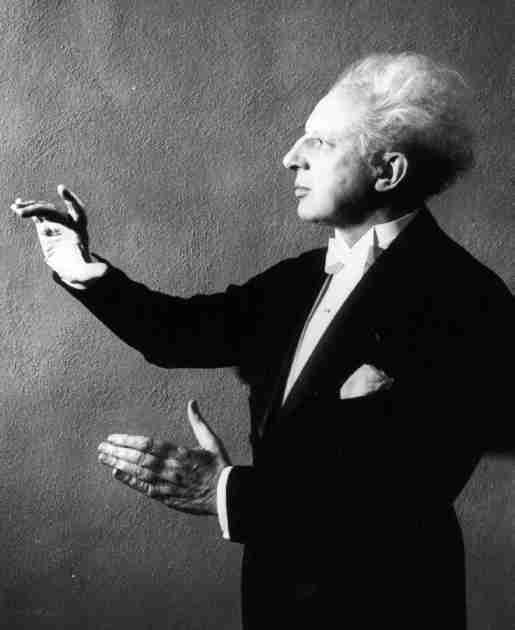
Maestro. Showman. Magician. Matinee idol. Prima donna. Charlatan. Genius. Superstar.
The multifaceted Leopold Stokowski was born on this date, 140 years ago.
Preserved (or parodied) in all media, he could be as outrageous as he was revelatory. He brought to concert music a glamour and vitality that today it too often lacks. His wild hair and faux middle-European accent, his dove-like hands, his flamboyant experiments in sound, his pursuit of the novel and the cutting edge of technology, made him a celebrity, often to the chagrin of his critics. But the proof is in the pudding, and thankfully his recorded legacy is enormous. There is ample evidence to support all claims.
Stokowski died in 1977 at the age of 95. At 94, he signed his final recording contract, with Columbia Records, which would have kept him busy into his 100th year.
Here’s a documentary filmed when he was 88:
At around the 11:23 mark, he states, “We have a motto in the American symphony orchestra, which is ‘do better.’ And it would be a good motto for life all over the world today, when we are killing instead of loving. Do better, world!”
Well said. Happy birthday, Leopold!
One of my favorite live performances on YouTube, when it shows up (it keeps getting taken down), with Stokowski conducting Debussy at the age of 90.
Bach in Philadelphia in 1927
Conducting Tchaikovsky in the film “Carnegie Hall” (1947)
Shaking hands with Mickey Mouse in “Fantasia” (1940)
It is ironic that one of the great conductors of opera would be comparatively unsung.
Victor de Sabata is fondly remembered by collectors largely for a single recording – a classic performance of “Tosca” with Maria Callas. The reasons for this have little to do with De Sabata’s merit. De Sabata was a creature of the theater, as opposed to the recording studio. Also, he happened to flourish at a time before the widespread adoption of stereo recording methods. His most cherished recordings were captured on the wing, which might be viewed as something of a mixed blessing. But while few of his performances were preserved under controlled circumstances, what we do have accurately reflects his volcanic temperament in all its terrible glory.
How much awe did De Sabata inspire? Apparently enough that a young Sergiu Celibidache was moved to hide overnight in the Bayreuth bathroom facilities in order to eavesdrop on his rehearsals of “Tristan und Isolde.”
For decades, De Sabata was principal conductor at La Scala. For a time, he was also its artistic director. One observer described his appearance while conducting as a cross between Julius Caesar and Satan. In 1953, a massive heart attack brought all that to an end. “Tosca” was planned to have been the first of a series of recordings for HMV which would have documented much of De Sabata’s operatic repertoire. In the event, he would return to conduct only twice more.
One of these “comebacks” was a molten performance of Giuseppe Verdi’s “Messa da Requiem,” a classic 1954 recording featuring soprano Elisabeth Schwarzkopf, mezzo-soprano Oralia Dominguez, tenor Giuseppe di Stefano, and bass Cesare Siepi. It’s a strikingly broad reading that yet manages to roil and sear.
Like that other titan of the podium, Wilhelm Furtwängler, De Sabata placed more importance on his activities as a composer than as a conductor, which might seem strange to us, given the nature of their respective legacies. There’s a good recording in modern sound of De Sabata’s symphonic poems on the Hyperion label, conducted by Aldo Ceccato. But Hyperion is pretty diligent about taking down unauthorized postings of its material from YouTube. So here’s “Juventus” (“Youth”) conducted by the composer in 1933:
Lorin Maazel conducts “La Notte di Plàton” (“The Night of Plato”)
New to me! Suite No. 2 for Orchestra
Verdi, “I Vespri Siciliani” Overture
Fragment of the Mozart Requiem
Rehearsing Brahms
“Dance of the Seven Veils”
Fly-on-the-wall “Tristan” from 1930
Sibelius!
Immortal “Tosca”
Celibidache remembers De Sabata
Happy birthday, Victor de Sabata, firebrand of the podium!
The conductor Michail Jurowski has died. His father, Vladimir, was a composer, and one his sons, also named Vladimir, is a conductor, who has appeared with the Philadelphia Orchestra many times. His grandfather was the conductor David Block.
His family was friendly with Dmitri Shostakovich, and as a young man Jurowski would play four-hand piano with the composer. Aram Khachaturian and David Oistrakh were also frequent visitors.
Russian-born, but of Jewish heritage, he claimed to have been hindered by the effects of anti-Semitism as a student. He graduated from the Moscow Conservatory and found early work at the Stanislavski and Bolshoi Theaters. Then he became an assistant to Gennadi Rozhdostevensky at the Moscow Radio Symphony.
In 1989, he left Russia for Germany. He spent much of his career there, working in opera houses in Berlin, Dresden, and Leipzig, and as music director of the Northwest German Philharmonic, conductor of the Berlin Radio Symphony Orchestra, and principal conductor of the WDR Symphony Orchestra. He was also active in Scandinavia, recording with orchestras in Sweden and Denmark, and in Argentina, where he conducted the Buenos Aires Philharmonic.
In 1995, he made the first recording of Shostakovich’s unfinished opera, “The Gamblers.” In 1996, he collapsed in the pit during a performance of Mussorgsky’s “Boris Godunov.” It was a beyond-and-back experience, as his heart is said to have stopped for four minutes.
My experience of Jurowski’s work is solely through his recordings, of which he made many, for labels such as CPO, Capriccio, Eurodisc, Naxos, and Sterling, among others.
Another son, Dmitri, is also a conductor. A daughter, Maria, is a music teacher.
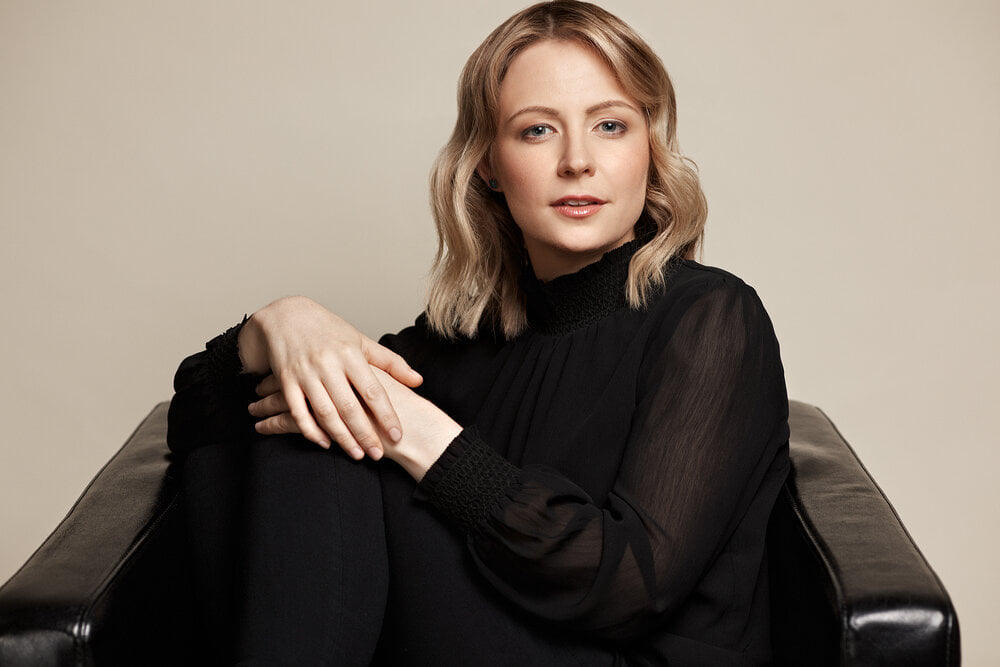
Congratulations to Gemma New, now back on her home turf as principal conductor of the New Zealand Symphony Orchestra!
New is a familiar face here in New Jersey, thanks to her five-year stint as associate conductor of the New Jersey Symphony. Like her compatriot Edmund Hillary, she has been scaling mountains ever since, as resident conductor of the St. Louis Symphony Orchestra, principal guest conductor of the Dallas Symphony Orchestra, and music director of the Hamilton Philharmonic Orchestra in Hamilton, Ontario.
I saw her lead a concert at Richardson Auditorium here in Princeton in 2019, and her Sibelius 2nd was a knockout – an inspiring performance, with New, an unassuming presence off the podium, astonishingly authoritative, with a clean and confident baton technique.
I interviewed her in advance of the concert for the Trenton Times. Nice to see the article linked among the footnotes on her Wikipedia page. I think I broke the ice by being so well-versed in the music of Douglas Lilburn (New Zealand’s national composer).
Best wishes to Gemma New. Now on to the next peak!