Tag: Conductor

  • Arturo Toscanini Legend Intensity and Legacy

    Arturo Toscanini Legend Intensity and Legacy

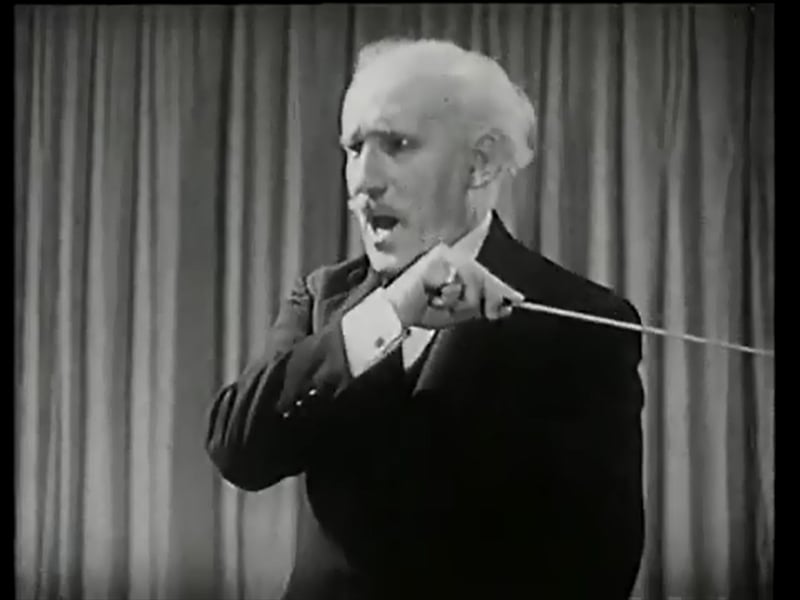
    Arturo Toscanini was one of the most celebrated conductors of the 20th century. His intensity, perfectionism, and alleged fidelity to the score have been enshrined in legend. And when the legend becomes fact, I print the legend.

    Toscanini served as music director of La Scala, Milan, the Metropolitan Opera, the New York Philharmonic, and the NBC Symphony Orchestra. He conducted first performances of Puccini’s “La bohème,” Leoncavallo’s “Pagliacci,” Respighi’s “Feste Romane,” and Barber’s “Adagio for Strings.” As a cellist, he played in the world premiere of Verdi’s “Otello.”

    From 1937 to 1954, he reached millions of Americans via his weekly broadcast concerts on NBC radio. These originated at Rockefeller Center’s Studio 8-H, now the home of “Saturday Night Live.”

    Toscanini was vehemently anti-fascist. He despised Hitler, and vowed never to conduct in Germany as long as “the Führer” remained in power. In Italy, he was beaten up by brownshirts and had his passport confiscated for refusing to conduct “Giovinezza,” the fascist anthem. He also worked closely with violinist Bronislaw Huberman in support of the Palestine Orchestra, made up of Jewish exiles from fascist Europe. He once confided to a friend, “If I were capable of killing a man, I would kill Mussolini.”

    Il Duce really caught a break when Toscanini emigrated to America. It sounds to me as if the Maestro could have been borderline more than once. Ironically, for someone who hated dictators, he sure could dish out an autocratic tirade.

    Happy birthday, Arturo Toscanini.


    Conducting Verdi, “La Forza del Destino Overture” (on film, 1944)

    Beethoven, Symphony No. 3, “Eroica” (at Carnegie Hall, 1939)

    https://www.youtube.com/watch?v=uYfgjL9dBkU

    Respighi, “Feste Romane” (“Roman Festivals,” 1949)

    Toscanini snaps his baton and calls his double bassists “ball breakers.”
    https://www.youtube.com/watch?v=i-1KtSOwLXE

  • Yuri Simonov Wild Conductor Turns 80

    Yuri Simonov Wild Conductor Turns 80

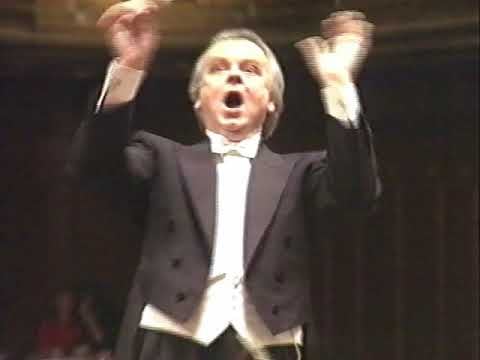
    Is Yuri Simonov, who turns 80 today, a live-action Warner Brothers cartoon? The only thing missing is the celluloid dickey rolling up like a blind. It only gets more preposterous as it goes on. You’re welcome to watch the whole thing, but on the assumption you’ve got places to go and things to do, I’m cueing it up to around the 12:30 mark.

    BONUS: Simonov conducts Shostakovich’s “Festive Overture.”

    If you can look past the histrionics, Simonov is actually a very fine conductor, who deserves to be much better known in the West. He just gets a little carried away, that’s all. Evidently he must be a trip to see in concert, but he takes his rehearsals very seriously. Here he is preparing Wagner, so that in concert he can let “The Flying Dutchman” really fly.

    https://www.youtube.com/watch?v=QvOrTQaLQjk

    You can’t argue with success. Simonov conducts Tchaik 4 in Budapest:

    Happy birthday, Maestro!

  • Fritz Reiner Tyrant Genius of the CSO

    Fritz Reiner Tyrant Genius of the CSO

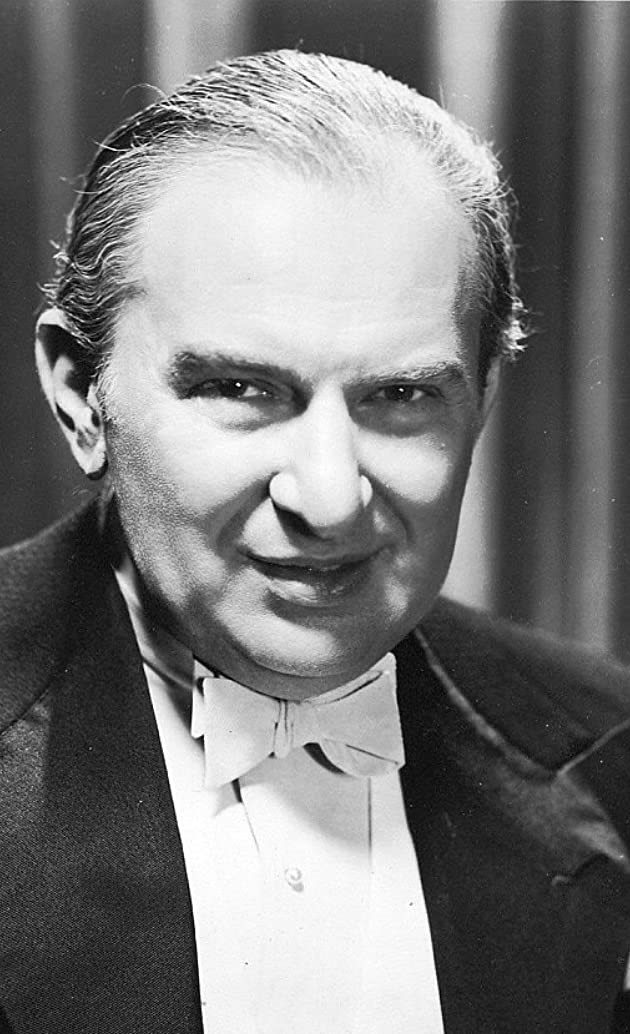
    At a time when tyrant conductors still very much roamed the earth, Fritz Reiner was one of the most feared. With a glower that would make Bela Lugosi quake – and sporting quite the similar hairline – Reiner was forged in Hungary at the twilight of the Austro-Hungarian Empire. Hungary at the time had quite the reputation for churning out great conductors. Among those to achieve considerable international success were George Szell, Eugene Ormandy, Antal Doráti, Ferenc Fricsay, Sir Georg Solti, and István Kertész.

    Among Reiner’s own teachers was Béla Bartók, with whom he studied piano. Reiner would later repay the favor with what many consider to be the benchmark recording of Bartók’s “Concerto for Orchestra.” He also worked closely with Richard Strauss in Dresden, and his recordings of Strauss’ works are equally revered. All in all, the Chicago Symphony under Fritz Reiner was a surefire choice to give the ol’ hi-fi a good workout in the early days of stereo.

    Reiner became a naturalized American citizen in 1928, and began to teach conducting at the Curtis Institute of Music in Philadelphia. Among his pupils was Leonard Bernstein. His first American post was as principal conductor of the Cincinnati Symphony. He led the Pittsburgh Symphony for ten years, from 1938 to 1948, then spent several years at the Met. But it was as music director of the Chicago Symphony that he attained legendary status.

    For a master interpreter of some of the largest and most challenging works in the repertoire, his baton technique was notable for its precision and economy. Much of what he achieved, unfortunately, was through the brutality he exerted in rehearsals. Reiner emerged from an Old World steeped in aristocratic methods. At the top of their profession, conductors then were regarded as gods-on-earth. When drive and ego were bolstered by absolute power, working conditions became downright perilous. Before strong musicians’ unions, conductors exercised the authority to fire anyone on the spot. So when musicians played for Reiner, they played as if there lives depended on it – or at the very least their livelihoods.

    Did it make for better musicmaking? You can’t argue with the excellence of Reiner’s Chicago Symphony.

    Read this account of the day Reiner finally gave his “perfect concert.”

    https://csosoundsandstories.org/125-moments-101-fritz-reiners-perfect-concert/#:~:text=In%20October%201958%2C%20Fritz%20Reiner,New%20Brunswick%2C%20and%20Washington%2C%20D.C.

    Even autocrats have birthdays. Happy birthday, Fritz Reiner.


    Reiner conducts Beethoven

    Reiner conducts Kodály and Bartók, with Rudolf Serkin at the piano
    https://www.youtube.com/watch?v=TOE83a1FrwA

    Reiner conducts Strauss’ “Salome”

  • Kenneth Alwyn Film Music Conductor Dies at 95

    Kenneth Alwyn Film Music Conductor Dies at 95

    Oh my goodness! The conductor Kenneth Alwyn has died.

    Alwyn recorded many popular classics and much film music. I remember the thrill of discovering his first, extensive digital recordings of music from “The Bride of Frankenstein” and “The Quiet Man” – two of my desert island film scores – in the bins at Tower Records.

    He also conducted Decca’s first stereophonic recording of the “1812 Overture” and several albums devoted to the works of Richard Addinsell, including, of course, the ubiquitous “Warsaw Concerto.”

    He was an experienced ballet and musical theater conductor. He held posts at the Sadler’s Wells Theatre Ballet and the Royal Ballet, Covent Garden. He served as musical director at the English premieres of many British and Broadway musicals. He recorded ballet music by Lord Berners. He made at least two very fine recordings of works by Samuel Coleridge-Taylor, including the complete oratorio, “The Song of Hiawatha.”

    Some of Alwyn’s other memorable records include albums devoted to Max Steiner, a selection of music from Ealing Studios comedies, and orchestral highlights from classic British film scores by Vaughan Williams, Sir Arthur Bliss, and others. For Silva records, he led collections devoted to Alfred Newman, Miklós Rózsa, and Ennio Morricone, as well as any number of thematically-organized anthologies.

    In 1992, he toured with the BBC Concert Orchestra, with his friend, Dudley Moore, at the piano.

    Alwyn died yesterday at the age of 95. By coincidence, I happened to include his recording of Sir Arnold Bax’s “Oliver Twist” on last night’s broadcast of “Picture Perfect,” and on Friday, shipped his recording of Paul Ben-Haim’s Symphony No. 2, as part of a Christmas mailing to a friend.

    R.I.P. Kenneth Alwyn.

  • Eugene Ormandy Underrated Maestro

    Eugene Ormandy Underrated Maestro

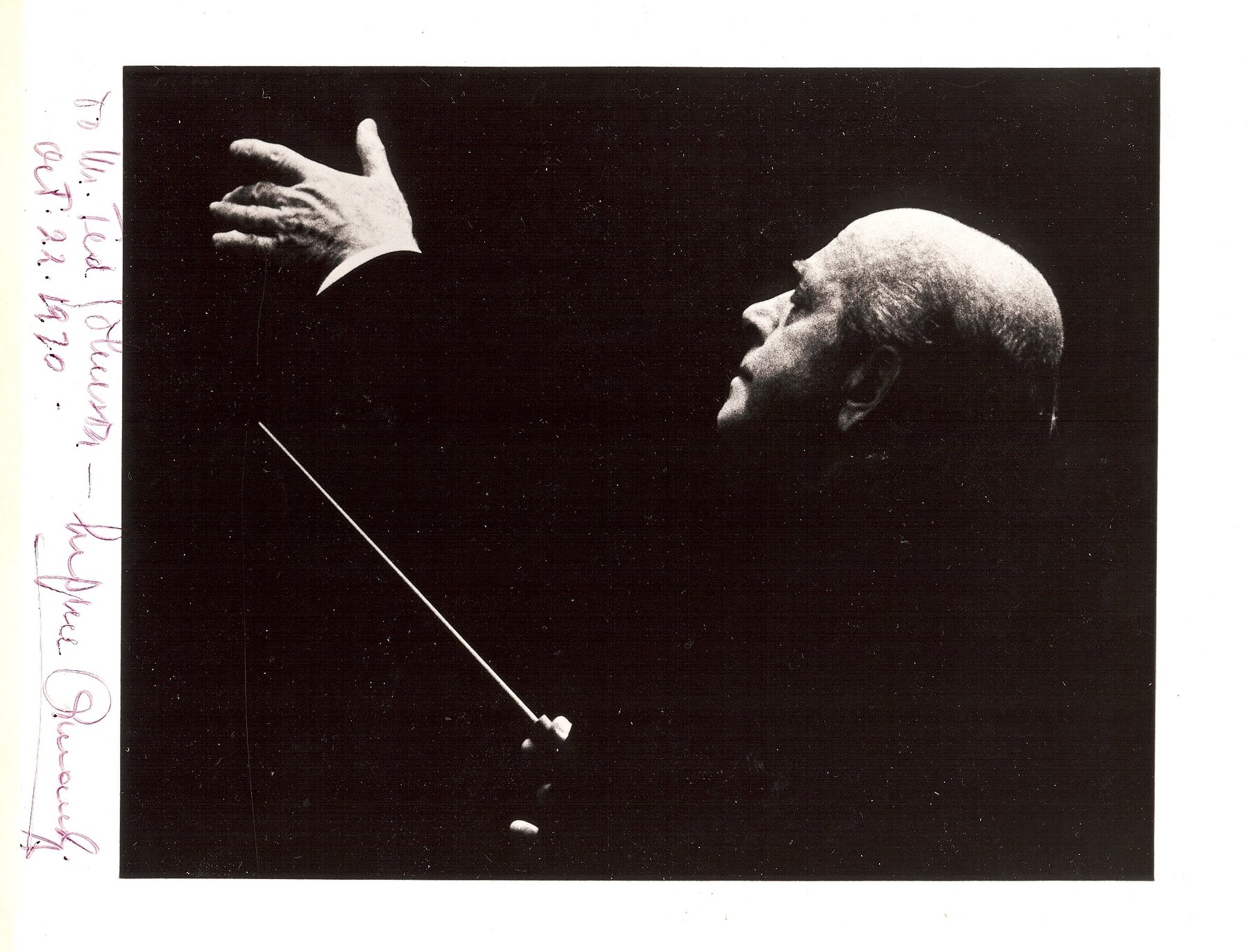
    What’s the big deal about this guy, Jenő Blau? Well, you probably know him better by his adopted name, Eugene Ormandy.

    Ormandy, a Hungarian-born violinist who had studied with Jenő Hubay (for whom he was named), became a naturalized American citizen in 1927. He ultimately wound up directing The Philadelphia Orchestra for 44 years. In that capacity, he became one of the world’s most-recorded conductors.

    However, in some respects, he remains a vastly underrated one. Sure, he was a superb interpreter of 19th century and post-romantic classics (his Columbia recording of Tchaikovsky’s “Pathétique” was one of my go-to favorites as a teen, and he was an authoritative conductor of Rachmaninoff and Sibelius), but he also championed much contemporary music and new works written by his adopted countrymen. Also, if ever there was a more sensitive accompanist in the concerto repertoire, I don’t know of him.

    One of my favorite Ormandy records was also one of his later ones. Throughout his career Ormandy succeeded in selling Sibelius’ “Four Legends from the Kalevala,” a collection of tone poems inspired by the Finnish national epic the “Kalevala,” for the early masterpiece that it is.

    Here again is the final section, “Lemminkainen’s Homeward Journey,” even more thrilling, in 1940:

    https://www.youtube.com/watch?v=FzQMyCsB8eQ

    The legendary Philadelphia strings in Vaughan Williams’ “Fantasia on a Theme by Thomas Tallis”

    Hindemith, “Concert Music for Strings and Brass”

    Ivan Davis joins Ormandy and the Philadelphians for Liszt’s “Hungarian Fantasy,” slight abridged:

    Bruckner “Te Deum” with Temple University Choir

    World premiere performance of Samuel Barber’s Violin Concerto:

    Shostakovich Symphony No. 4:

    Reinhold Glière’s “Russian Sailor’s Dance”

    Rachmaninoff Piano Concerto No. 2, with Eugene Istomin

    Ormandy conducts “Scheherazade” (complete). This is the Philly Orchestra I remember from my college years.

    Debussy, “Reverie”

    Saint-Saens’ Symphony No. 3 “Organ”


    Happy birthday, Eugene Ormandy (1899-1985)!

Tag Cloud

Aaron Copland (92) Beethoven (95) Composer (114) Film Music (123) Film Score (143) Film Scores (255) Halloween (94) John Williams (187) KWAX (229) Leonard Bernstein (101) Marlboro Music Festival (125) Movie Music (138) Opera (202) Philadelphia Orchestra (89) Picture Perfect (174) Princeton Symphony Orchestra (106) Radio (87) Ralph Vaughan Williams (85) Ross Amico (244) Roy's Tie-Dye Sci-Fi Corner (290) The Classical Network (101) The Lost Chord (268) Vaughan Williams (103) WPRB (396) WWFM (881)

DON’T MISS A BEAT

Receive a weekly digest every Sunday at noon by signing up here


RECENT POSTS