Tag: Experimental Music

  • Harry Partch’s Unique Sounds on Noontime Concert

    Harry Partch’s Unique Sounds on Noontime Concert

    Are you parched for new music? Then you’ll want to tune in to today’s Noontime Concert for music of Harry Partch.

    Partch’s vision encompassed unusual, often microtonal scales, but also striking combinations employing handmade instruments of his own design. Partch, a percussion ensemble that shares the composer’s name, will join the PRISM Quartet for “Castor and Pollux: A Dance for the Twin Rhythms of Gemini,” part of concert which took place at Philadelphia’s Kimmel Center for the Performing Arts in June.

    Also on the program will be “Skiagraphies” (“Shadow Etchings”), for saxophones and Partch instruments, by Stratis Minakakis, who is on the faculty of the New England Conservatory, and “Radical Alignment,” by jazz saxophonist and experimental composer Steve Lehman.

    Then, from a concert given at the Kauffman Center for the Performing Arts in Kansas City in October of 2015, PRISM will join the University of Missouri – Kansas City Conservatory Wind Symphony for “Ba Yin” (“The Eight Sounds”), a concerto for saxophone quartet, by Chen Yi. The title refers to a type of Ancient Chinese music played on eight kinds of traditional instruments made of – or with – metal, stone, silk, bamboo, gourd, clay, leather and wood.

    PRISM’s next set of concerts will take place at Drexel University’s URBN Annex Black Box Theater, 3401 Filbert Street, in Philadelphia, this Thursday at 7 p.m., and at 3LD Art & Technology Center + 3-Legged Dog Media & Theater, 80 Greenwich Street, in New York City, this Friday at 8 p.m. For more information, visit prismquartet.com.

    I hope you’ll join me for music by American original Harry Partch, part of today’s Noontime Concert, and that you’ll stick around. I’ll be on until 4:00 EDT, on WWFM – The Classical Network and wwfm.org.
  • Conlon Nancarrow’s Wild Player Piano Music

    Conlon Nancarrow’s Wild Player Piano Music

    Hope you’ve had your caffeine this morning. If you haven’t, Conlon Nancarrow will wake you up.

    Nancarrow was one of the first composers to treat musical instruments as if they were machines, rigging them so that they could perform in a manner far beyond human capability. He worked his experiments in virtual isolation, living in Mexico (where he fled to escape harassment for his communist affiliations) since the 1940s.

    He remained largely unrecognized until the late ‘60s, when Columbia released an album of his music. Indeed, it could be said he wasn’t terribly well known until recordings of his player piano pieces began to appear, on the 1750 Arch label, about ten years later. György Ligeti lauded Nancarrow as “the greatest discovery since Webern or Ives… the best of any composer living today.”

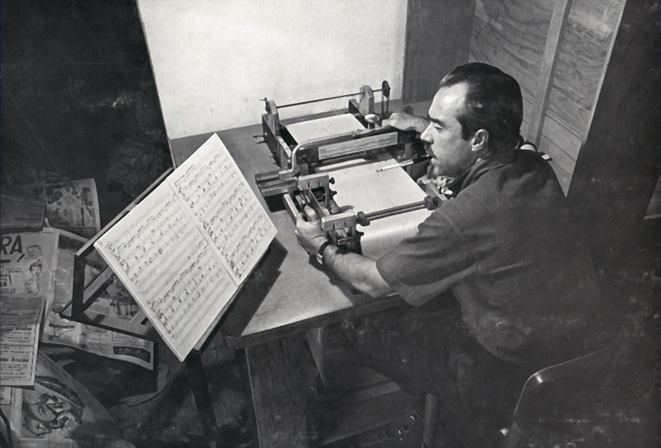
    In 1947, Nancarrow acquired a custom-built, manual punching machine, which enabled him to create his own piano rolls. It was very meticulous work, very slow. He also souped-up his player pianos, increasing their dynamic range, and covering the hammers with materials like leather and metal to create a more percussive sound.

    While his later pieces tend to be abstract, a lot of them extremely intricate canons, his early experiments emulate jazz. Drive your coworkers batty with this selection from Nancarrow’s Study No. 3 for Player Piano, known as the “Boogie-Woogie Suite.”

    https://www.youtube.com/watch?v=Kdm04Rz3wTk

    Happy birthday, Conlon Nancarrow (1912-1997)!


    PHOTO: Nancarrow rolling with it, ca. 1955

  • John Cage Freedom & Experimental Music

    John Cage Freedom & Experimental Music

    It’s ironic that a man named Cage would be all about freedom.

    A pioneer of aleotory or chance-controlled music, electroacoustic music, nonstandard use of musical instruments (such as the prepared piano), making music with found objects, and finding the music in everyday sounds, John Cage was a giant of 20th century music.

    It’s possible to not know a single work he ever “wrote,” or at any rate conceived, and still be exposed to his influence constantly. Cage taught us new ways to think about sound and the nature of music, literally opening up new worlds for exploration. His genius lay in recognizing what had always been invisible before our eyes and silent to our ears.

    To honor him on his birthday, I might insert objects between the caps lock and shift key of my laptop, or roll dice to determine which letters or combinations of letters to hit, or allow my cat to walk across the keyboard or spill a cup of coffee across the keys.

    Or I could write nothing at all and allow the peripheral impressions you receive from your own environment determine how you experience my blank post.

    Happy birthday, John Cage (1912-1992). There are plenty who would scoff at the Emperor’s New Clothes, but you were one hell of a tailor.


    “I can’t understand why people are frightened of new ideas. I’m frightened of the old ones.” – John Cage

    “Discovery consists of seeing what everybody else has seen and thinking what nobody has thought.” – Albert Szent-Györgyi

    Cage performs “Water Walk” on national television:
    https://www.youtube.com/watch?v=Yybn6iKmYdQ

    Cage for people who don’t like Cage:

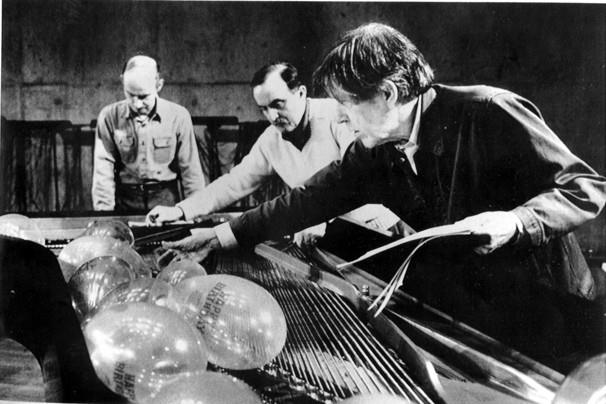
    PHOTO: What’s a birthday without balloons?

Tag Cloud

Aaron Copland (93) Beethoven (95) Composer (114) Film Music (129) Film Score (143) Film Scores (255) Halloween (94) John Williams (192) KWAX (229) Leonard Bernstein (103) Marlboro Music Festival (125) Movie Music (144) Mozart (88) Opera (206) Philadelphia Orchestra (89) Picture Perfect (174) Princeton Symphony Orchestra (108) Radio (88) Ross Amico (244) Roy's Tie-Dye Sci-Fi Corner (290) The Classical Network (101) The Lost Chord (268) Vaughan Williams (103) WPRB (396) WWFM (881)

DON’T MISS A BEAT

Receive a weekly digest every Sunday at noon by signing up here


RECENT POSTS