Hope you’ve had your caffeine this morning. If you haven’t, Conlon Nancarrow will wake you up.
Nancarrow was one of the first composers to treat musical instruments as if they were machines, rigging them so that they could perform in a manner far beyond human capability. He worked his experiments in virtual isolation, living in Mexico (where he fled to escape harassment for his communist affiliations) since the 1940s.
He remained largely unrecognized until the late ‘60s, when Columbia released an album of his music. Indeed, it could be said he wasn’t terribly well known until recordings of his player piano pieces began to appear, on the 1750 Arch label, about ten years later. György Ligeti lauded Nancarrow as “the greatest discovery since Webern or Ives… the best of any composer living today.”
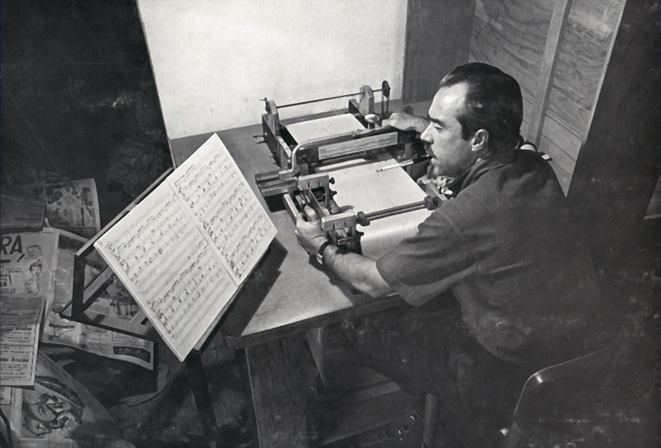
In 1947, Nancarrow acquired a custom-built, manual punching machine, which enabled him to create his own piano rolls. It was very meticulous work, very slow. He also souped-up his player pianos, increasing their dynamic range, and covering the hammers with materials like leather and metal to create a more percussive sound.
While his later pieces tend to be abstract, a lot of them extremely intricate canons, his early experiments emulate jazz. Drive your coworkers batty with this selection from Nancarrow’s Study No. 3 for Player Piano, known as the “Boogie-Woogie Suite.”
https://www.youtube.com/watch?v=Kdm04Rz3wTk
Happy birthday, Conlon Nancarrow (1912-1997)!
PHOTO: Nancarrow rolling with it, ca. 1955
Leave a Reply