Tag: Father’s Day

  • Spaghetti Western Music for Father’s Day on KWAX

    Spaghetti Western Music for Father’s Day on KWAX

    This week on “Picture Perfect,” for Father’s Day, it’s a fistful of spaghetti for Dad.

    We’ll be sampling an hour’s worth of distinctive scores from spaghetti westerns – ultra-cool, hyper-stylized entertainments, made by Italians but often shot in Spain, with their multinational casts heavily dubbed in post-production.

    Spaghetti westerns frequently turned the conventions of American westerns on their heads. At any rate, the morality of the traditional western was made much murkier, with antiheroes cast as protagonists, usually motivated by greed and revenge. Especially greed.

    As with the American film industry, only more so, when the Italians found something that worked, they went into overdrive, churning out literally dozens of knock-offs and imitations a year, until a given genre had run its financially lucrative course.

    To this end, over 600 European westerns were produced between 1960 and 1980. The most influential of these were those directed by Sergio Leone, especially those of the so-called “Dollars” Trilogy – “A Fistful of Dollars,” “For a Few Dollars More,” and “The Good, the Bad and the Ugly.”

    These, of course, featured then-rising star Clint Eastwood. His co-star in the second and third films was Lee Van Cleef, who in American westerns such as “High Noon” and “The Man Who Shot Liberty Valance” had bit parts as one of the villain’s henchmen, but became an international superstar as the spaghetti western’s most reliable – and bankable – heavy.

    We’ll sample from music for the “Dollars” Trilogy, composed by Ennio Morricone, and the “Sabata” Trilogy (which also starred Van Cleef), composed by Marcello Giombini.

    Tell Dad it’s all-you-can-eat. We’ll be piling the plates high with music from spaghetti westerns, on “Picture Perfect,” music for the movies, now in syndication on KWAX, the radio station of the University of Oregon!


    Clip and save the start times for all three of my recorded shows:

    PICTURE PERFECT, the movie music show – Friday at 8:00 PM EDT/5:00 PM PDT

    SWEETNESS AND LIGHT, the light music program – Saturday at 11:00 AM EDT/8:00 AM PDT

    THE LOST CHORD, unusual and neglected rep – Saturday at 7:00 PM EDT/4:00 PM PDT

    Stream them, wherever you are, at the link!

    https://kwax.uoregon.edu/

  • Father’s Day Music Kebab on KWAX

    Father’s Day Music Kebab on KWAX

    This week on “Sweetness and Light,” on the eve of Father’s Day, grab a cold one and meet me at the grill. I’ll be assembling a classical kebab for Dad.

    The adage, “the family that plays together, stays together,” will be borne out through all-in-the-family performances by Los Romeros (the Royal Family of the Spanish Guitar) and the Shostakoviches (composer father, conductor son, and pianist grandson). Cellist Julian Lloyd Webber, brother of Andrew Lloyd Webber, will play music by their father, William. Proud papa Erich Wolfgang Korngold will unveil his “Baby Serenade,” written for the impending arrival of his son, Georg (future record producer George Korngold). We’ll also hear a setting of a Danish folk song, “Father and Daughter,” by Percy Grainger, and a beloved Giacomo Puccini aria sung by a daughter to her father.

    All in all, it will be a more creative, and possibly more gratifying, alternative to the gift of yet another necktie. Lots of music on the menu for Dad on a savory “Sweetness and Light,” this Saturday morning at 11:00 EDT/8:00 PDT, exclusively on KWAX, the radio station of the University of Oregon!

    Stream it, wherever you are, at the link:

    https://kwax.uoregon.edu/

  • Father’s Day Movie Music Entitled Birds

    Father’s Day Movie Music Entitled Birds

    Sure, sure, sure. This weekend is Father’s Day. But I did movies about fathers last year.

    This year, I’m broadening the focus to “entitled birds.” It allows me to program music from “To Kill a Mockingbird,” with Gregory Peck playing one of the great fathers on film, but also to diversify.

    The hour will open with a suite from “The Maltese Falcon” (1941). Humphrey Bogart plays private dick Sam Spade, in John Huston’s adaptation of the Dashiell Hammett novel (not incidentally, full of avian symbols and similes). Mary Astor is the dangerous dame, and the first-rate cast supporting includes Peter Lorre, Sidney Greenstreet, and Elisha Cook, Jr.

    The music is by Adolph Deutsch, who in the 1950s became associated with musicals (he won Oscars for his work on “Oklahoma,” “Seven Brides for Seven Brothers,” and “Annie Get Your Gun,” and was nominated for “The Band Wagon” and “Showboat”), but in the 1940s, he was as noir as that closet song-and-dance man, George Raft, some of whose crime films he scored.
    .
    Then it’s on to the most overt Father’s Day association of the hour and the aforementioned “To Kill a Mockingbird” (1962), based on Harper Lee’s beautiful coming-of-age novel. Gregory Peck plays one of his most memorable roles – defense attorney and model father Atticus Finch (his surname yet another bird). The book was awarded the Pulitzer Prize in 1961. Peck won the Academy Award for Best Actor in 1962. Elmer Bernstein received his only Oscar for his work on “Thoroughly Modern Millie,” of all things. “Mockingbird” remains one of his most memorable and moving scores.

    “Jonathan Livingston Seagull” (1973) flies alone on the program as the only film in which the title refers to an actual bird, though the context is a fabulous one, based on Richard Bach’s bestselling parable. James Franciscus supplies a superimposed human voice. The score is by songwriter Neil Diamond, ably assisted by composer Lee Holdridge (who turned 80 on March 3). We’ll hear Holdridge’s music from the film’s “The Other World” sequence.

    Finally, Errol Flynn plays Geoffrey Thorpe, captain of the “Albatross” (yet another bird), who defends England on the eve of the Spanish Armada in “The Sea Hawk” (1940). The music, perhaps the greatest pirate score ever written, is by Erich Wolfgang Korngold. If I had kids, I would be perfectly content on Father’s Day if they left me alone to watch “The Sea Hawk.” As my grandfather used to say, “You can help me by standing over there.”

    I hope you’ll join me for “Entitled Birds,” on “Picture Perfect,” music for the movies, now in syndication on KWAX, the radio station of the University of Oregon!


    Clip and save the start times for all three of my recorded shows:

    PICTURE PERFECT, the movie music show – Friday at 8:00 PM EDT/5:00 PM PDT

    SWEETNESS AND LIGHT, the light music program – ALL NEW! – Saturday at 11:00 AM EDT/8:00 AM PDT

    THE LOST CHORD, unusual and neglected rep – Saturday at 7:00 PM EDT/4:00 PM PDT

    Stream them, wherever you are, at the link!

    https://kwax.uoregon.edu/

  • Indiana Jones Nostalgia Roy’s Sci-Fi Corner

    Indiana Jones Nostalgia Roy’s Sci-Fi Corner

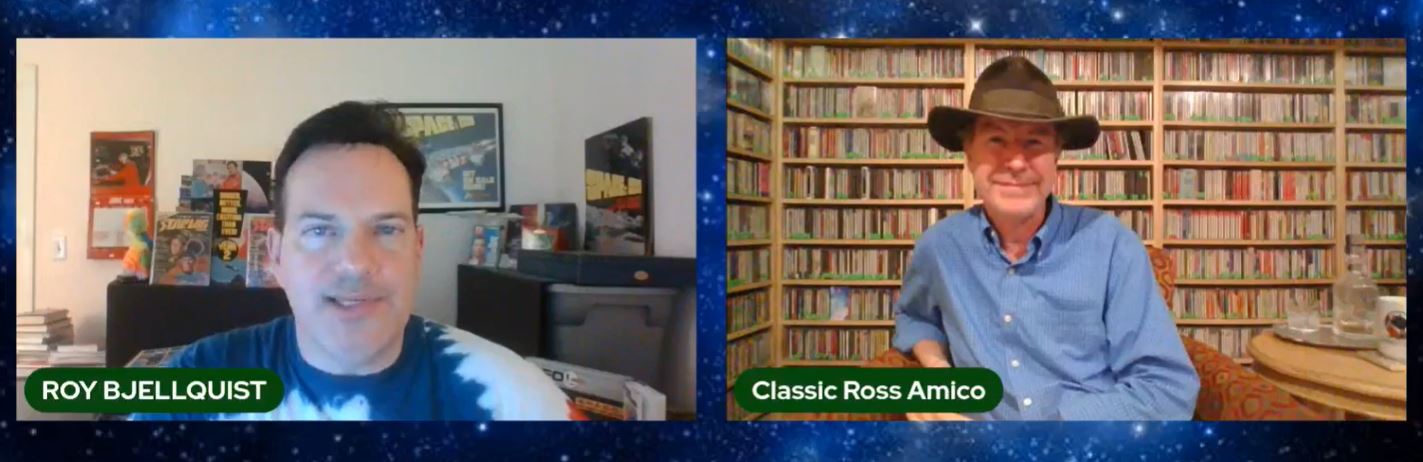
    No snakes were harmed in the making of last night’s episode of Roy’s Tie-Dye Sci-Fi Corner, which was essentially two children of the ‘80s reminiscing and sharing their observations about the Indiana Jones series. The emphasis of the discussion was on the first three films, and there were no spoilers about the latest installment, “Indiana Jones and the Dial of Destiny,” now in theaters. So if your concern is choosing wisely, you can guzzle from this grail with confidence! If nothing else, follow the link to see how dapper I look in a fedora and thrill to my amazing approximation of Raymond Scott’s “Powerhouse” (on which John Williams’ dad played the drums).

    Speaking of dads, I’d like to direct your attention to a special belated Father’s Day edition of the show, as tomorrow night, Roy will be joined by his dad, Ron, and his son, Ryan, for an intergenerational discussion of “It’s a Mad, Mad, Mad, Mad World” (1963). Okay, not a lot of science fiction in this one, but it’s a milestone in a genre of behemoth comedy that 16 years later spawned Steven Spielberg’s “1941.” It’s also the grandaddy of all scavenger hunt films, and the characters destroy as much stuff as the Blues Brothers.

    It’s fun to see all these mid-century comedians do their thing, even if a lot of the gags have whiskers, alongside dozens of blink-and-you’ll-miss-them celebrity cameos. It’s what I call a good Sunday afternoon movie. So watch the film, and then tune in for commentary by three generations of mad, mad, mad, mad Bjellquists, on the next “Roy’s Tie Dye Sci Fi Corner,” this Sunday evening at 7:00 EDT!

  • Korngold’s “Baby Serenade” for Father’s Day

    Korngold’s “Baby Serenade” for Father’s Day

    Happy Father’s Day!

    Proud papa Erich Wolfgang Korngold wrote his “Baby Serenade” after receiving news from his wife, Luzi, that she was expecting another child. This was in the spring of 1928. Korngold completed the work in time for the birth of his second son, Georg. It was good training for the composer, as there would certainly be plenty of firm deadlines in his future.

    Korngold, of course, became one of the great composers of Hollywood’s Golden Age, fondly remembered especially for his scores for the films of Errol Flynn. But he was also an astounding prodigy who achieved international fame for his operas and concert works.

    He came to the U.S. to assist theatrical impresario Max Reinhardt on a film adaptation of “A Midsummer Night’s Dream” for Warner Bros. Warner Bros. understood a good thing when they had it and offered Korngold a very generous contract, allowing him to pick his own projects and even permitting him to coach the actors on-set to get performances that would suit his musical ideas.

    It was while he was here scoring “The Adventures of Robin Hood” in 1938 that the Nazis marched into Austria and changed the course of Korngold’s life. For the safety of his family, he remained in California and became a U.S. citizen in 1943.

    The “Baby Serenade” was composed years before Korngold’s American adventure. Still, there’s plenty in it to suggest the cinematic Korngold to come. Also, there are saxophones and some jazz-inflected passages that very much reflect the era in which it was written. It’s certainly a lighthearted work, with leaner texters than those of the rich orchestral utterances of his larger concert pieces.

    Georg (whose family nickname was Schurli, but he went by George) repaid the favor years later, as a record producer who would help revive and preserve his father’s legacy.

    The “Baby Serenade” falls into five movements:

    I. Overture: Baby Comes Into the World

    II. Song: It’s a Good Baby

    III. Scherzino: It Has the Most Beautiful Toys

    IV. Jazz: Baby Tells a Story

    V. Epilogue: And Now It Sings Itself to Sleep

    Listen to it here:

    The arrival of Georg was one premiere which could not be postponed!


    PHOTO: Korngold and family, with Georg front and center

Tag Cloud

Aaron Copland (93) Beethoven (95) Composer (114) Film Music (129) Film Score (143) Film Scores (255) Halloween (94) John Williams (192) KWAX (229) Leonard Bernstein (103) Marlboro Music Festival (125) Movie Music (144) Mozart (88) Opera (206) Philadelphia Orchestra (89) Picture Perfect (174) Princeton Symphony Orchestra (108) Radio (88) Ross Amico (244) Roy's Tie-Dye Sci-Fi Corner (290) The Classical Network (101) The Lost Chord (268) Vaughan Williams (103) WPRB (396) WWFM (881)

DON’T MISS A BEAT

Receive a weekly digest every Sunday at noon by signing up here


RECENT POSTS