Tag: Film Scores

  • Dragon Movie Music Vermithrax & More

    Dragon Movie Music Vermithrax & More

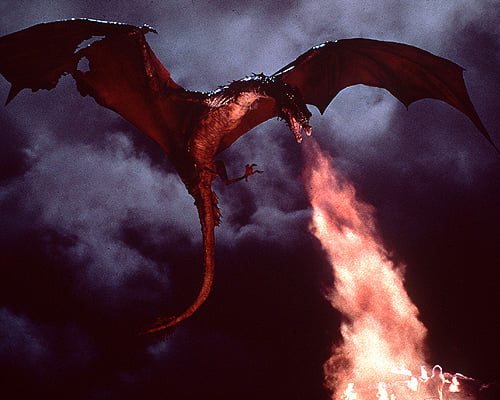
    Vermithrax Pejorative cares nothing for your cicadaphobia. This week on “Picture Perfect,” there be dragons!

    Who doesn’t enjoy a good dragon movie? Unfortunately, there are so few of them. Inevitably, the stories fail to live up to the production design, the special effects, and, yes, often the music.

    One score that Universal Pictures definitely took to, like a dragon to its hoard, was that for “Dragonheart” (1996). The film starred Dennis Quaid, with Sean Connery supplying the voice of the film’s dragon, Draco. The studio loved the music so much that it was used in its movie trailers for years, so don’t be surprised if you recognize it, even if you never saw the film. The composer was Randy Edelman.

    Alex North wrote one of the finest dragon scores for “Dragonslayer” (1981). “Dragonslayer” caused a bit of stir on its release, since it was an early foray by Disney into more mature territory. The film featured shocking (for the time) onscreen immolations and dismemberment.

    The story is a fairly generic sorcerer’s apprentice tale. However, the dragon, Vermithrax Pejorative, easily carries the movie, which also features a late performance by Sir Ralph Richardson as the master sorcerer. The composer reused portions of his rejected score for Stanley Kubrick’s “2001: A Space Odyssey.” A number of critics, including Pauline Kael, praised the result.

    The film was nominated for an Academy Award for its outstanding visual effects, but lost out to “Raiders of the Lost Ark.” George Lucas’ Industrial Light and Magic provided the effects for both films. In my humble assessment, Phil Tippett’s “go motion” dragon has yet to be surpassed.

    Many years later, Disney competitor Dreamworks released “How to Train Your Dragon” (2010), a wholly computer-animated film. The story is one of forbidden friendship between a young Viking and a scaly representative of his tribe’s hereditary foes. Despite the Viking characters and setting, the score has an overt Celtic flavor and the actors speak with a Scottish burr (!). The music was by John Powell.

    Purely animated films are often more successful in creating an organic, believable world than those supposedly “live action” films that place actors in front of green screens and surround them with video game pyrotechnics. Only director Peter Jackson could have devised a way to pad J.R.R. Tolkien’s classic bedtime story, “The Hobbit,” into three bloated installments, darkening the tone, tying it in with lore from Tolkien’s “The Silmarillion,” and self-consciously anticipating the events in the equally self-indulgent film versions of “The Lord of the Rings.”

    Howard Shore supplied the music for all of the Middle Earth movies. He was recognized with three Academy Awards – one for “The Fellowship of the Ring,” in 2001, and two for “The Return of the King” in 2003, for which he also provided the Best Original Song. We’ll hear a selection of his music for the second of the films inspired by “The Hobbit,” subtitled “The Desolation of Smaug” (2013). The part of the dragon, by the way, was voiced by Benedict Cumberbatch.

    Feel the burn! Fire your imagination and rekindle your affection for dragons, on “Picture Perfect,” music for the movies, this Saturday evening at 6:00 EDT, on WWFM – The Classical Network and wwfm.org.

  • Conan’s Musical Might 80s Film Scores

    Conan’s Musical Might 80s Film Scores

    In the film “Conan the Destroyer” (1984), one of Conan’s companions speculates, “I suppose nothing hurts you.”

    To which Conan responds, philosophically, “Only pain.”

    Discriminating viewers may feel a little pain themselves, watching these silly, cheesy, violent films, all of which were inspired by the writings of pulp master Robert E. Howard. Howard created the warrior Conan in 1932. The character became the center of a series of lucrative stories first published in “Weird Tales” magazine.

    It would be a half century before Conan made the leap to the big screen, under the direction of John Milius. “Conan the Barbarian” (1982) propelled Arnold Schwarzenegger, already a legend in the field of bodybuilding, to international superstardom. While “Conan” isn’t exactly “Citizen Kane,” it does have its pleasures. The intensity of the violence can be a little disturbing, but the ponderous tone is a blast. “Conan” is a film that takes itself just seriously enough to make it occasionally hilarious.

    Another thing “Conan” has going for it is the fact that it was made on a blockbuster budget. The first-rate production values extend to the music by Basil Poledouris, who employs a full symphony orchestra to impressive ends. In fact, the “Conan” score was one of the strongest of the decade. It’s amazing that anyone would find so much inspiration in such a mediocre film, but Poledouris’ music intersperses Borodin-style Central Asia lyricism with brawny, thrilling action music.

    Sadly, the sequel, “Conan the Destroyer,” betrays signs of penny-pinching, so that it often winds up feeling like a direct-to-video effort. Poledouris was forced to make do with a smaller orchestra, which sounds a bit too much like a television ensemble. Still, he gave it his all, and there’s something to be said for the fact that it is an original score, rather than a mere retread of the original.

    Another one of Howard’s creations, Kull of Atlantis, was given the big screen treatment as “Kull the Conqueror” (1997). Kevin Sorbo, TV’s Hercules, plays the title role. The composer, Joel Goldsmith (son of Jerry Goldsmith), was asked to incorporate heavy metal riffs into his orchestral underscore. I haven’t actually seen this one, but for some reason I don’t feel like I’m missing anything.

    The astoundingly prolific Ennio Morricone – with more than 500 motion picture and television scores to his name – had an uncanny knack for spinning garbage into gold. His music for “Red Sonja” (1985) lends the film an aura of ‘80s cheese ball fun, perhaps more so than it deserves. This is the film that introduced Brigitte Nielsen as the chain-mailed barbarian beauty. Schwarzenegger appears in the supporting role of Lord Kalidor.

    In the ‘80s, even bad films had great scores. I hope you’ll give “Conan the Barbarian” a shot this week, on “Picture Perfect,” music for movies, this Saturday evening at 6:00 EDT, on WWFM – The Classical Network and wwfm.org!

  • Restoration Cinema Beauty Patches and Film Scores

    Restoration Cinema Beauty Patches and Film Scores

    Beauty patches are back!

    This week on “Picture Perfect,” it’s an hour of lace and licentiousness, with music from movies set during the reign of Charles II.

    “Restoration” (1995) features quite the cast, with a pre-“Iron Man” Robert Downey, Jr. as a young doctor torn between duty and debauchery. He succumbs to the latter at the court of Charles, played by Sam Neill, before finding redemption as he battles the Great Plague and braves the Fire of London. The film also stars David Thewlis, Polly Walker, Meg Ryan, Ian McKellen, and Hugh Grant.

    The main title of James Newtown Howard’s score takes its impetus from Henry Purcell’s “The Fairy Queen.” And indeed there are baroque inflections throughout.

    George Sanders plays Charles in “The King’s Thief” (1955). Edmund Purdom is a highwayman who pilfers an incriminating book from David Niven. An aristocratic schemer, Niven will stop at nothing to get it back. The swashbuckling score is by Miklós Rózsa.

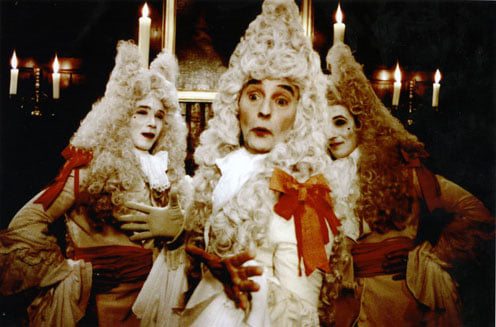
    I don’t recall Charles making an appearance in “The Draughtsman’s Contract” (1982), Peter Greenaway’s saucy, though strangely aloof, Restoration opus. However, there is plenty of licentiousness and an abundance of outlandish wigs. And, it being a Greenaway film, it is certainly strange in more ways than one. Michael Nyman’s score puts a minimalist spin on baroque sources.

    Finally, “Forever Amber” (1947) is based on a then-scandalous novel by Kathleen Winsor, about an ambitious young woman’s rise through the bedchambers of the Royal Court. The film was directed by Otto Preminger. Linda Darnell is Amber. Once again, George Sanders plays Charles, eight years before reprising the role for “The King’s Thief.” Cornel Wilde, Richard Greene, and Jessica Tandy are also in the cast. Philadelphia-born composer David Raksin, he of “Laura” fame, plays fast and loose with music of the era.

    Bwoo-hoo-hoo-hoo! It’s so naughty! Everyone, giggle into your handkerchiefs and wear ribbons on your shoes. We’ll be powdering our faces and going heavy on the rouge, on “Picture Perfect,” music for the movies, this Saturday evening at 6:00 EDT, on WWFM – The Classical Network and wwfm.org.
  • Faith & Film Scores: Black Robe to The Mission

    Faith & Film Scores: Black Robe to The Mission

    This week on “Picture Perfect,” in this season of wall-to-wall Biblical epics, enjoy a bit of counterprogramming in the form of music from films about faith, conscience, and grappling with self-abnegation.

    Bruce Bereford’s “Black Robe” (1991), based on a novel by Irish-Canadian writer Brian Moore, tells the tale of a Jesuit priest who treks through 1500 miles of Canadian wilderness on a mission to convert the native tribes of the Huron and the Algonquin. The evocative score is by Georges Delerue.

    “Black Narcissus” (1947), a Powell-Pressburger classic, is one of those startling films that just sort of sneaks up on you. Psychological tension abounds in a tale of repressed nuns struggling to maintain their composure in a voluptuous Himalayan valley. Eventually, the wheels begin to spin off the tracks, to spinetingling effect. The stunning cinematography is by Jack Cardiff. Incredibly, the entire film was shot in England, mostly on soundstages at Pinewood Studios. The music is by Brian Easdale, of “The Red Shoes” fame.

    Audrey Hepburn gave one of her most impressive performances in Fred Zinnemann’s “The Nun’s Story” (1959). A young woman enters a convent of sister-nurses and undergoes many trials in the hopes of becoming a missionary in the Belgian Congo. The film also features Peter Finch, Edith Evans, Peggy Ashcroft, and, in a memorable early role, an unhinged Colleen Dewhurst. The music is by Franz Waxman.

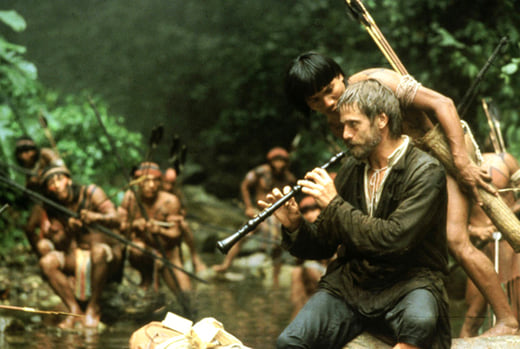
    Finally, Ennio Morricone composed on of his most-beloved scores for “The Mission” (1986). Jeremy Irons plays a Jesuit priest, who ventures into the South American rainforest to convert the Guarani to Christianity. Robert DeNiro is a reformed slave hunter, who seeks redemption. The moving music has received a great deal of exposure over the years through its use in television commercials and by figure skaters, who have made “Gabriel’s Oboe” a recognizable hit.

    Join me in seeking grace in an imperfect world, with music from films about nuns and missionaries this week, on “Picture Perfect,” music for the movies, this Saturday evening at 6:00 EDT, on WWFM – The Classical Network and wwfm.org.
  • Ides of March Rome on Film

    Ides of March Rome on Film

    Beware the Ides of March!

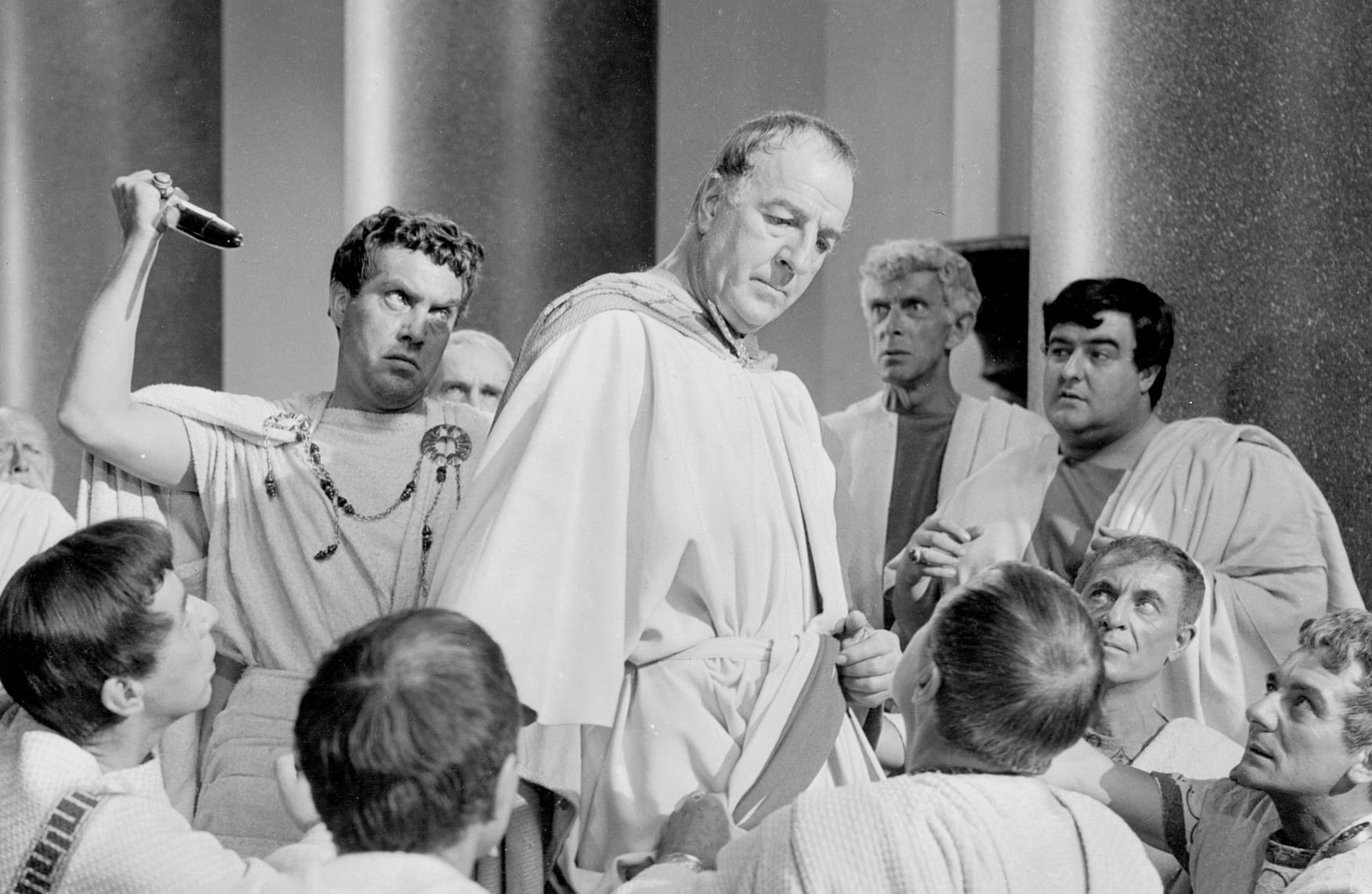
    March 15th is a day that has lived in infamy and superstition, ever since the murder of Julius Caesar in 44 B.C. After declaring himself Dictator for Life, Caesar was set upon by members of the Roman Senate and stabbed 23 times.

    This week on “Picture Perfect,” toga is the dressing of choice for a Caesar salad of films set in Ancient Rome.

    We’ll begin with Joseph L. Mankiewicz’s adaptation of Shakespeare’s “Julius Caesar” (1953). A two-time double Oscar winner, Mankiewicz – who won back-to-back Academy Awards for writing and directing “A Letter to Three Wives” in 1949 and “All About Eve” in 1950 – wrote and directed this big screen version of the Bard’s historical drama, which was produced by John Houseman, and features an all-star cast, including Marlon Brando as Mark Antony, James Mason as Brutus, John Gielgud as Cassius, and Louis Calhern as Caesar.

    The music is by MGM’s go-to composer for spectacles of this sort, Miklós Rózsa, who had earlier provided the score for “Quo Vadis,” and would go on to win his third Academy Award for “Ben-Hur.”

    Ten years later, Mankiewicz would return to Rome, at least in part, for “Cleopatra” (1963), though it was a decision he would come to rue. For budgetary and interpersonal reasons, “Cleopatra” became a nightmarish experience for practically everyone involved. Although a box office success – the year’s highest grossing release – the film achieved the dubious distinction of becoming the most expensive ever made. Its massive cost overruns and production woes nearly bankrupted 20th Century Fox.

    “Cleopatra” stars Elizabeth Taylor and Richard Burton, whose scandalous, extra-marital romance caught fire during the making of the film. Despite the behind-the-scenes drama, both film and score were nominated for Academy Awards, as was Rex Harrison for Best Actor, in the role of Julius Caesar.

    Alex North, who had written the highly-regarded music for “Spartacus” three years earlier, follows up on his success with another one of his finest scores.

    By contrast, the Pax Romana was an era of relative peace and stability. It spanned two centuries, from the reign of Augustus Caesar to the death of Marcus Aurelius. The movies would have us believe that Marcus was the victim of foul play, murdered by his son Commodus. Hollywood never did let history get in the way of a good story!

    Joaquin Phoenix plays Commodus in “Gladiator” (2000), something of a missed opportunity, with a dream cast, including Russell Crowe, Richard Harris, Derek Jacobi, and Oliver Reed. Alas, it gave most of its over-qualified supporting players very little to do.

    More damningly, the visual storytelling was marred by the over-use of shaky handheld cameras and an over-reliance on computer generated imagery, supplanting the traditional – though likely prohibitive – lavish sets and cast-of-thousands. Even so, the film was honored with five Academy Awards, including that for Best Picture.

    One of those Oscars went to Hans Zimmer for his score, though the music is not without controversy. As is often the case with this composer, Zimmer was heavily assisted by a lot of under-credited hands, who appear in fine print in the soundtrack’s CD booklet. Also, one of the battle scenes adheres so closely to “Mars, the Bringer of War” that Zimmer was actually sued by the Holst Foundation. That said, the score was tremendously popular, and the soundtrack remains one of the best-selling of all time.

    One of my biggest beefs with “Gladiator” is that, although never acknowledged as a remake, it essentially lifts most of its plot from “The Fall of the Roman Empire” (1964). Anthony Mann directed the old school sword-and-sandal epic, which stars Sophia Loren, Stephen Boyd, Alec Guinness, and James Mason. On this occasion, Christopher Plummer plays mad Commodus.

    The grandiose score is by Dimitri Tiomkin, who conducted a 110 piece orchestra, made up of (as advertised) “England’s finest musicians.” Only Tiomkin, a pupil of Alexander Glazunov, would include balalaikas in a score about Ancient Rome.

    Watch your back! Rome wasn’t built in a day. It falls in an hour this week, on “Picture Perfect,” music for the movies, this Saturday evening at 6:00 EST, on WWFM – The Classical Network and wwfm.org.

Tag Cloud

Aaron Copland (92) Beethoven (95) Composer (114) Film Music (123) Film Score (143) Film Scores (255) Halloween (94) John Williams (187) KWAX (229) Leonard Bernstein (101) Marlboro Music Festival (125) Movie Music (138) Opera (202) Philadelphia Orchestra (89) Picture Perfect (174) Princeton Symphony Orchestra (106) Radio (87) Ralph Vaughan Williams (85) Ross Amico (244) Roy's Tie-Dye Sci-Fi Corner (290) The Classical Network (101) The Lost Chord (268) Vaughan Williams (103) WPRB (396) WWFM (881)

DON’T MISS A BEAT

Receive a weekly digest every Sunday at noon by signing up here


RECENT POSTS