Tag: Film Scores

  • 80s Sword Sandal Film Scores

    80s Sword Sandal Film Scores

    “…To crush your enemies… to see them driven before you… and to hear the lamentations of their women!”

    Leave it to me to wait until the heat wave dissipates to program music from movies featuring lots of men without shirts. This week on “Picture Perfect,” we venture very far from Turner Classic Movies territory with an hour of guilty pleasures, as we listen to music from sword and sandal flicks from the 1980s.

    These include “The Beastmaster” (1982), a film that was once so pervasive on cable that comedian Dennis Miller branded HBO as “Hey, Beastmaster’s On!” and TBS was known in some circles as “The Beastmaster Station.” I still haven’t seen it, believe it or not, but I know it has something to do with swords, sandals, two ferrets, and Tanya Roberts.

    The music by Lee Holdridge is given the royal treatment, in a performance conducted by Charles Gerhardt, of RCA’s legendary “Classic Film Scores” series, on an album produced by George Korngold (son of Erich Wolfgang Korngold).

    To prove that I have no reason to lie to you about not having seen “The Beastmaster,” I enthusiastically own up to the fact that, as a 15 year-old, I totally lapped up “The Sword and the Sorcerer” (1982). And since I still love everything now that I did when I was 15, you can draw your own conclusions.

    A pre-“Matt Houston” Lee Horsley stars as Talon, a mercenary-warrior of royal blood, who wields an improbable sword with three blades that can be projected by unexplained means like lethal rockets. There’s also a hideous wizard played by Richard Moll, who went on to play Bull on television’s “Night Court,” king of the B-movie villains Richard Lynch, and George Maharis.

    This is the best example I can think of of a really trashy movie with a fantastic score. Revisiting the music for “The Sword and the Sorcerer” merely affirms what I’ve known for a long time – that 1982 was a kind of second Golden Age for film scores, when even the terrible movies had fabulous music. The first Golden Age, of course, was roughly 40 years earlier – though the movies were generally better.

    English composer David Whitaker, a veteran of 1970s Hammer Films, relates in the album’s liner notes that he wrote and orchestrated 75 minutes of music at white heat. The result sounds like one of the great scores of three or four decades earlier. If you like Korngold, John Williams, or Vaughan Williams, for that matter, definitely check this one out.

    “Clash of the Titans” (1981) had a much more distinguished pedigree. It was the last film of stop-motion special effects genius Ray Harryhausen before his retirement. Harryhausen was responsible in large part for such classic films as “Mighty Joe Young,” “It Came from Beneath the Sea,” “Earth Versus the Flying Saucers,” “Jason and the Argonauts,” and any number of Sinbad movies.

    The supporting cast employed Sir Laurence Olivier as Zeus, Claire Bloom as Hera, Maggie Smith as Thetis, and Ursula Andress as Aphrodite, alongside Burgess Meredith and Flora Robson in her final film appearance. It was also the film which introduced Harry Hamlin, as Perseus. Hamlin went on to success on television’s “L.A. Law.”

    Laurence Rosenthal, who studied at the Eastman School and with Nadia Boulanger in Paris, wrote the score. Rosenthal was responsible for the music for, among others, “A Raisin in the Sun,” “The Miracle Worker,” and “Becket.” This one actually does turn up on TCM from time to time.

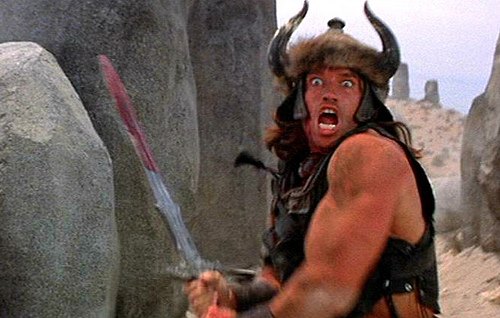
    While “The Clash of the Titans” was an end of an era of sorts, the success of “Conan the Barbarian” (1982) sparked a sword and sandal resurgence. Of course, most of the imitators it spawned were low-budget affairs that nobody ever saw. “Conan” proved a high water mark of its kind. It also made Arnold Schwarzenegger one of the biggest stars in Hollywood.

    It sports unquestionably the best-loved score of its composer, Basil Poledouris. The music is regarded in soundtrack collector’s circles as a classic. The original soundtrack was revived in a lavish 3-CD set on the Intrada label, featuring all the available music, with alternate takes.

    If this hour serves to illustrate anything, it’s that the overall quality of a film (or lack thereof) need not hinder a composer. At least back then. If you decide to stick with it, I think you’ll be pleasantly surprised.

    Release the Kraken! Then slip on your man-flops for an hour of ‘80s sword and sandal flicks, this Friday evening at 6:00 EDT, on WWFM – The Classical Network and wwfm.org.
  • Picaresque Novels on Film Rogues and Music

    Picaresque Novels on Film Rogues and Music

    Calling all rapscallions and scapegraces! This week on “Picture Perfect,” get ready to revel in some freewheeling lack of judgment, with an hour of films based on picaresque novels.

    In case you weren’t an English major, picaresque novels are generally characterized by having rogues or anti-heroes as protagonists, episodic, wayward structures, and, not infrequently, low humor.

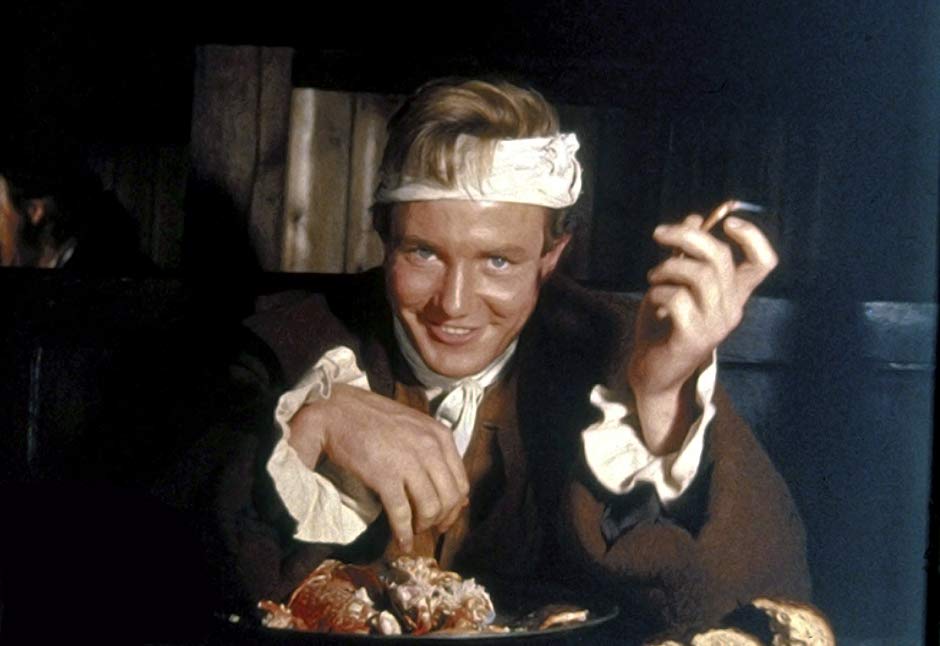
    We’ll hear music from “The Reivers,” after William Faulkner’s Pulitzer Prize-winning novel, a coming-of-age story about a boy swept into automobile theft and illicit horseracing in the American South. Mark Rydell directed the 1969 film, which starred Steve McQueen as the rakish Boon Hogganbeck and featured narration by Burgess Meredith. John Williams wrote the breezy Americana score.

    Mark Twain’s “The Adventures of Huckleberry Finn” is frequently characterized as an American picaresque. It’s certainly one of the funniest of “serious” books. A middling film adaptation was made in 1960, directed by Michael Curtiz, with Tony Randall given top billing, shifting the focus of the story to the con artistry of the King and the Duke. It features an evocative score by Jerome Moross.

    If Hervey Allen’s “Anthony Adverse” had any humor to begin with, it was definitely lost in translation. (Too bad the novel was written in English.) However, the 1936 screen adaptation certainly does sprawl. One could say it’s picaresque in the worst way. It just doesn’t go anywhere. It does, however, feature a top-notch cast (Frederic March, Olivia De Havilland, Claude Rains, etc.) and an Academy Award-winning score by Erich Wolfgang Korngold.

    While the modern picaresque novel had its roots in the Renaissance, the genre really seemed to hit its stride in the 18th century, with comic novelists like Henry Fielding. Fielding’s “Tom Jones,” perhaps the quintessential picaresque, was made into a film in 1963. It went on to win Academy Awards for Best Picture, Best Director (Tony Richardson), Best Adapted Screenplay (John Osborne) and Best Original Score (John Addison). Addison’s music suits Richardson’s quirky virtuosity like an off-kilter powdered wig.

    We’re up to no good, with an hour of picaresque adventures, this Friday evening at 6:00 EDT, on WWFM – The Classical Network and wwfm.org.
  • Lost Worlds Epic Film Scores Picture Perfect

    Lost Worlds Epic Film Scores Picture Perfect

    This week on “Picture Perfect,” prepare to get “lost.” We’ll have an hour of music from fantasy films set in lost worlds.

    In “King Kong” (1933), filmmaker and entrepreneur Carl Denham hires a ship to an uncharted island, known only from a secret map in his possession. There the crew discovers the titular gorilla and other outsized and should-be-extinct creatures. Kong is abducted from his natural habitat – and you know the rest. The composer, Max Steiner, pulls out all the stops. “Kong” was one of the first films to demonstrate how truly powerful an orchestral soundtrack could be.

    Then we travel to the earth’s core, courtesy of Jules Verne, and “Journey to the Center of the Earth” (1959). James Mason is the professor who leads the expedition. The film sports one of Bernard Herrmann’s most outlandish soundscapes, the orchestra consisting of winds, brass and percussion, but also cathedral organ, four electric organs, and an obsolete Renaissance instrument called the serpent. Watch out for that giant chameleon!

    “One Million Years B.C.” (1966) is a guilty pleasure if ever there was one. Produced by Hammer, the studio that gave us all those repugnant yet somehow delicious Peter Cushing-Christopher Lee horror team-ups, the film features special effects by the legendary Ray Harryhausen and an equally legendary fur bikini, worn by Raquel Welch. The music is by Mario Nascimbene, who wrote one of my favorite scores for Kirk Douglas, for “The Vikings.” We’ll be listening to the film’s climactic volcano sequence.

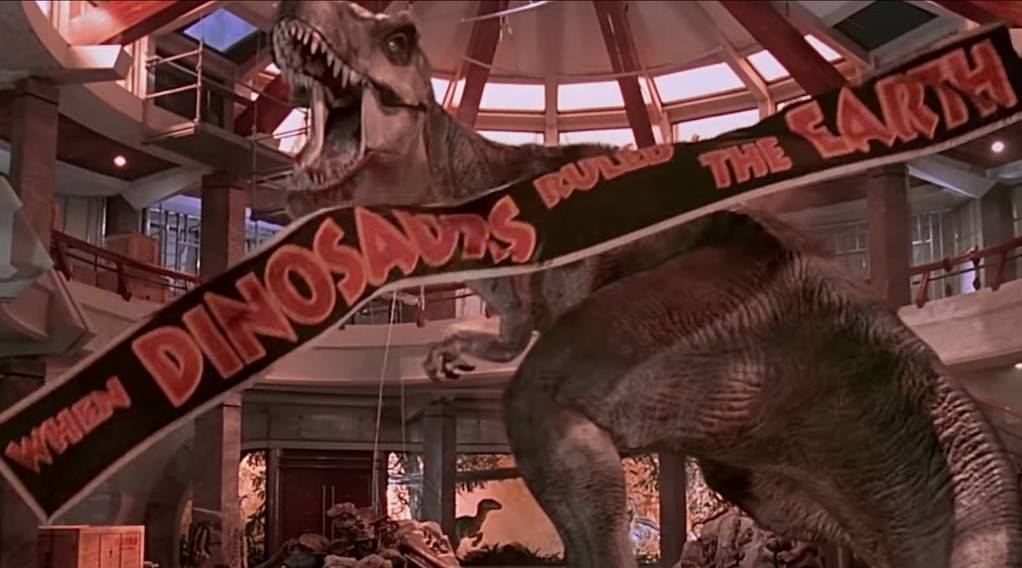
    As he did with the Indiana Jones films, director Steven Spielberg turned to B-movie source material for his visual inspiration for “Jurassic Park” (1993), based on the novel by Michael Crichton. The herky-jerky dinosaur effects of yore are replaced by state of the art computer-generated effects, in the story of a safari park on a remote island gone wrong.

    Sure, we’ve come a long way from Raquel Welch getting carried off by a pteranodon, but admit it, we all still want to see people fight dinosaurs. Instead of fudging history, now we can feel superior by fudging science. “Jurassic Park” plays on the most recent scientific thinking, with DNA extracted from mosquitoes trapped in amber, cloning, and the theory that dinosaurs were not lizards, after all, but rather birds. The music is by long-time Spielberg-collaborator, John Williams.

    I hope you’ll join me for music for these “Lands That Time Forgot,” this Friday evening at 6:00 EDT, on WWFM – The Classical Network and wwm.org.


    Did anyone else see this story about the 25-foot statue of Jeff Goldblum erected in London this week to celebrate 25 years of “Jurassic Park?”

    https://www.usatoday.com/story/life/entertainthis/2018/07/18/25-foot-statue-jeff-goldblum-london-celebrates-jurassic-park/796609002/

  • Jane Austen Film Scores: A Radio Playlist

    Jane Austen Film Scores: A Radio Playlist

    It is a truth universally acknowledged that a radio host in possession of a weekly film music show must be in want of a good theme. This week on “Picture Perfect,” we eschew the usual fare of Vikings, pirates and dinosaurs, to enter the world of Jane Austen.

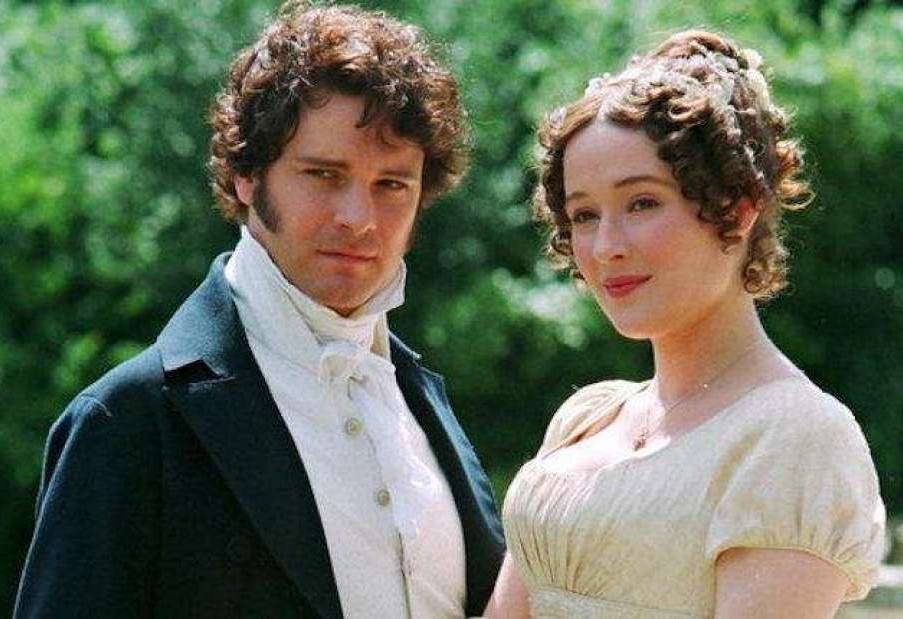
    We’ll hear Rachel Portman’s Academy Award winning score for “Emma” (1996), Patrick Doyle’s music for “Sense and Sensibility” (1995), and selections from two versions of “Pride and Prejudice,” with music by Carl Davis (1995) and Dario Marianelli (2005).

    Not only do Austen adaptations sport amazing casts, the scores attract some of classical music’s star performers. Listen in for contributions by soprano Jane Eaglen, pianist Jean-Yves Thibaudet, and fortepianist Melvyn Tan.

    A large income is the best recipe for happiness I ever heard of – at least according to “Mansfield Park.” The next best is a playlist assembled from Jane Austen movies. Join me this Friday evening at 6:00 EDT, on WWFM – The Classical Network and wwfm.org.

    Jane Austen
    Jane Austen Society of North America
    Jane Austen Society of North America – Eastern Pennsylvania Region

  • Rózsa Morricone South America Film Scores

    Rózsa Morricone South America Film Scores

    If you are a Miklós Rózsa fan, you’ll want to join me for this week’s “Picture Perfect,” as I dig deep into the archive for two contrasting scores to movies set in South America.

    Rózsa, who is probably best remembered for his work on Biblical and historical epics (he won his third Academy Award for “Ben Hur” in 1959) provides a lush symphonic tapestry for “Green Fire” (1954), starring Stewart Granger and Grace Kelly. Rózsa piles on the MGM gloss, for a conflict between love and lust for emeralds in the jungles of Colombia.

    Then we’ll hear perhaps Rózsa’s most unusual venture, “Crisis” (1950). “Crisis” starred Cary Grant and Jose Ferrer in the story of a brain surgeon who must weigh ethical considerations when faced with saving the life of a dictator who oppresses the people of an unnamed banana republic. Unusual for a composer who likes to swing for the fences, Rózsa set himself the limitations of writing for solo guitar.

    M-G-M must have felt it had scored a major coup when securing famed Brazilian composer Heitor Villa-Lobos to supply music for “Green Mansions” (1959). The big screen an adaptation of W.H. Hudson’s novel, set in the rainforests of southeastern Venezuela, starred Audrey Hepburn as Rima the Bird Girl. Unfortunately, the studio deemed what Villa-Lobos produced unusable, since the composer had begun writing based on his impressions of the novel, rather than wait for the completed film. M-G-M house composer Bronislau Kaper was brought in to salvage what he could.

    Finally, we’ll turn to one of Ennio Morricone’s best-loved scores – that for “The Mission” (1986). “The Mission” starred Jeremy Irons, as a Jesuit priest who penetrates the South American jungle to convert the native Guarani to Christianity, and Robert DeNiro, as a reformed slave hunter. The lovely and moving “Gabriel’s Oboe” became a recognizable hit, thanks in particular to its use by figure skaters and Aer Lingus.

    This is the score for which Morricone believed he should have won the Oscar.

    I hope you’ll join me for these South American adventures this week, on “Picture Perfect” – music for the movies – this Friday evening at 6:00 EDT, on WWFM – The Classical Network and wwfm.org.

Tag Cloud

Aaron Copland (92) Beethoven (95) Composer (114) Film Music (123) Film Score (143) Film Scores (255) Halloween (94) John Williams (187) KWAX (229) Leonard Bernstein (101) Marlboro Music Festival (125) Movie Music (138) Opera (202) Philadelphia Orchestra (89) Picture Perfect (174) Princeton Symphony Orchestra (106) Radio (87) Ralph Vaughan Williams (85) Ross Amico (244) Roy's Tie-Dye Sci-Fi Corner (290) The Classical Network (101) The Lost Chord (268) Vaughan Williams (103) WPRB (396) WWFM (881)

DON’T MISS A BEAT

Receive a weekly digest every Sunday at noon by signing up here


RECENT POSTS