“Picture Perfect” follows the English abroad this week, with music from “Enchanted April” (Richard Rodney Bennett), “A Passage to India” (Maurice Jarre), “The Best Exotic Marigold Hotel” (Thomas Newman) and “Around the World in 80 Days” (Victor Young).
Bennett, quite the accomplished concert composer (and occasional torch song singer), provides a sensitive score for the 1991 Merchant/Ivory adaptation of Elizabeth von Arnim’s novel about four English ladies who spend an idyllic month at an Italian villa.
Jarre received his third Academy Award for his music to David Lean’s final film, the 1984 adaptation of E.M. Forster’s novel of repression and racial tension in colonial India.
Newman incorporates traditional Indian elements into his score for “The Best Exotic Marigold Hotel,” the 2012 surprise hit about English pensioners reinventing themselves in their retirement abroad.
Young won his only Oscar (alas, posthumously bestowed) for “Around the World in 80 Days,” the star-studded, light-as-a-feather, though admittedly charming megawinner at the 1956 Academy Awards. It takes longer to watch the movie than it does to read Jules Verne’s novel – though it does provide a rare opportunity to see Ronald Colman in color.
The weekend’s coming, so pack your valise and join me for “Picture Perfect,” this Friday evening at 6:00 EDT, on WWFM – The Classical Network and wwfm.org.
March is Early Music Month. While the concept may seem quite remote from the world of film music, this week on “Picture Perfect,” we’ll endeavor to tie in with four scores that employ melodies and modes of the Middle Ages.
We’ll hear selections from “Becket” (1964), by Laurence Rosenthal. In the film, based on a play by Jean Anouilh, Richard Burton plays the Archbishop of Canterbury, and Peter O’Toole, King Henry II. The music is reliant on chant, with a quotation from the familiar Gregorian melody, “Dies Irae” (“Day of Wrath”), occurring fairly early in the action.
Then we’ll hear music from “The Hunchback of Notre Dame” (1939), by Alfred Newman. This time based on a novel – “Notre Dame de Paris,” by Victor Hugo – the film features Maureen O’Hara as Esmeralda and Charles Laughton as Quasimodo, with Cedric Hardwicke, Thomas Mitchell, Edmond O’Brien, and Harry Davenport in the supporting cast. The project was one of nine scored by Newman that year, which many historians regard as Hollywood’s finest. Again, the composer evokes the era through sacred choral passages and secular dances.
“The Warlord” (1965) starring Charlton Heston, Richard Boone and Rosemary Forsyth, is the tale a knight who falls in love with a peasant woman, and in order to keep her, claims his right of “droit du seigneur” – his prerogative to spend the first night with any new bride among his serfs. She falls in love with him, and all hell breaks loose.
It was an unusual project for the composer, Jerome Moross, who is best-known for the kind of breezy Americana sound employed in his best-known score, that for “The Big Country.” Here, he evokes the 11th century with an underscore that, again, takes its inspiration from authentic music of the era.
Finally, we’ll turn to “The Lion in Winter” (1965), adapted from a play by James Goldman, an historical drama set at the Christmas court of Henry II – again, as in “Becket,” played by Peter O’Toole. Henry spars with his estranged wife, the temporarily paroled Eleanor of Aquitaine (played by Katherine Hepburn), in a familial power struggle, which also involves their three sons, played by Anthony Hopkins, Timothy Dalton and Nigel Terry.
The film was the winner of three Academy Awards, including one for Best Original Score. The composer was John Barry. Yet again the music is steeped in that of the Middle Ages, yet given a distinctly modern edge.
I hope you’ll join me for these cinematic forays into Early Music, on “Picture Perfect,” this Friday evening at 6 EDT, on WWFM – The Classical Network and wwfm.org.
Early Music America
While you’re waiting, here’s the cast of SCTV in “The Man Who Would Be King of the Popes” – which employs music from “The Lion in Winter!”
PHOTOS: Peter O’Toole as dueling Henrys, in “Becket” (top, with Richard Burton) and “The Lion in Winter” (with Katharine Hepburn)
The best movie about King Arthur is probably “Excalibur.” We will NOT be hearing music from that movie.
The reason for this is that the soundtrack, while excellent, is made up mostly of pre-existing works by Wagner and Carl Orff. Granted, it is one of the better uses of classical music in film since “2001: A Space Odyssey.”
Barring that, this week on “Picture Perfect,” we’ll hear original music from movies inspired by the legends of King Arthur.
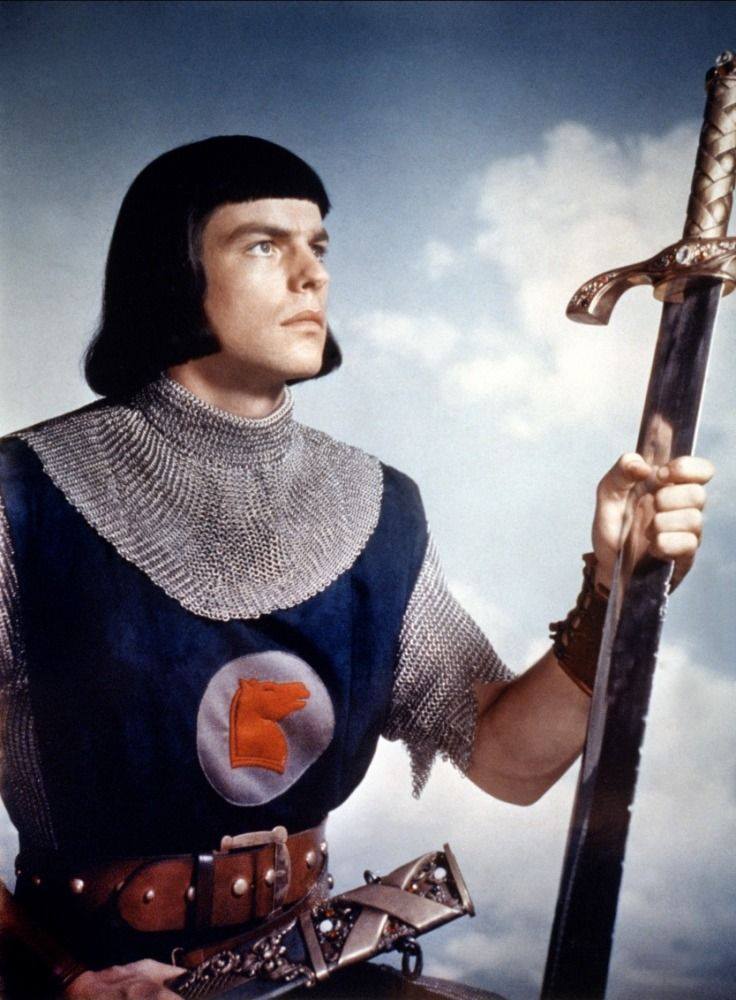
The legends provide so much grist for “Prince Valiant” (1954), based on Hal Foster’s enduring comic strip, set in the days of Arthur, though Val himself is a Viking prince of the kingdom of Scandia. Janet Leigh plays Princess Aleta, James Mason the villainous Sir Brack, Victor McLaglen Val’s Viking pal Boltar, and Sterling Hayden a preposterous Gawain. For the title role, Robert Wagner dons the signature page-boy haircut. The score, by Franz Waxman, is every bit as vivid as the film’s Technicolor, and a clear prototype for the thrilling, leitmotif-driven music of John Williams.
“The Mists of Avalon” (2001), adapted from Marion Zimmer Bradley’s novel, took the ingenious approach of retelling the Arthurian stories from the perspective of the often-marginalized female characters. The revisionist perspective breathed fresh life into the familiar tales, so that the book was greeted with critical and popular acclaim upon its release in 1983. A television miniseries, starring Julianna Margulies, Angelica Huston and Joan Allen, was produced for TNT, with music by Lee Holdridge.
“First Knight” (1995) featured the unlikely cast of Sean Connery as Arthur, Richard Gere as Lancelot, and Julia Ormond as Guinevere. The film is unique, to my knowledge, in being based on the writings of medieval French poet Chrétien de Troyes, as opposed to the more frequent source, Sir Thomas Malory.
The score was by Jerry Goldsmith. It was actually a bit of a rush job for Goldsmith, who stepped up at the very last minute to replace Maurice Jarre. Jarre had been approached to write music for what was originally a three-hour cut of the film. However, he only had four weeks to do so. Goldsmith, very well-known for his ability to write at white heat, was able to complete the score, and record the music in the allotted time.
“Knights of the Round Table” (1953) is like “Excalibur” without the gravitas and grit, with Robert Taylor as Lancelot, Ava Gardner as Guinevere, and Mel Ferrer as Arthur. As envisioned by MGM, it’s far too glossy and pat, though it does sport some satisfying 1950s spectacle and a fine score by Miklós Rózsa.
Join me, in the name of God, St. Michael and St. George, for music inspired by the legends of Arthur, on “Picture Perfect” – music for the movies – this Friday evening at 6:00 EST, on WWFM – The Classical Network and wwfm.org.
At 86 years-old and with one more “Star Wars” score to finish, John Williams is thinking about getting his affairs in order. It’s just been announced that Williams has bequeathed his complete library of film scores and concert music to Juilliard. At least now we won’t have to worry about them being consumed by the Pacific once California is hit by “The Big One.”
NEW YORK –– The Juilliard School announced today that it has received a bequest from Academy Award-winning composer and conductor John Williams of his complete library of concert music and film music scores as well as his sketchbooks. Mr. Williams, who studied piano with longtime Juilliard faculty member Rosina Lhévinne, announced the gift at a special alumni event held in Los Angeles at the Four Seasons Beverly Hills, where Mr. Williams was also presented with a President’s Medal by Juilliard President Joseph W. Polisi.
Acknowledging this gift, Juilliard President Joseph W. Polisi said, “We are deeply grateful to John for his extraordinary generosity in bequeathing Juilliard his extensive library of both concert and film scores. John has been a wonderful friend and colleague for many years. His artistry, creativity, and endless imagination make him one of the most admired and respected musicians of our time. His gift will be a unique resource for all of our musicians at the school, particularly composition students who can study first-hand John’s breadth and versatility as a composer.”
“Since my earliest days as a fledgling piano student, I have looked up to the Juilliard School as the Mecca for the study of music in our country and beyond,” Mr. Williams said. “It’s therefore a privilege for me to donate my sketches, papers, and scores to Juilliard, to be made available to those students particularly interested in the intimate processes of film scoring.“
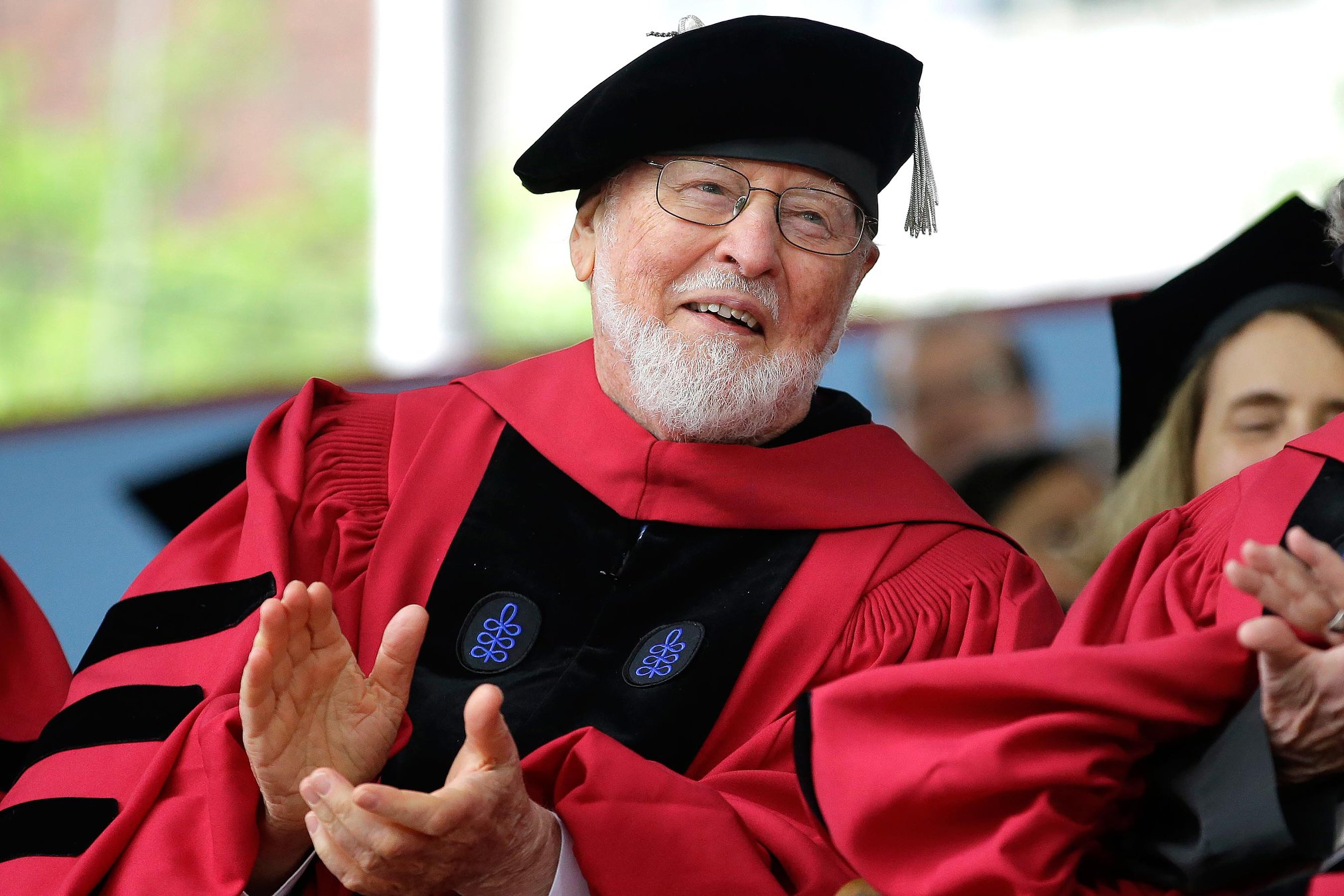
PHOTO: Williams receives an honorary doctorate from Harvard University. Sorry, guys, it’s all going to Juilliard…
Holy cow! One of my favorite movies is 80 years-old this year? Then again, that is SO me.
Join me this Sunday morning on WPRB, as we look back on Oscar history – WAY back.
We’ll hear a rare 1938 recording of selections from “The Adventures of Robin Hood,” by Erich Wolfgang Korngold, with Sir Guy of Gisborne himself, Basil Rathbone, the narrator, and Korngold conducting.
Sir Thomas Beecham will direct the Royal Philharmonic Orchestra in music by Brian Easdale, written for the 1948 Powell-Pressburger classic, “The Red Shoes.”
And virtually every major composer in Hollywood will come together at the Hollywood Bowl for a concert of now-classic film scores that was originally broadcast on CBS Television in 1963. The event is now looked back upon as “the greatest film music concert in history.” Participants included, among others, Alfred Newman (“How the West Was Won”), David Raksin (“Laura”), Alex North (“Cleopatra”), Johnny Green (“Raintree County”), Franz Waxman (“A Place in the Sun”), Bernard Herrmann (“North by Northwest”), Dimitri Tiomkin (“High Noon”), and Miklos Rozsa (“Ben-Hur”).
An album was released on LP, but understandably the three-hour concert was severely truncated. This was somewhat remedied on a CD-reissue, that included 70 minutes of music. Among the casualties, however, was Elmer Bernstein conducting the theme to “The Magnificent Seven.” We’ll restore that cut when we hear the concert this morning.
Also in the audience was Max Steiner, whose music for “A Summer Place” and “Gone with the Wind” were on the program. “Gone with the Wind” didn’t make the album, but we will more than remedy the exclusion with an extended suite conducted by Steiner himself.
Collectively, these composers earned over sixty Academy Awards and over 300 Oscar nominations.
I hope you’ll travel back with me to a time when Oscar really was gold, this Sunday morning from 7 to 10 EST, on WPRB 103.3 FM and wprb.com. Scores will be settled, on Classic Ross Amico.
More about the legendary “Music in Hollywood” concert here: