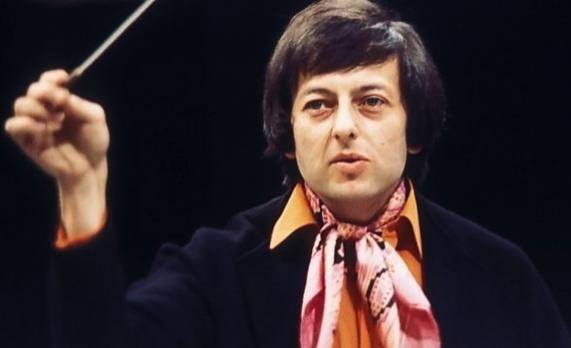
Before André Previn became an acclaimed conductor of symphonies, he stood before some of the greatest sight-readers in the world, who made up the Hollywood studios’ crackerjack orchestras. From Lassie to “My Fair Lady” to “Rollerball,” Previn worked on over 50 films.
He was nominated for 11 Academy Awards, and won four – in 1958, 1959, 1963 and 1964. He is one of the few composers to be recognized with back-to-back Oscars, and only one of two to have been so twice.
This week on “Picture Perfect,” we’ll focus on this comparatively neglected aspect of a supremely talented musical polymath, through selections from his scores to “The Four Horsemen of the Apocalypse,” “Irma la Douce,” “Dead Ringer,” and “Elmer Gantry.”
Previn’s Hollywood career began when he was still in high school, as he was brought in by his great uncle, Charles Previn, one-time music director for Universal Studios, to transcribe jazz improvisations for José Iturbi. Soon young André was writing and recording his own scores. His first official screen credit was for “The Sun Comes Up,” an entry in the Lassie series, in 1949. The same year, he scored “Challenge to Lassie.”
He went on to compose music for “Kim,” “Bad Day at Black Rock,” “The Fastest Gun Alive,” “Designing Woman,” “The Subterraneans,” “Long Day’s Journey into Night,” and “Inside Daisy Clover,” among others. He won Oscars for his work on “Gigi,” “Porgy and Bess,” “Irma la Douce,” and “My Fair Lady.”
I hope you’ll join me for André Previn at the movies, this Friday evening at 6:00 EST, on WWFM – The Classical Network and wwfm.org.
PLEASE NOTE: Of perhaps related interest, I’ll be sharing an hour of Previn’s concert works on “The Lost Chord,” this Sunday night at 10:00 EDT.
Regardless of what the Academy would have us believe, the notorious Best Picture snafu of 2017 was not the first time such a mix-up occurred. Here’s an earlier episode that momentarily delayed Previn from collecting his third Oscar, well-fielded by Sammy Davis, Jr.
Note the other nominees in both categories and weep over just how far civilization has declined in the past 50 years.
PHOTO (left to right): André Previn, Sammy Davis, and Elmer Bernstein
It’s been impressive and heartwarming to observe the outpouring of affection for André Previn the past couple of days. Previn, of course, died on Thursday at the age of 89.
A fabulous and frequently stunning musician, he was not only a top conductor, but also a fine pianist – fluent in both the classical and jazz worlds – a talented composer, totally without pretense, a crackerjack writer of film scores and musical arrangements, an author, an entertaining raconteur, and a sly wit. He was a true Renaissance man, like Leonard Bernstein, though he tended to play his cards a little closer to the vest. His love life could be a little over the top – he was married five times – and who knows, if he had come up in the age of Twitter, maybe he would have taken more of a beating.
Previn never achieved the level of public adulation that Lenny did, which is why the tsunami of love from all quarters kind of comes as a surprise to me. A pleasant surprise, granted. Criticisms of some of his musical performances were akin to damning with faint praise. On the other hand, when he was on, he was really on. The man could conduct the tar out of Rachmaninoff, Vaughan Williams, Prokofiev, Shostakovich, and William Walton, and he could surprise in his easy mastery of composers such as Richard Strauss.
I was lucky enough to see him conduct live twice. In 1995, he led a luminous performance of Vaughan Williams’ Symphony No. 5, with the Curtis Symphony Orchestra, which he recorded with the ensemble shortly thereafter. As is generally the case – Curtis is one of the top conservatories in the world – the students played like gods.
Later, I saw him lead the Philadelphia Orchestra, in 2009. On the program was Mozart’s Piano Concerto No. 24 and Strauss’ “Symphonia Domestica.” It was a shock to realize at that point that Previn was 80, and it was with concern that I watched as he stepped with evident care onto the stage, as if he were living the famous Danny Kaye routine. It was painful to see, and one of those instances where you wonder if the conductor is even going to make it to the podium.
The Mozart may not have been transcendent, but it was still a joy to hear him play (he conducted from the keyboard), even if some of the facility was diminished; but the Strauss, which he conducted from a chair, was as assured as it had been when he made his knock-out recordings of the complete tone poems with the Vienna Philharmonic.
I was also fortunate enough to interact with him twice. The first time was wholly by chance. It was in the early ‘90s, a day like any other day, and I walked out of my apartment building in Philadelphia to encounter André Previn passing on the street. Startled, I said the first thing that popped into my head – which was, I am embarrassed to report, “Maestro! Good to see you!” To which he replied with a wry smile, “Good to see you, too.”
It was on 18th Street, below Spruce. He was heading south into a residential neighborhood, where he must have been staying, because at the time there was nothing else in that direction. Of course, I lived a block and half from the Curtis Institute.
The second time was an actual conversation, in which we got to talk music. It was in the late ‘90s or early 2000s, and Previn was engaged in recording a couple of Korngold albums. I know it was after he did the symphony, but it may have been before he recorded the film scores, both for Deutsche Grammophon. He remarked that he would love to record the complete “Die tote Stadt” with Renée Fleming, but it was a matter of getting their schedules to mesh. Can you imagine? Unfortunately, it never came to pass. I also asked him why he didn’t include the overture in his otherwise fine recording of Korngold’s “Much Ado About Nothing.” His answer, again with that smile: “I didn’t know there was an overture!”
Because of the timing of his death, it’s been hard to engineer a proper tribute, but I will be working Previn’s recordings into my air shifts over the coming week. So you’ll have a good chance of encountering his artistry if you tune in on Monday from 4 to 7 p.m., Tuesday from 1 to 4 p.m., and Wednesday from 4 to 6 p.m. In fact, I am planning to make the playlist on Tuesday all-Previn, encompassing his talents as conductor, pianist, and composer.
On Friday at 6 p.m., “Picture Perfect” will focus on his work in the film industry. He was involved with 50 movies, and on top of everything else won four Oscars.
Then next Sunday night, February 10, on “The Lost Chord,” I’ll present an hour of his original concert music, at 10 p.m.
All times are EST, and all shows can be heard on WWFM – The Classical Network and at wwfm.org.
Finally, Patrick Jonathan reminded me of this classic Morecambe and Wise sketch with “Mr. Preview” conducting the Grieg Piano Concerto. As an American, it is my only exposure to Morecambe and Wise, but it has the reputation of being the ne plus ultra of the team’s career.
This week on “Picture Perfect,” we’ll take a nostalgic journey down Memory Lane with Michel Legrand.
Legrand died on January 26 at the age of 86. The recipient of three Academy Awards (he was nominated for 13) and five Grammys, Legrand wrote music that tugs at the heart even as it lifts the soul.
We’ll honor this multifaceted musician with indelible selections from a handful of his over 200 film and television scores, including “Summer of ’42,” “The Picasso Summer,” “The Go-Between,” “Yentl,” “The Thomas Crown Affair,” and “The Umbrellas of Cherbourg.”
Le Grand, indeed! Join me in remembering Michel Legrand, on “Picture Perfect,” music for the movies, this Friday evening at 6:00 EST, on WWFM – The Classical Network and wwfm.org.
How many times have you felt like dropping everything, heading to the Mountain in search of peace and clarity, and returning to the world cleansed? If only it were that simple. The path to salvation is narrow and as difficult to walk as the razor’s edge.
This week on “Picture Perfect,” we journey through the awe-inspiring landscapes of India and Tibet, even as we feel our way to the inner realms of spirit and psyche, with an hour of Himalayan adventures.
The Himalayas, in film, have frequently been the source of enlightenment; though occasionally their overwhelming influence has also led to madness. Intriguingly the latter is the case in the Powell-Pressburger classic, “Black Narcissus” (1947). Psychological and emotional tensions abound in this tale of repressed nuns struggling to maintain their composure in a voluptuous Himalayan valley.
The stunning cinematography was by Jack Cardiff, and Brian Easdale (of “The Red Shoes” fame) wrote the music. Incredibly, the entire film was shot in England, mostly at Pinewood Studios. From a purely visual standpoint, “Black Narcissus” must be one of the most beautiful films ever made. It’s also one of the craziest, with unlikely object-of-desire Mr. Dean driving the sisters to the brink.
The Himalayas also form the backdrop to “Seven Years in Tibet” (1997), based on a memoir of Austrian mountaineer Heinrich Harrer. Harrer escapes from a British internment camp in India during the Second World War. He travels across Tibet to its capital, Lhasa, where he eventually becomes the tutor of the 14th Dalai Lama. In the film, Brad Pitt plays Harrer. John Williams wrote the music, and Yo-Yo Ma performs the cello solos.
“The Razor’s Edge” (1946) tells the story of a traumatized World War I veteran, who sets off in search of some kind of transcendent meaning to his existence. He finds it in India, at a Himalayan monastery. The 1946 adaptation of W. Somerset Maugham’s novel (which he claimed was thinly-veiled fact) features Tyrone Power, Gene Tierney, and Ann Baxter. The music is by Alfred Newman, who will conduct a selection from his score.
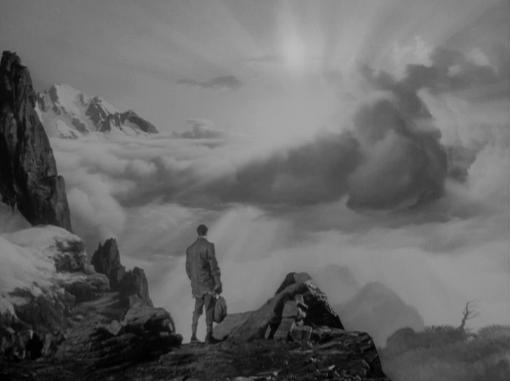
Finally, we’ll hear a suite from the Frank Capra classic, “Lost Horizon” (1937). Based on the book by James Hilton, the film stars Ronald Colman, with a great supporting cast, including Jane Wyatt, Thomas Mitchell, Edward Everett Horton, H.B. Warner and Sam Jaffe. The novel, and the film, brought the term “Shangri-La” into popular usage, a Utopian paradise hidden in a secluded Himalayan valley, a place of ageless beauty and serenity.
“Lost Horizon” provided composer Dimitri Tiomkin (a pupil of Alexander Glazunov) with his first major project. The result is one of his most colorful scores. The recording is one of the gems of RCA’s Classic Film Scores series, originally issued in the early 1970s. Made in the presence of the composer, it features 157 performers, with the chorus standing on a platform behind the conductor (Charles Gerhardt), and the various percussionists positioned in the encircling balcony.
I can’t guarantee that you’ll find enlightenment, but there will be plenty to awe and inspire in these Himalayan adventures, on “Picture Perfect,” music for the movies, this Friday evening at 6:00 EST, on WWFM – The Classical Network and wwfm.org.
2018 marks the 150th anniversary of the publication of “Little Women.” Among the many enduring charms of Louisa May Alcott’s magnum opus is a memorable Christmas chapter, in which the women of the March family help out a neighbor in need by donating their Christmas breakfast – only to be rewarded later in the day with a feast of their own.
This week on “Picture Perfect,” we’ll have music from movies based on literary classics for little women. Of course readers of either gender have enjoyed these books, but with female protagonists and female authors, they have proved great favorites among generations of female readers. All of them have been adapted for film numerous times.
We’ll hear selections from a 1993 version of “The Secret Garden.” Frances Hodgson Burnett’s 1911 novel tells of an ill-tempered child who loses her neglectful parents in India, only to blossom at the discovery of the titular garden on her uncle’s otherwise gloomy estate on the Yorkshire moors. Agnieszka Holland directed. The film was released through Francis Ford Coppola’s independent studio, American Zoetrope. Zbigniew Preisner provided the music.
Another popular novel by the same author, from 1905, is “A Little Princess.” Alfonso Cuarón directed his adaptation in 1995. In Cuarón’s version, a well-bred English girl, again brought up in India, is placed in a boarding school in New York. Her fortunes change when her father goes missing in action during World War I. The girl entertains her fellow students by reciting tales from the Hindu epic, “The Ramayana.” Her Indian connection is reflected in Patrick Doyle’s score.
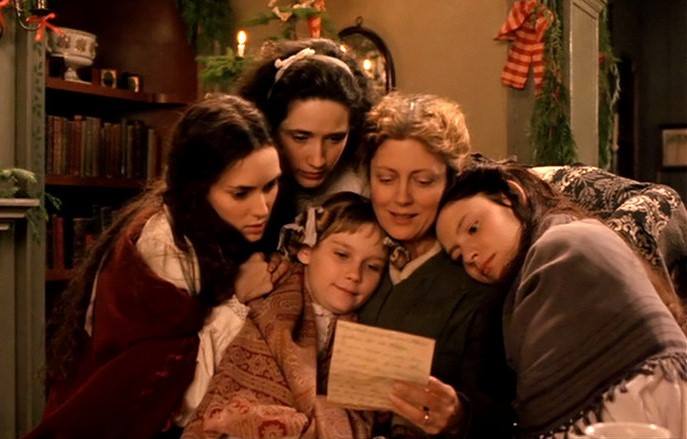
“Little Women” follows the lives of four sisters of the March family, as they pass from childhood to adulthood in Concord, Massachusetts, during and after the American Civil War. A sensation on its publication in 1868, the book remains one of the most beloved of all time. In 1994, it received its fifth adaptation for the big screen, with Winona Ryder as Jo and Susan Sarandon as Marmee. Thomas Newman, one of the sons of famed film composer Alfred Newman and a cousin of Randy Newman, wrote the music.
Finally, “Heidi,” by the Swiss writer Johanna Spyri, recounts the events in the life of a young girl who shares a home with her grandfather in the Swiss Alps. There have been roughly 20 film or television productions of “Heidi” to date. This one, from 1968, starred Jennifer Edwards, daughter of Blake Edwards and stepdaughter of Julie Andrews. Maximilian Schell, Jean Simmons and Michael Redgrave were in the supporting cast. The music was written by an up-and-coming composer then known as “Johnny” Williams. And there’s plenty in the score to indicate great things to come.
Make “Picture Perfect” your secret garden, with music from film adaptations of girl’s literary classics, this Friday evening at 6:00 EST, on WWFM – The Classical Network and wwfm.org.