Tag: Jerry Goldsmith

  • Arthurian Movie Music Legends on Screen

    Arthurian Movie Music Legends on Screen

    “Whoso pulleth out this sword of this stone and anvil is rightwise king born of all England.”

    — Sir Thomas Malory, “Le Morte d’Arthur” (because simply pulling a sword from a stone isn’t enough)


    This week on “Picture Perfect,” we have music from movies inspired by the legends of King Arthur.

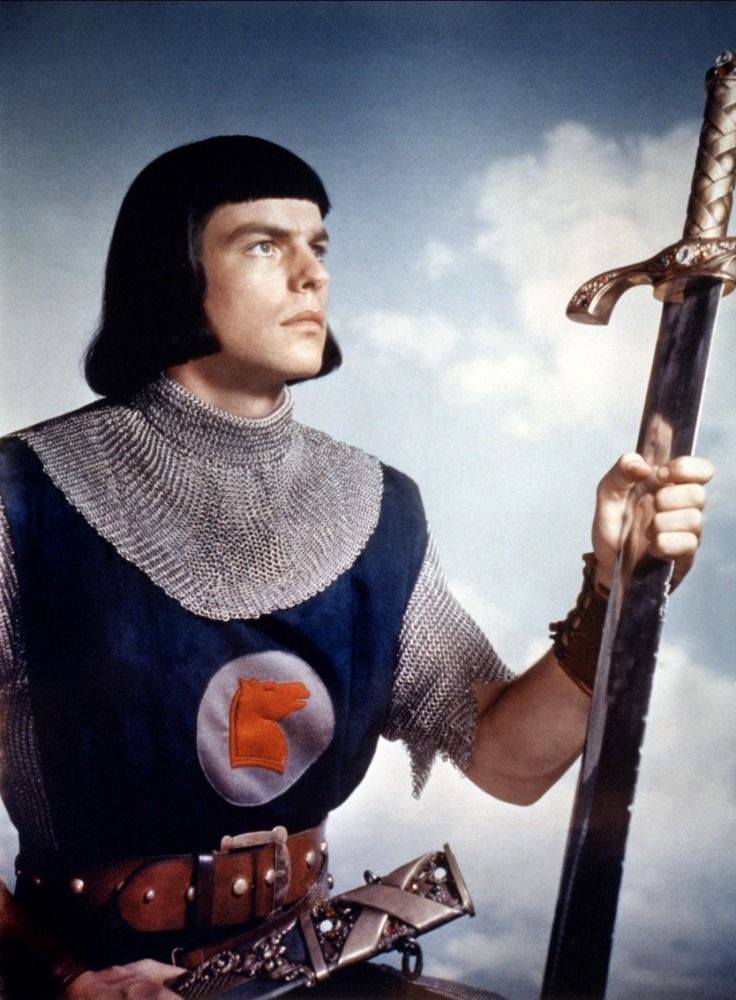
    The legends provide so much grist for “Prince Valiant” (1954), based on Hal Foster’s enduring comic strip, set in the days of Arthur, though Val himself is a Viking prince of the kingdom of Scandia. Janet Leigh plays Princess Aleta, James Mason the villainous Sir Brack, Victor McLaglen Val’s Viking pal Boltar, and Sterling Hayden a preposterous Gawain. For the title role, Robert Wagner dons the signature page-boy haircut. The score, by Franz Waxman, is every bit as vivid as the film’s Technicolor, and a clear prototype for the thrilling, leitmotif-driven music of John Williams.

    “The Mists of Avalon” (2001), adapted from Marion Zimmer Bradley’s novel, took the ingenious approach of retelling the Arthurian stories from the perspective of the often-marginalized female characters. The revisionist perspective breathed fresh life into the familiar tales, so that the book was greeted with critical and popular acclaim upon its release in 1983. A television miniseries, starring Julianna Margulies, Angelica Huston and Joan Allen, was produced for TNT, with music by Lee Holdridge.

    “First Knight” (1995) featured the unlikely cast of Sean Connery as Arthur, Richard Gere as Lancelot, and Julia Ormond as Guinevere. The film is unique, to my knowledge, in being based on the writings of medieval French poet Chretien de Troyes, as opposed to the more frequent source, Sir Thomas Malory.

    The score was by Jerry Goldsmith. It was actually a bit of a rush job for Goldsmith, who stepped up at the very last minute to replace Maurice Jarre. Jarre had been approached to write music for what was originally a three-hour cut of the film. However, he only had four weeks to do so. Goldsmith, very well-known for his ability to write at white heat, was able to complete the score, and record the music in the allotted time.

    For my money, the version most faithful to the spirit – if not always the letter – of “Le Morte d’Arthur” is “Excalibur” (1981). The film sports a peerless British and Irish cast, with an uncanny number of the supporting players going on to achieve world fame.

    Unfortunately the soundtrack is largely made up of pre-existing music by Wagner and Carl Orff (put to brilliant use, by the way) – with only a few atmospheric numbers composed by Trevor Jones. These, to my knowledge, have never been issued commercially. However, the same story was given the M-G-M treatment, as “Knights of the Round Table” (1953), with Robert Taylor as Lancelot, Ava Gardner as Guinevere, and Mel Ferrer as Arthur.

    While the film is nowhere in the same league as “Excalibur” – it’s far too glossy and pat – it does sport some satisfying 1950s spectacle, and a fine score by Miklós Rózsa.

    I hope you’ll join me, in the name of God, St. Michael and St. George, for music inspired by the legends of Arthur, on “Picture Perfect” – music for the movies – this Friday evening at 6, with a repeat tomorrow morning at 6; or enjoy it later as a webcast at wwfm.org.

  • Real Horror Behind the Screen Movie Soundtracks

    Real Horror Behind the Screen Movie Soundtracks

    I’ve been so busy the past two days that I haven’t even been able to type up a description of this week’s “Picture Perfect,” which is slated to air in just a few minutes. Nothing too in-depth, then. Suffice it to say, I’ll be featuring music from movies inspired by real-life horror and science fiction icons.

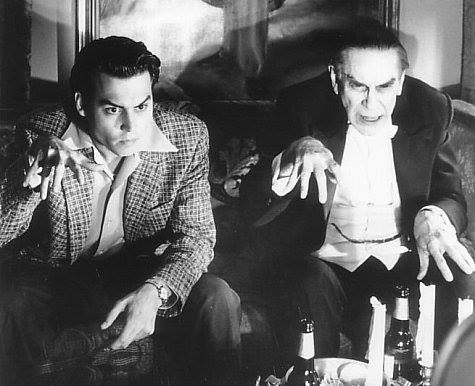
    We’ll be listening to selections from “Hitchcock” (2012), a behind-the-scenes look at the making of “Psycho,” with music by Danny Elfman; “Matinee” (1993), with John Goodman as a William Castle-type filmmaker, promoting his latest B-masterpiece against the backdrop of the Cuban Missile Crisis, with music by Jerry Goldsmith; “Gods and Monsters” (1998), set during the final days of James Whale, the director of “Frankenstein” and “The Invisible Man,” with music by Carter Burwell; and “Ed Wood” (1994), Tim Burton’s love-letter to the director notorious for having helmed some of the worst films ever made, including “Plan 9 from Outer Space,” with bongo- and theremin-laden music by Howard Shore.

    I hope you’ll join me for an hour of behind-the-scenes horrors this week, on “Picture Perfect,” tonight at 6 ET, with a repeat tomorrow morning at 6; or that you’ll listen to it later as a webcast at wwfm.org.

  • Remembering Jerry Goldsmith: A Film Music Legend

    Remembering Jerry Goldsmith: A Film Music Legend

    Oh, Jerry, I can’t tell you how much I miss you. What a joy it was to go to the movies when you were still alive. Of course, the movies got precipitously worse in your last decade, but you lent a degree of enjoyment even to the transparently crappy ones – even if it was combined with a lingering wistfulness for the glory days of the 1970s.

    I will always cherish your music for “The Flim Flam Man,” “Patton,” “Chinatown,” “Papillon,” “The Great Train Robbery,” “Star Trek: The Motion Picture,” and especially “The Wind and the Lion.”

    You often wound up playing second banana to John Williams (Williams got “Superman;” you got “Supergirl”), and a great many of the films you scored were unworthy of your talents, but you were always a professional (if at times a bit grouchy). I can recall many a moviegoing experience when your music wound up being the only redeeming quality.

    But that’s the price of being fast and good. You were often brought on, on very short notice, especially late in your career, to write replacement scores for bad movies. Still, every once in a while you were tossed a bone, as with “L.A. Confidential.”

    Criminally, you were honored with but a single Academy Award, for your work on “The Omen.” It was bad luck that “The Wind and the Lion” was released the same year as “Jaws.”

    How many people know you also worked in television, providing music for shows like “Gunsmoke” and “The Twilight Zone,” or that you wrote the theme music for “The Man from U.N.C.L.E.” and “The Waltons?”

    I confess I don’t share your enthusiasm for electronics, but I understand you felt it was something you needed to work through. At least you didn’t require an intervention like Maurice Jarre.

    What I would give to go see a quasi-intelligent, mainstream American movie again and see the credit, “Music by Jerry Goldsmith.” Those days will never come again, on any level.

    Happy birthday, Jerry. I hope they’re still making good movies where you are.

    “The Wind and the Lion”

    “Patton”
    https://www.youtube.com/watch?v=vdEy4GneZfw

    “Star Trek: The Motion Picture”

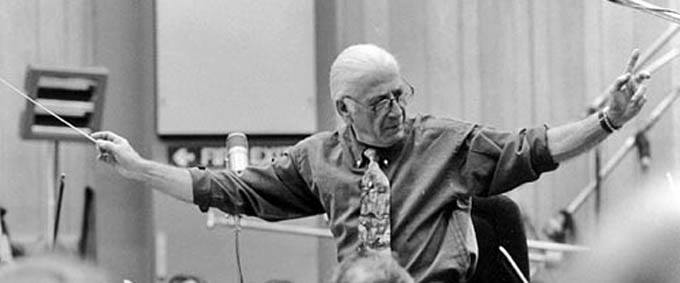
    PHOTO: Jerry Goldsmith (1929-2004)

  • Madness and Piano Movie Music

    Madness and Piano Movie Music

    This week on “Picture Perfect,” practice makes psychotic, as we listen to music from movies about madness and the piano.

    Laird Cregar plays an unhinged pianist-composer, who, whenever he hears a loud, discordant sound, is compelled to commit murder, in the 1945 film “Hangover Square.” Bernard Herrmann wrote the moody, romantic score, which includes a piano concerto, played by Cregar’s character during the film’s conflagration finale.

    Peter Lorre is an unstable musicologist who is haunted by the disembodied hand of a murdered pianist with a penchant for Brahms’ arrangement of Bach’s Chaconne, in “The Beast with Five Fingers,” from 1946. Max Steiner wrote the music. The piano is played on the film’s soundtrack by Victor Aller, the brother-in-law of Felix Slatkin, and therefore Leonard Slatkin’s uncle.

    Alan Alda plays a frustrated pianist who falls in with a ring of Satanists, in “The Mephisto Waltz” from 1971. This time, Jerry Goldsmith blends Franz Liszt with amplified instruments and electronics to memorably eerie effect. Five years later, Goldsmith would win his only Academy Award for his music to “The Omen.”

    Finally, Hans Conried plays a dictatorial pedagogue in “The 5000 Fingers of Dr. T,” released in 1953, which holds the distinction of being the only feature film written by Dr. Seuss. The film features outrageous production design (including a gargantuan keyboard for 500 enslaved boys) and whimsical songs.

    The composer was Frederick Hollander, born in London. Hollander came to fame in Germany as Friedrich Hollander. His best-known international success was with “The Blue Angel,” with Marlene Dietrich, who introduced his song, “Falling in Love Again. With the rise of the Nazis, Hollander fled to the United States, where he worked on over 100 films.

    Join me for madness and the piano this week, on “Picture Perfect,” music for the movies, this Friday evening at 6 ET. In case you haven’t heard, the show will now repeat Saturday mornings at 6. (It ought to be a real treat to hear “The Mephisto Waltz” at that hour!) If you’re still not able to listen, you can catch it later as a webcast at http://www.wwfm.org.

  • Big Cats on Film Wind Lion Leopard Cat People

    Big Cats on Film Wind Lion Leopard Cat People

    Any excuse to get “The Wind and the Lion” and “The Leopard” in the same show…

    This week on “Picture Perfect,” the focus will be on metaphorical big cats.

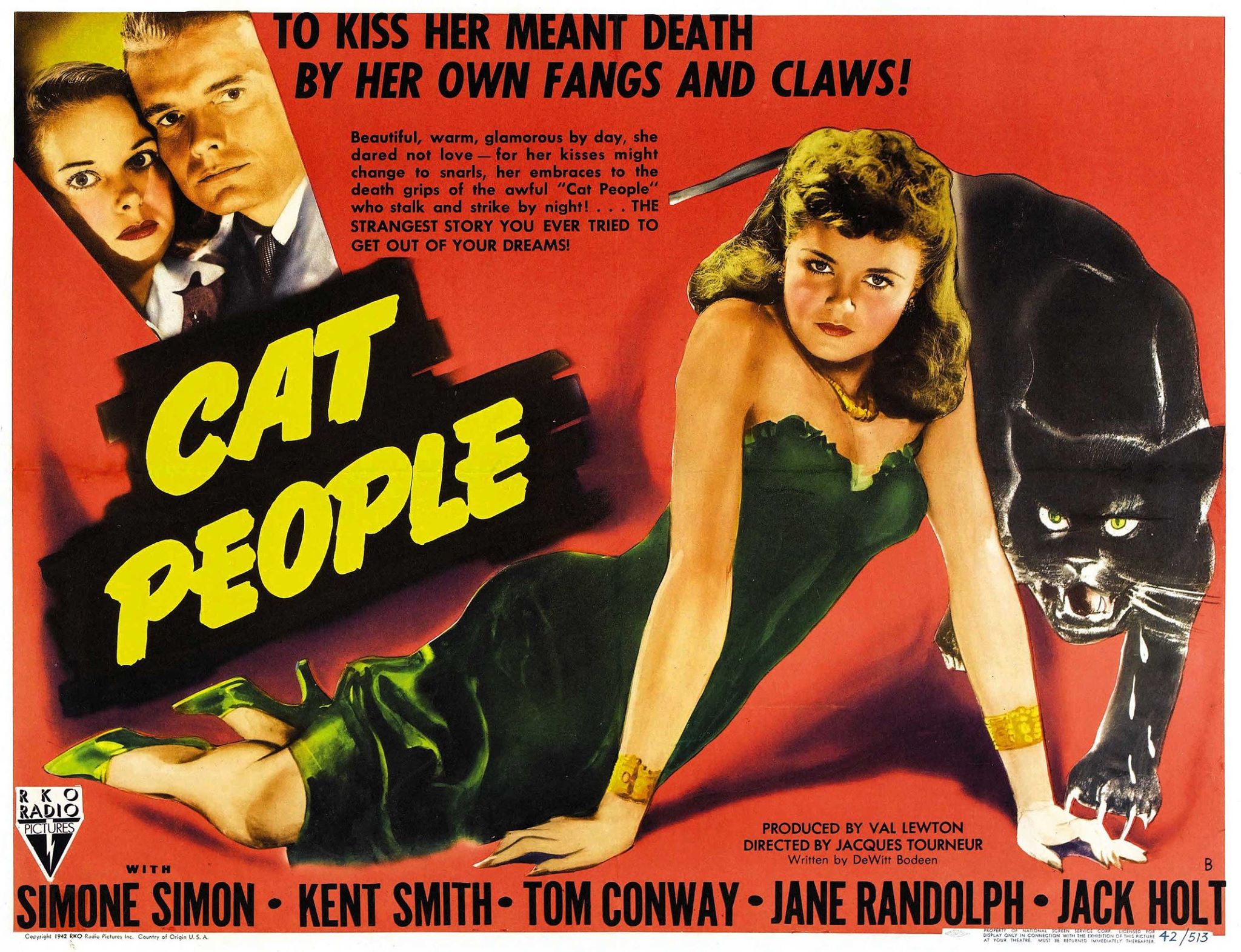
    Simone Simon’s barely repressed desires are made manifest in Val Lewton’s “Cat People” (1942). Lewton was a master of suggestion, with a majority of the horrors in his films imagined, rather than seen. Part of the approach was practical, the result of shoestring budgets imposed by RKO. Whatever the case, the insinuating weirdness undeniably produced psychological chills. In fact, it was only as a concession to the studio that a literal big cat was included at all. The music was by RKO workhorse Roy Webb.

    Sean Connery plays a Berber chieftain who faces off against Teddy Roosevelt in “The Wind and the Lion” (1975). In a letter to Roosevelt (played in the film by Brian Keith), Connery’s character writes, “I, like the lion, must stay in my place, while you, like the wind, will never know yours.” Jerry Goldsmith provided one of his best scores for the Moroccan adventure. In fact, he was fairly confident he finally had a lock on the Oscar. He experienced a harsh reality check when he went to see “Jaws.” (Goldsmith would win his only Academy Award the following year for his music to “The Omen.”)

    Luchino Visconti’s epic telling of Giuseppe Tomasi di Lampedusa’s “The Leopard” (1963) is a melancholy exploration of the fading Sicilian aristocracy. A bewhiskered Burt Lancaster plays Prince Fabrizio, who feels himself slipping into obsolescence. Nino Rota gives the film a full-blooded, operatic soundtrack, full of lyricism and pathos.

    Finally, Lyn Murray provides the breezy accompaniment for Alfred Hitchcock’s “To Catch a Thief” (1955), with Cary Grant a reformed burglar, known as The Cat, who attempts to clear himself of some “copycat” crimes while romancing Grace Kelly on the French Riviera.

    Join me for an hour of metaphorical big cats this week, on “Picture Perfect” – music for the movies – this Friday evening at 6 ET, or listen later to the webcats – er, webcast – at http://www.wwfm.org.

Tag Cloud

Aaron Copland (92) Beethoven (95) Composer (114) Film Music (123) Film Score (143) Film Scores (255) Halloween (94) John Williams (187) KWAX (229) Leonard Bernstein (101) Marlboro Music Festival (125) Movie Music (138) Opera (202) Philadelphia Orchestra (89) Picture Perfect (174) Princeton Symphony Orchestra (106) Radio (87) Ralph Vaughan Williams (85) Ross Amico (244) Roy's Tie-Dye Sci-Fi Corner (290) The Classical Network (101) The Lost Chord (268) Vaughan Williams (103) WPRB (396) WWFM (881)

DON’T MISS A BEAT

Receive a weekly digest every Sunday at noon by signing up here


RECENT POSTS