Tag: Jerry Goldsmith

  • Hemingway on Film: Music for Stoic Manliness

    Hemingway on Film: Music for Stoic Manliness

    This week on “Picture Perfect,” we get in touch with our masculine side, with music from movies inspired by the writings of Ernest Hemingway.

    Seemingly at odds with Hemingway’s minimalist, “iceberg” style, big screen adaptations of the writer’s work show what the stories don’t tell. In the case of 1946’s “The Killers,” the screenwriters unapologetically just made stuff up, an entire back story explaining the motivations for the hit of boxer “Swede” Andreson. Fortunately those screenwriters happened to include an uncredited John Huston, who virtually codified noir with “The Maltese Falcon.”

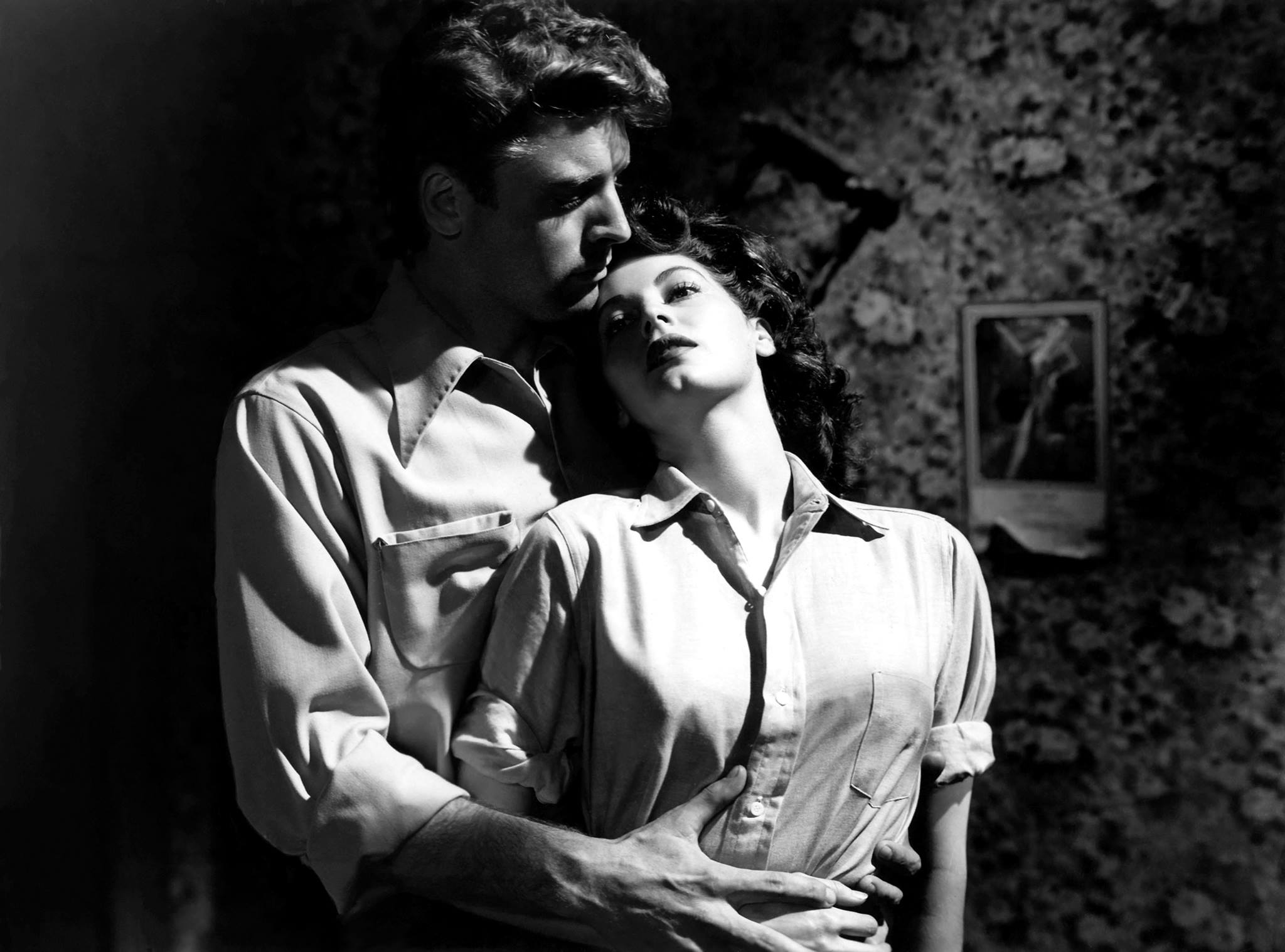
    “The Killers” provided Burt Lancaster with his break-out role. It also features a knock-out score by Miklós Rózsa, in which he uses the dum-dee-dum-dum theme later made famous by the television series “Dragnet.”

    In 1977, George C. Scott reunited with his “Patton” director, Franklin J. Schaffner, for an adaptation of Hemingway’s posthumously published novel, “Islands in the Stream.” Scott gives one of his best performances as a Hemingway-like figure living on a Caribbean island. “Patton” composer Jerry Goldsmith wrote the music. Goldsmith spoke of it often as his favorite score.

    Hemingway himself handpicked the leads for the 1943 adaptation of “For Whom the Bell Tolls,” with Gary Cooper and Ingrid Bergman falling in love against the backdrop of the Spanish Civil War. The music was by the prolific and versatile Victor Young.

    And finally, Spencer Tracy is the whole show, as he faces off against a large marlin, in the 1958 version of “The Old Man and the Sea.” Dimitri Tiomkin’s music earned him his fourth Academy Award.

    Join me for an hour of laconic grace and stoic manliness on “Picture Perfect,” music for the movies, this Friday evening at 6. Or listen to it later as a webcast, at http://www.wwfm.org.

    PHOTO: Burt Lancaster and Ava Gardner killing it in “The Killers”

  • Film Scores Why Aren’t They Great Anymore

    Film Scores Why Aren’t They Great Anymore

    The Orquestra Sinfônica Brasileira strikes back with music of John Williams:

    http://www.classicfm.com/music-news/latest-news/john-williams-youtube-save-brazilian-symphony/

    Granted, the story is a year old, but clearly people still respond to this music. So why are most film scores today so anonymous, slipshod or just plain lacking in craftsmanship? I understand that a tight post-production schedule can leave little time for the film composer to do his job, but surely there must be someone of a caliber of a Jerry Goldsmith out there, who could churn out a decent score before breakfast.

    There are probably still a lot of people who don’t actively think about the fact that the music they hear in the movies is being played by very talented orchestral musicians. (That is, when it isn’t being sampled on a keyboard.) For them, perhaps, it’s just something that emanates from the screen. Exposure is key. Ironically, in an age when everything is a keystroke away, there seems to be less of that than ever before. It’s a useful endeavor to bring this music to the public and to play it with passion and commitment.

    I wonder if the day will ever come when the very best music written for film will be held on a level with incidental music written for plays by earlier masters? It would be nice to hear something more than snappy main title music dished up on pops concerts or, what seems to be the latest trend, music performed live with the actual movies. These practices have their place, but why not program a suite from “E.T.” or “Ben-Hur” or “The Bride of Frankenstein” or “The Adventures of Robin Hood” once in a while? Let the music speak for itself.

    And spare me the condescending program notes. Other folks besides Prokofiev and Walton have written great music for the screen.

    The Philadelphia Orchestra will be performing musical selections from Pixar films at The Kimmel Center for the Performing Arts this Friday at 7 p.m. and Saturday at 2 p.m. The press release promises selections from 14 films, so expect a lot of short pieces, with film clips. Still, with music by Michael Giacchino, Thomas and Randy Newman, and Patrick Doyle, why complain? They’re some of the best film composers working today, and Pixar makes some of the best movies. It seems like an ideal intro for the kids.

    http://www.philorch.org/concert/philadelphia-orchestra-pixar-concert

  • Planet of the Apes Music Jerry Goldsmith

    Planet of the Apes Music Jerry Goldsmith

    With the publicity machine going full-throttle for the new “Planet of the Apes” movie, I thought we’d take the opportunity this week on “Picture Perfect” to look back to Jerry Goldsmith’s music for the original 1968 classic.

    Goldsmith incorporated all sorts of unusual effects into his groundbreaking score. He employed such instruments as tuned mixing bowls, a bass slide-whistle, and the cuika, a Brazilian wind instrument used to mimic the hooting of excited apes. He instructed his hornists to play without mouthpieces, and he manipulated percussion through the use of an Echoplex.

    Barbaric and unnerving, with little in the way of lyricism, I can’t imagine anything like it being used in a major Hollywood film today. Well, from my description, I guess I can, but Goldsmith was the real deal – a talented composer with real tools (not just a laptop) at his disposal.

    While my initial impulse had been to fill out the hour with music from some of the other films in the “Apes” franchise, after listening for a while, the grimness and brutality became a bit too unremitting, so instead we’ll swing with the gorilla theme.

    Among the other selections will be an extended passage from the Dian Fossey biopic, “Gorillas in the Mist,” which starred Sigourney Weaver and featured music by Maurice Jarre, of “Lawrence of Arabia” and “Doctor Zhivago” fame, though from his later, lamentable “electronic” period.

    We’ll also hear a bit from the “Mighty Joe Young” remake (since I couldn’t get a hold of Roy Webb’s score for the original). The music is pretty much standard James Horner (eg. “Titanic”), though he does incorporate a Swahili choir.

    Finally, we’ll sample from Max Steiner’s landmark score to the 800-pound gorilla of all monkey movies, 1933’s “King Kong.”

    I hope you’ll join me this week as we go ape, on “Picture Perfect,” music for the movies, tomorrow evening at 6 ET. Remember, you can always listen to the show later as a webcast at http://www.wwfm.org.

    “Take your stinkin’ paws off me…!” (with Goldsmith’s music, including cuika effects):

    https://www.youtube.com/watch?v=pBMvR_RnKu4

  • WWII Film Scores Memorial Day Special

    WWII Film Scores Memorial Day Special

    Today is Richard Wagner’s birthday. Perhaps in his honor, I am going to go his megalomania one better by completely ignoring the fact and using the space for shameless self-promotion!

    This week on “Picture Perfect,” as we near Memorial Day, the focus will be on music from World War II classics.

    Among the selections will be a new release – and a very fine one – on the Intrada label of music by Miklós Rózsa. The album is called “The Man in Half Moon Street,” and includes re-recordings of some of his underrepresented though certainly deserving scores, among them, “Valley of the Kings,” “The Strange Love of Martha Ivers,” and “Sahara.”

    In “Sahara,” Humphrey Bogart plays a WWII tank commander who holes up at a desert well and uses his apparent position of power to delay a parched German battalion from participating in the First Battle of El Alamein. Allan Wilson conducts the Royal Scottish National Orchestra, in what is truly the best project of its kind I have encountered in quite some time. Re-recordings so often lack the punch of the originals, but here is Rózsa is all his glory, sounding wholly idiomatic and presented in vivid digital splendor.

    Jerry Goldsmith’s music for “Patton” should require no introduction. The film is a bona fide classic, a winner of seven Academy Awards, including Best Picture. Unfortunately for Goldsmith, at that stage of his career, he was always a bridesmaid but never a bride. George C. Scott notoriously rejected his Oscar for Best Actor; he should have given it to Goldsmith.

    Errol Flynn may seem an unlikely choice to play a U.S. Army captain, but he does just that in “Objective, Burma!” Flynn received criticism for remaining in Hollywood during the war, but the Warner Brothers publicity machine did what it could to hush up the fact that the world’s most famous swashbuckler had tried to enlist but was rejected on medical grounds. “Objective, Burma!” infuriated Churchill, and the film was actually banned in Britain for what was perceived as the Americanization of a largely British, Indian and Commonwealth conflict. The rousing score, also nominated for an Oscar, was by Franz Waxman.

    “The Guns of Navarone,” adapted from the novel of Alistair MacLean, is one of the all-time great adventure films. A team of Allied military specialists – played by Gregory Peck, David Niven and Anthony Quinn, among others – undertake a mission to blow up some very big Nazi guns trained over the Aegean Sea. Dimitri Tiomkin pulled out all the stops for his Oscar-nominated music. The recording features a spoken introduction by James Robertson Justice, who plays Commodore Jensen in the film.

    Join me for these scores from World War II classics on “Picture Perfect,” music for the movies, this Friday evening at 6:00 ET, or listen to it as a webcast, at http://www.wwfm.org.

Tag Cloud

Aaron Copland (92) Beethoven (95) Composer (114) Film Music (123) Film Score (143) Film Scores (255) Halloween (94) John Williams (187) KWAX (229) Leonard Bernstein (101) Marlboro Music Festival (125) Movie Music (138) Opera (202) Philadelphia Orchestra (89) Picture Perfect (174) Princeton Symphony Orchestra (106) Radio (87) Ralph Vaughan Williams (85) Ross Amico (244) Roy's Tie-Dye Sci-Fi Corner (290) The Classical Network (101) The Lost Chord (268) Vaughan Williams (103) WPRB (396) WWFM (881)

DON’T MISS A BEAT

Receive a weekly digest every Sunday at noon by signing up here


RECENT POSTS